
Two Dan Sullivans on Alaska’s Senate Ballot,Can a Candidate Use an Incumbent’s Name, and Can the DOJ Stop the Election?
What Is the Dispute About?
Alaska’s 2026 U.S. Senate race is one of the most closely watched in the country because it could help decide control of the Senate.
On the ballot are:
- Sen. Dan S. Sullivan, a Republican seeking reelection,
- Mary Peltola, the Democratic nominee and a former U.S. Representative,
- Daniel J. Sullivan Jr., a retired teacher with no party affiliation, and
- another candidate who has done little campaigning.
Sen. Sullivan, President Trump and other Republicans say Daniel J. Sullivan was recruited as a decoy to confuse voters and draw votes away from the incumbent. Peltola’s campaign says it had no involvement in recruiting either Sullivan, and Peltola has said she is “not interested in tricking voters.” Daniel J. Sullivan said in June that he had no contact with the Peltola campaign about running. The Democratic Senatorial Campaign Committee (DSCC) has also denied involvement.
In the week before Election Day, The New York Times reported that Peltola’s campaign and Democratic operatives appeared to have been involved in efforts to recruit him. Those are allegations under investigation, not findings.
Quick Facts
| Question | Answer |
| What is the dispute? | Two men named Dan Sullivan are on Alaska’s 2026 U.S. Senate ballot. Republicans say the second was recruited to confuse voters. |
| Who are the candidates? | Sen. Dan S. Sullivan (R, incumbent), Mary Peltola (D, former U.S. Representative), Daniel J. Sullivan Jr. (no party affiliation, a retired teacher from Petersburg), and one other candidate. |
| Is it legal to run with a similar name to an incumbent? | Generally yes. No general federal or Alaska law bans similar names. |
| Why is the second Sullivan on the ballot? | Alaska’s courts, including the Alaska Supreme Court, rejected efforts to keep him off. |
| What did the DOJ do? | It sued Alaska to block certification of the Senate result if the incumbent lost, and opened a criminal investigation. |
| What happened to the DOJ lawsuit? | On November 1, 2026, U.S. District Judge Sharon Gleason dismissed it. DOJ said it would appeal. |
| Is the criminal investigation over? | No. It is ongoing, and a grand jury is involved. |
| Has anyone been charged? | No charges had been reported as of November 4, 2026. |
| Has any wrongdoing been proven? | No. The recruitment allegations are being investigated and are denied by those named. |
| Does Alaska use ranked-choice voting? | Yes. |
| Is the Senate race result final? | No. Counting and the ranked-choice tabulation are not complete. |
Are the Two Candidates Using the Same Name?
Not exactly. The names are similar, not identical:
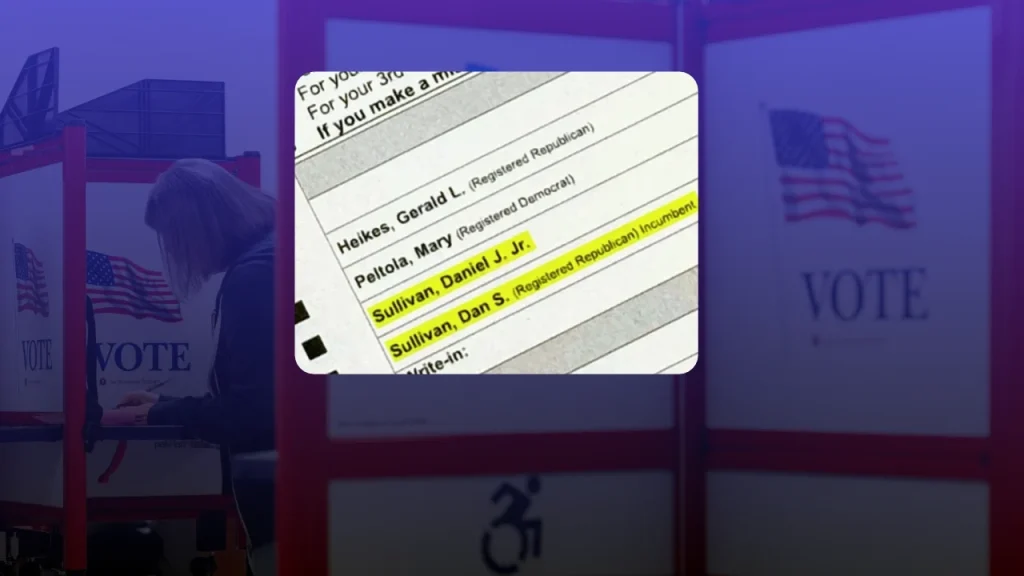
- Dan S. Sullivan: the incumbent, listed on the ballot as “Registered Republican” and “Incumbent.”
- Daniel J. Sullivan Jr.: the other candidate, listed with no party affiliation.
The legal question is not whether two people can have similar names. They can. The question is whether anyone used the name, ballot presentation or recruitment process to deliberately deceive voters, and whether that conduct violates a specific law.
Is It Legal to Run Against an Incumbent With a Similar Name?
Generally, yes. Ballot access is controlled mainly by state law. A person who meets the basic requirements (age, citizenship, residency, filing and signature rules) is normally entitled to be on the ballot. Courts are reluctant to remove candidates because of a name, because of the First Amendment and state constitutional protections for candidates and voters.
Alaska has a regulation on how candidates’ names appear on the ballot (6 Alaska Administrative Code 25.212). It is designed to keep names from appearing in a way that is confusing or misleading to voters. But the regulation focuses on how a name is presented, and it does not by itself bar two people with similar names from running.
How Did Alaska’s Courts Handle the Ballot Challenge?
Alaska election officials initially investigated the second Sullivan’s candidacy and moved to remove him from the ballot. According to the state’s determination, officials pointed to the name he requested, a change in his party registration shortly before filing, similarities in campaign websites and a consultant’s political ties.
He challenged the removal in court. The Alaska Superior Court ruled in his favor, and the Alaska Supreme Court upheld his place on the ballot. As the Associated Press reported, state courts rejected the Republican-backed efforts to keep him off the August primary ballot. He appeared as Daniel J. Sullivan Jr. with no party affiliation, and the senator appeared as Dan S. Sullivan, Republican and incumbent.
In the August open primary, Peltola placed first and Sen. Sullivan second. Daniel J. Sullivan received about 2.5%, which was enough to finish in the top four and qualify for the November 3 ranked-choice general election.
What that ruling does and does not mean
| It means | It does not mean |
| A candidate may stay on the ballot even if officials suspect his motives. | The recruitment allegations are false. |
| Officials cannot add an unwritten “good faith” test for candidates. | No one can be investigated for how the candidacy was arranged. |
| The ballot-access question is separate from any criminal question. | Anyone has been cleared. |
Being on the ballot is a different legal question from whether people who helped put someone there broke the law.
How Does Ranked-Choice Voting Change the Picture?
Alaska’s general elections use ranked-choice voting (RCV). Voters rank candidates in order of preference. Alaska voters narrowly rejected a ballot measure to repeal RCV in 2024.
How the count works:
- First-choice votes are counted. If a candidate has more than 50% of active votes, that candidate wins.
- If no one does, the candidate with the fewest votes is eliminated.
- Ballots for that candidate go to each voter’s next-ranked candidate still in the race.
- The process repeats until someone has a majority.
Do all votes for the second Sullivan go to the incumbent?
No. That is a common misunderstanding.
| Voter | First choice | Second choice | If Daniel J. Sullivan is eliminated |
| A | Daniel J. Sullivan | Dan S. Sullivan | Vote goes to the incumbent |
| B | Daniel J. Sullivan | Mary Peltola | Vote goes to Peltola |
| C | Daniel J. Sullivan | No further choice | Ballot becomes inactive |
A ballot shows what a voter ranked, not why. A voter could have chosen the second Sullivan deliberately, could have ranked both Sullivans, or could have been confused. The state argued that RCV allows a confused voter to rank both, and that there is no way to tell intent from the ballot without violating voter privacy.
Sen. Sullivan said he expects “to lose a lot of votes” to the other candidate, but whether, and how many, is a factual question that cannot be answered until ballots are counted and analyzed.
Why Did the Justice Department Sue Alaska?
The Justice Department filed a civil lawsuit in federal court in Alaska less than two weeks before the election, while early voting was already underway. President Trump has said he directed the Justice Department to file it.
The lawsuit sought to stop Alaska from certifying the Senate result if the incumbent lost, and called for an investigation into whether votes for Daniel J. Sullivan were actually intended for the incumbent. DOJ later added a request to segregate all ballots showing a vote for him. The complaint relied on the National Voter Registration Act (NVRA) and the Supremacy Clause.
What are those laws?
The NVRA (52 U.S.C. § 20501 and following) governs voter registration and the maintenance of voter rolls for federal elections. It lets the Attorney General bring civil actions to enforce it (52 U.S.C. § 20510). It does not, on its face, say anything about candidate names or the certification of results, and Alaska argued that it covers registration, not certification.
The Supremacy Clause (Article VI, Clause 2) makes valid federal law supreme over conflicting state law. But the federal government must identify a federal legal requirement that actually conflicts with state law. The clause does not by itself give federal agencies broad control over how states run elections.
Why Did the Federal Judge Dismiss the Lawsuit?
On Sunday, November 1, 2026, two days before Election Day, U.S. District Judge Sharon Gleason dismissed the case. The reported reasons include:
- The relief was “infeasible.” Many voters had already voted.
- No workable plan. She wrote that the United States provided no workable plan to segregate ballots cast for Daniel J. Sullivan on Election Day and then conduct a court-ordered “investigation” of those ballots in a way that preserved voter secrecy.
- Federalism. She found the attempt to block certification ran counter to the Constitution’s grant of authority over elections to the states.
- The Purcell principle. Federal courts should generally not change election rules close to an election (Purcell v. Gonzalez, 549 U.S. 1 (2006)).
- Timing. DOJ sued after voting began, nearly four months after the Alaska Supreme Court ruled that Daniel J. Sullivan could stay on the ballot.
- No refiling. She said she would not allow DOJ to amend and refile so close to Election Day.
Some reports describe the ruling as turning on the federal government’s inability to bring the case at all (a standing problem), and DOJ called it a procedural dismissal. The Justice Department filed a notice of appeal. The ACLU, which intervened on Alaska’s side, said the judge refused to “throw out Alaska’s election results before a single ballot was counted.”
Why “standing” matters
To sue in federal court, a plaintiff must show a concrete injury, that the defendant caused it, and that a court order can fix it (Lujan v. Defenders of Wildlife, 504 U.S. 555 (1992)). That last element is called redressability. If a court cannot give effective, lawful relief, the case can be dismissed even without deciding the underlying dispute.
What Is the Criminal Investigation?
The civil case is separate from the criminal investigation, which is continuing.
As reported by the Associated Press, ABC News, CBS News and The New York Times:
- A federal grand jury in Alaska is investigating. U.S. Attorney Michael Heyman said the investigation has been under way for several months.
- Prosecutors have issued more than 100 subpoenas, some reportedly to phone and email providers.
- About 20 target or preservation letters have been sent, including to Democratic election lawyer Marc Elias, one of his law partners and at least one DSCC official. The DSCC also received a grand jury subpoena.
- The FBI has been contacting people who donated to Daniel J. Sullivan, asking whether they were misled about whom they were supporting.
- According to sources, the investigation involves possible conspiracy and donor-fraud offenses.
What is a target letter?
A target letter tells a person that prosecutors consider them a target of a grand jury investigation. It is not an indictment and does not mean charges will follow. Elias’s side called the investigation a “sham,” and Peltola’s campaign and the DSCC deny involvement. Note also that the Justice Department has had difficulty securing indictments in some politically sensitive cases.
Alaska’s own investigation
Alaska’s Republican governor also ordered a state investigation and suggested he might not certify a Peltola victory. Certification is generally a legal duty of election officials, and a refusal would likely be challenged in court.
Which Laws Could Apply?
Prosecutors would need evidence of a specific crime. Possible theories discussed in connection with the investigation include:
| Law | What it covers |
| 18 U.S.C. § 371 | Conspiracy to commit an offense against the United States, or to defraud it. |
| 18 U.S.C. § 241 | Conspiracy to interfere with a person’s constitutional rights, which courts have applied to some election-related schemes. |
| 52 U.S.C. § 20511 | Criminal provision tied to the NVRA, aimed at schemes to deprive residents of a fair and impartially conducted federal election through fraudulent registration or voting. |
| 18 U.S.C. §§ 1343, 1349 | Wire fraud and conspiracy, which prosecutors sometimes apply to schemes that deceive donors out of money. |
| 52 U.S.C. § 30122 | Ban on making a campaign contribution in the name of another person. |
| 52 U.S.C. § 30124 | Fraudulent misrepresentation of authority to speak or act for a candidate or party, which can be relevant in donor-solicitation cases. |
| Alaska election and campaign laws | State offenses covering misleading campaign activity, candidate filing and campaign finance. |
Whether any of these fits the facts is unknown. Several raise hard questions. For example, a scheme must generally involve deception or an unlawful purpose beyond ordinary political strategy.
Is Recruiting a “Spoiler” Candidate Illegal?
Not by itself. Recruiting a third-party or independent candidate to draw votes from an opponent is a long-standing political tactic, and both parties have used it. Encouraging someone to run, supporting their campaign and speaking about them to voters are forms of political speech and association protected by the First Amendment.
The legal analysis changes when the plan involves deception or a separate violation of law, such as lying to voters about a candidate’s identity, concealing who is behind a campaign in violation of disclosure rules, misleading donors, or funneling money in violation of campaign-finance law.
In other states, similar “ghost candidate” scandals have led to prosecutions under campaign-finance law rather than any ban on similar names. That is the kind of theory investigators would have to establish here.
Can the Election Still Be Challenged?
Yes, but the standards are high.
Post-election contest
A candidate or other party with standing can file an election contest under Alaska law (see Alaska Stat. § 15.20.540), which generally requires showing misconduct, fraud or other irregularities sufficient to change the result. A challenger would need to show that voter confusion, rather than ordinary voter choice, changed the outcome. That is difficult to prove, especially because Alaska’s constitution preserves the secrecy of voting (Alaska Constitution, Article V, Section 3).
Blocking or delaying certification
Courts are reluctant to interrupt certification without strong evidence of outcome-changing problems that normal procedures cannot fix. Judge Gleason’s ruling reflects that approach.
The Senate’s own authority
Article I, Section 5, Clause 1 of the U.S. Constitution makes each chamber the judge of the elections, returns and qualifications of its own members. After state certification, the Senate itself could ultimately decide a contested seat.
What Happens Next?
- Counting continues. Ballots are still being counted, and the ranked-choice tabulation, if needed, is scheduled for later in November. Check the Alaska Division of Elections for the official date and results.
- The DOJ appeal. The Justice Department said it would appeal the dismissal.
- The criminal investigation. The grand jury can continue to investigate. Any charges would be a separate step, and none had been reported as of November 4.
- Possible election contests or state litigation. These depend on the final margin.
- Possible Senate proceedings. If the result is disputed after certification.
Frequently Asked Questions
Is it illegal to run for Senate with the same name as an incumbent?
No, not by itself. Candidates generally have a right to be on the ballot if they meet the eligibility and filing requirements. Sharing a similar name is not a disqualifying factor.
Are the two Dan Sullivans legally the same name?
No. They are Dan S. Sullivan and Daniel J. Sullivan Jr. The ballot also lists the incumbent as a Registered Republican and Incumbent, and the other candidate with no party affiliation.
Why was the second Dan Sullivan allowed to stay on the ballot?
Alaska’s courts, including the Alaska Supreme Court, rejected efforts to remove him.
Did a court find that Democrats recruited him as a decoy?
No. The courts ruled on ballot access. The recruitment allegations are being investigated, and those named have denied involvement.
Did the Justice Department lose its lawsuit?
Yes, at the trial level. Judge Gleason dismissed the civil case on November 1. DOJ said it would appeal.
Is anyone charged with a crime?
Not as of November 4, 2026, based on available reporting.
What is a target letter?
A notice that a person is considered a target of a grand jury investigation. It is not a charge, and it does not mean the person will be indicted.
Do all votes for Daniel J. Sullivan go to the incumbent?
No. In ranked-choice voting, each ballot transfers according to the voter’s own next choice, or becomes inactive if there is none.
Can a court stop Alaska from certifying the Senate election?
Only in rare cases. Courts are generally reluctant to block certification without strong evidence, and the federal court here dismissed the request.
Can the Senate decide who wins?
Yes, in a dispute over a seat. Article I, Section 5 gives the Senate the power to judge the elections and returns of its own members.
Is it legal to recruit a spoiler candidate?
Generally yes, as political activity. It becomes a legal problem if the plan involves fraud, deception that violates a specific law, or campaign-finance violations.
Final Takeaway
Two candidates with similar names on one ballot is not illegal, and state courts have already allowed the second Sullivan to stay in the race. The federal judge also refused to let the Justice Department block certification before the votes were counted.
But the criminal investigation is separate, and its outcome will depend on evidence of a specific crime, not on the name similarity. Until the ballots are counted, any court filings are decided, and prosecutors either bring charges or do not, the allegations about the recruitment remain unproven.
This article is for general informational purposes only and is not legal advice. AllAboutLawyer.com is an independent U.S. legal information website, not a law firm.
Related Articles
Sources and Legal Authorities
Current reporting
- Associated Press: Judge dismisses lawsuit seeking to block certification of Alaska Senate race if GOP incumbent loses, November 1, 2026
- Associated Press: Justice Department identifies potential targets as it escalates Alaska Senate criminal probe, November 3, 2026
- CBS News: Marc Elias is a target of DOJ’s Alaska ballot investigation, sources say
- ABC News: DOJ ramps up probe of Alaska Senate race with target letters, new subpoenas
- Alaska Beacon: Alaska fights back against Trump-ordered elections lawsuit, seeks its dismissal, October 27, 2026
- Anchorage Daily News: Alaska election officials ask federal judge to toss Trump-ordered Senate race lawsuit, October 27, 2026
- Alaska Public Media: State of Alaska says DOJ lawsuit over Senate race has no legal basis, October 27, 2026
Statutes, regulations and constitutional provisions
- 6 Alaska Administrative Code 25.212 (names on the ballot); Alaska Stat. § 15.20.540 (election contests); Alaska Constitution, Article V, Section 3 (secrecy of voting)
- 52 U.S.C. §§ 20501 to 20511 (National Voter Registration Act)
- 18 U.S.C. §§ 241, 371, 1343 and 1349; 52 U.S.C. §§ 30122 and 30124
- U.S. Constitution, Article I, Section 4 (Elections Clause); Article I, Section 5 (each chamber judges its own elections); Article VI, Clause 2 (Supremacy Clause)
Cases
- Purcell v. Gonzalez, 549 U.S. 1 (2006)
- Lujan v. Defenders of Wildlife, 504 U.S. 555 (1992)
About the Author
Israr Ahmad is a legal content researcher with 4+ years of experience covering class action settlements and consumer rights cases. He has researched and published coverage of 2,500+ settlements using verified court records, settlement administrator filings, and government sources. Learn more about Israr.