
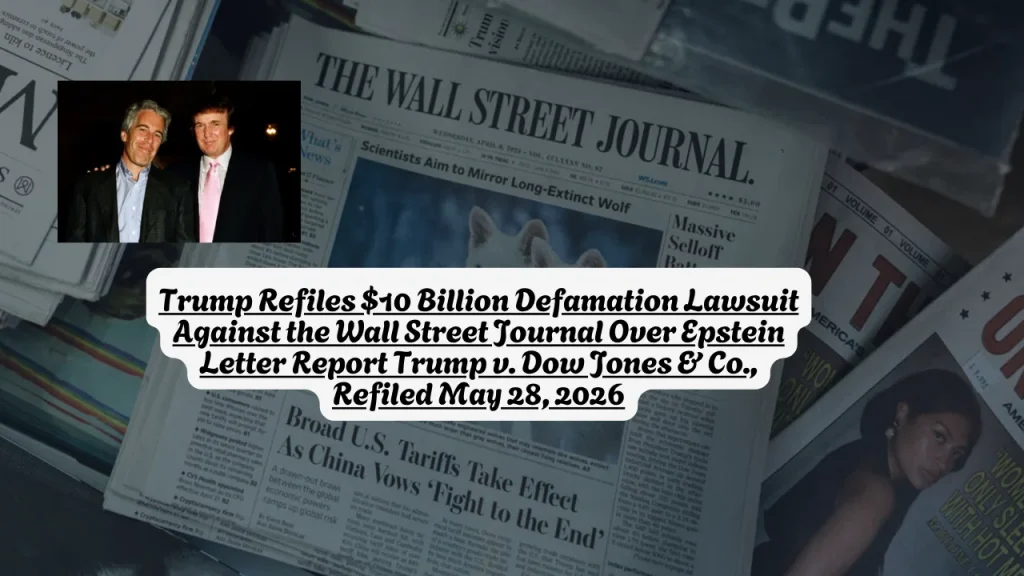
Trump Refiles $10 Billion Defamation Lawsuit Against the Wall Street Journal Over Epstein Letter Report Trump v. Dow Jones & Co., Refiled May 28, 2026
President Donald Trump on Wednesday refiled a defamation lawsuit seeking at least $10 billion in damages against the Wall Street Journal over its reporting on his ties to Jeffrey Epstein, after a judge threw out an earlier version over legal deficiencies. The case centers on a single article and a single question: did the Journal defame Trump by reporting that a birthday letter for Epstein bore his signature?
Trump vs. Wall Street Journal Defamation Lawsuit — Key Facts
| Field | Detail |
| Lawsuit Filed (Original) | July 18, 2025 |
| Lawsuit Refiled | May 28, 2026 |
| Defendant | Dow Jones & Co. (publisher of The Wall Street Journal), Rupert Murdoch, and two Journal journalists |
| Alleged Harm | Defamation — reporting that a birthday letter to Jeffrey Epstein bore Trump’s signature |
| Specific Law Alleged | Defamation under applicable federal and Florida law |
| Damages Sought | At least $10 billion |
| Court | U.S. District Court, Southern District of Florida |
| Presiding Judge | U.S. District Judge Darrin P. Gayles |
| First Dismissal Date | April 13, 2026 |
| Reason for Dismissal | Failure to plausibly allege “actual malice” |
| Current Court Stage | Amended complaint refiled May 28, 2026 — active litigation |
| Settlement Status | None — active lawsuit |
| Law Firms Involved | TBD — pending updated court filings |
| Last Updated | May 28, 2026 |
Who Is the Wall Street Journal and Why Is It Facing a $10 Billion Defamation Lawsuit From Trump?
The Wall Street Journal is owned by News Corp., the media company controlled by Rupert Murdoch. It is one of the most widely read newspapers in the United States, with a particular focus on business and political news. Trump’s lawsuit said the Rupert Murdoch-owned newspaper tarnished his reputation with an article describing a birthday card to deceased sex offender Jeffrey Epstein as bearing Trump’s signature.
What Did the Wall Street Journal Report — and Why Does Trump Say It Was False?
On July 17, 2025, the Wall Street Journal reported that a letter bearing Trump’s name appeared in a birthday book containing letters from the family and friends of Epstein, the disgraced financier who was a convicted sex offender. In an interview with the paper, the president denied writing the letter.
Trump and his lawyers said the card is fake, even after it was released by lawmakers investigating Epstein’s case. The Journal stood by its reporting throughout. Before running the story, the Journal contacted President Trump, Justice Department officials, and the FBI for comment. Trump responded with his denial, the Justice Department did not respond at all, and the FBI declined to comment.
Epstein, the disgraced financier and sex offender, died in a New York jail cell in 2019. His case generated conspiracy theories that became popular among Trump’s base of supporters who believed the government was covering up Epstein’s ties to the rich and powerful. Trump has said he parted ways with Epstein before the financier’s legal troubles became public in 2006.
This is part of a broader pattern of media litigation by the current president. For a full picture of every active case, see our tracker covering every major Trump lawsuit in 2026 and what has happened so far. Trump is also pursuing a separate $10 billion defamation lawsuit against the BBC that is headed to trial in 2027.
Why Did a Judge Throw Out Trump’s First Lawsuit Against the Journal — and What Changed?
On April 13, 2026, a federal judge dismissed President Donald Trump’s lawsuit against the Wall Street Journal, ruling that the president had failed to prove the paper’s reporting on his relationship with Jeffrey Epstein was defamatory.
The legal obstacle was a doctrine called “actual malice.” Defamation is not protected speech under the First Amendment. However, courts have found that public officials and figures must clear a higher bar than others when making a defamation claim, in order to avoid chilling free speech and press rights. That standard — established by the U.S. Supreme Court in New York Times Co. v. Sullivan (1964) — requires a public figure to show the publisher either knew the statement was false or recklessly ignored whether it was true or false.
Related article: Alta Orthopaedics Data Breach Lawsuit, Were Your Patient Records Exposed in the February 2026 Cyberattack?
Judge Gayles concluded that Trump failed to prove that the Wall Street Journal knowingly published false information. Trump filed the suit arguing the Journal “acted with serious doubts about the truth of their reporting” because the president had claimed the letter was fake. However, Judge Gayles concluded that the reporters “attempted to investigate” the letter and did not act recklessly just because Trump denied its authenticity.
Gayles dismissed the lawsuit without prejudice, meaning Trump’s camp had until April 27 to file an amended complaint addressing the judge’s concerns. Trump refiled that amended complaint on May 28, 2026.
Are You Part of the Trump vs. Wall Street Journal Defamation Lawsuit?
This is not a class action. It is a personal defamation lawsuit brought by President Trump against a news organization. No consumer class is involved. Ordinary readers of the Journal or members of the public are not plaintiffs and have no claim to file.
If you are a journalist, media organization, or public figure trying to understand how the “actual malice” standard applies to your own situation, this case is worth following closely — but your specific circumstances require separate legal guidance.
Does This Case Affect People Outside Florida?
The lawsuit is filed in the U.S. District Court for the Southern District of Florida, but it concerns national press freedom law. The lawsuit is one of several Trump has brought in his personal capacity against news organizations, part of what critics say is a wider pressure campaign against the media. The legal outcome will affect press freedom standards across the country, not just Florida.
If you are a media professional or journalist concerned about defamation liability in your own work, a free consultation with a media law attorney can help you understand how the actual malice standard applies to your situation.
What Are the Parties Asking the Court to Award in the 2026 Defamation Lawsuit?
Trump is seeking at least $10 billion in damages, according to the amended lawsuit. That figure is based on Trump’s claim that the reporting damaged his personal and professional reputation.
What Could Trump Receive If This Defamation Case Succeeds?
No money is available yet. No settlement exists. The amended complaint was just refiled today, May 28, 2026. Even if Trump ultimately prevails, any damages award would be determined by a jury based on the evidence presented at trial — which is far into the future.
Legal experts note Trump has never won a jury verdict in a libel case. His recent media litigation resulted in settlements with ABC ($15 million) and CBS ($16 million) before reaching discovery. Whether this case follows a similar path or goes to trial is impossible to predict at this stage. If you want to understand your rights in a defamation matter, speaking with a media law attorney is the right first step.
What Should You Do Right Now If You Are Following This Case?
- No action is required from members of the public. This is not a class action and there is no claim form.
- Journalists and media organizations should monitor the docket through PACER at the U.S. District Court, Southern District of Florida.
- Save any relevant coverage from the Journal’s July 17, 2025 article if you are researching this case, as the original reporting remains at the center of all proceedings.
- Watch for the Journal’s formal response to the amended complaint — Dow Jones has said it will vigorously defend the lawsuit.
- Dow Jones has said it has full confidence in the rigor and accuracy of the Journal’s reporting and will vigorously defend the lawsuit.
- Monitor the case through PACER for all hearing dates and future filings as the amended complaint moves through court.
Trump vs. Wall Street Journal Defamation Lawsuit — Timeline
| Milestone | Date |
| WSJ article published about Epstein birthday letter | July 17, 2025 |
| Trump files original $10 billion defamation lawsuit | July 18, 2025 |
| WSJ files motion to dismiss | Late 2025 |
| Judge Gayles dismisses original complaint | April 13, 2026 |
| Deadline to refile amended complaint | April 27, 2026 |
| Amended complaint refiled | May 28, 2026 |
| Journal’s response to amended complaint | TBD — pending court schedule |
| Next scheduled hearing | TBD — pending court scheduling |
| Expected resolution | TBD — early-stage active litigation |
Trump vs. Wall Street Journal Defamation Lawsuit — Frequently Asked Questions, Refiled May 28, 2026
Is there an active defamation lawsuit against the Wall Street Journal from President Trump right now?
Yes. Trump refiled his defamation lawsuit against the Wall Street Journal on May 28, 2026, seeking at least $10 billion in damages over a July 2025 article about a birthday letter purportedly written by Trump to Jeffrey Epstein.
Why was Trump’s first Wall Street Journal lawsuit thrown out?
Judge Gayles concluded that Trump failed to prove that the Wall Street Journal knowingly published false information, and that the complaint came “nowhere close” to the standard for showing the newspaper deliberately avoided investigating the truth. The case was dismissed without prejudice, allowing Trump to refile.
What is “actual malice” and why does it matter for this case?
Actual malice is the legal standard public figures must meet to win a defamation case. It requires proving the publisher either knew the statement was false or acted with reckless disregard for whether it was true or false. This standard exists to prevent the chilling of free speech and press related to issues of public concern, providing what the Supreme Court described as “breathing space” for debate. Trump’s amended complaint must now adequately plead this standard to survive dismissal.
Can I file a lawsuit against the Wall Street Journal because of this case?
No. This is a personal defamation lawsuit brought by President Trump. It does not create any claim for members of the public. Ordinary readers of the Journal are not part of this case.
What specific law does Trump allege the Wall Street Journal violated?
This is a defamation claim under federal and Florida law. The core legal doctrine at issue is the actual malice standard established in New York Times Co. v. Sullivan, 376 U.S. 254 (1964), which governs defamation claims brought by public figures and officials.
How much could Trump receive from the Wall Street Journal if this case succeeds?
Trump is seeking at least $10 billion in damages in the amended lawsuit. However, no money exists yet. Any award would be determined by a jury after a full trial — and the case is in its earliest stages after being refiled today.
How will I know if this case settles or goes to trial?
Monitor the PACER docket for the U.S. District Court, Southern District of Florida. Major developments will also be reported by Reuters, AP, and other wire services. We will update this article as the case moves forward.
What other media lawsuits has Trump filed?
Trump has also filed defamation and other lawsuits against the New York Times, the BBC, and Iowa’s Des Moines Register. Those outlets have denied wrongdoing and are fighting the cases in court. His earlier media litigation resulted in settlements with ABC ($15 million) and CBS ($16 million) before either case reached full discovery.
Sources Used in This Trump vs. Wall Street Journal Defamation Lawsuit Article
- Reuters — Trump refiles $10 billion defamation suit against WSJ, May 28, 2026: https://www.usnews.com/news/politics/articles/2026-05-28/trump-refiles-10-billion-defamation-suit-against-wsj-over-report-on-epstein-ties
Prepared by the AllAboutLawyer.com Editorial Team and reviewed for factual accuracy against Reuters reporting dated May 28, 2026, the CNN Business dismissal report dated April 13, 2026, and CNBC’s coverage of Judge Gayles’ April 13, 2026 ruling. Last Updated: May 28, 2026.
This article is for informational purposes only and does not constitute legal advice. Laws vary by state and individual circumstances differ. For advice about your specific situation, consult a qualified attorney.
About the Author
Israr Ahmad is a legal content researcher with 4+ years of experience covering class action settlements and consumer rights cases. He has researched and published coverage of 2,500+ settlements using verified court records, settlement administrator filings, and government sources. Learn more about Israr.