
Trump’s Mandatory ICE Detention Lawsuit, What the 2nd Circuit Ruling Means for Immigrants Held Without Bond
Prepared by the AllAboutLawyer.com Editorial Team and reviewed for factual accuracy against official ACLU press release, 2nd U.S. Circuit Court of Appeals ruling, and NBC News reporting. Last Updated: April 29, 2026.
The Trump administration is facing a federal class action challenge in the 2nd U.S. Circuit Court of Appeals after courts ruled its no-bond immigration detention policy violates both the Immigration and Nationality Act and the U.S. Constitution, affecting potentially millions of noncitizens held or at risk of being held without any bond hearing. The case centers on ICE’s mid-2025 policy shift that stripped long-term U.S. residents of their right to ask a judge for release. As of April 29, 2026, the 2nd Circuit has ruled against the administration, creating a direct split with the 5th and 8th Circuits and setting the stage for a likely Supreme Court appeal.
Quick Facts: Trump Mandatory ICE Detention Lawsuit
| Field | Detail |
| Lawsuit Filed | September 2025 (habeas petition); 2nd Circuit ruled April 28, 2026 |
| Defendant | U.S. Department of Homeland Security / ICE |
| Alleged Violation | Immigration and Nationality Act; Due Process Clause of the U.S. Constitution |
| Who Is Affected | Noncitizens detained by ICE without a bond hearing, particularly long-term U.S. residents who entered without inspection |
| Current Court Stage | 2nd Circuit ruled against the administration; Supreme Court appeal anticipated |
| Court & Jurisdiction | 2nd U.S. Circuit Court of Appeals, New York |
| Lead Law Firm | ACLU Immigrants’ Rights Project; New York Civil Liberties Union; Law Office of Paul O’Dwyer PC |
| Next Hearing Date | TBD — pending DHS appeal to the U.S. Supreme Court |
| Official Case Website | aclu.org/press-releases/federal-appeals-court-rules-against-trump-administrations-new-mandatory-detention-policy |
| Last Updated | April 29, 2026 |
What Is the Trump Mandatory Detention Lawsuit About? Barbosa da Cunha v. DHS, 2nd U.S. Circuit Court of Appeals (April 28, 2026)
In July 2025, ICE Director Todd Lyons issued a new interpretation of the Illegal Immigration Reform and Immigrant Responsibility Act of 1996 (IIRIRA), declaring that anyone who had ever entered the U.S. without inspection — regardless of how long ago — would be treated as an “applicant for admission” subject to mandatory detention. That one policy change eliminated bond hearings for millions of people who had previously been entitled to them.
Before this shift, undocumented immigrants who had lived in the U.S. for years could appear before an immigration judge and argue they deserved release while their cases were decided. Judges could grant bond if the person posed no flight risk or danger. The new policy wiped that out entirely — no hearing, no judge, no chance to make your case.
The lead plaintiff, Ricardo Aparecido Barbosa da Cunha, came to the U.S. from Brazil around 2005, filed for asylum in 2016, received work authorization, built a construction business, and raised two U.S. citizen children in Massachusetts. He had never been arrested or charged with a crime. ICE detained him in September 2025 under the no-bond policy anyway. His case, brought by the ACLU and NYCLU under 28 U.S.C. § 2241 (habeas corpus), became the vehicle that forced the 2nd Circuit to confront whether this interpretation of IIRIRA was lawful. If you want a broader look at how courts have historically handled ICE detention lawsuits and what detainees have won, that background is relevant to understanding where this case fits.
Are You Part of the Trump No-Bond ICE Detention Lawsuit?
This case does not work like a traditional class action where you sign up for a claim form. Understanding whether the ruling protects you right now comes down to where you are detained and how you entered the country.
You may be protected by the 2nd Circuit ruling if:
- You are detained by ICE in New York, Connecticut, or Vermont (the 2nd Circuit’s jurisdiction)
- You entered the U.S. without inspection but have lived here for years
- You are currently held without a bond hearing under the administration’s mandatory detention policy
- You have no final order of removal and have pending immigration proceedings
- You have no criminal history beyond the civil immigration violation itself
You are likely NOT protected by this specific ruling if:
- You are detained within the 5th Circuit (Texas, Louisiana, Mississippi) or 8th Circuit (Missouri, Arkansas, Iowa, Minnesota, Nebraska, North Dakota, South Dakota) — those circuits have ruled in favor of the administration’s policy
- You entered the U.S. recently at or near the border (traditional mandatory detention rules still apply)
- You have a final order of removal already issued
- You have criminal convictions that fall under separate mandatory detention statutes
The 2nd Circuit’s ruling directly contradicts decisions from two other circuits. That means your geography right now determines your legal rights — which is exactly why this case is heading toward the Supreme Court. Separately, if you believe ICE targeted you based on race or ethnicity rather than lawful grounds, the Minnesota ICE racial profiling class action may also be relevant to your situation.
What Are Plaintiffs Seeking in This Lawsuit?
Plaintiffs are not seeking money — they are fighting for the right to due process: specifically, the right to stand before an immigration judge and ask to be released on bond while their cases are decided.
Related article: ADOR vs. Danielle and Min Hee-jin Lawsuit, Court Freezes $29M Assets as Kim & Chang Quits Before Key Hearing
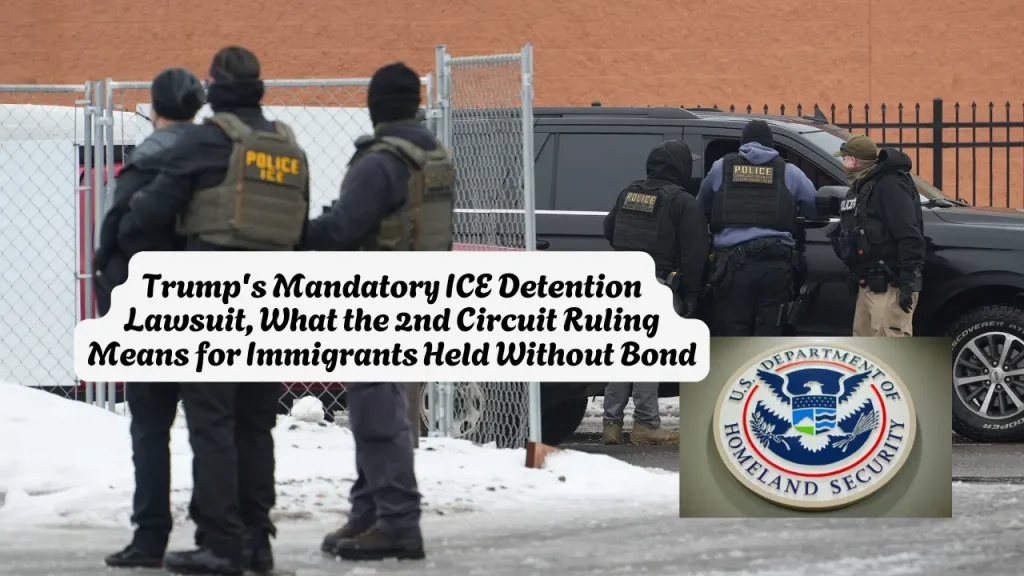
The ACLU argued, and the 2nd Circuit agreed, that the administration’s reading of IIRIRA defies the plain text of the statute. The court also found the policy raises serious constitutional problems under the Due Process Clause of the Fifth Amendment, because detaining millions of people — including those with no criminal record, pending legal applications, and deep community ties — without any individual assessment bears no “reasonable relation” to any legitimate non-punitive government purpose.
The panel, which included Trump-appointed Judge Joseph F. Bianco along with Judges Alison J. Nathan and Jose A. Cabranes, ruled unanimously. What plaintiffs achieved here is a ruling that the government must provide bond hearings to individuals in the 2nd Circuit’s jurisdiction who do not fall under traditional mandatory detention categories. No monetary damages are part of this case. The goal was — and remains — stopping indefinite detention without process, and that goal has succeeded at the circuit level for now.
What Should You Do If You or a Family Member Is Being Held Without Bond?
If someone you know is detained by ICE and has been told they are not eligible for a bond hearing, the 2nd Circuit ruling may directly affect their situation. Here is what to do right now.
If detained in New York, Connecticut, or Vermont:
- Contact an immigration attorney or civil rights lawyer immediately — the 2nd Circuit ruling gives courts in this region grounds to order a bond hearing
- File a habeas corpus petition under 28 U.S.C. § 2241 in federal district court if bond was denied — this is the exact legal tool used in the Barbosa da Cunha case
- Save all documents: detention notices, communications from ICE, any prior immigration filings or work authorization approvals
- Contact the ACLU or NYCLU for free legal consultation if you cannot afford an attorney
If detained outside the 2nd Circuit:
- The legal landscape is different — the 5th and 8th Circuits have upheld the administration’s policy
- Consult a consumer rights lawyer or immigration attorney who handles federal habeas petitions in your district
- Monitor the Supreme Court docket closely — if the Court takes this case, a national ruling could follow
For all affected families:
- Most people who are part of a class challenge do not need to take individual action to be covered — but you do need a lawyer to enforce the right to a bond hearing in your specific case
- Document everything. If ICE detained someone without a warrant or bond hearing, preserve every piece of paperwork you received
Trump Mandatory ICE Detention Lawsuit Timeline
| Milestone | Date |
| ICE Director issues no-bond policy interpretation | July 2025 |
| Ricardo Barbosa da Cunha arrested by ICE, Massachusetts | September 2025 |
| District court orders bond hearing; immigration judge releases da Cunha | Fall 2025 |
| DHS appeals to 2nd U.S. Circuit Court of Appeals | Late 2025 |
| 2nd Circuit panel rules unanimously against mandatory detention policy | April 28, 2026 |
| DHS signals intent to appeal to U.S. Supreme Court | April 28, 2026 |
| Supreme Court review / certiorari decision | TBD — petition not yet filed as of April 29, 2026 |
| Possible national ruling | TBD — pending Supreme Court acceptance and briefing schedule |
Frequently Asked Questions
Is there a class action lawsuit against Trump’s no-bond ICE detention policy?
Yes. The case Barbosa da Cunha v. DHS, decided by the 2nd U.S. Circuit Court of Appeals on April 28, 2026, directly challenges the administration’s mandatory detention policy. The ACLU brought the case on behalf of noncitizens detained without bond hearings in violation of the Immigration and Nationality Act and the Constitution.
Do I need to do anything right now to be protected by this ruling?
Not automatically. The ruling applies within the 2nd Circuit’s jurisdiction — New York, Connecticut, and Vermont. If you or a family member is detained in those states without a bond hearing, you need an immigration attorney to file a habeas corpus petition to enforce the right to a hearing. The ruling doesn’t release anyone automatically.
When will a settlement be reached in this case?
This is not a settlement case. The plaintiffs are seeking constitutional rights — specifically the right to bond hearings — not money. The next major development will be a potential U.S. Supreme Court appeal by DHS, which the department has signaled it intends to file.
Can I file my own lawsuit against ICE for detaining me without a bond hearing?
Yes. Individuals detained without a bond hearing can file a habeas corpus petition under 28 U.S.C. § 2241 in federal district court. This is exactly how the Barbosa da Cunha case started. You should consult an immigration attorney or seek a free legal consultation through the ACLU, NYCLU, or a local legal aid organization before filing.
How will I know if the mandatory detention policy changes nationally?
Monitor the U.S. Supreme Court’s docket at supremecourt.gov. If the Court grants certiorari (agrees to hear the case), a national ruling could follow within 12–18 months of acceptance. Subscribe to updates from the ACLU Immigrants’ Rights Project, which is actively litigating this case.
What law does the Trump administration claim allows this detention?
DHS argues the Illegal Immigration Reform and Immigrant Responsibility Act of 1996 (IIRIRA) authorizes mandatory detention of anyone who ever entered without inspection. The 2nd Circuit rejected this reading as inconsistent with the statute’s plain text and said the administration’s interpretation raises serious constitutional problems under the Due Process Clause.
Does this ruling affect immigrants in Texas or Florida?
No — not yet. The 5th Circuit (which covers Texas, Louisiana, and Mississippi) and the 8th Circuit have already sided with the administration. Immigrants detained in those states remain subject to the no-bond policy unless the Supreme Court issues a national ruling overturning it.
What is compensation for damages in this type of case?
This lawsuit does not involve financial compensation. The legal remedy being sought is injunctive — the right to a bond hearing before a judge. However, individuals who were wrongfully detained may have separate civil rights claims; consult a civil rights attorney about those specific facts.
Sources & References
- ACLU Press Release: Federal Appeals Court Rules Against Trump Administration’s New Mandatory Detention Policy (April 28, 2026)
- NBC News: Appeals court rejects Trump’s no-bond immigration detentions, setting stage for Supreme Court review (April 28, 2026)
- CBS News: Appeals court rejects Trump administration’s mandatory ICE detention policy (April 28, 2026)
Disclaimer: This article is for informational purposes only and does not constitute legal advice. Legal claims and outcomes depend on specific facts and applicable law. For advice regarding your particular situation, consult a qualified immigration or civil rights attorney.
About the Author
Israr Ahmad is a legal content researcher with 4+ years of experience covering class action settlements and consumer rights cases. He has researched and published coverage of 2,500+ settlements using verified court records, settlement administrator filings, and government sources. Learn more about Israr.