
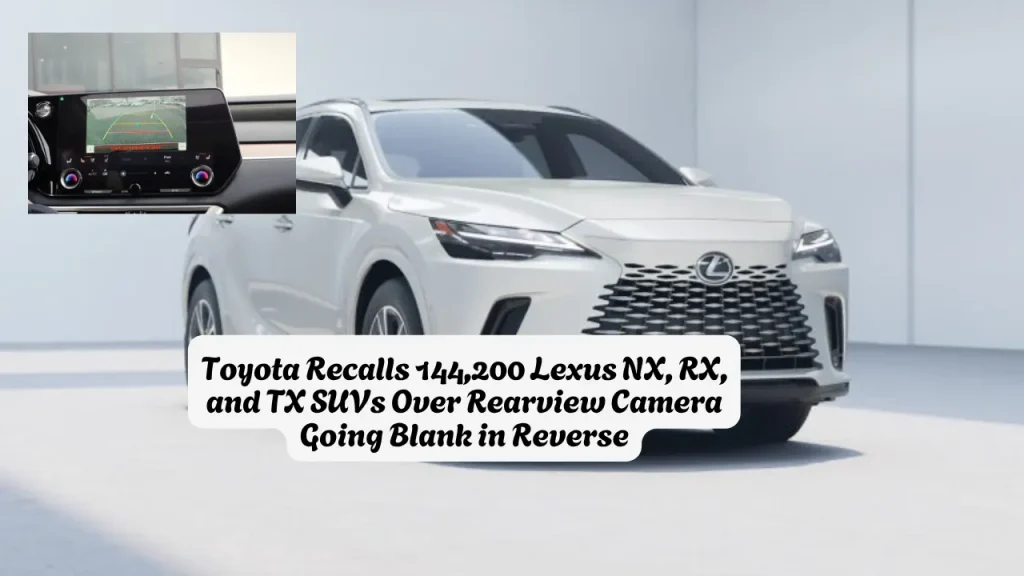
Toyota Recalls 144,200 Lexus NX, RX, and TX SUVs Over Rearview Camera Going Blank in Reverse
Your Backup Camera May Go Dark at the Worst Possible Moment
Toyota is recalling more than 144,200 Lexus vehicles in the U.S. because a software defect may prevent the rearview camera from displaying an image when the vehicle is shifted into reverse — reducing driver visibility and increasing the likelihood of a crash. The recall was officially announced on March 18, 2026, and covers three of Lexus’s most popular non-hybrid SUVs sold across recent model years. The recall is listed under NHTSA campaign number 26V162000 and involves a failure to comply with Federal Motor Vehicle Safety Standard No. 111 on rear visibility.
If you own a Lexus NX, RX, or TX, keep reading — even if your camera seems to work fine right now, your vehicle almost certainly carries the underlying defect.
The Fast Facts You Need Right Now
| Detail | Information |
| Company / Brand | Toyota Motor North America / Lexus |
| Affected Models | 2022–2025 Lexus NX250 & NX350 · 2023–2026 Lexus RX350 · 2024–2026 Lexus TX350 |
| Hybrid models included? | No — gas-only (non-hybrid) versions only |
| Units Affected (U.S.) | ~144,200 |
| Recall Announced | March 18, 2026 |
| NHTSA Campaign Number | 26V162000 |
| Recall Numbers | 26LB02 and 26LA02 |
| Hazard | Blank rearview camera screen when reversing → increased crash risk |
| Remedy | Free software update or free camera replacement at any Lexus dealer |
| Owner Letters Mailed | Beginning May 3, 2026 |
| Check Your VIN | nhtsa.gov/recalls or Lexus.com/recall |
| Lexus Phone | 1-800-255-3987 |
| NHTSA Safety Hotline | 1-888-327-4236 |
What Is Actually Wrong With These Vehicles
This is not a complex defect to understand, even if the cause is buried in software code.
When certain affected vehicles are restarted shortly after being turned off, a brief drop in electrical power can interrupt the camera system before it fully loads. The result: drivers shift into reverse and get nothing on the screen.
The recall condition affects combustion-only vehicles equipped with a specific in-cabin USB charger and multimedia system. The charger does not include a capacitor that can prevent a voltage drop. Such voltage drops may interrupt the rearview camera boot sequence, resulting in a black screen.
Panasonic Automotive Systems is the supplier of the rearview camera assemblies in question, which are listed under six part numbers.
Critically, federal safety standards have required all new vehicles sold in the United States since May 2018 to display a rearview image during backing. A blank screen violates that standard and means the driver is reversing with zero rear camera visibility, relying entirely on mirrors and physical head turns.
Regulators estimate all affected vehicles contain the underlying condition, though the issue may only appear under specific operating scenarios. In other words, your camera may work perfectly most of the time — but every vehicle on this recall list has the defect sitting inside it, waiting for the right moment to appear.
Related article: Insulet Recalls Omnipod 5 Insulin Pods Over Defect That Can Cut Off Insulin — 18 Hospitalizations Already Reported
How the Breakdown in Numbers Looks
The 144,200-vehicle recall population is split between 3,843 examples of the TX 350, 25,529 units of the NX 250, 43,744 of the NX 350, and 71,084 of the RX 350. An additional 17,000 vehicles in Canada are covered under a parallel recall filed with Transport Canada.
How This Was Discovered
Toyota Motor North America started investigating this matter in March 2025. Toyota began investigating reports of inoperative rearview cameras in early 2025 and concluded in March 2026, after months of testing, that a recall was necessary. That means owners of affected vehicles spent up to a year driving with this defect before a formal recall was issued.
This Is Toyota’s Second Major Lexus Camera Recall in Six Months
This recall did not happen in a vacuum, and Lexus owners should understand the difference between this action and the earlier one.
In October 2025, Toyota issued a recall covering more than one million Toyota and Lexus vehicles equipped with the Panoramic View Monitor system. That recall touched a wide range of models including the Camry, Highlander, RAV4, Prius, and several Lexus models.
This new March 2026 recall is a separate action. It does not reference the Panoramic View Monitor and covers different model years and a different set of conditions. Owners whose vehicles were fixed under the 2025 recall are not automatically covered by this one, and vice versa. Any owner of a 2022 to 2026 Lexus NX, RX, or TX should confirm their specific VIN is clear before assuming they are in the clear.
If your Lexus was repaired last year, do not assume you are safe. Check your VIN again.
Earlier in 2026, Toyota also recalled about 161,268 Tundra and Tundra Hybrid pickups over a similar rearview camera issue. And over 1.7 million Ford and Lincoln models were recalled for a similar issue earlier in March 2026, and Audi recalled over 350,000 models for the same thing in January 2026. This is an industry-wide software-era problem, not a one-off event.
Exactly What to Do If You Own One of These Vehicles
Do not wait for a letter to arrive in May. Here is what to do right now:
Step 1 — Check your VIN today. Go to nhtsa.gov/recalls or Lexus.com/recall and enter your 17-digit Vehicle Identification Number. You’ll find your VIN on the driver’s side dashboard, visible through the windshield, or on your registration documents.
Step 2 — Contact a Lexus dealership. Dealers will update the camera software or replace the camera, as necessary, for free. Call your nearest authorized Lexus dealer and reference NHTSA recall numbers 26LB02 and 26LA02 when you schedule your appointment.
Step 3 — Until the repair is done, use your mirrors. Officials say you should not treat the backup camera as your only set of eyes. Use your mirrors and a quick shoulder check to confirm what is behind the vehicle before you roll. Be especially careful if you have just restarted your vehicle after a short stop.
Step 4 — Keep records of everything. Write down the date of your service appointment, the work performed, and ask for a copy of the repair order. If your camera continues to malfunction after the recall repair, that documentation matters — especially if you later pursue a lemon law claim.
Step 5 — Call Lexus or NHTSA with questions. Those with further questions can contact the brand at 800-255-3987, visit Lexus.com/recall, call the NHTSA vehicle-safety hotline at 888-327-4236, or visit its website.
What the Recall Covers — and What It Does Not
The free repair includes either a software update or a full camera replacement, depending on what your vehicle needs. For the majority of vehicles, a software update to the backup camera system will resolve the issue at no cost. In cases where a software update is not sufficient, dealers will replace the backup camera hardware entirely, also at no cost to the owner.
What the recall does not cover is financial compensation for diminished vehicle value, time spent at the dealership, or prior out-of-pocket repairs you may have paid for before the recall was announced. If you paid for a rearview camera repair on one of these vehicles before March 18, 2026, contact Lexus customer service — you may have grounds to request reimbursement.
Could This Lead to Legal Action?
No class action lawsuit has been filed specifically over this recall as of the date of publication. However, that does not mean owners have no legal recourse.
Owners who experience ongoing camera failures after the recall repair, or who believe the defect impaired the safety or value of their vehicle, may have options under state lemon laws. Under most lemon law statutes, a manufacturer must be given a reasonable number of attempts to fix a safety defect before the vehicle qualifies for replacement or a refund. A malfunctioning rearview camera tied to a federal safety recall can meet that threshold in many states.
Toyota has faced significant legal action over prior safety defects. If you want to understand how automaker accountability claims work in practice, the Toyota airbag class action lawsuit settlement — a $78.5 million resolution over ACU defects — shows what those cases can look like. Similarly, the Toyota Prius door switch recall of 2026 demonstrates how Toyota has handled repeat safety issues on multiple fronts this year.
If you have experienced a crash, near-miss, or property damage related to a blank rearview camera screen in one of the recalled models, consult a product liability or lemon law attorney. Many work on contingency, meaning you pay nothing unless you recover compensation. You can also see how product liability lawsuits against manufacturers are structured by reviewing what happened with the Nissan Rogue windshield defect case, which followed a similar pattern of owner complaints before legal filings.
Common Questions From Lexus Owners
Which exact models are included in this recall?
The recall applies to the 2022–2025 Lexus NX250, 2022–2025 Lexus NX350, 2023–2026 Lexus RX350, and 2024–2026 Lexus TX350. Hybrid and plug-in hybrid versions of these models are not included in this recall.
How do I know if my specific vehicle is affected?
Enter your 17-digit VIN at nhtsa.gov/recalls or Lexus.com/recall. Do not rely on model year alone — only specific production configurations are involved. The VIN check will give you a definitive answer.
My camera works fine. Do I still need to come in?
Yes. Regulators estimate all affected vehicles contain the underlying condition, though the issue may only appear under specific operating scenarios. The defect may be present in your vehicle even if you have never seen the camera go blank.
I already had my Lexus fixed under the 2025 recall. Am I covered by this one?
Not automatically. This new March 2026 recall is a separate action covering different model years and a different set of conditions. Owners whose vehicles were fixed under the 2025 recall are not automatically covered by this one. Check your VIN regardless of what was done previously.
What does the repair actually involve, and does it cost anything?
For the majority of vehicles, a software update to the backup camera system will resolve the issue at no cost. In cases where a software update is not sufficient, dealers will replace the backup camera hardware entirely, also at no cost to the owner. All work is 100% free.
When will I get a notification letter?
Owner notification letters are expected to be mailed starting May 3, 2026. You do not have to wait for the letter — you can call Lexus at 1-800-255-3987 or check your VIN online right now.
Is there any physical danger right now while I wait for the repair?
The camera does not fail constantly — it fails under specific restart conditions. That said, until the software update or repair is complete, officials say drivers should not treat the backup camera as their only set of eyes. Always check your mirrors and physically look before reversing, whether or not your camera appears to be working.
Who oversees this recall, and where can I find the official documents?
The recall is listed under NHTSA campaign number 26V162000. You can view the official filings at nhtsa.gov/recalls by searching the campaign number or your VIN. The NHTSA vehicle safety hotline is 1-888-327-4236.
Could I qualify for a lemon law claim?
If your Lexus requires multiple repair attempts for this defect and the camera continues to malfunction, you may qualify under your state’s lemon law. Requirements vary by state but typically involve a set number of repair attempts or a certain number of days out of service. Contact a lemon law attorney in your state for a case evaluation — many offer free consultations.
Last Updated: April 6, 2026. This article is for informational purposes only. Always follow official recall guidance from Toyota, Lexus, NHTSA, or your state’s relevant consumer protection authority. Nothing in this article constitutes legal advice. Consult a licensed attorney in your jurisdiction if you believe you have a legal claim.
About the Author

Sarah Klein, JD, is a licensed attorney and legal content strategist with over 12 years of experience across civil, criminal, family, and regulatory law. At All About Lawyer, she covers a wide range of legal topics — from high-profile lawsuits and courtroom stories to state traffic laws and everyday legal questions — all with a focus on accuracy, clarity, and public understanding.
Her writing blends real legal insight with plain-English explanations, helping readers stay informed and legally aware.
Read more about Sarah