
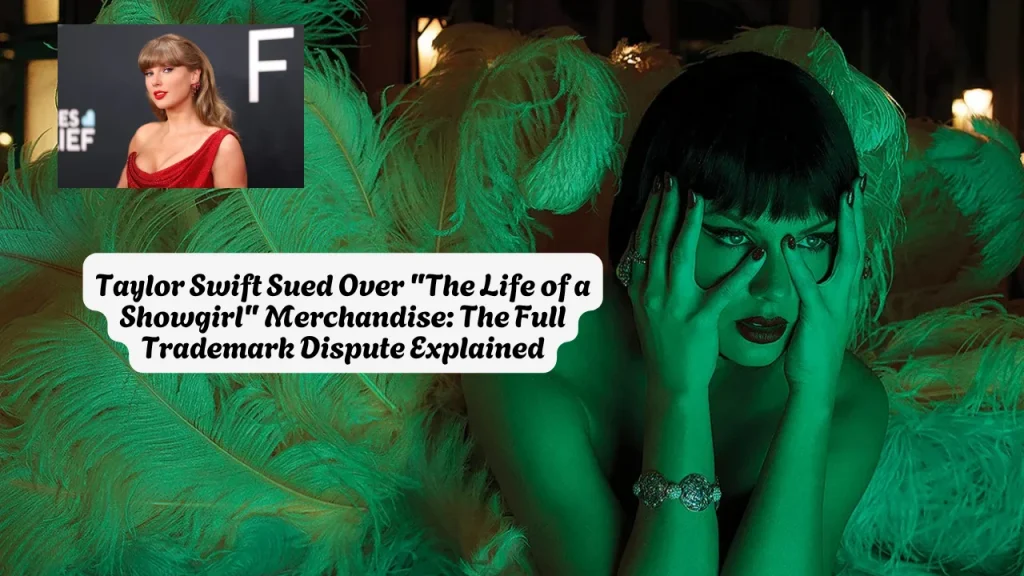
Taylor Swift Sued Over “The Life of a Showgirl” Merchandise: The Full Trademark Dispute Explained
Nearly six months after Taylor Swift released her album “The Life of a Showgirl,” the pop star is being sued for alleged trademark infringement. The plaintiff is a Las Vegas performer who says Swift’s entire album brand — its name, its merchandise, and its glittery showgirl aesthetic — directly collides with a trademark she has owned and built her career around since 2014. And critically, the U.S. Patent and Trademark Office already agreed with her — refusing Swift’s own trademark application months before the lawsuit was filed.
Quick Facts
| Field | Detail |
| Plaintiff | Maren Flagg (performing as Maren Wade) |
| Defendants | Taylor Swift, Universal Music Group (UMG), Bravado International Group Merchandising Services Inc. |
| Lawsuit Filed | March 30, 2026, U.S. District Court, Los Angeles |
| Court | U.S. District Court, Central District of California |
| Plaintiff’s Trademark | “Confessions of a Showgirl” (registered, in use since 2014) |
| Album at Issue | “The Life of a Showgirl” (released October 2025) |
| USPTO Trademark Refusal | November 2025 (partial refusal; application suspended March 2026) |
| What Wade Wants | Permanent injunction + profits from merchandise + legal fees + jury trial |
| Injunction Hearing | Tentatively scheduled late May 2026 |
| Swift’s Response | No public comment as of April 8, 2026 |
| Album Sales | Over 4 million copies first week; best-selling vinyl of 2025 |
Where Things Stand Right Now
- On April 7, 2026, Wade filed a motion for an immediate injunction to bar Swift from selling any “The Life of a Showgirl” merchandise while the lawsuit plays out.
- The motion for the injunction is tentatively set to be heard by a judge in Los Angeles federal court in late May 2026.
- The USPTO suspended Swift’s trademark application in early March 2026, putting proceedings on hold pending resolution of the conflict.
- Swift and her representatives had not publicly responded to the lawsuit as of April 8, 2026.
Who Is Maren Wade and What Did She Build
Most people searching this story are asking the same thing: who is this person suing Taylor Swift, and does she have a real case? The answer starts with understanding what she actually owns.
The plaintiff is Maren Flagg, who performs professionally as Maren Wade. She has spent more than a decade building a brand around the name “Confessions of a Showgirl,” which she first used in 2014 as the title of a weekly column she wrote for Las Vegas Weekly, centered on her experiences as a performer in the Las Vegas entertainment industry.
Related article: $2.81M Whirlpool Refrigerator Wire Harness Settlement, Is Your Fridge Eligible for Free Repair or Cash? File Before November 2
Wade parlayed that column into a live show, a touring production, a book, a podcast, and a federally registered trademark.
This is not a social media personality with a handle. This is a performer with a federally registered trademark — the legal kind that the U.S. government formally recognized and recorded — covering entertainment services in the exact same commercial space as Swift’s album rollout.
Wade’s complaint states that while Swift’s business success “does not depend on the continued use of any single designation,” Confessions of a Showgirl is Wade’s only trademark and the entire basis of her professional identity and career. “It is not one mark among hundreds,” the complaint states. “It is the only one she has.”
For context: Swift’s trademark portfolio reportedly includes more than 170 active or pending registrations covering phrases, imagery, and brand elements connected to her various album eras and tours.
What Taylor Swift’s Album and Merchandise Actually Look Like
To understand why the lawsuit has traction, you need to understand the scale of Swift’s “The Life of a Showgirl” commercial rollout.
The album’s visual identity is built around a glittery, art deco, feathered showgirl aesthetic, and that aesthetic has been applied across an extensive merchandise line including candles, drinkware, accessories, and clothing — the exact commercial goods the lawsuit targets.
Wade is asking a federal judge to drop the curtain on any drink tumblers, brushes, or other merchandise bearing Swift’s “The Life of a Showgirl” album title while the case proceeds.
The album was released in numerous formats, including at least 11 CD editions, eight vinyl variants, and multiple digital versions, alongside a wide range of merchandise. The Life of a Showgirl was the best-selling vinyl release of 2025, with 1.6 million copies sold in that format alone.
The commercial reach of Swift’s showgirl branding is global. Wade’s is regional and niche. That disparity is exactly what makes the trademark claim meaningful — and exactly what makes a permanent injunction financially consequential for Swift’s team.
The USPTO Already Said No — Before the Lawsuit Was Filed
This is the detail that gives the lawsuit its sharpest edge. Swift’s team did not launch merchandise in ignorance. They tried to protect the name legally and were told they could not.
When Swift’s team applied to register “The Life of a Showgirl” as a trademark in August 2025, the USPTO issued a partial refusal in November 2025, finding a likelihood of confusion with Wade’s already-registered mark. The two names, the office found, share the same structure, the same dominant phrase, and the same overall commercial impression, and both are associated with entertainment involving musical and theatrical performances.
The complaint states: “When Defendants applied to register ‘THE LIFE OF A SHOWGIRL,’ the Office refused on the ground that Defendants’ designation is confusingly similar to Plaintiff’s established mark. Defendants were therefore placed on actual notice that their chosen designation was likely to be confused with a mark that already belonged to someone else. They continued using it anyway, expanding it across a coordinated commercial program and distributing it through retail channels reaching millions of consumers.”
Wade’s attorney Jaymie Parkkinen stated: “When Taylor Swift’s team applied to register ‘The Life of a Showgirl,’ the Trademark Office refused, finding Swift’s mark confusingly similar.”
In trademark law, receiving official notice from the USPTO that your mark conflicts with an existing one — and continuing commercial use anyway — significantly strengthens the infringement claim against you. That is precisely the legal ground Wade is standing on.
What the Lawsuit Actually Claims
The complaint includes claims for trademark infringement, false designation of origin, and unfair competition, and seeks unspecified damages along with an injunction to prevent further use of the name.
The lawsuit alleges the “similarity between ‘Confessions of a Showgirl’ and ‘The Life of a Showgirl’ is immediate,” alleging they share “the same structure, the same dominant phrase, and the same overall commercial impression.”
The complaint also states: “Even a cursory trademark search would have revealed Plaintiff’s federally registered mark and her years of continuous prior use. That similarity would not have escaped Defendants’ notice.”
Wade is seeking a permanent injunction barring Swift and her companies from using the name at all, all profits attributable to the infringing use, legal fees, and a jury trial.
Swift’s Fans Pushed Back — and So Did Wade’s Social Media History
While representatives for Swift did not immediately respond to media requests for comment, fans quickly took to social media to push back against the allegations, highlighting multiple social media posts dating back to September 2025, in which Flagg purportedly utilized Swift’s music and associated hashtags — including #TS12 and #thelifeofashowgirl — while appearing to express excitement and count down to the release of Swift’s album.
Wade appeared to embrace Swift’s use of the showgirl image initially, sharing Instagram posts that used Swift’s music, hashtags related to the album, and the mint green color scheme. But Wade’s social media presence has gone silent in recent months.
Whether Wade’s early enthusiasm for the album undercuts her legal claims will likely be an argument Swift’s legal team makes. However, under trademark law, a trademark owner’s personal appreciation of another’s work does not waive their legal right to protect their registered mark from commercial infringement.
Frequently Asked Questions
What is trademark infringement and why does it apply here?
Trademark infringement occurs when someone uses a name, phrase, or logo in commerce that is confusingly similar to an existing registered trademark — causing consumers to potentially confuse the two. Here, both marks use the word “showgirl” as their dominant phrase, both are connected to entertainment, and the USPTO itself found them confusingly similar when it refused Swift’s application.
Does Taylor Swift have to stop selling merchandise immediately?
Not yet. Wade filed a motion for a preliminary injunction on April 7, 2026, asking the court to halt merchandise sales while the case proceeds. A judge will hear arguments on that motion, currently scheduled for late May 2026. Until a court orders it, Swift can continue selling the merchandise.
Why are UMG and Bravado named in the lawsuit and not just Swift?
Maren Flagg filed the lawsuit against Swift, Universal Music Group, and Bravado International Group Merchandising Services Inc. UMG is Swift’s record label and Bravado is the company that manufactures and distributes artist merchandise. In trademark infringement cases, all commercial parties profiting from the allegedly infringing use are typically named as defendants.
Did the government actually reject Taylor Swift’s trademark?
Yes. The USPTO issued a partial refusal in November 2025, finding a likelihood of confusion with Wade’s already-registered mark, and subsequently suspended Swift’s application in early March 2026. That suspension means the application cannot move forward while the conflict is unresolved.
What is Maren Wade asking for in this lawsuit?
Wade is seeking a permanent court order barring Swift from using “The Life of a Showgirl” name on any merchandise or commercial product, all profits earned from goods using the phrase, her attorney’s fees, and a trial before a jury.
Could this lawsuit force Swift to rename the album?
In theory, an injunction could prevent future commercial use of the name — including on merchandise, streaming, and physical releases. However, courts rarely require the removal of an already-released creative work entirely. The more likely outcome, if Wade prevails, would be restrictions on ongoing merchandise sales and a financial damages award. A full album retitling would be an extraordinary remedy.
Is Maren Wade a well-known performer?
Wade has built her career around “Confessions of a Showgirl” since 2014, growing it from a Las Vegas Weekly column into a live cabaret show, a national touring production, a podcast, and a book. She is well known within the Las Vegas entertainment scene but does not have Taylor Swift’s global profile. Her attorney addressed this directly: “Maren spent more than a decade building ‘Confessions of a Showgirl.’ She registered it. She earned it.”
When will this case be resolved?
The injunction hearing is scheduled for late May 2026. The full case will take significantly longer — trademark litigation typically takes one to three years to reach a verdict or settlement. Settlement before trial is common in trademark disputes of this kind.
Sources & References
- Rolling Stone — Taylor Swift’s “Life of a Showgirl” Merch Under Fire in Trademark War, April 7, 2026
Last Updated: April 8, 2026
Disclaimer: This article is for informational purposes only and does not constitute legal advice. Legal claims and outcomes depend on specific facts and applicable law. For advice regarding a particular situation, consult a qualified attorney.
About the Author
Israr Ahmad is a legal content researcher with 4+ years of experience covering class action settlements and consumer rights cases. He has researched and published coverage of 2,500+ settlements using verified court records, settlement administrator filings, and government sources. Learn more about Israr.