
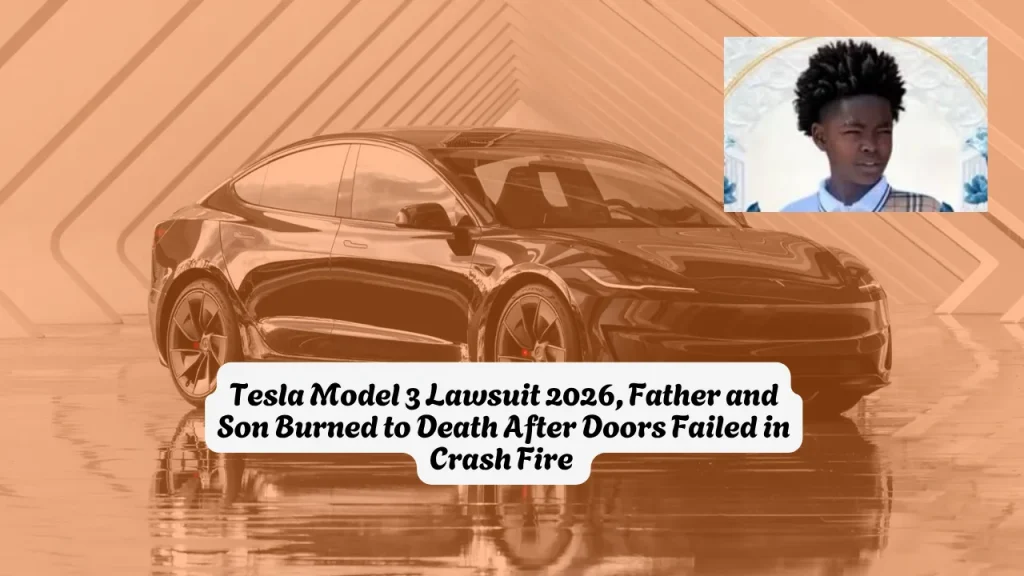
Tesla Model 3 Lawsuit 2026, Father and Son Burned to Death After Doors Failed in Crash Fire
On December 23, 2024, a father and his 14-year-old son were killed when their 2021 Tesla Model 3 left a Georgia highway, struck a tree, and erupted in flames. A bystander rushed to help but could not open the car’s doors. Both occupants died. Now the boy’s mother has filed a wrongful death lawsuit against Tesla, alleging that a cascade of product defects — a malfunctioning Autopilot system, a battery that triggered an unstoppable fire, and electric door handles that stopped working at the worst possible moment — turned a survivable crash into a death trap.
This is not a class action lawsuit and no settlement fund exists. It is a wrongful death and product liability case filed by one grieving mother on behalf of her son.
Quick Facts
| Field | Detail |
| Case Name | Shantorria Herring v. Tesla, Inc. |
| Court | U.S. District Court, Northern District of Georgia (Atlanta Division) |
| Date Filed | April 2, 2026 |
| Plaintiff | Shantorria Herring (mother of Karter Breon Smith) |
| Defendant | Tesla, Inc. |
| Vehicle | 2021 Tesla Model 3 |
| Crash Date | December 23, 2024 |
| Crash Location | Highway 35, Thomas County, Georgia |
| Victims | Karter Breon Smith, age 14, and his father Margarret Smith, age 35 |
| Settlement Amount | TBD — No settlement reached |
| Claim Type | Wrongful death / Product liability / Punitive damages |
| Tesla’s Response | No public comment issued |
Where the Case Stands
- Shantorria Herring filed her complaint in the United States District Court for the Northern District of Georgia on March 31, 2026. The case is in its earliest stage. Tesla has not yet formally responded to the complaint.
- The lawsuit seeks special damages for funeral and burial expenses, compensatory damages for the pain and suffering Karter experienced before his death, and punitive damages intended to deter Tesla from similar conduct in the future.
- Tesla has not issued a public statement about the lawsuit. Tesla did not immediately respond to a request for comment.
Who Were Karter and Margarret Smith?
Before this case becomes about legal theories and vehicle data, it helps to understand who was lost.
Karter Smith was described by his former high school athletic director as having “a heart the size of a mountain.” He was “always smiling, laughing and had just this impressive aura about him wherever he went.” His mother told reporters that her son wanted to be a basketball player, but she always emphasized academics. Herring said her son “was going to be amazing whatever he did and whatever he decided to do because he put his all into it.”
Karter was an honors student with a bright future. His father, Margarret Smith, was a Florida A&M University graduate who was pursuing a doctorate at the time of the crash. The two were headed from Tallahassee, Florida toward Atlanta on the day before Christmas Eve — a family trip that would never reach its destination.
What the Lawsuit Says Happened
The Crash
The incident occurred on December 23, 2024, when Karter’s father picked his son up at his mother’s home in Tallahassee, Florida, to drive to Atlanta. As the two were traveling north on Highway 35 in Thomas County, the Model 3 — which was reportedly in self-driving mode at the time — abruptly departed the road, struck a tree and burst into flames.
According to a Georgia State Patrol crash report, the Model 3 went off the road and straight into a pecan orchard, where it crashed head-on into a tree. The car then immediately caught fire.
Related article: Denver Zoo’s $19 Million Sea Lion Habitat Is Leaking. Now the Zoo Is Suing the People Who Built It
The Data That Drives the Case
The lawsuit does not rely only on eyewitness accounts. It draws on the car’s own internal computers. According to the complaint, the Tesla EDR records show that the accelerator pedal went from 0.0 — with a speed of 63 mph — to 100.0, without any significant change in vehicle speed and without any reported service brake recording.
In plain terms: the car was cruising at highway speed with no pedal input, then the accelerator went to full throttle — but the car did not speed up, and the brakes were never applied. The lawsuit argues this sequence points to a sudden, uncontrolled system event, not a driver falling asleep or making a deliberate choice.
The Fire That Could Not Be Survived
Once the car hit the tree, the lawsuit alleges the battery system triggered what engineers call thermal runaway. Thermal runaway describes a chain reaction of battery short-circuits ultimately resulting in a domino effect of uncontrollable combustion, with temperatures that get so hot they can literally pulverize a person’s bones. Battery fires burn far more intensely than gasoline fires, and make it easier for the rest of the car to ignite while making it far more difficult for firefighters to contain such a blaze.
The Doors That Would Not Open
Even if the occupants survived the impact, the lawsuit alleges they had no way out. The complaint states that an occupant from another vehicle rushed to help, but that person was unable to open the vehicle’s doors because the electric-powered handles were “inoperable.”
Both occupants burned to death in the thermal runaway and fire that occurred after impact, according to the complaint.
The Three Product Defects Tesla Faces
The lawsuit does not pin this tragedy on a single failure. It alleges three separate design defects that combined to make survival impossible.
1. Autopilot / Full Self-Driving System
The complaint says the Tesla’s Autopilot features were “improperly designed,” contrary to CEO Elon Musk’s claims. The lawsuit argues the vehicle abruptly accelerated and failed to brake when confronted with an obstacle — behavior that the complaint attributes to a system that was released to the public before it was safe. Herring’s attorney Quinton Seay told The Independent that self-driving technology “is not a bad idea, but like any other piece of technology, it has to be fully tested in real-world scenarios before putting members of the driving public in those vehicles.”
Herring’s complaint takes Tesla to task for “falsely reassuring customers that the ‘Autopilot’ feature worked as intended” and for marketing it as road-ready when the lawsuit contends it was not.
2. Battery Fire / Thermal Runaway
The lawsuit alleges that the Model 3’s lithium-ion battery pack is prone to thermal runaway fires that burn with greater intensity than traditional gasoline fires, spread faster through the vehicle, and actively resist firefighting efforts. The complaint frames this not just as an accident of physics but as a foreseeable design risk that Tesla had an obligation to address before selling the vehicle to the public.
3. Electric Door Handles That Fail in Fires
This is the defect at the heart of the case. Tesla’s Model 3 uses electrically powered door handles — a design choice that gives the car its sleek, flush exterior look. When the car loses power after a crash or fire, those handles stop working. Tesla vehicles have two batteries: one for low-voltage power to windows, doors, the touchscreen and other functions, and the high-voltage pack that propels the car. If the low-voltage battery dies or is disabled — which can happen after a crash — the doors may not unlock and must be opened manually from the inside. While there are mechanical releases inside Teslas, many owners and passengers are unfamiliar with where they’re located.
The result, according to this and other lawsuits like it: people who survived the impact burned to death because they could not get out.
This Is Not an Isolated Case
What makes this lawsuit more than one family’s tragedy is the pattern it fits into. Tesla’s door handle design has become the subject of multiple federal investigations and lawsuits across the country.
Bloomberg reported that there have been at least 15 deaths over the last decade in which motorists or rescuers were unable to open the doors of a Tesla that had crashed and caught fire.
The National Highway Traffic Safety Administration said it is evaluating claims that Tesla’s mechanical door release is hidden, unlabeled, and not intuitive to locate during an emergency. That probe covers an estimated 179,071 Model 3 sedans from the 2022 model year, and investigators have indicated it could expand to additional model years and the Model Y.
One Georgia Tesla owner, Kevin Clouse, described his own near-fatal experience to NHTSA: “I was unaware of the location of the hidden mechanical emergency door release because it is not visibly labeled, not explained upon delivery, and not intuitive in an emergency. I was forced to climb to the back seat and break the rear passenger window with my legs to escape while the interior was burning.”
A separate lawsuit filed in November 2025 alleged that five people died in a Wisconsin Tesla Model S crash for the same reason — Tesla’s design choices created a highly foreseeable risk: that occupants who survived a crash would remain trapped inside a burning vehicle.
In response to growing scrutiny, Tesla design chief Franz von Holzhausen acknowledged in a September 2025 interview that the company is exploring combining the manual and electronic door releases into a single interface that would meet safety requirements. No timeline has been provided.
What Damages Are Being Sought
Herring is not asking for a fixed dollar amount in the public filing. The complaint seeks three categories of relief:
- Special damages — reimbursement for funeral and burial expenses
- Compensatory damages — for the pre-impact shock, fear, and physical suffering Karter experienced in the moments before his death
- Punitive damages — an amount the court determines is sufficient to deter Tesla from repeating this conduct in the future
Attorney Quinton Seay has said he is cautiously optimistic about the case. “There have been some very encouraging recent developments in litigation that make us hopeful we will be able to hold Tesla accountable for the deaths of these two folks,” Seay said.
Important Dates
| Milestone | Date |
| Crash Occurred | December 23, 2024 |
| Lawsuit Filed | April 2, 2026 |
| Tesla Response Due | TBD |
| Trial Date | TBD |
| Settlement | TBD |
Frequently Asked Questions
Is this a class action lawsuit I can join?
No. This is an individual wrongful death lawsuit filed by Karter Smith’s mother on behalf of her son. It is not a class action, and there is no settlement fund to file a claim against. If you believe you or a family member have been harmed by a Tesla product defect, consult an attorney who handles product liability or wrongful death cases in your state.
What is thermal runaway and why is it so dangerous?
Thermal runaway is a chain reaction inside a lithium-ion battery where one failing cell heats neighboring cells, causing them to fail in sequence. The process results in uncontrollable combustion with temperatures that can literally pulverize a person’s bones. Battery fires burn far more intensely than gasoline fires, make it easier for the rest of the vehicle to ignite, and are far more difficult for firefighters to contain.
Where is the manual door release in a Tesla Model 3?
Tesla Model 3 vehicles have a mechanical emergency door release, but it is located inside the door panel — not at the obvious door handle position. It requires a user to know where to look and how to operate it. NHTSA is currently evaluating claims that this release is hidden, unlabeled, and not intuitive to locate during an emergency. Owners should consult their vehicle manual to locate it before they ever need it.
Has Tesla recalled these vehicles?
As of this writing, no recall has been issued. NHTSA has opened a formal defect investigation into the 2022 Tesla Model 3 emergency door release, and a separate investigation is ongoing for the Model Y. An investigation does not automatically result in a recall — NHTSA must determine a safety defect exists before it can order or request one.
Was Autopilot definitely engaged at the time of the crash?
The complaint alleges the vehicle was in self-driving mode at the time of the crash and that EDR data shows the accelerator going to full throttle with no brake application. It is worth noting that Herring originally told local media after the crash that she believed her ex-husband fell asleep while driving. Her lawsuit now places all responsibility on the vehicle’s design. The court will ultimately weigh the EDR data, witness testimony, and expert analysis when evaluating these competing accounts.
What should Tesla Model 3 owners do right now?
Locate and familiarize yourself with the manual emergency door release before you ever need it — it is described in the owner’s manual. If you have concerns about Autopilot behavior, report any incidents to NHTSA at safercar.gov. If you or a family member have been injured in a Tesla due to door handle failure or Autopilot malfunction, consult a personal injury or product liability attorney in your state.
Will this case go to trial?
It is too early to say. Most product liability wrongful death cases settle before trial, but some — especially those with punitive damage claims against large corporations — do proceed to a jury. Discovery, in which both sides exchange evidence including Tesla’s internal documents and EDR data, will be a critical phase to watch.
For related coverage on product defect and wrongful death lawsuits, see our coverage of the Wisconsin Tesla Model S wrongful death lawsuit and our article on product liability law and what burned injury victims need to know.
Last Updated: April 5, 2026
Disclaimer: This article is for informational purposes only and does not constitute legal advice. The allegations described are claims made in a complaint and have not been proven in court. Tesla has not been found liable for any wrongdoing in this matter. For advice regarding a particular situation, consult a qualified attorney.
About the Author

Sarah Klein, JD, is a licensed attorney and legal content strategist with over 12 years of experience across civil, criminal, family, and regulatory law. At All About Lawyer, she covers a wide range of legal topics — from high-profile lawsuits and courtroom stories to state traffic laws and everyday legal questions — all with a focus on accuracy, clarity, and public understanding.
Her writing blends real legal insight with plain-English explanations, helping readers stay informed and legally aware.
Read more about Sarah