
Supreme Court Takes Up Trump Asylum Ban Case, What the November 13 Decision Means for Migrants
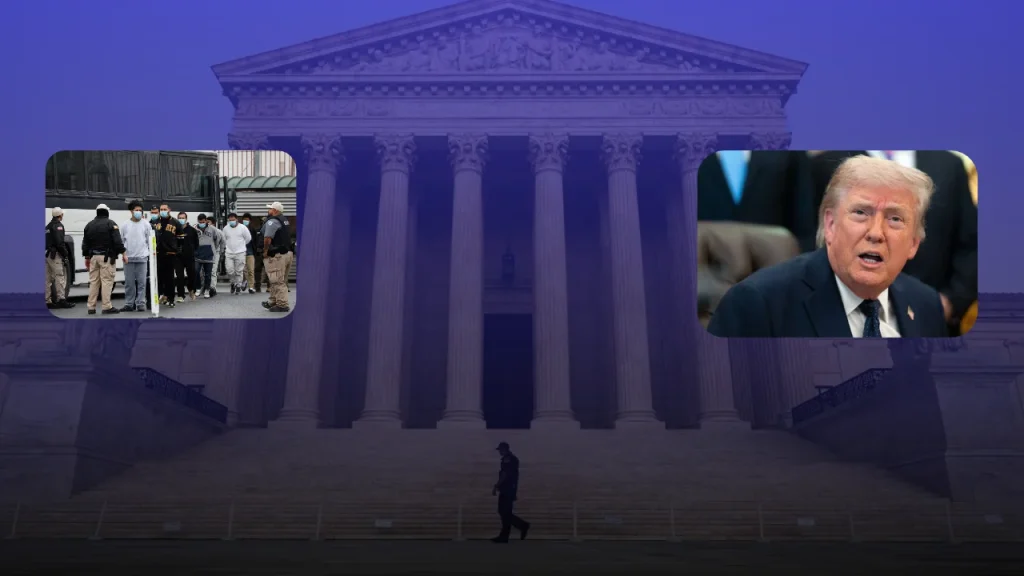
On November 13, 2026, the U.S. Supreme Court agreed to hear Mullin v. Refugee and Immigrant Center for Education and Legal Services (RAICES), No. 26-239. The case is about Presidential Proclamation 10888, which the Trump administration issued on January 20, 2025 to restrict access to asylum for people who cross the southern border between ports of entry. Critics call it an “asylum ban.” The administration describes it as a suspension of entry in response to what the proclamation calls an “invasion.”
Agreeing to hear a case is not a ruling. The Court has not decided whether the proclamation is lawful, and the grant does not by itself reopen asylum applications, stop removals or change the existing court orders. Oral argument has not been scheduled as of November 14, 2026.
Supreme Court Asylum Case: Key Facts
| Question | Verified information |
| Case | Mullin v. Refugee and Immigrant Center for Education and Legal Services |
| Docket number | 26-239 |
| Supreme Court action | Petition for certiorari granted November 13, 2026 |
| Petitioners | Government officials, led by the Secretary of Homeland Security (Markwayne Mullin) |
| Respondents | RAICES and other immigrant-services organizations, with individual migrants |
| Policy challenged | Proclamation 10888, “Guaranteeing the States Protection Against Invasion” (90 Fed. Reg. 8333) |
| Signed | January 20, 2025 |
| Lower court rulings | District court, July 2, 2025; D.C. Circuit, April 24, 2026 |
| Has the Court ruled on legality? | No |
| Does the grant change the rules today? | No |
| Oral argument | Not yet scheduled |
| Type of case | Challenge to government policy, not a settlement; no payment or claim form |
Official record: Supreme Court docket, No. 26-239
What Did the Supreme Court Agree to Decide?
The Court granted the government’s petition but accepted only some of the questions it raised:
- Whether Proclamation 10888 and its implementing guidance are lawful. The respondents frame this as whether the proclamation lawfully bars people from applying for asylum.
- Whether 8 U.S.C. § 1252(f)(1) bars the classwide relief the district court ordered.
The government also asked the Court to review whether the certified class met Article III and Federal Rule of Civil Procedure 23. According to the Court’s order, that third question was not accepted for separate review. See the questions presented.
The second question matters even apart from the first. The justices could address how far lower courts may go in protecting a group of migrants, whatever they decide about the proclamation itself.
What Is Proclamation 10888?
The proclamation declares that the situation at the southern border “qualifies as an invasion” and says the federal government has not been able to obtain operational control of the border. It relies on the president’s authority under two immigration statutes and on the Constitution:
- 8 U.S.C. § 1182(f): lets the president suspend the entry of noncitizens, or classes of them, whose entry would be detrimental to the interests of the United States.
- 8 U.S.C. § 1185(a)(1): makes it unlawful to enter contrary to presidential regulations and limitations.
- Article IV, Section 4 of the Constitution: the federal government’s duty to protect each state against invasion.
The proclamation suspends the entry of covered people at the southern border and directs that they not be allowed to use certain immigration provisions, including asylum, to stay. It is not a prohibition on every asylum application filed anywhere. Whether it covers a particular person depends on the proclamation, the guidance implementing it, and that person’s circumstances. The Federal Register text controls.
Does the Supreme Court’s Decision Reopen Asylum Applications?
No. The status quo is shaped by earlier court orders, not by the grant:
- July 2, 2025: U.S. District Judge Randolph Moss, in a 128-page opinion, blocked the administration from imposing the restrictions on removal and asylum.
- August 1, 2025: the D.C. Circuit partially stayed that ruling. As described by the plaintiffs’ counsel at the Center for Gender and Refugee Studies, the stay keeps the asylum restriction in effect while leaving in place protections tied to withholding of removal, Convention Against Torture (CAT) claims and statutory removal procedures.
- April 24, 2026: the D.C. Circuit ruled against the administration on the merits (reported at 174 F.4th 81).
- Since then: the government asked the Supreme Court to step in, and the earlier partial stay has remained the key practical factor. The Court’s November 13 order did not change it, based on the sources reviewed.
Because orders in this case have changed more than once, check the docket or ask counsel for the current status before relying on any summary, including this one.
Related article: Brookdale Assisted Living Settlement, Who Qualifies for 26% Community Fee Refunds or $255 (Claim Deadline January 24, 2027)
Can Migrants Still Seek Protection From Removal?
Asylum, withholding of removal and CAT protection are different legal protections. Losing access to one does not automatically remove the others.
| Protection | Legal basis | What it generally provides |
| Asylum | 8 U.S.C. § 1158 | Discretionary protection for people who meet the refugee definition; can lead to a green card |
| Withholding of removal | 8 U.S.C. § 1231(b)(3) | Bars removal to a country where life or freedom would be threatened on a protected ground; higher proof standard; no direct path to a green card |
| CAT protection | Foreign Affairs Reform and Restructuring Act of 1998; 8 C.F.R. §§ 208.16 to 208.18 | Bars removal to a country where a person is more likely than not to be tortured with official involvement or acquiescence |
The right to apply for asylum is not the same as the right to be granted it. Asylum is discretionary even for people who qualify. A pending Supreme Court case does not pause individual removal proceedings or deadlines.
The Legal Dispute: Both Sides’ Arguments
The case turns on how presidential authority over entry fits with the asylum and removal system Congress wrote. The following summarizes each side’s position as stated in the parties’ filings and the lower-court opinions.
The government’s position
- Asylum is discretionary, so the president may categorically deny it to a defined group, and officials need not process applications that cannot succeed.
- Section 1182(f) gives the president broad power over entry. The Solicitor General relies on Trump v. Hawaii, 585 U.S. 667 (2018), which upheld a proclamation under that section.
- The Constitution’s invasion language and the president’s border-security role support the action.
- Section 1252(f)(1) bars lower courts from issuing classwide injunctions against the operation of certain immigration provisions, citing Garland v. Aleman Gonzalez, 596 U.S. 543 (2022).
The challengers’ position
- Congress wrote that a person physically present in or arriving in the United States “whether or not at a designated port of arrival” and “irrespective of such alien’s status” may apply for asylum (8 U.S.C. § 1158(a)(1)). A proclamation, they argue, cannot cancel that right.
- Congress allowed additional limits on asylum only if “consistent with” the statute (§ 1158(b)(2)(C), (d)(5)(B)), and set detailed removal procedures (for example 8 U.S.C. §§ 1225 and 1229a) that the proclamation bypasses.
- Section 1182(f) governs entry, not the process for people already in the country, and the president cannot override statutory protections like withholding of removal.
- Section 1252(f)(1) does not bar an order requiring the government to follow the law, and a class action is a proper way to provide relief after Trump v. CASA, Inc. (2025) limited universal injunctions.
The D.C. Circuit sided with the challengers. The Supreme Court will review that decision. Neither side’s position is guaranteed to prevail, and no one can reliably predict the outcome.
What Is the Class in the Case?
The lawsuit is a certified class action for prospective relief (an order about future government conduct), not a lawsuit for money. According to descriptions of the district court’s order, the class covers noncitizens present in the United States while the proclamation or its implementation is in effect, and not people who may arrive later. There is no settlement fund and no claim form. The government’s request for separate review of the class definition was not accepted.
How Did the Case Reach the Supreme Court?
| Date | Development |
| January 20, 2025 | Proclamation 10888 signed |
| February 2025 | RAICES and other groups file suit in D.C. federal court |
| July 2, 2025 | District court rules against the administration |
| August 1, 2025 | D.C. Circuit partially stays the ruling |
| November 3, 2025 | D.C. Circuit hears argument |
| April 24, 2026 | D.C. Circuit decides against the administration |
| June 25, 2026 | Supreme Court decides Mullin v. Al Otro Lado (separate border case) |
| August 24, 2026 | Government files its certiorari petition |
| September 23, 2026 | Respondents file brief in opposition |
| November 13, 2026 | Supreme Court grants review |
How Is This Different From Mullin v. Al Otro Lado?
On June 25, 2026, the Supreme Court decided Mullin v. Al Otro Lado, No. 25-5 (146 S. Ct. 2079). It held that, for purposes of the statutory provisions at issue, a person who is still on the Mexican side of the border has not “arrived in” the United States, in a challenge to border “metering.” That case concerned people who had not entered. RAICES asks a different question: whether the president may use Proclamation 10888 to bar people from asylum and displace the removal framework. Both sides cite Al Otro Lado, but it did not decide this case.
What Laws and Precedents Matter?
- 8 U.S.C. § 1158 (asylum). Sets who may apply, the one-year filing deadline, bars and the discretionary nature of a grant. INS v. Cardoza-Fonseca, 480 U.S. 421 (1987), explains that qualifying for asylum and receiving it are different.
- 8 U.S.C. § 1182(f) and § 1185(a)(1). The entry-suspension powers the government invokes, applied in Trump v. Hawaii.
- 8 U.S.C. § 1225(b)(1) and § 1229a. Expedited removal with credible-fear screening, and full removal proceedings before an immigration judge.
- 8 U.S.C. § 1231(b)(3). Withholding of removal, which the Refugee Act of 1980 modeled on the nonrefoulement obligation in the 1967 Refugee Protocol.
- 8 U.S.C. § 1252(f)(1). Limits lower federal courts’ power to enjoin or restrain operation of certain immigration provisions, with an exception for relief to individual noncitizens in proceedings. See Garland v. Aleman Gonzalez and Biden v. Texas (2022).
- Federal Rule of Civil Procedure 23(b)(2). The class-action rule used for group-wide injunctive relief.
- Earlier asylum-restriction litigation. A 2018 presidential proclamation limiting asylum for people crossing between ports of entry was blocked in lower courts, and the Supreme Court declined to stay that block in Trump v. East Bay Sanctuary Covenant, 139 S. Ct. 782 (2018). That earlier measure differed from Proclamation 10888, but it is part of the background.
- Limits on rights at the border. DHS v. Thuraissigiam, 591 U.S. 103 (2020), held that people stopped at the border have limited constitutional procedural rights. Statutory rights, like those in § 1158, are the focus here.
What Does This Mean for People Already in the United States?
The November 13 order does not change anyone’s current status, cancel a pending asylum application, end existing asylum grants, issue work permits or terminate removal proceedings. Whether the proclamation affects a person depends on how and when they entered, the type of proceeding they are in, and any court order covering them. Detention is a separate issue. See Fifth Circuit Immigration Detention Ruling, Why Some Immigrants Can Be Held Without Bond Hearings for a ruling on bond hearings, which is not about this proclamation.
This is also a different matter from the litigation over removals to third countries, covered in Trump Administration Asks the Supreme Court, for a Third Time, to Restart Third-Country Deportations — DHS v. D.V.D., No. 26A406. A ruling in one will not automatically decide the other.
What Should Asylum Seekers and Families Do Now?
- Find out your case status. Know whether your matter is with USCIS, an immigration court, expedited removal or a final removal order.
- Keep your documents. Save notices, filings, receipts and any prior protection decisions.
- Tell your lawyer about any fear of persecution or torture right away, because screening and protection procedures depend on your circumstances.
- Do not miss hearings or deadlines. The Supreme Court case does not suspend them.
- Get qualified help. An immigration attorney or DOJ-accredited representative can advise on protections and emergency options. Beware of “notarios” and anyone who promises a result.
Someone facing imminent removal needs individual advice now. A pending Supreme Court case is not a substitute for it.
What Happens Next?
The parties will file merits briefs on the two accepted questions, and outside groups may file amicus briefs. The Court will then schedule argument. Cases granted in mid-November are commonly argued in the winter or spring and decided by the end of the term in late June or early July, but no argument date has been announced, so treat that timing as an expectation, not a deadline.
Possible outcomes include a ruling for the government on the proclamation, a ruling for the challengers, or a narrower ruling focused on the scope of classwide relief. The Court could also resolve the two questions differently.
Supreme Court Asylum Case FAQ
Did the Supreme Court uphold Trump’s asylum ban on November 13, 2026?
No. It agreed to hear the government’s appeal. It has not ruled on legality.
Is the asylum restriction lifted now?
No. The grant of review does not change the existing orders. Access to asylum under the challenged policy has remained restricted under the D.C. Circuit’s partial stay, according to the plaintiffs’ counsel.
Can migrants still apply for asylum at the southern border?
It depends on whether the proclamation covers the person and on current court orders. Other protections, like withholding of removal and CAT, are legally separate.
Can the government deport someone while the case is pending?
Potentially, under applicable law and any individual court orders. Supreme Court review does not impose a general halt.
Do people who already have asylum lose it?
Nothing in the grant cancels existing asylum grants.
Is this a class action settlement?
No. It is a challenge to a government policy with a certified class for court orders. There is no payment or claim form.
What is the case number?
No. 26-239.
When will the Supreme Court decide?
No date has been set. A decision by about the end of June 2027 is a common expectation for cases granted at this time, not a guarantee.
Why did the Court decline the class-definition question?
The Court did not explain. Its order simply accepted two questions and not the third.
Official Sources and Authorities
- Supreme Court Docket, No. 26-239
- Questions Presented
- Government’s Petition for Certiorari (August 24, 2026)
- Respondents’ Brief in Opposition (September 23, 2026)
- D.C. Circuit Opinion, April 24, 2026 (PDF)
- Proclamation 10888, Federal Register
- SCOTUSblog: Supreme Court agrees to hear case on Trump administration’s suspension of asylum
- 8 U.S.C. § 1158
- 8 U.S.C. § 1252
- Supreme Court: Mullin v. Al Otro Lado (June 25, 2026)
- Center for Gender and Refugee Studies: RAICES Litigation Updates
Bottom Line
The Supreme Court has agreed to decide two questions: whether Proclamation 10888 lawfully restricts asylum, and whether federal courts may order classwide relief against it. The administration and the challengers disagree sharply on both, and the Court has not signaled how it will rule. Nothing changes automatically because of the November 13 grant. The existing orders and each person’s own immigration requirements still control. This page will be updated when argument is scheduled and when the Court rules.
Researched and written by Israr Ahmad, legal content researcher and founder of AllAboutLawyer.com. All facts verified against the Supreme Court docket in No. 26-239, the Solicitor General’s certiorari petition and the respondents’ brief in opposition, the D.C. Circuit’s April 24, 2026 opinion, Proclamation 10888 as published in the Federal Register, and SCOTUSblog and Associated Press reporting on the grant, as of November 14, 2026. Last Updated: November 14, 2026.
This article is for informational purposes only and does not constitute legal advice. Laws vary by state and individual circumstances differ. For advice about your specific situation, consult a qualified attorney or a DOJ-accredited representative.
About the Author
Israr Ahmad is a legal content researcher with 4+ years of experience covering class action settlements and consumer rights cases. He has researched and published coverage of 2,500+ settlements using verified court records, settlement administrator filings, and government sources. Learn more about Israr.