
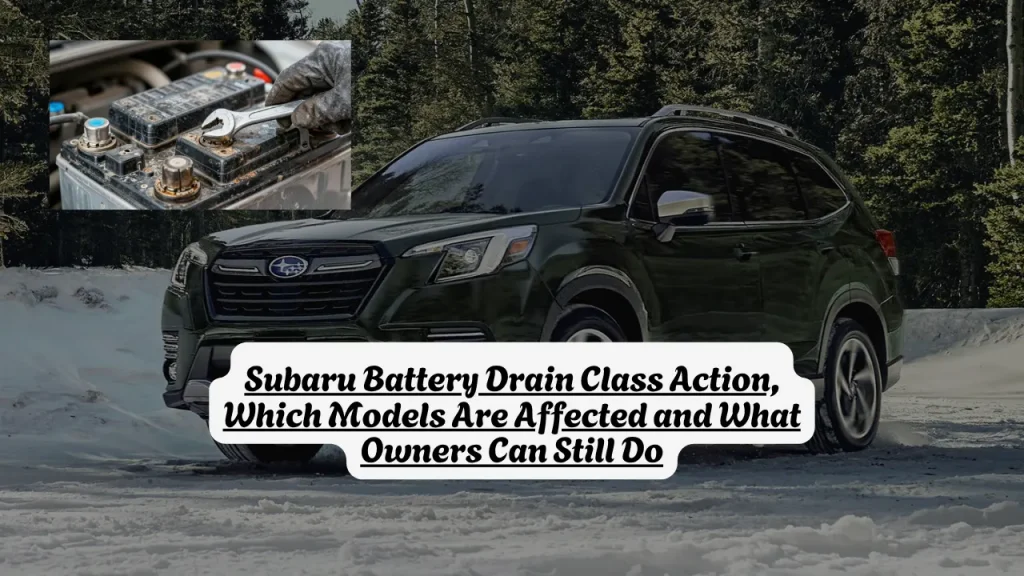
Subaru Battery Drain Class Action, Which Models Are Affected and What Owners Can Still Do
If your Subaru has left you stranded with a dead battery — sometimes more than once — you are not alone. Subaru vehicles have faced allegations of defective electrical systems that cause premature battery draining, with the defect allegedly stemming from insufficient battery capacity that fails to support vehicle components when the vehicle is turned off.
There are two separate legal situations depending on which model year you own. Owners of 2015–2020 vehicles are covered under a finally approved class action settlement. Owners of 2021–2025 vehicles are the subject of an active new legal investigation that has not yet resulted in a filed lawsuit. Read the section that applies to your car.
Quick Facts: Subaru Battery Drain — Two Cases, Two Timelines
| Field | 2015–2020 Models (Settled) | 2021–2025 Models (Under Investigation) |
| Case Name | In re Subaru Battery Drain Products Liability Litigation | TBD — investigation phase only |
| Case Number | No. 1:20-cv-03095-JHR-MJS | TBD — no complaint filed yet |
| Court | U.S. District Court, District of New Jersey | TBD |
| Defendant | Subaru of America, Inc. | Subaru of America, Inc. |
| Alleged Violation | Product defect; breach of warranty | Product defect; breach of warranty (alleged) |
| Models Affected | 2015–2020 Outback, Forester, Legacy, WRX; 2019–2020 Ascent | 2021–2025 Ascent, Outback, Forester, Legacy |
| Settlement Status | Finally Approved — January 25, 2023 | No lawsuit filed — investigation active |
| Cash Claim Deadline | Closed — May 8, 2023 | TBD — no claim form exists yet |
| Extended Warranty | Still active — contact administrator | TBD — pending any lawsuit and settlement |
| Administrator | JND Legal Administration | TBD |
| Administrator Contact | 1-855-606-2625 or [email protected] | TBD |
| Last Updated | May 7, 2026 | May 7, 2026 |
What Is the Subaru Battery Drain Lawsuit About? In re Subaru Battery Drain Products Liability Litigation, No. 1:20-cv-03095-JHR-MJS
The problem has a name: parasitic drain. The batteries in these Subaru vehicles are subject to a continuous parasitic drain allegedly caused by the Controller Area Network (CAN) system, which is designed to let components like electronic units, microcontrollers, sensors, and actuators communicate without a host computer — but allegedly fails to enter sleep mode when the vehicle is turned off, continuing to draw power from the battery even when the car is parked.
When the battery is replaced with the same or similar model, the defect allegedly continues. Plaintiffs argued that Subaru was aware of the defect for years due to online consumer complaints and an internal service bulletin, yet failed to warn customers.
Several class action lawsuits, including Dalen v. Subaru and Tomasian v. Subaru, were consolidated into the Subaru Battery Drain Products Liability Litigation. On January 25, 2023, Judge Joseph H. Rodriguez ruled the deal fair, reasonable, and adequate, granting final approval and approving $4.1 million in attorneys’ fees and expenses. The settlement also included a software update designed to improve the on-board computer’s charging logic.
If you own a 2021–2025 model, the same alleged defect — undersized batteries combined with electrical drain after the vehicle powers off — is now the basis of a new legal investigation. For comparison, the Hyundai engine class action settlement followed a similar path: years of consumer complaints, internal bulletins, and a finally approved settlement that included extended warranty coverage for affected owners.
Are You Part of the 2015–2020 Subaru Settlement? Extended Warranty Benefits Are Still Active
The cash claim deadline closed on May 8, 2023. But that does not mean your options are gone — the extended warranty is still running for qualifying battery failures.
You were part of the settlement class if:
- You currently own or previously owned or leased one of these vehicles in the U.S. (including Alaska and Hawaii):
- 2015–2020 Subaru Outback
- 2015–2020 Subaru Forester
- 2015–2020 Subaru Legacy
- 2015–2020 Subaru WRX
- 2019–2020 Subaru Ascent
You are likely NOT included if:
- Your vehicle is a 2021 or newer model — those are covered by the separate new investigation
- You owned a different Subaru model not listed above
What extended warranty coverage still applies:
For first battery replacements, the extended warranty covers 100% of battery replacement costs up to five years or 60,000 miles from the vehicle’s in-service date, or 50% of the battery replacement cost for vehicles that have exceeded those benchmarks.
Related article: $8.7M CRA Data Breach Class Action Settlement, 47,000 Canadians May Qualify for Up to $5,000
After five years or 60,000 miles, the extended warranty covers 80% of replacement costs for up to seven years or 84,000 miles, and 60% of replacement costs for up to eight years or 100,000 miles.
Settlement class members can still call 1-855-606-2625 or email [email protected] to get information on qualifying battery events or instruction on which forms are needed to obtain extended warranty service. All battery service must be performed by an authorized Subaru dealership, and you need an authorization code from the settlement administrator before going in — call ahead.
For a broader understanding of how class action settlement notices work and what your rights are once a settlement is finally approved, our guide to understanding a legal notice of class action settlement explains the process from approval through payment.
Are You Part of the New Subaru Battery Investigation? 2021–2025 Models
If you own a newer Subaru, the legal situation is different — and earlier. No lawsuit has been filed yet.
The law firm Sauder Schelkopf is investigating a class action lawsuit on behalf of owners of Subaru Ascent, Outback, Forester, and Legacy vehicles (model years 2021–2025) that are prone to premature battery failure. The allegation is that the batteries in these vehicles may not only be undersized, but that these vehicles also have a defect resulting in a constant electrical drain on the battery after the vehicle is turned off. As a result, these batteries may suffer premature failure and require early replacement. Unfortunately, customers are often forced to pay out of pocket for these battery replacements even when the vehicles are still under warranty.
The investigation was publicly announced in March 2026. No complaint has been filed in court as of the date of this article, and no settlement, claim form, or claim deadline exists. This is the stage that comes before a lawsuit — attorneys are gathering affected owners and building the case.
You may be part of the future class if:
- You currently own or lease a 2021, 2022, 2023, 2024, or 2025 Subaru Ascent, Outback, Forester, or Legacy
- You have experienced premature battery failure or repeated dead batteries during normal use
- You were charged out of pocket for a battery replacement on a vehicle still under warranty
You are likely NOT included if:
- Your vehicle is a 2020 or older model — those are under the prior settled case
- Your battery failure was caused by a modification you made to the electrical system
What Should You Do If Your Subaru Battery Keeps Dying?
If you own a 2015–2020 model:
- Contact the settlement administrator directly at 1-855-606-2625 or [email protected] before visiting a dealer. You need an authorization code first — going in without one can result in you being charged.
- Bring your vehicle only to an authorized Subaru dealership for battery service under the extended warranty.
- Save every receipt and service record. If extended warranty coverage is denied, you will need documentation to appeal.
- If you believe you were wrongly denied coverage, consulting a consumer rights lawyer costs nothing upfront — most work on contingency.
If you own a 2021–2025 model:
- Document every battery failure. Note the date, mileage, and what you were charged.
- Keep every repair receipt, dealer invoice, and any correspondence with Subaru or the dealership.
- Contact Sauder Schelkopf through their investigation page to register your experience — attorneys need affected owners to build a viable defective product lawsuit.
- Do not wait for a lawsuit to be filed before saving records. Courts often set class periods based on when owners first experienced problems.
- Most importantly: do not assume your battery issue is normal wear. If your Subaru battery is failing before the vehicle reaches five years old or 60,000 miles, that is premature failure worth documenting.
Subaru Battery Drain Lawsuit Timeline
| Milestone | Date |
| First Battery Drain Complaints Reported | As early as 2015 |
| Subaru Issues Internal Technical Service Bulletins | 2017 |
| First Class Action Filed (Dalen v. Subaru) | April 2020 |
| Second Class Action Filed (Tomasian v. Subaru) | 2021 |
| Cases Consolidated in District of New Jersey | 2021–2022 |
| Final Approval Hearing | January 24, 2023 |
| Final Approval Granted by Judge Rodriguez | January 25, 2023 |
| Cash Claim Deadline (CLOSED) | May 8, 2023 |
| Extended Warranty — Ongoing for Qualifying 2015–2020 Owners | Active |
| New Investigation Opened (2021–2025 Models) | March 2026 |
| New Lawsuit Filed | TBD — investigation stage |
| Next Court Hearing (2021–2025 case) | TBD — no complaint filed yet |
Frequently Asked Questions
Is there a class action lawsuit against Subaru for battery problems?
Yes — two situations. The original case, In re Subaru Battery Drain Products Liability Litigation, received final court approval on January 25, 2023, covering 2015–2020 models. A separate class action investigation targeting 2021–2025 Ascent, Outback, Forester, and Legacy models opened in March 2026 — no lawsuit has been filed yet in that case.
Do I need to do anything right now to be included in the 2021–2025 investigation?
No formal action is required yet because no lawsuit exists. However, you should document every battery failure, keep receipts for out-of-pocket battery replacements, and contact Sauder Schelkopf to register your experience. Your records now could determine your recovery later.
Is the Subaru battery extended warranty still active for my 2015–2020 vehicle?
Yes, for qualifying battery failures. Settlement class members can still call 1-855-606-2625 or email [email protected] to get information on qualifying battery events or instruction on which forms are needed to obtain extended warranty service. The cash reimbursement claim deadline passed in May 2023, but warranty coverage for new battery failures continues under the settlement terms.
When will a settlement be reached in the 2021–2025 Subaru battery case?
TBD — no lawsuit has been filed yet as of May 2026. The investigation stage typically takes several months to a year before a complaint is filed, and class action cases then take one to three years to reach a settlement from filing. No timeline has been announced.
Can I file my own lawsuit against Subaru instead of joining the class action?
You can consult a product liability attorney about an individual claim, especially if your out-of-pocket losses are significant. Most attorneys handling defective product cases work on contingency — no upfront fees. Individual claims can sometimes recover more than class settlements depending on the specific facts.
How will I know if a new Subaru battery lawsuit is filed for 2021–2025 models?
Monitor the Sauder Schelkopf investigation page and check this article for updates. When a complaint is filed in federal court, it becomes public record on PACER. The case will be assigned a docket number at that point, and class members will eventually receive formal notice if a class is certified.
Why didn’t the 2015–2020 settlement fix the problem for newer models?
The settlement included a software update designed to improve the on-board computer’s charging logic, but owner complaints from 2021 and newer vehicles suggest the underlying design issue — undersized batteries combined with parasitic electrical drain — was not fully resolved in subsequent model years. Attorneys investigating the newer models allege the same core defect persists.
Will a future Subaru battery settlement affect my taxes?
Small consumer settlements tied to reimbursement of out-of-pocket repair costs are generally treated as a return of what you overpaid rather than income. However, tax treatment depends on how the settlement categorizes payments and your individual situation. Consult a tax professional once any settlement is announced.
Sources & References
- Court Docket: In re Subaru Battery Drain Products Liability Litigation, No. 1:20-cv-03095-JHR-MJS, U.S. District Court, District of New Jersey — publicly accessible via PACER
- Official Settlement Website: SubaruBatterySettlement.com
- Settlement Administrator: JND Legal Administration, 1-855-606-2625 or [email protected]
- Bloomberg Law: Subaru Battery Drain Class Settlement Gets Final Approval — January 25, 2023
Prepared by the AllAboutLawyer.com Editorial Team and reviewed for factual accuracy against the official settlement website (SubaruBatterySettlement.com), the court record (Case No. 1:20-cv-03095-JHR-MJS), Bloomberg Law’s final approval report, and Sauder Schelkopf’s published investigation announcement on May 7, 2026. Last Updated: May 7, 2026
Disclaimer: This article is for informational purposes only and does not constitute legal advice. Legal claims and outcomes depend on specific facts and applicable law. For advice regarding a particular situation, consult a qualified attorney.
About the Author
Sarah Klein, JD, is a licensed attorney and legal content strategist with over 12 years of experience across civil, criminal, family, and regulatory law. At All About Lawyer, she covers a wide range of legal topics — from high-profile lawsuits and courtroom stories to state traffic laws and everyday legal questions — all with a focus on accuracy, clarity, and public understanding.
Her writing blends real legal insight with plain-English explanations, helping readers stay informed and legally aware.
Read more about Sarah