
Shane Huffman Lawsuit, Hunter Sues South Carolina DNR Over Deer Decoy Arrest, Seized Truck and Dismissed Night Hunting Charge
Timothy Shane Huffman, a South Carolina hunter, is suing the South Carolina Department of Natural Resources (SCDNR). He says wildlife officers arrested him without probable cause and took his truck and hunting gear after he stopped to look at a fake deer through binoculars.
The arrest happened on November 15, 2024, during an SCDNR deer-decoy operation on Cox Mill Road near Taylors in Greenville County. Huffman says he never shined a light on the decoy, never fired a weapon and never touched his rifle. Officers arrested him for night hunting, booked him into the Greenville County Detention Center and seized his truck and equipment. His complaint says he was told he would have to pay $2,500 to get the truck back.
Prosecutors dismissed the night hunting charge on March 7, 2025, for insufficient evidence. Huffman then filed a civil lawsuit alleging false arrest and imprisonment, malicious prosecution, defamation and negligence. SCDNR denies the allegations.
The civil case was moved from Richland County to Greenville County on April 21, 2026. No final verdict or publicly confirmed settlement was identified in the records reviewed as of November 13, 2026. These are Huffman’s allegations, and no court has found SCDNR or any officer liable.
Shane Huffman Lawsuit Against SCDNR: Quick Facts
| Detail | Information |
| Plaintiff | Timothy Shane Huffman |
| Defendant | South Carolina Department of Natural Resources (SCDNR) |
| Officers named in the complaint | Patrol Officer Robert Thomas and Lance Corporal Zach Tatum |
| Incident date | November 15, 2024 |
| Location | Cox Mill Road, Taylors, Greenville County, South Carolina |
| Original charge | Unlawful night hunting |
| Criminal outcome | Dismissed March 7, 2025 (“insufficient evidence,” per the public index) |
| Civil complaint filed | October 8, 2025, Richland County Court of Common Pleas |
| Original case number | 2025-CP-40-06930 |
| Current case number | 2026-CP-23-02597 (Greenville County, after April 21, 2026 transfer) |
| Plaintiff’s attorneys | Lori S. Murray and Patrick McLaughlin |
| Claims | False arrest and imprisonment, malicious prosecution, defamation, negligence and gross negligence |
| Damages sought | Unspecified compensatory damages |
| Latest verified step | Protective-order motion by SCDNR listed for July 13, 2026 hearing; outcome not confirmed |
| Final judgment or settlement | None verified |
| Class action or claim form | None; this is an individual lawsuit |
What Happened to Shane Huffman During the SCDNR Deer Decoy Sting?
According to the complaint, Huffman had hunted earlier that evening and was driving with his girlfriend after picking up dinner. He saw what looked like a deer in a field beside Cox Mill Road, stopped his truck, backed up a little and looked at it through binoculars. His lawyers say he recognized it as a decoy and drove on.
Officers Thomas and Tatum were running the sting. The complaint and news reports say Thomas acknowledged, while calling for backup, that Huffman had not shined any light on the decoy, and that he said he would stop him anyway. Reports also say Huffman’s headlights pointed down the road while the decoy sat off to the side in the field.
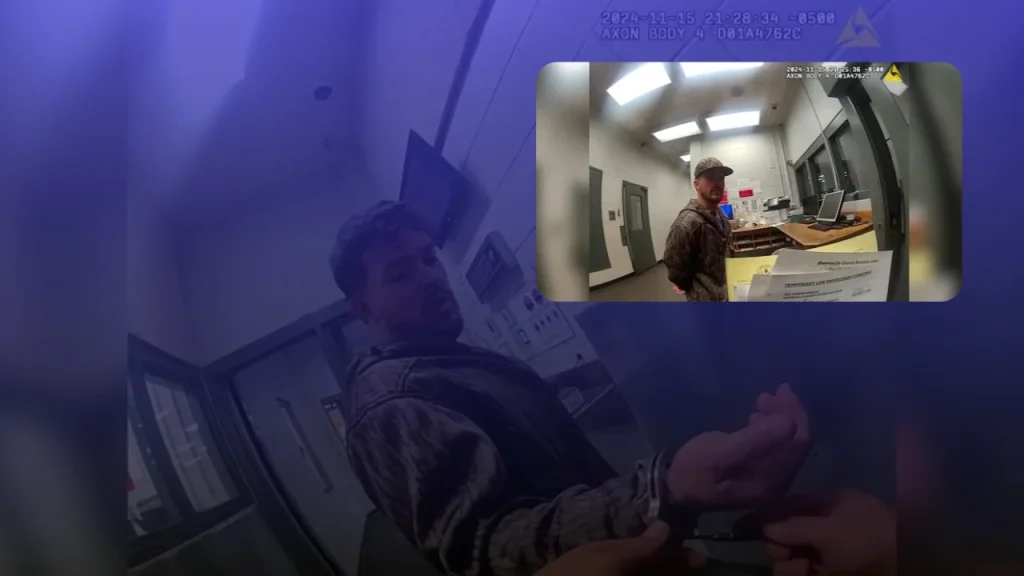
Officers pulled Huffman over, searched him and his truck, and found a rifle and thermal optics. Huffman said he planned to hunt coyotes later that night. He says the rifle stayed untouched and only the binoculars were in his lap when he was stopped. Thomas arrested him on a night hunting charge and took him to the Greenville County Detention Center, where, according to a SCDNR photo cited in reporting, he was handcuffed for booking.
Whether the officers had other lawful grounds for the stop, arrest and seizure is the core dispute.
What Does the Body-Camera Footage Show in the Huffman Case?
Body-camera video is central to the complaint. The footage became public in early 2026. The allegations include:
- No light before the stop. Thomas is recorded acknowledging that Huffman did not shine a light on the decoy before he decided to stop him.
- Interest in the truck. Officers are alleged to have talked about the truck being new and about having it towed. Huffman’s lawyers say this shows an improper motive.
- Camera muting. The complaint alleges officers muted or deactivated body cameras during part of the encounter and warned each other when recording was on.
These comments and actions do not on their own prove the arrest was made to get the truck. A court would weigh the full recordings, testimony, the statutes and the officers’ explanations. SCDNR has said the news coverage did not tell the full story and that the evidence should be sorted out in court.
Why Was Shane Huffman’s Night Hunting Charge Dismissed?
Huffman’s attorney, Lori Murray, reviewed the video and raised the lack of light with prosecutors. Greenville County court records show the charge was dismissed on March 7, 2025, for “insufficient evidence.”
A dismissal means Huffman was not convicted. It does not automatically prove false arrest or malicious prosecution. Those claims have to be proven separately in the civil case.
Is It Illegal to Look at a Deer Through Binoculars in South Carolina?
Looking at a deer through binoculars is not hunting. Whether conduct amounts to unlawful night hunting depends on the statute and the evidence.
What does S.C. Code § 50-11-705 say about night hunting?
S.C. Code § 50-11-705 prohibits hunting deer, bear and turkey at night except where the law allows it. Subsection (E) sets a rule of evidence: displaying or using artificial light at night in a way that could reveal deer, bear or turkey, while having a firearm and ammunition within immediate reach, is prima facie evidence of unlawful night hunting.
Huffman’s lawyers say the missing element is the light. But that rule creates a presumption. It does not necessarily mean prosecutors must prove a spotlight in every case, so a court would ask what the officers knew at the time.
Can a hunter legally have a rifle and thermal optics in a truck at night in South Carolina?
Having the equipment is not proof of deer hunting. S.C. Code § 50-11-715 separately allows night hunting of coyotes, feral hogs and armadillos with certain firearms, lights and night-vision devices under conditions such as property rules and landowner permission. Huffman says he meant to hunt coyotes. Equipment that is lawful for one purpose does not give unlimited permission to use it anywhere, so the question is whether his actual conduct gave officers reasonable suspicion for the stop and probable cause for the arrest.
Could SCDNR Legally Seize and Keep Huffman’s Truck Under South Carolina Law?
South Carolina allows seizure and forfeiture of property used in qualifying night hunting violations. S.C. Code § 50-11-740 covers vehicles, firearms and other items used in unlawful night hunting of deer, bear or turkey, and sets forfeiture procedures. A separate provision, § 50-11-745, addresses release of seized property in some cases.
The question is whether the truck was lawfully subject to seizure at all. Huffman says officers misrepresented what he had to pay to get it back. A release process in the statute does not settle whether the original seizure or the $2,500 payment was proper.
Federal law also limits forfeiture:
- Fourth Amendment. Seizures must be reasonable.
- Timbs v. Indiana (2019). The Excessive Fines Clause applies to state and local forfeitures.
- Culley v. Marshall (2024). The Supreme Court held that due process does not require a separate preliminary hearing on a vehicle’s retention before the forfeiture hearing, though timely forfeiture proceedings are still required.
What Is Shane Huffman Suing SCDNR For Under South Carolina Law?
The complaint asserts four types of state-law claims.
Does Huffman have a false arrest and false imprisonment claim against SCDNR?
He alleges officers restrained him without lawful justification. In South Carolina, false imprisonment generally requires an intentional, unlawful restraint of a person. The question is whether the officers had legal authority to arrest, not just whether prosecutors later dropped the charge.
Does Huffman have a malicious prosecution claim against SCDNR?
South Carolina law generally requires the plaintiff to show that the defendant started the prosecution, that it ended in the plaintiff’s favor, that there was malice, that there was no probable cause and that the plaintiff was injured. See Parrott v. Plowden Motor Co. (S.C. 1965). A dismissal helps on one element but does not prove the rest.
Does Huffman have a defamation claim against SCDNR officers?
Huffman alleges officers falsely told others, including a tow-truck driver and family members, that he committed a crime. Falsely accusing someone of a crime can be defamation, but the outcome depends on the exact words, whether they were false and any privileges that apply.
Does Huffman have a negligence claim against SCDNR for training and supervision?
He alleges SCDNR failed to train, supervise and control its officers on the night hunting statute and on seizures. The complaint seeks damages for emotional distress, reputational harm, humiliation, defense costs and other losses.
What Do Probable Cause and Reasonable Suspicion Mean in the Huffman Arrest?
- Reasonable suspicion lets an officer briefly stop someone based on specific facts suggesting wrongdoing (Terry v. Ohio, 1968).
- Probable cause is the higher standard needed to arrest. It looks at whether the facts and circumstances would lead a reasonable officer to believe a crime was committed (Illinois v. Gates, 1983).
- Officer motive. Under Whren v. United States (1996), an officer’s subjective motive generally does not decide whether a stop or arrest was reasonable under the Fourth Amendment, which is why SCDNR may argue that the truck comments do not matter if the stop was otherwise justified.
- Different offense. Under Devenpeck v. Alford (2004), an arrest can be valid if probable cause existed for some offense, even one the officer did not name. SCDNR may rely on this.
- Mistakes of law. In Heien v. North Carolina (2014), the Supreme Court held that an officer’s objectively reasonable mistake about the law can still support reasonable suspicion.
These standards cut both ways, which is why this case turns on what the officers knew and saw, not only on how it looks on video.
What Has the Greenville County Court Done in Huffman v. SCDNR So Far?
Based on court records cited in research and reporting:
- October 8, 2025: Huffman files his complaint in Richland County Common Pleas Court.
- November 14, 2025: SCDNR files an answer denying the allegations and asks to move the case to Greenville County.
- December 29, 2025: Huffman’s lawyers file a motion to compel, arguing SCDNR’s discovery responses were inadequate and its privilege claims improper.
- February to March 2026: The parties file more motions about discovery, public statements and venue.
- April 21, 2026: The court transfers the case to Greenville County, under No. 2026-CP-23-02597.
- May 22, 2026: SCDNR files a motion for a protective order.
- July 13, 2026: The Greenville County roster lists that motion for hearing before Judge Vernon F. Dunbar. The records reviewed do not show how the court ruled.
Some earlier reports still describe the case as pending in Richland County. That is out of date because of the April 2026 transfer. The case can be checked on the Greenville County Public Index using case number 2026CP2302597.
How Much Money Could Shane Huffman Recover From SCDNR?
A recovery is possible but not guaranteed. Because SCDNR is a state agency, the South Carolina Tort Claims Act (S.C. Code Title 15, Chapter 78) governs the case.
- Proper defendant. The Act generally makes the agency, not the individual officers, the defendant for torts committed within the scope of official duties (§ 15-78-70). An employee can lose that protection if the conduct involved actual malice, intent to harm or a crime involving moral turpitude, which is why the allegations about motive matter.
- Damage limits. § 15-78-120 generally caps recovery at $300,000 per person and $600,000 per occurrence, and excludes punitive damages and prejudgment interest, with limited exceptions.
- Immunity defenses. The Act lists exceptions to the waiver of immunity (§ 15-78-60), including discretionary government acts, which SCDNR could raise.
- Deadline. Claims generally must be brought within two years of when the loss was or should have been discovered (§ 15-78-110), with an outside limit.
Huffman’s complaint asks for unspecified compensatory damages and a jury trial. No dollar demand appears in the complaint.
Could Shane Huffman also file a federal civil rights claim under 42 U.S.C. § 1983?
42 U.S.C. § 1983 lets people sue state officials who violate their constitutional rights while acting under color of state law. The complaint reviewed is a state-court tort suit against SCDNR, not a federal § 1983 damages action against the officers. A state agency is not a “person” under § 1983 (Will v. Michigan Department of State Police, 1989), and sovereign immunity under the Eleventh Amendment limits federal damages claims against the state.
For a separate case involving a police detention and federal civil rights claims, see James Hodges Lawsuit, Blind Navy Veteran Arrested for Carrying a Cane.
What Should People Do After an Arrest Without Probable Cause?
If you believe you were arrested or had property seized without legal grounds:
- Save video, court papers, receipts, messages and proof of financial losses.
- Do not rely on a dismissal alone to prove a civil claim.
- Check deadlines early, since claims against a government agency have strict time limits and procedures.
- Talk to a licensed civil rights or criminal defense attorney in your state.
Other cases involving dismissed charges and disputed police conduct include Levi Trumbull Lawsuit Update, Sober Driver Arrested for DUI, Then Charges Dropped, The Levi Trumbull Case and William McNeil Jr. Lawsuit, $100K Federal Case Against Jacksonville Officers After Viral Traffic Stop Beating. Those cases have different facts and do not decide Huffman’s case.
Frequently Asked Questions About the Shane Huffman Lawsuit
Why was Shane Huffman arrested?
SCDNR officers arrested him for night hunting during a deer-decoy operation on November 15, 2024. Huffman says he only looked at the decoy through binoculars.
Did Shane Huffman shoot the fake deer?
No. The complaint says he never fired or touched his rifle while stopped, and reports say he used only binoculars.
Were Shane Huffman’s night hunting charges dropped?
Yes. Prosecutors dismissed the charge on March 7, 2025, for insufficient evidence, according to Greenville County court records.
Who are the SCDNR officers in the Huffman lawsuit?
The complaint names Patrol Officer Robert Thomas and Lance Corporal Zach Tatum. The named defendant in the civil case is SCDNR.
Did Shane Huffman get his truck back?
The complaint describes a $2,500 payment demand to recover it. The release records would be needed to confirm all the terms.
Where is the Shane Huffman lawsuit being heard?
It was filed in Richland County and transferred to Greenville County on April 21, 2026.
Is Shane Huffman suing for $1 million?
No $1 million demand appears in the complaint. It seeks unspecified compensatory damages.
Has Shane Huffman won his lawsuit?
No final judgment or settlement was identified as of November 13, 2026.
Is there a Shane Huffman class action or settlement fund?
No. It is an individual lawsuit with no claim form for other hunters.
Is this the same Shane Huffman as the racing driver?
No. Other people share the name, including a former NASCAR and ARCA driver and crew chief. They are not connected to this wildlife enforcement case.
Bottom Line: Where the Shane Huffman v. SCDNR Lawsuit Stands
Shane Huffman’s lawsuit asks whether SCDNR officers had probable cause to arrest him and lawful grounds to seize his truck when, by his account and the body-camera footage described in his complaint, he never used a light or touched a weapon. The criminal charge was dismissed in March 2025, and the civil case moved to Greenville County in April 2026.
The key question is probable cause. Huffman’s lawyers say the video undercuts the arrest. SCDNR says the full record matters. Until a court rules, the allegations are unproven, and a new ruling, trial date or settlement would change the status.
Primary sources and court records
- Huffman v. SCDNR: October 8, 2025 Civil Complaint (PDF)
- Greenville County Official Court Roster, July 13, 2026
- Greenville County Public Index
- South Carolina Code, Title 50, Chapter 11: Night Hunting and Forfeiture
- South Carolina Tort Claims Act, Title 15, Chapter 78
News reporting
- Outdoor Life: Hunter sues South Carolina DNR over wrongful arrest
- WBTW: Greenville County night hunting case coverage
- WSPA: Huffman lawsuit coverage
Disclaimer: AllAboutLawyer.com provides general legal information, not legal advice. Allegations in a civil complaint are not court findings.
Researched and written by Israr Ahmad, legal content researcher and founder of AllAboutLawyer.com. All facts verified against the filed civil complaint, Greenville County court records, South Carolina statutes and published news reports, as of November 13, 2026. Last Updated: November 13, 2026.
About the Author
Israr Ahmad is a legal content researcher with 4+ years of experience covering class action settlements and consumer rights cases. He has researched and published coverage of 2,500+ settlements using verified court records, settlement administrator filings, and government sources. Learn more about Israr.