
Return to the Land Arkansas Lawsuit, A “Whites-Only” Community Faces Federal Civil Rights Claims
A lawsuit filed in the U.S. District Court for the Eastern District of Arkansas accuses Return to the Land, a whites-only community in Lawrence County, of violating the Fair Housing Act by refusing to sell property to a woman based on her race and religion. The plaintiff, Michelle Walker, is a woman of Jewish ancestry who is married to a Black man and has biracial children. She is seeking unspecified damages, including punitive damages. The case landed in federal court on May 20, 2026, and is assigned to District Judge D. Price Marshall.
Quick Facts: Return to the Land Fair Housing Discrimination Lawsuit
| Field | Detail |
| Lawsuit Filed | May 20, 2026 |
| Defendant | Return to the Land; its Ozarks Chapter; co-founders Eric Orwoll, Peter Csere, Gavin Baker, Peter Neugebauer, Scott Hallowood; and Wisdom Woods LLC |
| Alleged Violation | Federal Fair Housing Act; Arkansas Fair Housing Act; federal and state civil rights laws |
| Who Is Affected | Anyone denied the right to purchase land or housing at Return to the Land communities based on race, religion, ancestry, or family composition |
| Current Court Stage | Active litigation — complaint filed, pre-answer stage |
| Court & Jurisdiction | U.S. District Court, Eastern District of Arkansas — assigned to Judge D. Price Marshall |
| Plaintiff’s Legal Team | Relman Colfax PLLC (Washington, D.C.); NAACP Legal Defense Fund; Legal Aid of Arkansas |
| Next Hearing Date | TBD — scheduling order not yet issued |
| Official Case Website | TBD — no official case site released |
| Last Updated | May 21, 2026 |
What Is the Return to the Land Lawsuit About?
The complaint alleges Return to the Land is “attempting to create an all-white nation within the United States by building smaller settlements that exclude anyone who isn’t a white, Christian, heterosexual homebuyer.” The lawsuit names the Fair Housing Act (42 U.S.C. § 3604) and its Arkansas state equivalent as the specific laws the organization violated — both of which flatly prohibit refusing to sell property based on race, color, national origin, or religion.
Walker, a real estate broker who lives in St. Louis, applied to buy land in the town of Ravenden, Arkansas in 2025 because of its below-market price. When she applied to purchase land in the community, she encountered a series of questions about her ancestry and religion and that of her husband and children, which she understood as violating federal and state fair housing laws. The application also asked potential members about their views on immigration, what the organization calls “transgenderism,” and segregation.
Shortly after completing the application, a Return to the Land member interviewed her and asked whether she belonged to “any other white nationalist organizations.” A month later, she was told she should not expect her application to be approved. This denial sits at the core of the housing discrimination lawsuit. Anyone who has faced similar barriers purchasing land or property can speak with a consumer rights lawyer for a free legal consultation — AllAboutLawyer.com’s coverage of the PayPal class action lawsuit illustrates how civil rights and consumer protection claims can overlap when organizations use gatekeeping systems to exclude people.
Are You Part of This Housing Discrimination Case?
This is not a class action — it is a civil rights lawsuit filed on behalf of Michelle Walker individually. But the legal claims could extend to others if the court determines a pattern of discrimination exists across Return to the Land’s multiple chapters.
You may have a related claim if you:
- Applied to purchase land or housing at any Return to the Land community and were rejected based on race, religion, ancestry, national origin, or family composition
- Were asked discriminatory questions about your heritage, religion, spouse, or children during a housing application with Return to the Land or any of its affiliated chapters
- Were told — explicitly or implicitly — that your application would not be approved because of who you are or who you are married to
You are likely not directly affected if:
- You have never applied to purchase land or housing from Return to the Land or its affiliated organizations
- You were denied for reasons unrelated to race, religion, or protected characteristics under the Fair Housing Act
Related article: AppLovin Privacy Collective Illegal Tracking Dutch Class Action Lawsuit, Millions of Dutch Users Tracked Without Consent Are You Affected?
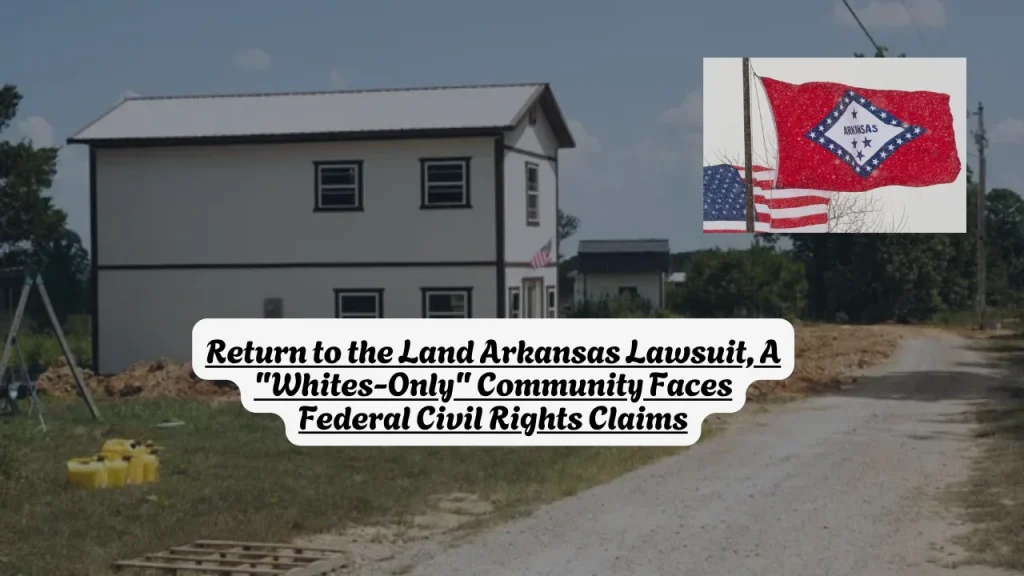
Return to the Land promotes itself as a private membership association “for individuals and families with traditional views and common continental ancestry.” Beyond its Ozarks Regional Chapter covering parts of Arkansas, Missouri, and eastern Oklahoma, the organization says it has chapters around the United States. If you were rejected by any of those chapters under similar circumstances, this lawsuit’s legal arguments may be relevant to your situation. Families dealing with housing and civil rights issues may also find context in AllAboutLawyer.com’s coverage of the 23andMe class action lawsuit for how federal civil rights protections interact with private organizations.
What Are the Plaintiffs Seeking in the Return to the Land Case?
The lawsuit seeks to stop Return to the Land’s discriminatory housing practices and obtain relief for violations of federal and state civil rights laws. Specifically, Walker’s legal team is pursuing compensatory damages, punitive damages, and injunctive relief — meaning a court order requiring Return to the Land to stop using race and religion as criteria for land sales.
Relman Colfax partner John Relman stated the lawsuit “sends the message to Return to the Land and any other white separatist organizations seeking to perpetuate segregation — the rule of law remains intact.” NAACP Legal Defense Fund senior counsel Jason Bailey added that a community grounded in excluding people based on race and religion “cannot be squared with the Fair Housing Act and other civil rights laws that have been in place for decades.”
No specific dollar amount has been named in the complaint. The court will determine compensation for damages if liability is established. No settlement exists. No claim form is open. Anyone telling you otherwise is not working from verified sources.
What Should You Do If You Were Denied Housing by Return to the Land?
Right now, this case is in its earliest stage. Here is what you should do:
- Save all records. If you applied to Return to the Land — or any affiliated chapter — keep copies of your application, any correspondence, interview notes, and any rejection communication you received.
- Do not delete emails or messages. Any written exchange with Return to the Land or its representatives is potentially relevant evidence.
- Consult an employment discrimination attorney or housing rights lawyer. If you believe you were denied housing based on race, religion, or family composition, a free legal consultation with a civil rights attorney can help you understand your options. You may have an individual claim under the Fair Housing Act independent of Walker’s case.
- Contact Legal Aid of Arkansas if you are an Arkansas resident who was affected. They are actively involved in this litigation and can advise you on your rights.
- Monitor the case docket. The case is active in the U.S. District Court for the Eastern District of Arkansas before Judge D. Price Marshall. You can track filings at PACER (pacer.gov).
Return to the Land Discrimination Lawsuit Timeline
| Milestone | Date |
| Return to the Land Established in Ravenden, Arkansas | Prior to August 2025 |
| CNN Investigative Report on the Community | August 2025 |
| Michelle Walker Applies for Land Purchase | 2025 |
| Walker’s Application Effectively Rejected | 2025 |
| Lawsuit Filed in Eastern District of Arkansas | May 20, 2026 |
| Case Assigned to Judge D. Price Marshall | May 20, 2026 |
| Scheduling Order / Initial Hearing | TBD — not yet set by the court |
| Expected Resolution | TBD — civil rights cases of this complexity typically take 1–3 years |
Frequently Asked Questions
Is there a federal lawsuit against Return to the Land’s whites-only community in Arkansas?
Yes. The lawsuit was filed May 20, 2026, in the U.S. District Court for the Eastern District of Arkansas before Judge D. Price Marshall. It alleges violations of the federal Fair Housing Act and Arkansas civil rights laws. The plaintiffs are represented by Relman Colfax PLLC, the NAACP Legal Defense Fund, and Legal Aid of Arkansas.
Do I need to do anything right now to be included in this case?
This is not a class action, so there is no automatic inclusion. If you believe you were denied housing by Return to the Land based on race, religion, or protected characteristics, contact Legal Aid of Arkansas or a housing discrimination attorney to discuss whether you have an individual claim.
Is the Return to the Land community in Arkansas operating legally?
The executive director of Legal Aid of Arkansas stated plainly: “A whites-only community is illegal, discriminatory and unacceptable.” The Federal Fair Housing Act has prohibited race-based exclusions in property sales since 1968. The court has not yet ruled in this specific case.
Can Return to the Land argue it is a private club exempt from the Fair Housing Act?
The Fair Housing Act contains a narrow exemption for certain private clubs, but it does not extend to organizations that sell or rent properties to the public, even under a membership structure. The court will decide whether Return to the Land qualifies for any such exemption. Legal experts in this area generally view broadly marketed property developments as covered by the Act regardless of how they characterize their membership model.
When will the Return to the Land lawsuit be resolved?
TBD — the case was filed May 20, 2026, and is at the very beginning of litigation. Civil rights housing cases of this type typically take one to three years to reach a trial or settlement. No settlement discussions have been reported as of this writing.
Can I file my own lawsuit against Return to the Land if I was denied housing there?
Potentially yes. The Fair Housing Act gives individuals the right to file their own complaints with the U.S. Department of Housing and Urban Development (HUD) or file a private lawsuit in federal court within two years of the discriminatory act. A consumer rights lawyer familiar with fair housing claims can assess your specific situation.
How will I know if this case settles or results in a court order?
Court filings are publicly available through PACER at pacer.gov under the Eastern District of Arkansas docket. AllAboutLawyer.com will also update coverage of this case as it progresses.
Sources & References
- Arkansas Times — Lawsuit Filed Against Whites-Only Settlement in Northern Arkansas, May 20, 2026: https://arktimes.com/arkansas-blog/2026/05/20/lawsuit-filed-against-whites-only-settlement-in-northern-arkansas
- KARK / FOX 16 Arkansas — Federal Lawsuit Filed Against Whites-Only Community in Lawrence County, May 20, 2026: https://www.kark.com/news/arkansas-courts/federal-lawsuit-filed-against-whites-only-community-in-lawrence-county-alleging-federal-arkansas-law-violations/
- PACER / U.S. District Court, Eastern District of Arkansas — case assigned to Judge D. Price Marshall: https://www.pacer.gov
Prepared by the AllAboutLawyer.com Editorial Team and reviewed for factual accuracy against AP reporting, Arkansas Times, KARK, and court records on May 21, 2026. Last Updated: May 21, 2026
Disclaimer: This article is for informational purposes only and does not constitute legal advice. Legal claims and outcomes depend on specific facts and applicable law. For advice regarding a particular situation, consult a qualified attorney.
About the Author
Israr Ahmad is a legal content researcher with 4+ years of experience covering class action settlements and consumer rights cases. He has researched and published coverage of 2,500+ settlements using verified court records, settlement administrator filings, and government sources. Learn more about Israr.