
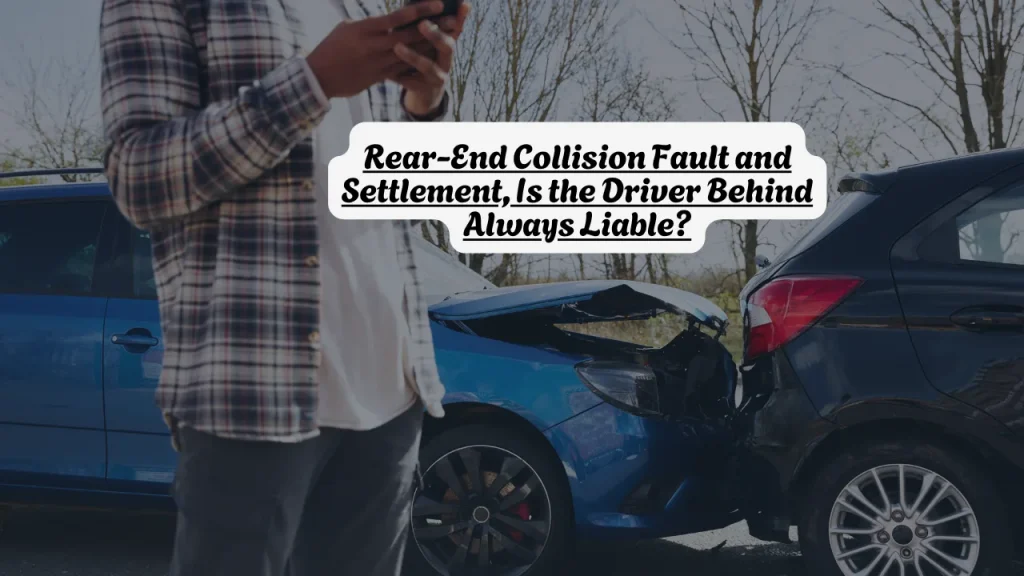
Rear-End Collision Fault and Settlement, Is the Driver Behind Always Liable?
You got hit from behind. Your neck hurts. Your car needs work. And now the insurance company is calling.
Most people assume rear-end crashes are open-and-shut cases — of course the driver who hit you was at fault. And most of the time, they are right. But insurers do not always see it that way. They challenge these claims constantly, and the details of your case determine whether you walk away with a fair settlement or far less than you deserve.
According to the National Highway Traffic Safety Administration (NHTSA), rear-end collisions are the most common type of car crash, accounting for approximately 29 percent of all automobile collisions. That means hundreds of thousands of people go through this exact situation every year. This article explains how fault is actually determined, what these settlements pay by injury type, and how long you can expect the whole process to take.
Who Is Legally at Fault in a Rear-End Collision — and Why the Answer Is Not Always Simple
The general rule is straightforward. In most rear-end accidents, the rear driver is presumed to be at fault. This is based on the fundamental traffic rule that every driver has a legal responsibility to maintain a safe following distance. When a driver fails to stop in time, it usually suggests they were distracted, driving too fast, following too closely, or not paying enough attention.
That presumption is powerful. In most states, it means the rear driver’s insurance starts the conversation already on defense.
But presumed is not the same as proven — and that gap matters more than most people realize.
There are exceptions where the lead vehicle shares some liability. If the vehicle in front slammed on their brakes suddenly and without cause, it may have contributed to the crash. A third party — such as a reckless driver who cut off the front vehicle and forced a sudden stop — may also share fault. Liability is determined based on all circumstances that contributed to the collision.
Whether you are the person who got hit or the person who did the hitting, the specific facts of your case determine how fault is split — and that directly determines how much you recover.
Five Situations Where the Driver in Front Bears Some or All of the Fault
The rear driver is not always solely responsible. Here are the situations where fault can shift — fully or partially — to the front driver.
Brake checking or deliberate sudden stops
Examples where the front driver can be liable include sudden, unnecessary stops in moving traffic without a clear reason, and brake checking or aggressive driving which can intentionally provoke a rear-end crash. If a driver slammed their brakes on purpose to intimidate you or as an act of road rage, that is not your fault.
Broken or non-functioning brake lights
If a front driver’s brake lights are not functioning properly, the rear driver may have no way of knowing when the vehicle ahead is about to stop. Vehicle maintenance is a legal responsibility, and drivers who fail to repair known issues such as broken brake lights can be held liable for accidents that result from their negligence.
Cutting off and stopping suddenly
If someone abruptly pulls in front of you and comes to a sudden stop at a green light, leaving you with no time to react, the fault would likely not be attributed to you as the rear driver.
Reversing unexpectedly
If a driver in a parking lot or at an intersection reversed into your vehicle, they caused the crash — not you. This is a clear case where the “rear-end presumption” does not apply.
Road hazards and third-party negligence
Potholes, road construction zones, and sudden detours can force drivers to brake abruptly, causing chain reaction collisions. When hazardous road conditions contribute to an accident, the city, municipality, or construction company responsible for maintaining safe roads may be held liable.
If any of these situations apply to your crash, a personal injury attorney can assess who actually bears responsibility — most offer a free consultation with no upfront cost.
Related article: Spinal Cord Injury Lawsuit, Settlements, Real Costs, and What Families Need to Know
What Rear-End Collision Settlements Actually Pay — Real Numbers by Injury Type
Settlement amounts in rear-end crashes vary enormously based on what was hurt and how badly. Here is what the data shows by injury category.
Minor injuries — whiplash and soft tissue damage
The average settlement payout for a whiplash injury in a car accident case is between $12,000 and $30,000, assuming no permanent impairments or complications. This amount can increase or decrease based on how the injury affects daily life and how long recovery takes.
Minor rear-end crashes involving soft tissue damage with full recovery typically settle in the $5,000 to $25,000 range.
Moderate injuries — herniated discs and back injuries requiring extended treatment
Settlements for lower back injuries from rear-end collisions typically range from $10,000 to $100,000 or more. Moderate injuries such as herniated discs requiring physical therapy or injections may fall in the $25,000 to $75,000 range.
A real example: a 34-year-old teacher who was rear-ended at a red light suffered two herniated discs requiring epidural injections and physical therapy. Medical expenses totaled $38,000, lost wages $12,000. Using a 3.5x multiplier, the total settlement reached $175,000 after 11 months of negotiations.
Severe injuries — spinal fractures, nerve damage, long-term disability
Severe neck injuries involving fractures, nerve damage, or long-term disability produce settlements ranging from $500,000 to $5 million or more. Cervical spine injury settlements often fall between $100,000 and $500,000, with permanent paralysis or significant spinal cord damage exceeding $1 million.
Another real example: a client who was rear-ended during heavy traffic on a freeway sustained a neck injury causing chronic pain and frequent migraines. The insurance company initially offered $23,400. After the attorney pushed back and took the case to trial, the final verdict reached $380,000.
That gap — $23,400 versus $380,000 — is what legal representation does in these cases.
What Drives Your Rear-End Settlement Amount Up or Down
Two people can be hit from behind on the same road at the same speed and settle for completely different amounts. Here is what determines which category your case lands in.
Injury severity and whether it is permanent
This is the biggest factor by far. A whiplash that resolved in four weeks is a different claim than a herniated disc requiring surgery and six months of physical therapy. Final settlement values are typically calculated by multiplying special damages — medical bills and lost wages — by a multiplier of 1.5 to 5 times, depending on injury severity, to account for pain and suffering.
How clearly fault is established
Even in rear-end cases, disputed fault reduces your settlement. If the insurer successfully argues you stopped suddenly without cause or had non-working brake lights, they reduce their payout offer. Dashcam footage, police reports, and witness statements are the best tools to lock in clear fault.
Whether you sought medical treatment immediately
Gaps in treatment are one of the first things insurance adjusters look for. If you waited two weeks to see a doctor, they will argue your injuries were not that serious or came from something else. Seek care the same day or the day after the accident — and keep attending every appointment.
Your lost income
Beyond medical costs, settlements account for lost wages and pain management treatment. If you missed significant time from work, those lost wages factor directly into both economic damages and the pain and suffering multiplier.
Insurance policy limits of the at-fault driver
Even a well-documented, serious injury claim can be capped by the other driver’s policy limits. Your attorney will investigate whether the driver carried only minimum liability coverage — and whether your own underinsured motorist coverage can fill the gap.
If the first settlement offer you received feels low, it almost certainly is. Insurers open with the minimum they think you will accept. A personal injury attorney handling rear-end accident cases can assess the real value of your claim and push back with documentation.
How Long a Rear-End Collision Settlement Takes — A Realistic Timeline
This is the question people ask most, and the honest answer is: it depends on how hurt you are and how the other side behaves.
Simple rear-end collisions with clear fault settle fastest, often within three to six months. Multi-vehicle accidents, commercial vehicle crashes, or cases with disputed liability extend timelines significantly.
Here is what the stages actually look like:
Weeks 1–4: Accident reporting and medical treatment File the insurance claim. See a doctor immediately and at every follow-up. Keep all records. Do not give a recorded statement to the other driver’s insurer without an attorney.
Months 1–3: Evidence gathering and investigation Your attorney collects the police report, photos, witness statements, dashcam footage, and your medical records. This stage takes longer when there is a dispute about fault.
Until MMI: Reach Maximum Medical Improvement Do not settle before your doctor says your condition has stabilized. If you settle too soon, you give up the right to claim costs for treatment you did not know you would need. This is the most critical thing to understand about timing.
Months 3–9: Demand letter and negotiations Negotiations with an insurance company typically take anywhere from one month to three months. Complex cases can take up to a year or longer. The insurer almost always opens low. Your attorney responds with documented economic and non-economic damages. Multiple rounds of offers and counteroffers are normal.
If no agreement: Litigation If negotiations fail and a lawsuit is filed, the timeline extends one to three or more years due to discovery, depositions, mediation, and possibly trial. Most cases settle before that — but having an attorney willing to file gives you real leverage.
After settlement is signed Once a settlement is reached, the check typically goes to your attorney’s trust account, where any medical liens, outstanding bills, and legal fees are paid before you receive your portion. Most people receive their funds within a 30-day window after signing.
What Insurance Adjusters Do to Reduce Rear-End Settlements — and How to Respond
Rear-end cases look clean from the outside. Inside the insurance process, they are fought over constantly. Here is what to expect.
They call you fast — before you know your full diagnosis. The goal is a recorded statement or a quick lowball offer before you understand what your injury actually costs. Do not speak to the other driver’s insurer without first talking to an attorney.
They dispute injury severity. Soft tissue injuries like whiplash do not show on X-rays. Adjusters use this to suggest exaggeration. Counter this with MRI results, physical therapy records, and a treating physician’s written opinion on the impact to your daily function.
They point to pre-existing conditions. Any history of neck or back issues becomes a target. Your attorney establishes what was pre-existing versus what the accident made worse or caused — a legal distinction called the “eggshell plaintiff” doctrine that protects you regardless of prior health.
They use delay as a financial pressure tactic. Bills accumulate while negotiations drag on. A contingency-fee attorney removes that pressure — they are paid only when you win, so you do not have to accept a low offer just to pay this month’s bills.
They challenge whether you needed all your treatment. Every doctor visit, every physical therapy session, and every specialist referral gets scrutinized. Follow your treatment plan exactly as prescribed and do not miss appointments.
Frequently Asked Questions About Rear-End Collision Fault and Settlements
How long do I have to file a rear-end collision lawsuit before losing my right to sue?
In most states, the statute of limitations for a personal injury claim is two years from the date of the accident. Some states allow three years. If the at-fault driver was a government employee or a government vehicle was involved, the deadline can be as short as six months. Missing this deadline permanently ends your right to compensation. Talk to a personal injury attorney as soon as possible after the crash.
How long does a rear-end collision settlement take from start to finish?
A rear-end collision settlement typically takes anywhere from two to three months for straightforward cases, and as long as six to eight months for more complex ones. Cases involving serious injuries, disputed fault, or litigation can take a year or more.
Is the driver in the rear always at fault in a rear-end crash — can I be blamed if I was hit from behind?
Not automatically. While the rear driver is presumed at fault, situations where the front driver can be held liable include sudden, unnecessary stops without clear reason, faulty brake lights, reversing into another vehicle, and brake checking. If any of those apply, fault may be shared or shifted entirely to the front driver.
What is the average settlement for a rear-end collision involving whiplash?
The average settlement payout for a whiplash injury in a car accident case is between $12,000 and $30,000 when there are no permanent impairments. Cases with longer recovery, ongoing pain, or permanent cervical damage settle for significantly more.
Do I need a lawyer for a rear-end collision, or can I handle it alone?
You can handle minor fender-benders with no injuries on your own. But if you were injured — even soft tissue injuries — an attorney changes the outcome. In one documented case, an attorney took a rear-end collision claim from an initial insurance offer of $23,400 to a final verdict of $380,000 after taking the case to trial. Most personal injury attorneys work on contingency — no fee unless you win.
Can I still recover compensation if I was partially at fault for the rear-end crash?
In most states, yes — under comparative negligence rules. In Texas, for example, you can recover as long as you are 50 percent or less at fault, with your compensation reduced by your fault percentage. Being 51 percent or more at fault bars recovery entirely. Rules vary by state. An attorney can tell you exactly which standard applies where your crash happened.
What if the driver who hit me had no insurance or not enough coverage?
Your own uninsured or underinsured motorist coverage steps in. Check your own policy — this coverage exists specifically for situations where the at-fault driver cannot pay what your case is worth. Your attorney will identify every available source of compensation.
What is the first thing I should do after a rear-end collision to protect my settlement?
Call the police and get a report. Photograph everything — all vehicles, all damage, the road, any skid marks, and traffic signals. See a doctor that day or the following morning even if you feel mostly fine. Whiplash and spinal injuries often worsen in the days after a crash. Document symptoms in writing from day one. Do not accept any offer or give any recorded statement until you have spoken to a personal injury attorney.
Legal Terms Used in Rear-End Collision Cases
Presumption of Fault: The legal starting assumption in rear-end crashes that the driver who hit from behind was negligent. It can be challenged with evidence but puts the burden of rebuttal on the rear driver.
Comparative Negligence: A rule in most states allowing both drivers to share fault. Your compensation is reduced by your percentage of responsibility. Some states bar recovery entirely if you are more than 50 percent at fault.
Economic Damages: Losses with a hard dollar value — medical bills, vehicle repair costs, and lost wages. The foundation of every rear-end settlement.
Non-Economic Damages: Losses without a receipt — pain, suffering, emotional distress, and loss of enjoyment of life. Calculated using a multiplier of 1.5 to 5 times your economic damages.
Maximum Medical Improvement (MMI): The point at which your doctor says your condition has stabilized. Settling before MMI risks leaving future medical costs on the table — costs you will have no legal right to recover later.
Contingency Fee: The arrangement where your personal injury attorney is paid only if you win — typically 33 to 40 percent of the final settlement. You pay nothing upfront.
Diminished Value Claim: Compensation for the loss in market value of your vehicle after it has been repaired. Even a quality repair leaves a record on the vehicle’s history. You can claim this separately from repair costs.
Statute of Limitations: The legal deadline to file your lawsuit. In most states, two years from the date of the accident for personal injury claims.
Brake Checking: Deliberately slamming brakes to intimidate or provoke the driver behind you. A form of aggressive driving that can shift fault to the front driver.
Underinsured Motorist Coverage: Your own insurance policy coverage that pays when the at-fault driver’s policy limits are not enough to cover your full damages.
You now know that fault in a rear-end crash is presumed but not guaranteed, that settlement values range from a few thousand dollars for minor whiplash to hundreds of thousands for serious spinal injuries, and that timing and documentation determine which end of that range you end up on.
If you were rear-ended and the insurance company’s first offer felt low, you are probably right. Visit AllAboutLawyer.com to connect with a personal injury attorney who handles rear-end collision cases. One free consultation can tell you what your case is actually worth.
If your rear-end crash left you with head injuries or lasting psychological effects, our guides on traumatic brain injury lawsuit settlements and emotional distress claims including PTSD explain how those damages are valued and claimed alongside your physical injury settlement.
Prepared by the AllAboutLawyer.com Editorial Team and reviewed for factual accuracy against NHTSA data, verified settlement records, and current legal sources. Last Updated: June 1, 2026.
This article is for informational purposes only and does not constitute legal advice. Laws vary by state and individual circumstances differ. For advice about your specific situation, consult a qualified attorney licensed in your state.