
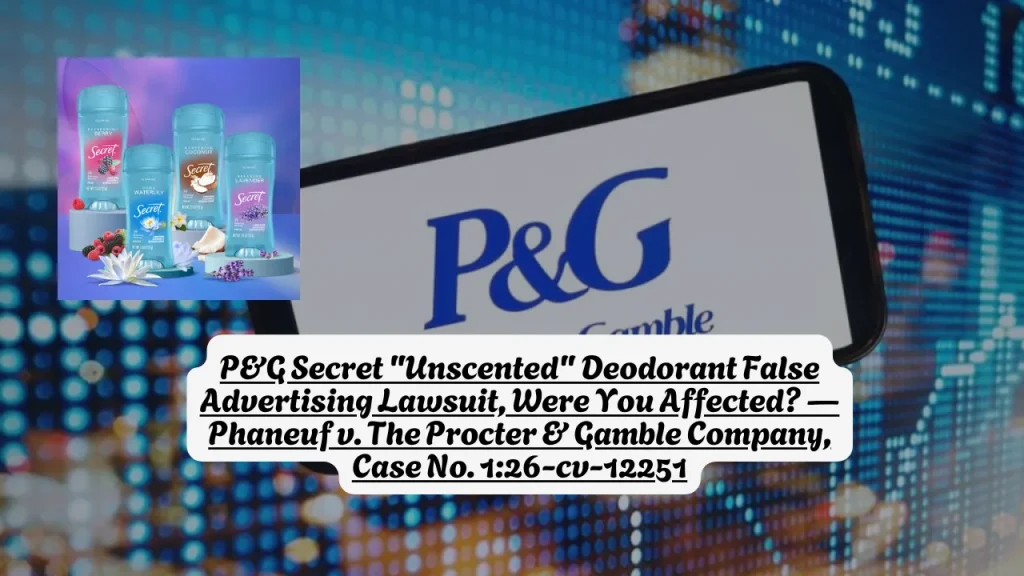
P&G Secret “Unscented” Deodorant False Advertising Lawsuit, Were You Affected? Phaneuf v. The Procter & Gamble Company, Case No. 1:26-cv-12251
A class action lawsuit filed in Massachusetts federal court alleges that The Procter & Gamble Company falsely labels its Secret Invisible Solid Antiperspirant and Deodorant products as “unscented” when the products actually contain fragrance ingredients. The suit seeks to represent every American who bought the supposedly offending products, with a Massachusetts residents subclass, and claims potential damages of more than $5 million. No settlement has been reached and no claim form exists yet.
P&G Secret Deodorant False Advertising Lawsuit — Key Facts
| Field | Detail |
| Lawsuit Filed | 2026 |
| Defendant | The Procter & Gamble Company |
| Alleged Harm | False advertising — “unscented” label on product containing fragrance |
| Specific Law Alleged | Consumer fraud and unjust enrichment |
| Who Is Affected | U.S. consumers who purchased Secret Invisible Solid “Unscented” Antiperspirant and Deodorant |
| Court & Case Number | U.S. District Court for the District of Massachusetts, Case No. 1:26-cv-12251 |
| Current Court Stage | Complaint filed — early litigation |
| Lead Plaintiff | Lisa Phaneuf, Massachusetts |
| Settlement Status | No settlement reached — active lawsuit |
| Law Firms Involved | TBD — pending docket confirmation |
| Last Updated | May 29, 2026 |
Who Is Procter & Gamble and Why Are They Facing a False Advertising Lawsuit Over Secret Deodorant?
Procter & Gamble is one of the world’s largest consumer goods companies, headquartered in Cincinnati, Ohio, with brands sold in more than 180 countries. Its Secret deodorant line is one of the top-selling women’s antiperspirant brands in the United States, stocked in virtually every major retailer — Walmart, Target, Amazon, CVS, and beyond. The lawsuit matters to you specifically because millions of Americans who avoid fragrance ingredients for medical reasons — skin sensitivity, allergies, asthma — specifically seek out products labeled “unscented,” trusting that label to be accurate.
What Did P&G Put on Secret “Unscented” Deodorant Labels That Started This Lawsuit?
P&G’s Secret “Unscented” deodorant labeling is the core issue in this case. Plaintiff Lisa Phaneuf says she never would have purchased a stick of Ph Balanced Secret Unscented deodorant at a Walmart last fall if she had known the product’s ingredient list includes “fragrance.”
The complaint argues that P&G intentionally misleads consumers into believing the products contain no fragrance ingredients, doing so because consumers seeking fragrance-free products are specifically trying to avoid ingredients that can cause skin irritation and allergic reactions. The label says “unscented.” The ingredient list says otherwise.
This is not a trivial labeling dispute. Walmart’s own product listing for Secret Women’s pH Balanced 24-Hour Protection Invisible Solid Antiperspirant and Deodorant, Fresh Unscented, lists “Fragrance*” among its inactive ingredients, with the asterisk noting “*masking fragrance.” The complaint points directly to this gap between what the front of the package promises and what the ingredient panel reveals.
For people with fragrance allergies, asthma, or skin conditions like eczema, “unscented” is not a preference — it is a medical necessity. To understand how similar false advertising cases against major consumer product companies have played out in court, our coverage of how false advertising class actions against P&G products have played out in court covers the pattern in depth. And if you want to see how another consumer product mislabeling case at this exact same early stage typically progresses, our piece on how similar consumer product mislabeling lawsuits unfold at the earliest stage breaks it down clearly.
The complaint charges fraud and unjust enrichment — meaning Phaneuf argues P&G collected money from consumers who paid for a product they believed was fragrance-free and received something materially different from what was advertised.
If you purchased Secret Invisible Solid Antiperspirant and Deodorant labeled “Unscented” — whether at Walmart, a drugstore, or online — this case may directly affect you.
Are You Part of the P&G Secret Deodorant False Advertising Class Action?
Here is exactly how to know if this lawsuit includes you.
The class action targets consumers who purchased Secret Invisible Solid Antiperspirant and Deodorant products labeled as “unscented.”
You may be included if:
- You bought Secret Invisible Solid Antiperspirant and Deodorant labeled “Unscented” or “Ph Balanced Unscented” at any point before the lawsuit was filed
- You purchased the product because you were specifically looking for a fragrance-free option
- You experienced skin irritation, an allergic reaction, or another adverse effect after using the product
- You paid a premium price for what you believed to be a fragrance-free formula
You are likely not included if:
- You purchased a different Secret product that is not labeled “Unscented”
- You were aware the product contained masking fragrance and purchased it anyway
- You bought a clearly scented Secret product (Powder Fresh, Shower Fresh, etc.)
P&G Deodorant Buyers Outside Massachusetts — Are You Still Covered?
Yes. The lawsuit seeks to represent every American who bought the affected Secret products, with a subclass specifically for Massachusetts residents. This is a federal case, so where you live does not limit your ability to be part of the nationwide class. Buyers in Texas, California, Florida, or any other state are included in the broader class.
If you are unsure whether your specific purchase of Secret deodorant qualifies in the P&G false advertising class action, a free consultation with a consumer rights lawyer can help you understand your options before any future deadline is set.
What Are P&G Customers Asking the Court to Award in the 2026 False Advertising Lawsuit?
The lawsuit seeks damages of more than $5 million on the specific charges of fraud and unjust enrichment. The $5 million figure reflects the damages threshold commonly cited in nationwide class actions — the actual amount recovered, if the case settles or goes to trial, would depend on how many class members participated, the strength of the evidence, and what the parties negotiate or the court decides.
No money is available right now. No claim form exists. P&G has not responded publicly to the lawsuit at this stage.
What Could P&G Customers Receive If the Secret Deodorant False Advertising Case Settles?
It is impossible to predict a per-person amount at this early stage. In consumer false advertising cases involving everyday products, settlements often result in modest per-purchase refunds or vouchers — but that depends entirely on the number of claimants, what documentation they provide, and what both sides agree to. What matters right now is that you document your purchases and hold onto any receipts or packaging you still have. Speaking with a consumer rights lawyer or false advertising class action attorney is the most reliable way to assess what your participation could be worth.
What Should P&G Secret Deodorant Customers Do Right Now?
- You are likely already included in the class. Most class members in consumer false advertising cases do not need to take any immediate action. There is no claim form yet and no deadline to file.
- Save your receipts and packaging. If you have any proof of purchase — a Walmart receipt, an Amazon order, a CVS email, or the product itself — keep it. In consumer false advertising cases, proof of purchase strengthens a future claim. Photographs of the product label showing “Unscented” on the front are also worth saving.
- Document any health effects. If you experienced skin irritation, a rash, or an allergic reaction that you believe was caused by fragrance in a product you bought as fragrance-free, write it down while it is fresh. Note the date, the symptoms, and any medical treatment you sought.
- Monitor the docket. The case is public record at the U.S. District Court for the District of Massachusetts under Case No. 1:26-cv-12251. If you want to track filings directly, the court’s PACER system lets you search by case number.
- Watch for a court notice. If the case is certified as a class action, affected consumers are notified by mail or email. Make sure your contact information is current with retailers where you purchased the product.
- Consider a free consultation. If you bought Secret Unscented regularly over several years or experienced allergic reactions from it, a consumer fraud attorney can evaluate whether your situation warrants individual attention beyond the class.
P&G Secret Deodorant False Advertising Lawsuit Timeline
| Milestone | Date |
| Alleged consumer purchases begin | TBD — pending complaint confirmation of class period start |
| Lawsuit filed by Lisa Phaneuf | 2026 |
| Case assigned to U.S. District Court, Massachusetts | 2026 |
| Class certification motion | TBD — not yet filed |
| P&G response to complaint | TBD — not yet filed |
| Next scheduled hearing | TBD — early litigation stage |
| Expected resolution | TBD — case was just filed |
P&G Secret Deodorant Lawsuit — Frequently Asked Questions, No. 1:26-cv-12251
Is there a class action lawsuit against P&G for false advertising on Secret Unscented deodorant right now?
Yes. Plaintiff Lisa Phaneuf filed a class action lawsuit against The Procter & Gamble Company in U.S. District Court in Massachusetts, Case No. 1:26-cv-12251, alleging the Secret Invisible Solid Antiperspirant and Deodorant products are labeled “unscented” but actually contain fragrance ingredients. The case is in early litigation — no settlement exists.
Do I need to do anything right now to be part of the P&G Secret deodorant class action?
No immediate action is required. Class members in consumer false advertising cases are typically included automatically once the class is certified. There is no claim form and no deadline to act yet. Save your receipts and any product packaging you still have.
When will the P&G Secret deodorant false advertising case settle?
There is no way to predict that at this stage. The lawsuit was just filed in 2026. P&G has not yet formally responded to the complaint. Cases like this can take months or years to reach a settlement or trial, depending on whether P&G contests the claims, how long discovery takes, and whether the parties reach a negotiated resolution.
Can I file my own lawsuit against P&G for false advertising on Secret deodorant instead of joining the class?
Yes, you can pursue an individual lawsuit, but for a consumer product purchase, individual cases are rarely cost-effective unless your damages are substantial — for example, significant documented medical costs from an allergic reaction. For most consumers, participating in the class action provides access to compensation without the cost of individual litigation. Talk to a consumer rights lawyer to weigh your specific situation.
How will I find out if the P&G Secret deodorant lawsuit settles?
If the case is certified and a settlement is reached, the court-approved administrator will send notice to class members by mail or email. We will also update this article as soon as any settlement is announced. Bookmark this page and check back for updates.
What specific laws does P&G allegedly violate in the Secret deodorant false advertising case?
The complaint charges fraud and unjust enrichment — both civil claims under federal and state law. Fraud requires proving that P&G knowingly made a false representation (the “unscented” label), that consumers relied on it, and that they suffered harm as a result. Unjust enrichment argues P&G profited from consumers who paid for a fragrance-free product they never actually received.
How much could P&G customers receive from a future Secret deodorant false advertising settlement?
No money is available yet and no settlement exists. The lawsuit seeks damages of more than $5 million. If a settlement is reached, individual payouts in consumer product false advertising cases typically depend on the number of valid claimants, proof of purchase submitted, and the final settlement amount negotiated. Speaking with a consumer fraud attorney is the best way to understand what your individual claim could be worth.
Why does it matter if a deodorant labeled “unscented” contains fragrance?
Phaneuf argues that fragrance ingredients can cause skin irritation and allergic reactions — and that many consumers specifically seek out fragrance-free products to avoid those effects. People with eczema, contact dermatitis, asthma, or fragrance allergies routinely depend on “unscented” labels to make safe purchasing decisions. If that label is inaccurate, those consumers are exposed to ingredients they were trying to avoid, without their knowledge or consent.
Sources Used in This P&G Secret Deodorant False Advertising Lawsuit Article
Universal Hub — “Area woman says something stinks about ‘unscented’ Secret, so she sues,” May 2026: https://www.universalhub.com/2026/area-woman-says-something-stinks-about-unscented-secret-so-she-sues
Law360 — “Anthem Inks $3.6M Settlement In Proton Beam Therapy Suit” (case filing context), May 19, 2026: https://www.law360.com/articles/2479515
Walmart Product Listing — Secret Women’s pH Balanced 24-Hour Protection Invisible Solid Antiperspirant and Deodorant, Fresh Unscented, ingredient list confirming “Fragrance* *masking fragrance”: https://www.walmart.com/ip/Secret-Unscented-Invisible-Solid-Antiperspirant-and-Deodorant-2-6-oz/10311905
Justia Federal Dockets — Phaneuf v. The Procter & Gamble Company, Case No. 1:26-cv-12251, U.S. District Court for the District of Massachusetts: https://dockets.justia.com
Prepared by the AllAboutLawyer.com Editorial Team and reviewed for factual accuracy against Universal Hub reporting, the Walmart product ingredient listing, and Justia federal court docket records for Case No. 1:26-cv-12251 on May 29, 2026. Last Updated: May 29, 2026.
This article is for informational purposes only and does not constitute legal advice. Laws vary by state and individual circumstances differ. For advice about your specific situation, consult a qualified attorney.
About the Author
Israr Ahmad is a legal content researcher with 4+ years of experience covering class action settlements and consumer rights cases. He has researched and published coverage of 2,500+ settlements using verified court records, settlement administrator filings, and government sources. Learn more about Israr.