
PFAS Found in Village of Maine Private Wells Here Are Your Rights as a Well Owner
What rights do Village of Maine well owners have if PFAS contaminated their water?
Village of Maine private well owners whose water has been contaminated by PFAS have the right to get their water tested, join the active class-action lawsuit against 3M, and seek compensation for property damage, health monitoring costs, and personal injuries. Getting your well tested is the critical first step.
Your water is supposed to be safe. For many families in the Village of Maine, Wisconsin, that assumption is now in serious question.
PFAS contamination in Village of Maine private wells has become a growing crisis, with residents learning that “forever chemicals” may have seeped into the groundwater they have been drinking for years. The source alleged in a federal class-action lawsuit: 3M’s Greystone Facility and Quarry, located approximately one mile from the village, where roofing granules containing PFAS were manufactured and allegedly disposed of. If you own a private well in the area, you have legal rights — and time matters.
This article explains what those rights are, what 3M and state regulators are required to do, and how to protect your family and your property right now.
What PFAS Contamination in Village of Maine Wells Actually Means for Your Family
PFAS stands for per- and polyfluoroalkyl substances — a group of more than 12,000 synthetic chemicals that do not break down in the environment or in the human body. That is why they are called “forever chemicals.”
Testing by the Wisconsin Department of Natural Resources found levels of PFOA and PFOS — the two most widely studied PFAS compounds — at 210 parts per trillion (ppt) and 310 ppt respectively in water samples near the 3M Greystone facility. [DNR data cited in December 2024 Wausau Pilot & Review reporting] Those figures far exceed the EPA’s current drinking water standard of 4 ppt for PFOA and PFOS, established in April 2024 under the Safe Drinking Water Act.
A PFOS reading of 2,100 ng/L was recorded at a well near the Greystone site in September 2025 — more than 500 times Wisconsin’s proposed limit of 4 ng/L. Wausau Pilot & Review, May 2026 reporting] At a third nearby well, NEtFOSAA — a PFAS compound that converts to PFOS in the body — was detected at 9,700 ng/L. These are not trace amounts. These are levels that warrant immediate attention.
Health effects linked to PFAS exposure include thyroid disease, high cholesterol, liver and immune system problems, preeclampsia, and certain cancers, including kidney and testicular cancer. The class-action complaint filed in federal court states that plaintiffs have a measurable bioaccumulation of PFAS in their blood and have either been diagnosed with — or face elevated risk of — several of these conditions.
If you are worried about how many years your family has been drinking this water, you are not alone. A free consultation with a PFAS contamination attorney is one of the fastest ways to understand where you stand.
Related article: GM OnStar Class Action Lawsuit Moves Forward, Here Are Your Rights as a GM Driver
Your Legal Rights as a Village of Maine Private Well Owner
Private well owners in the Village of Maine are not without options. Here is what the law actually gives you the right to do.
You have the right to have your well tested.
Attorney Gabriel Vasquez of Napoli Shkolnik, who is representing Village of Maine plaintiffs, has publicly advised every resident in the area to get their water tested to determine whether they are eligible to join the lawsuit. Testing is the foundation of any legal claim — without it, you cannot establish contamination.
You have the right to seek compensation for damages.
The class-action lawsuit filed in December 2024 in federal court seeks compensation for personal injuries, property damage, diminished property values, and the cost of obtaining clean water. Plaintiffs also seek medical monitoring costs for future health surveillance. [ Napoli Shkolnik/Davczyk & Varline class-action complaint, December 2024]
You have the right to join an active lawsuit.
The case against 3M is moving through the federal court system with a class certification deadline of July 24, 2026. [ May 2026 reporting] That means there is still time to be included — but the window is not unlimited.
You have the right to demand regulatory action.
Under Wisconsin’s Spills Law — which the Wisconsin Supreme Court upheld in a landmark 2025 ruling — the Wisconsin DNR has the authority to investigate PFAS contamination and require responsible parties to remediate it. The DNR has already issued a Responsible Party letter to 3M on March 10, 2025, directing the company to begin a formal environmental investigation of the Greystone site. Wausau Pilot & Review, March 2025
Under 2025 Wisconsin Act 200 and 2025 Wisconsin Act 201, signed by Governor Tony Evers, the DNR now has expanded authority to investigate PFAS contamination and issue grants to help private parties — including well owners — deal with contamination. Wisconsin Legislature records
What 3M and State Regulators Are Required to Do About PFAS at Greystone
The Wisconsin DNR is not sitting on the sidelines. The agency has ordered 3M to conduct a formal site investigation of the Greystone facility at 410 Decator Drive in Wausau. Engineering firm Tetra Tech, acting on behalf of 3M, reported a hazardous substance discharge at the site on February 14, 2025. A site investigation report submitted in April 2026 confirmed PFAS contamination across large sections of the Greystone property, as well as in stormwater basins near the Wisconsin River. [ Wisconsin DNR hydrogeologist statement, Wausau Pilot & Review, May 2026]
The EPA has also been directly involved. In August 2024, the agency sent 3M a formal information-request letter under Section 104(e) of CERCLA — the federal Superfund law — related to the Wausau Groundwater Contamination Superfund Site. That letter asked 3M highly specific questions about its use of NEtFOSAA in roofing granule production at the Greystone and Downtown Wausau sites. [ EPA 104(e) letter, August 6, 2024, cited in Wausau Pilot & Review reporting]
Under CERCLA as amended, PFOA and PFOS are now designated as hazardous substances — a designation the EPA confirmed it would continue to defend in court in September 2025. That designation matters because it triggers CERCLA’s strict liability framework, which does not require proof of negligence to establish that 3M is a responsible party.
For you as a well owner, this means the regulatory machinery is moving — but it moves slowly. A compensation for damages claim through the civil lawsuit is the most direct path to holding 3M financially accountable for what your family has experienced.
What to Do Right Now If You Own a Well in the Village of Maine
You do not need to wait for the DNR investigation to conclude before taking steps to protect yourself.
- Stop drinking well water if you are concerned. Switch to bottled water immediately for drinking, making coffee, tea, juice, and infant formula. Use of well water for bathing is generally considered lower risk unless contamination levels are very high.
- Get your well tested for PFAS. Contact the Wisconsin DNR or a state-accredited laboratory to arrange testing. The Wisconsin DNR has been conducting free residential well testing in areas of suspected PFAS contamination.
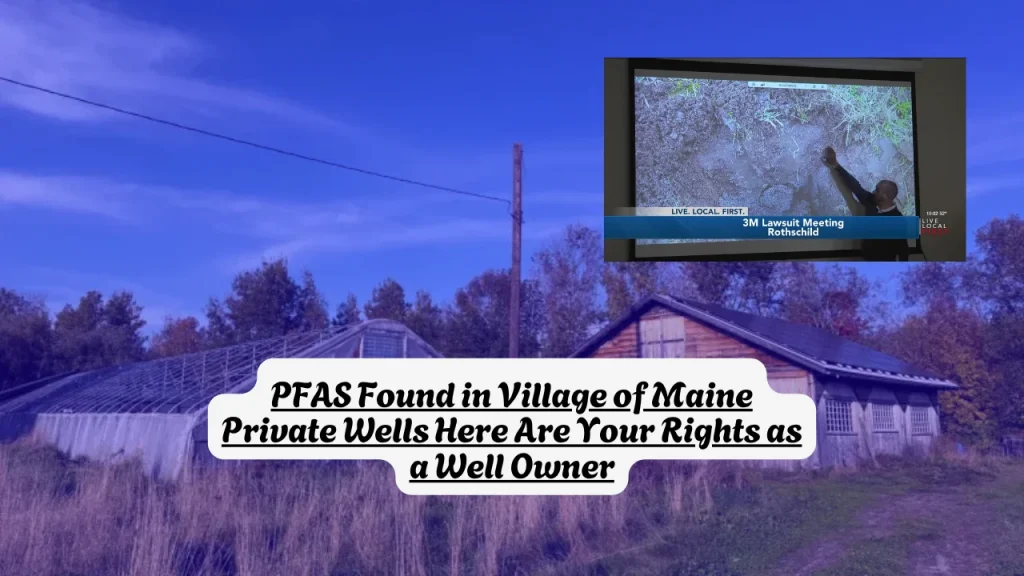
- Attend or reach out to the law firm holding community sessions. Napoli Shkolnik and Davczyk & Varline, the attorneys representing current plaintiffs, held a town hall at the Bantr Grand Hotel Wausau on May 3, 2026, at 805 Creske Ave. in Rothschild. Attorneys are continuing to speak with residents who are considering whether to file a claim. Contact their offices directly to schedule a consultation.
- Document everything. Keep records of all water test results, any medical visits related to conditions linked to PFAS, and any costs you have incurred to obtain clean water — bottled water receipts, filter purchases, and so on.
- Consult a PFAS contamination attorney before the class certification deadline. Plaintiffs have until July 24, 2026, to file for class certification. An environmental contamination attorney can assess whether your situation qualifies and walk you through the process of joining the lawsuit. Most offer a free legal consultation with no upfront cost to you.
How to Document Your PFAS Exposure and Build a Strong Legal Claim
Evidence is what separates a valid legal claim from a story with no legal standing. Here is what courts and attorneys will want to see in a case like this.
Water test results are the foundation. A positive PFAS test from a state-accredited lab, showing levels above the EPA’s 4 ppt standard for PFOA or PFOS, establishes that contamination exists in your well. Without it, there is no claim.
Medical records matter. If you or a family member has been diagnosed with thyroid disease, high cholesterol, liver problems, or a PFAS-linked cancer, those records connect the contamination to your health. Get copies now and keep them organized.
Receipts document your out-of-pocket costs. Every bottle of water you buy because you cannot drink from your well is a compensable expense. Keep receipts. If you have purchased a filtration system, keep the installation records and cost documentation.
Property records establish your standing. As a private well owner, your standing to participate in the lawsuit is tied to your property. Keep your deed, mortgage statements, and any property appraisals on file. Diminished property values are a recognized category of damages in PFAS contamination cases.
If you are not sure whether the evidence you have is strong enough, an environmental contamination attorney can tell you in one conversation — and most offer a free initial consultation.
When You Need a Lawyer and Why This Case Is Not One to Handle Alone
Some legal matters you can navigate on your own. A class-action lawsuit against one of the world’s largest corporations, involving complex federal environmental law, is not one of them.
The Village of Maine case involves CERCLA, Wisconsin’s Spills Law, federal drinking water standards, and state groundwater regulations that are still being finalized. 3M has already succeeded in getting several claims trimmed by the court in March 2026 — which means the legal strategy matters enormously. Discovery is ongoing. [May 2026 reporting on case status]
Napoli Shkolnik and Davczyk & Varline are handling this case on a contingency fee basis, meaning you pay nothing upfront and only if the case results in a recovery. If you are a current plaintiff or considering joining, reaching out to these attorneys — or consulting with another qualified environmental contamination attorney — is the right move.
The class certification deadline of July 24, 2026, is a real and firm legal deadline. If you wait until after that date, joining this specific class action becomes significantly more difficult. Article on how PFAS class-action lawsuits work and what to expect
Frequently Asked Questions About PFAS Contamination and Well Owner Rights in Village of Maine, Wisconsin
What is the deadline to join the Village of Maine PFAS class-action lawsuit against 3M?
The current class certification deadline in the federal case is July 24, 2026. You should speak with an attorney as soon as possible — preferably before that date — to understand whether your situation qualifies and what steps you need to take to be included.
How long will this PFAS lawsuit against 3M take to reach a resolution?
The trial in the Village of Maine case is currently scheduled for November 2027, according to court filings as of May 2026. PFAS class-action cases can take years, but plaintiffs may receive interim relief or early settlements in some situations. Your attorney can give you a realistic timeline for your specific claim.
Do I need a lawyer to participate in the class-action lawsuit against 3M?
Yes, strongly recommended. Napoli Shkolnik and Davczyk & Varline are the attorneys of record for current plaintiffs and operate on a contingency fee basis — no upfront cost. You should not attempt to navigate a federal environmental class-action lawsuit on your own, particularly one involving CERCLA and corporate defendants with significant legal resources.
What PFAS levels were found near the 3M Greystone site in Village of Maine?
Wisconsin DNR testing found PFOA at 210 parts per trillion and PFOS at 310 ppt near the Greystone facility — far above the EPA’s 4 ppt standard. A well near the site measured PFOS at 2,100 ng/L in September 2025. A third well showed NEtFOSAA at 9,700 ng/L. These levels are among the highest recorded in Wisconsin’s public environmental database.
What health problems are linked to PFAS exposure from contaminated well water?
Documented health conditions linked to PFAS exposure include thyroid disease, high cholesterol, liver and immune system dysfunction, preeclampsia, and certain cancers including kidney and testicular cancer. The class-action complaint states that plaintiffs have measurable PFAS bioaccumulation in their blood and face elevated risk of several of these conditions.
Can I sue 3M separately from the class-action lawsuit?
You can pursue an individual claim rather than joining the class action, but this is a complex legal decision. Individual claims may allow for larger individual compensation in some cases, but they require more resources and carry higher legal risk. An environmental contamination attorney can walk you through the tradeoffs in your specific situation during a free legal consultation.
Is free well testing available for Village of Maine residents?
The Wisconsin DNR has been expanding free residential PFAS well testing in areas of suspected contamination across the state. Contact the Wisconsin DNR or the Marathon County Health Department, which issued an official health notification related to the Greystone contamination, to find out whether your property falls within the testing program area.
What damages can Village of Maine well owners recover in the 3M lawsuit?
The class-action complaint seeks compensation for personal injuries, property damage, diminished property values, and costs to obtain clean water. Plaintiffs also seek medical monitoring costs. Whether you qualify for each category of compensation for damages depends on your specific circumstances and the evidence you can provide.
Legal Terms Used in This Article
PFAS (Per- and Polyfluoroalkyl Substances): A group of more than 12,000 synthetic chemicals used in industrial and consumer products since the 1940s. They are called “forever chemicals” because they do not break down in the environment or the human body, and they accumulate over time.
Class-Action Lawsuit: A type of lawsuit where a large group of people with similar legal claims sue a defendant together as one case. Individual plaintiffs benefit from shared legal resources and do not pay attorney fees upfront in contingency-fee class actions.
CERCLA (Comprehensive Environmental Response, Compensation, and Liability Act): The federal Superfund law that gives the EPA authority to investigate contaminated sites and hold responsible parties liable for cleanup costs. PFOA and PFOS were designated as hazardous substances under CERCLA in April 2024.
Contingency Fee: A payment arrangement where the attorney only gets paid if the case results in a recovery. You owe nothing upfront — the fee comes out of any settlement or court award. This is the fee structure used in the Village of Maine case.
Statute of Limitations: The legal deadline by which a lawsuit must be filed. After this deadline passes, you lose the right to file. In Wisconsin, the statute of limitations for personal injury cases is generally three years, but PFAS contamination cases have specific considerations that an attorney should evaluate for your situation.
Damages: Money awarded by a court to compensate a plaintiff for losses. In PFAS contamination cases, this includes medical costs, property damage, the cost of clean water, diminished property values, and in some cases, punitive damages designed to punish especially harmful corporate conduct.
You Have Rights And a Specific Deadline to Act On Them
You now know what PFAS contamination in Village of Maine private wells means legally, what 3M and state regulators are required to do, and what steps you can take right now to protect your family and preserve your right to compensation.
The class certification deadline in this case is July 24, 2026. If your well has not been tested, that is the place to start. If it has, and levels came back elevated, speaking with a PFAS contamination attorney is not optional — it is the most important call you can make for your family’s future.
Prepared by the AllAboutLawyer.com Editorial Team and reviewed for factual accuracy against official Wisconsin DNR records, EPA regulatory filings, federal court documents, and verified local news reporting from Wausau Pilot & Review and WSAW. Last Updated: May 3, 2026
Disclaimer: This article is for informational purposes only and does not constitute legal advice. Laws vary by state and individual circumstances differ. For advice regarding your specific situation, consult a qualified attorney licensed in Wisconsin.
About the Author
Israr Ahmad is a legal content researcher with 4+ years of experience covering class action settlements and consumer rights cases. He has researched and published coverage of 2,500+ settlements using verified court records, settlement administrator filings, and government sources. Learn more about Israr.