
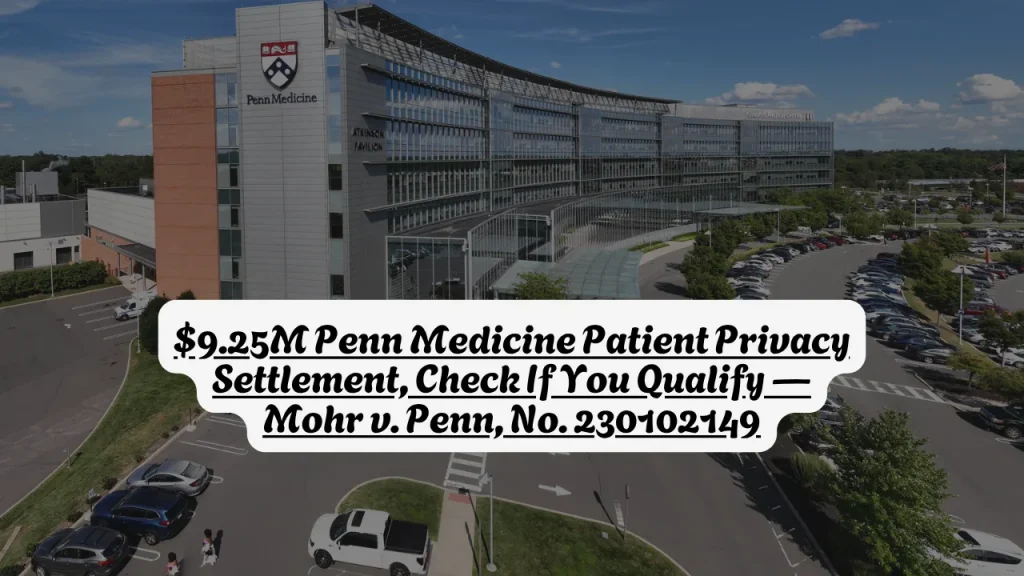
$9.25M Penn Medicine Patient Privacy Settlement, Check If You Qualify — Mohr v. Penn, No. 230102149
Quick answer: if you logged into the myPennMedicine patient portal between January 23, 2021, and January 23, 2023, and had a Pennsylvania address on file at the time — yes, you’re likely included. There’s a $9,250,000 settlement fund, a $15 payout per valid claim, and a September 16, 2026 deadline to file.
Penn Medicine Patient Privacy Settlement — Key Facts
| Settlement Amount | Up to $9,250,000 total fund |
| Claim Deadline | September 16, 2026 |
| Who Qualifies | Anyone who accessed the myPennMedicine portal Jan. 23, 2021–Jan. 23, 2023, with a Pennsylvania address on file |
| Estimated Payout | Up to $15 per valid claim |
| Proof Required | No — but you need the Notice ID and PIN from your settlement notice |
| Settlement Status | Preliminarily approved; final approval hearing Nov. 12, 2026 |
| Court & Case Number | Court of Common Pleas of Philadelphia County, No. 230102149 |
| Law Alleged | Pennsylvania Wiretapping and Electronic Surveillance Control Act (WESCA) |
| Administrator | Epiq |
| Official Claim Site | UPHSPixelSettlement.com |
| Last Updated | July 18, 2026 |
Who Is Penn Medicine and Why Are They Being Sued for Patient Privacy Violations?
Penn Medicine runs the myPennMedicine patient portal for the University of Pennsylvania Health System — the place patients log in to see lab results and message doctors. That login activity is exactly what plaintiffs say got shared without permission. The lawsuit claims Penn Medicine put Meta and Google tracking pixels on that portal, and those pixels quietly sent patient identifiers to advertisers every time someone logged in.
What Did Penn Medicine Do to Patients Between 2021 and 2023?
The case, Mohr, et al. v. The Trustees of The University of Pennsylvania as Owner and Operator of The University of Pennsylvania Health System (d/b/a Penn Medicine), No. 230102149, was filed in the Court of Common Pleas of Philadelphia County. Plaintiffs say Penn Medicine violated the Pennsylvania Wiretapping and Electronic Surveillance Control Act — a state law that bars intercepting or disclosing someone’s communications without consent. The claim: tracking pixels from Meta and Google embedded on the portal captured patients’ personally identifiable information and sent it to those companies for ad targeting, without anyone agreeing to it.
Here’s the detail most coverage of these pixel cases glosses over. Penn Medicine’s own settlement notice specifically states it “denies any access to, use of, or disclosure of health records.” That’s a real distinction. This isn’t a case about your test results or diagnosis leaking — it’s about the fact that you had a portal account and logged in becoming data Meta and Google could use. Smaller violation than a medical-records breach. Still a violation.
Penn Medicine has already stopped using the Meta pixel on pennmedicine.org, and agreed not to use tracking or advertising technology on the site for two years unless a web governance committee signs off. Similar changes showed up after the Northwell Health pixel tracking settlement, another $15-payout case built on the same tracking-pixel theory. Penn Medicine denies any wrongdoing — that’s standard in these settlements. It doesn’t mean the underlying claims weren’t real.
Related article: $2.5 Million FitOn Video Privacy Settlement, Check If You Qualify — Ava Hoffman et al. v. FitOn, Inc., No. 542301/2025
Who Qualifies for the Penn Medicine Patient Privacy Settlement?
Here’s exactly how to know if this case includes you.
- Anyone who accessed the myPennMedicine patient portal between January 23, 2021, and January 23, 2023
- People with a Pennsylvania address on file at the time they accessed the portal
- Current and former Penn Medicine patients who used the portal during that window — regardless of whether you still have an account today
- Those excluded: anyone without a Pennsylvania address on file during the class period, and anyone who accessed the portal only outside those dates
You don’t need to have clicked anything specific inside the portal. Logging in during that window with a PA address is what counts.
Penn Medicine Patients Outside Pennsylvania — Are You Still Covered?
No. This settlement class is defined by state, not by where Penn Medicine operates. If you had a non-Pennsylvania address on file when you accessed the portal, you’re not part of this class — even if you’re a longtime Penn Medicine patient. This is a state-law case (WESCA is Pennsylvania-specific), so the class tracks the state, not the hospital system’s footprint.
Not sure if you qualify for the Penn Medicine patient privacy settlement? A free consultation with a data privacy attorney can help before the September 16 deadline.
How Much Can Penn Medicine Settlement Class Members Get? Up to $15 Per Person
Every valid claim gets a flat cash payment of up to $15. There’s no tiered proof system here — you don’t submit more documentation to get more money. Penn Medicine has agreed to pay up to a total of $9,250,000, which covers the individual payments, notice costs, administration, attorneys’ fees, and incentive awards to the class representatives.
Class Counsel — Bursor & Fisher, P.A. and Drury Legal, LLC — can seek up to $3,700,000 in fees. That’s roughly 40% of the entire fund, before a single class member gets their $15. The court still has to approve that number at the November 12 hearing, and could award less. Worth knowing before you decide the $15 is or isn’t worth ten minutes of your time.
Payment goes out by check by default, though you can choose PayPal, Venmo, Zelle, ACH, or an eMasterCard instead. If the court grants final approval and no one appeals, payments go out 90 days later. Checks expire 180 days after they’re issued, so don’t let one sit in a drawer.
How to File Your Penn Medicine Settlement Claim — Step by Step
- Go to UPHSPixelSettlement.com and click “Submit a Claim”
- Enter your Unique ID and PIN from the notice you got by mail or email
- Confirm your name, address, and contact details
- Pick how you want to be paid — check, PayPal, Venmo, Zelle, ACH, or eMasterCard
- Submit and save your confirmation number
- Watch your email — the administrator will follow up if anything’s missing
Takes about five minutes. If you lost your notice or never got one but believe you qualify, call 1-877-327-7567 to verify your identity before filing.
⚠️ You have until September 16, 2026 to file — mark it now.
Should Penn Medicine Class Members Opt Out or Object Before September 1, 2026?
What Opting Out of the Penn Medicine Settlement Actually Means
Opting out means you get no payment, but you keep the right to sue Penn Medicine separately over the same claims. Most people shouldn’t opt out without talking to a lawyer first, especially given how modest the $15 payment is compared to what an individual WESCA claim could theoretically be worth. The opt-out deadline is September 1, 2026 — mailed to the settlement administrator in Portland, OR.
How to Object to the Penn Medicine Settlement
Objecting is different — you stay in the class, but you tell the court in writing why you think the deal is unfair. Your objection needs your name, your reasoning, and your signature, mailed to the Settlement Administrator by September 1, 2026, the same deadline as opting out.
Talk to a class action lawsuit attorney before September 1 if you’re considering either option.
Penn Medicine Patient Privacy Settlement — Key Dates, 2026
| Milestone | Date |
| Settlement Proposed | Fully executed April 7, 2026 |
| Preliminary Approval | June 12, 2026 |
| Opt-Out Deadline | September 1, 2026 |
| Objection Deadline | September 1, 2026 |
| Claim Filing Deadline | September 16, 2026 |
| Final Approval Hearing | November 12, 2026 (via Zoom) |
| Expected Payment Date | 90 days after final approval, pending appeals |
Penn Medicine Patient Privacy — Frequently Asked Questions, No. 230102149
Do I need a lawyer to file a Penn Medicine patient privacy settlement claim?
No. Filing takes a Unique ID and PIN from your notice — no attorney required. Class Counsel, Bursor & Fisher and Drury Legal, already represent the class at no cost to you.
Is the Penn Medicine settlement legitimate?
Yes. It was preliminarily approved by the Court of Common Pleas of Philadelphia County on June 12, 2026, and is administered by Epiq, a court-approved settlement administrator.
When will Penn Medicine settlement payments be sent?
Payments go out roughly 90 days after the November 12, 2026 final approval hearing, assuming the court approves the deal and no one appeals.
What if I missed the Penn Medicine claim deadline?
Claims must be submitted or postmarked by September 16, 2026. There’s no stated late-filing exception in the settlement notice, so file well before the deadline.
Will my Penn Medicine settlement payment go on a 1099?
At $15, it’s unlikely to trigger a 1099 — those generally apply to payments over $600. Check with a tax professional if you have questions.
What happens if I do nothing?
You get no payment, and unless you’ve excluded yourself, you give up the right to sue Penn Medicine separately over the pixel-tracking claims covered by this case.
Does this settlement mean Penn Medicine leaked my medical records?
No — Penn Medicine’s notice specifically denies any disclosure of health records. The claims are about tracking pixels sharing portal-access data, not diagnoses or test results. For more on how this fits into the broader wave of hospital pixel litigation, see the MyChart / Epic Systems pixel tracking settlements roundup.
Sources Used in This Penn Medicine Article
Settlement FAQ — UPHS Pixel Settlement, Epiq, updated July 17, 2026: https://www.uphspixelsettlement.com/Home/FAQ Long Form Notice — Mohr v. Penn, court-authorized, dated July 10, 2026: https://www.uphspixelsettlement.com/Content/Documents/Mohr%20v.%20Penn%20-%20LFN%207.10.26_Final.pdf Settlement Claim Form (AM893 v.01): https://www.uphspixelsettlement.com/Content/Documents/AM893_v01.pdf Settlement Documents Page (Settlement Agreement, Preliminary Approval Order): https://www.uphspixelsettlement.com/Home/Documents
Researched and written by Israr Ahmad, legal content researcher and founder of AllAboutLawyer.com. All facts verified against the court-authorized Long Form Notice and the official settlement FAQ on July 18, 2026. Last Updated: July 18, 2026.
This article is for informational purposes only and does not constitute legal advice. Laws vary by state and individual circumstances differ. For advice about your specific situation, consult a qualified attorney.
About the Author
Israr Ahmad is a legal content researcher with 4+ years of experience covering class action settlements and consumer rights cases. He has researched and published coverage of 2,500+ settlements using verified court records, settlement administrator filings, and government sources. Learn more about Israr.