
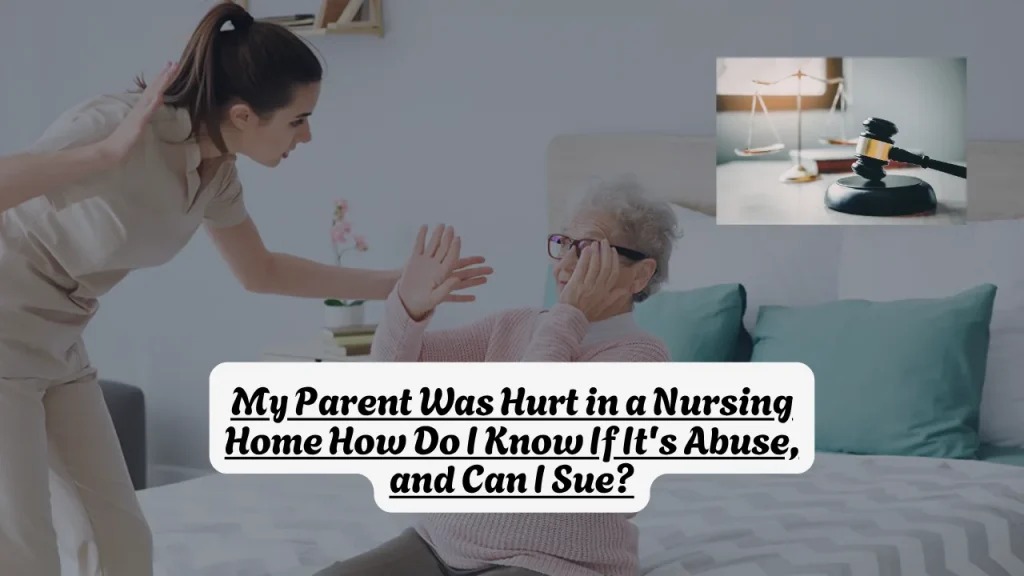
My Parent Was Hurt in a Nursing Home How Do I Know If It’s Abuse, and Can I Sue?
You trusted a facility with someone you love. You visited, you asked questions, you signed paperwork. And now something has gone wrong — a fall with no explanation, unexplained bruises, sudden weight loss, a parent who flinches when a staff member walks in. That sick feeling in your stomach is telling you something.
You are right to trust it.
Research has consistently found that elder abuse and neglect occur in nursing homes and long-term care facilities across the United States, although experts believe many incidents go unreported because residents may fear retaliation or may be unable to communicate what happened. Most of it is never reported — because the victims cannot speak for themselves, and families do not know what to look for or what to do.
This article tells you both. What the warning signs actually look like. What the law says nursing homes must do. How to build a case. And what families recover when they sue.
Can you sue a nursing home for abuse or neglect — and who can file the lawsuit?
Yes. You may be able to sue a nursing home for negligence if you are the resident who suffered harm, an immediate family member such as an adult child or spouse acting on behalf of a loved one, the estate representative of a deceased resident, or a legal guardian with power of attorney. If your parent has dementia or cannot speak for themselves, you can still act on their behalf. If they died as a result of abuse or neglect, you may be able to file a wrongful death lawsuit.
Warning Signs of Nursing Home Abuse That Families Most Often Miss
Physical abuse leaves marks. But the signs that get missed most often are subtler — behavioral changes, unexplained health declines, patterns that only become clear when you know what to look for.
Physical signs to document immediately:
Signs and symptoms of physical abuse include unexplained broken bones, dislocations, or sprains. Families must watch for unexplained bruises, welts, or lacerations — especially in uncommon places like the torso, back, buttocks, or inner arms. A single bruise can be an accident. The same bruise in the same location on two separate visits is a pattern.
Bedsores — also called pressure ulcers — are one of the clearest signs of neglect. They develop when a resident is left in one position for too long without being repositioned. A properly staffed facility prevents most bedsores. When they appear, especially at advanced stages, it signals that basic care was not being provided.
Other signs that could signal abuse include dehydration — dry skin, cracked lips, or weakness — and falls leading to fractures or head injuries, which can indicate inadequate supervision or improper mobility assistance.
Behavioral and emotional signs:
Sudden withdrawal, unusual fear around specific caregivers, or unexplained behavioral changes indicate severe emotional distress. Family members have noted a sudden onset of extreme negativity or paranoia as a sign of cognitive and emotional distress resulting from a poor environment.
If your parent cannot or will not talk when staff members are in the room, that is worth paying close attention to. Fear of a specific person — refusing care from one aide, tensing up when a particular name is mentioned — is a significant warning sign.
What to do the moment you see something:
Take photographs. Write down dates, times, and exactly what you observed. Get copies of medical records at every visit. Do not wait for the facility to investigate itself. If your parent is in immediate danger, call 911. For everything else, the next section explains who to contact and how.
What the Law Actually Requires Nursing Homes to Do — and What Breaks the Law
Nursing homes are not just bound by professional ethics. They operate under federal law, and violations of that law form the legal foundation of most abuse lawsuits.
The Omnibus Budget Reconciliation Act of 1987 (OBRA ’87) remains the foundational federal law governing nursing home care. Its core mandate requires facilities to provide services that allow residents to attain and maintain their highest practicable physical, mental, and psychosocial well-being, codified at 42 U.S.C. § 1395i-3 for Medicare facilities and 42 U.S.C. § 1396r for Medicaid facilities.
The law said that every nursing facility must provide all the services that each resident needs to achieve the highest physical, mental, and psychosocial well-being. It also revised the survey process for determining whether facilities meet those care standards and the enforcement system for when they do not.
In plain terms, a nursing home that accepts Medicare or Medicaid funding — which is most of them — must meet these federal minimums. When it falls short and a resident is harmed, the facility can be held legally responsible.
Residents have the right to remain in a nursing home except in cases of non-payment, dangerous behavior, or significant changes in medical condition. They have rights to choose their personal physicians and access to their own medical records.
A nursing home abuse attorney can tell you in one conversation whether what happened to your parent crosses a legal line — and most offer a free legal consultation with no obligation.
Related article: I Got Hurt at Work Should I File Workers’ Comp, Sue My Employer, or Both?
How to Report Nursing Home Abuse Before Filing a Lawsuit
Reporting and suing are two different things, and you can do both — at the same time. Reporting creates an official record. That record becomes evidence.
To report nursing home abuse, begin by collecting evidence — photos, medical records, and statements from witnesses. Then file a complaint with a state or federal agency, such as Adult Protective Services, a long-term care ombudsman, or the Centers for Medicare and Medicaid Services. If someone is in immediate danger, call local law enforcement right away.
Here is where to go:
The Long-Term Care Ombudsman — Every state is required to have one. The ombudsman investigates complaints about nursing homes and advocates for residents. To get connected with your local ombudsman, call 1-800-677-1116 or use the Eldercare Locator at eldercare.acl.gov. You can report confidentially or anonymously.
Adult Protective Services (APS) — Each state has an APS office, and some provide elder abuse hotlines for reporting concerns anonymously. You can call or submit an online claim to your local APS office to begin the process of reporting nursing home abuse.
The Centers for Medicare and Medicaid Services (CMS) — If the facility accepts federal funding, CMS regulates it. A formal complaint triggers a state inspection of the facility.
Local law enforcement — For physical assault, sexual abuse, or any situation where a crime has occurred, file a police report. The criminal investigation runs separately from your civil lawsuit and does not prevent you from suing.
You can also file a written grievance directly with the nursing home. Ask for a grievance form or write a letter yourself. Keep a copy, because it may be useful in a state investigation or in a legal case.
Evidence That Wins Nursing Home Abuse and Neglect Cases
The odds of winning a lawsuit against a nursing home depend largely on the strength of the evidence. Documentation like medical records, internal facility notes, photographs, witness statements, and expert medical opinions can all help establish that the harm was preventable and caused by negligence.
Here is what to gather — and why each piece matters:
Medical records before and after — The single most important documents in your case. Records from before the abuse show your parent’s baseline condition. Records after show what changed. A gap between the two is the core of your claim.
Photographs of injuries — Date-stamped photos of bedsores, bruises, weight loss, or conditions inside the room. Take them at every visit once you have concerns.
Facility inspection reports — The federal government publishes nursing home inspection reports at Medicare.gov. A history of violations for the same type of harm strengthens your case dramatically. A facility cited three times for inadequate fall prevention that then lets your parent fall has a serious problem defending itself.
Staffing records — Chronic understaffing is one of the leading causes of nursing home neglect. Your attorney can subpoena staffing logs to show whether the facility had enough staff on duty the night your parent was hurt.
Witness statements — Other residents, family members of other residents, and former staff members all may have seen or experienced similar problems. Their accounts can establish a pattern rather than an isolated incident.
Your own records — Keep a written log of every visit, every conversation with staff, every complaint you made, and every response you received or did not receive. This log is evidence. Start it today if you have not already.
If your loved one is still in the facility, do not remove them without speaking to an attorney first — the process matters for your case. If they are in immediate danger, get them safe first. Everything else can be sorted out after.
What Compensation Families Recover in Nursing Home Abuse Lawsuits
Money does not undo what happened. But it holds facilities accountable — and it covers real, devastating costs that families absorb when a nursing home fails their loved one.
The average nursing home abuse settlement is approximately $400,000 to $406,000 for severe harm cases, though amounts vary widely from $150,000 to over $20 million. Settlement value depends on injury severity, whether wrongful death occurred, medical costs, facility negligence, and jurisdiction.
Compensation in nursing home cases typically falls into three categories:
Economic damages — Medical expenses including hospital stays, medications, rehabilitation, and ongoing care. Relocation costs for moving your loved one to a safer facility. Lost earning capacity if the victim was still working. Funeral and burial expenses in wrongful death cases.
Non-economic damages — Money for physical pain, emotional suffering, loss of dignity, and the diminished quality of life your parent experienced as a result of the abuse. These are harder to calculate but often represent the largest portion of a settlement.
Punitive damages — Awarded when the facility’s conduct was especially egregious — not just careless, but reckless or intentional. Wrongful death cases sometimes include punitive damages meant to punish the nursing home for its wrongdoing. These are less common but can significantly increase the total recovery.
Recent high-value results include $20 million in California, $18.2 million in Rhode Island, and $12 million in New York. Most cases settle without going to trial. Most cases settle within 1 to 2 years, though complex cases with multiple defendants or severe injuries that require lengthy treatment can take longer.
Most nursing home abuse attorneys work on contingency — you pay nothing upfront and nothing at all unless they win.
Frequently Asked Questions About Nursing Home Abuse Lawsuits
What is the deadline to file a nursing home abuse lawsuit in my state?
The statute of limitations for nursing home abuse cases is typically 2 to 3 years from the date the harm occurred or was discovered, depending on your state. These timeframes may be extended under certain circumstances, such as when the victim has dementia or when fraud concealed the abuse. If your loved one passed away from the abuse, wrongful death deadlines may differ from standard personal injury deadlines. An attorney can confirm the exact deadline in your state in a single call.
How long does a nursing home abuse lawsuit take to settle?
Most nursing home abuse cases settle within 1 to 2 years. Complex cases involving multiple defendants or severe injuries that require lengthy medical treatment can take longer. Cases that go to trial take longer still. Most families receive compensation through settlement without going to court.
Do I need a lawyer to sue a nursing home — or can I handle it alone?
Nursing homes are typically insured by large carriers with experienced defense teams. They will investigate your claim, challenge your evidence, and look for reasons to minimize what they pay. Nursing home negligence lawsuits often involve complex medical and legal issues, so working with a legal team is essential. Most nursing home abuse attorneys work on contingency, so there is no upfront cost to you.
What if my parent has dementia and cannot describe what happened?
You can still file a lawsuit. If your loved one has a health condition like dementia or is otherwise unable to speak for themselves, whoever has power of attorney may be able to file a nursing home abuse lawsuit on their behalf. Medical records, physical evidence, staff testimony, and expert opinion can all establish what happened without requiring your parent to testify.
What if my parent died in the nursing home — can I still sue?
Yes. If your loved one passed away due to abuse or neglect in a care facility, your family may be able to file a wrongful death lawsuit. Compensation can help cover funeral expenses, unpaid medical bills, loss of companionship, and more. Wrongful death cases are among the highest-value nursing home lawsuits and are taken seriously by courts.
Can I sue the nursing home even if I signed an arbitration agreement when my parent was admitted?
Possibly. Many nursing homes include arbitration clauses in their admission paperwork to keep disputes out of court. Whether that clause is enforceable varies by state and the circumstances of signing. A nursing home abuse attorney can review the agreement and tell you whether it applies to your claim. Do not assume it ends your options.
Legal Terms Used in Nursing Home Abuse and Neglect Cases
Negligence: A facility’s failure to provide the level of care that a reasonably competent nursing home would provide — and that failure caused harm to a resident.
Standard of Care: The minimum level of care nursing homes are legally required to provide, set by federal law under OBRA ’87 and 42 U.S.C. § 1395i-3, and enforced by state agencies.
Wrongful Death: A lawsuit filed when a person dies because of another party’s negligence or wrongful act. Family members or estate representatives typically file on behalf of the deceased.
Punitive Damages: Money courts add beyond actual losses to punish a facility for conduct that was especially reckless or intentional — not just careless.
Long-Term Care Ombudsman: A state-appointed advocate who investigates complaints about nursing homes and other long-term care facilities. Required in every state by federal law.
Adult Protective Services (APS): State agency that investigates abuse, neglect, and exploitation of vulnerable adults. Can investigate nursing home complaints and refer cases to law enforcement.
Power of Attorney: A legal document giving one person the authority to act on behalf of another. If you hold power of attorney for your parent, you may be able to file a lawsuit on their behalf.
Contingency Fee: Your attorney gets paid only if you win — a percentage of your settlement or verdict. No upfront costs.
You now know the warning signs that signal abuse or neglect, what federal law requires nursing homes to provide under OBRA ’87 and 42 U.S.C. § 1395i-3, who to contact to report what happened, what evidence actually wins these cases, and what families typically recover. If something happened to your parent that should not have, you do not have to figure out what comes next alone. Visit AllAboutLawyer.com to connect with a nursing home abuse attorney who can review what happened for free, tell you whether you have a case, and fight for the compensation your family is owed.
Prepared by the AllAboutLawyer.com Editorial Team and reviewed for factual accuracy against official federal statutes and verified legal sources. Last Updated: May 31, 2026
This article is for informational purposes only and does not constitute legal advice. Laws vary by state and individual circumstances differ. For advice about your specific situation, consult a qualified attorney licensed in your state.