
What Is the Lowest Level of Assault and How Serious Is It?
What is the lowest level of assault? In most states, the lowest level of assault is simple assault — sometimes called fourth-degree assault. It typically involves threatening someone or making minor unwanted physical contact without causing serious injury. No weapon is required, and in many states, even an attempt to cause harmful contact is enough to qualify.
The moment someone threatens you, shoves you, or makes you genuinely fear you’re about to be hurt, the law treats that as assault — even if no one ends up with a bruise. But the legal system doesn’t treat every assault the same way. A shove in a parking lot argument is handled very differently from an attack with a weapon.
If you’re trying to figure out how serious a charge is, whether for yourself, a family member, or as a victim deciding whether to press charges, understanding where the lowest level of assault sits — and what it actually means in practice — is the right starting point.
Speaking with a criminal defense attorney can help you understand exactly where a specific situation falls under your state’s law. Most offer free consultations.
How Assault Charges Are Graded
States generally use one of two systems to classify assault by severity.
The first is a degree-based system, where assault runs from first degree (most serious) down to fourth degree (least serious). The second is a simple vs. aggravated framework, where simple assault covers lower-level incidents and aggravated assault covers everything more serious.
Both systems point to the same basic idea at the bottom: minor threatening behavior or unwanted contact, no serious injury, no deadly weapon.
What moves a charge up the ladder includes using a weapon, causing serious bodily harm, targeting a protected person like a police officer or child, or having a prior criminal record that prosecutors can point to.
What Exactly Is Simple Assault?
Simple assault — the lowest level — generally covers three types of conduct:
Threatening language or behavior that makes another person reasonably believe they are about to be physically harmed. The threat has to be credible. Saying “I’ll get you someday” in a text message typically doesn’t qualify. Raising a fist at someone in a parking lot, with the ability to follow through, often does.
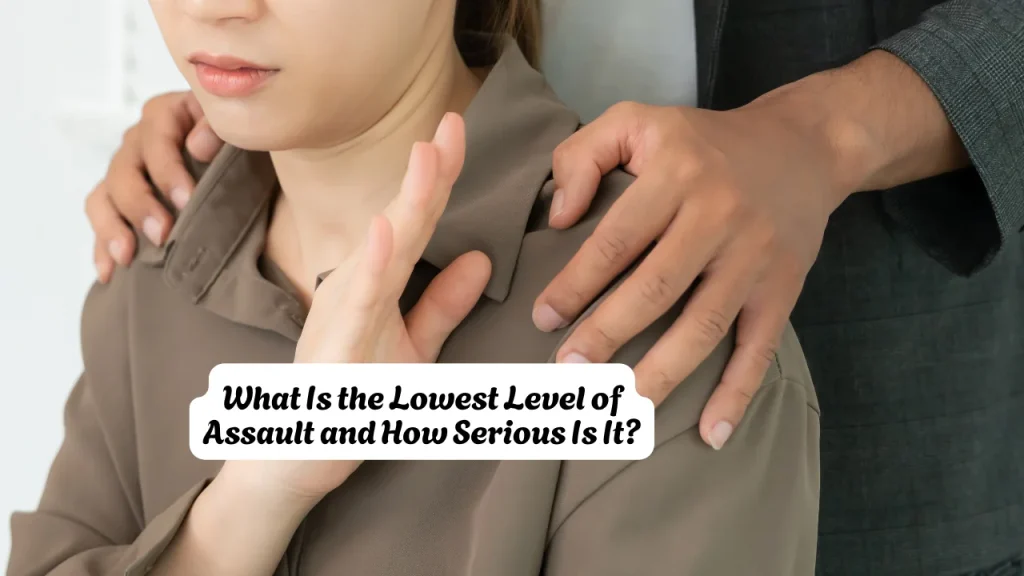
Minor unwanted physical contact that doesn’t cause serious injury. A shove, a slap, grabbing someone by the arm — these can all qualify as simple assault depending on the circumstances and state law.
Attempted harmful contact where no actual touching occurred but the intent and action were present. Some states define assault specifically as the attempt, with battery being the actual physical contact. Others fold both into the word “assault.”
The key factors courts look at are intent, the victim’s reasonable fear, and whether any actual injury occurred. Under the Model Penal Code, which many states have used as a foundation for their own laws, a person commits simple assault when they attempt to cause or purposely, knowingly, or recklessly cause bodily injury to another.
Related article: What Is a Level 2 Assault and How Serious Is the Charge? Penalties & What to Expect
Simple Assault vs. Aggravated Assault — Where the Line Is
Understanding the lowest level means understanding what pushes a charge past it.
Simple assault stays at the lowest level when no weapon was involved, the injury was minor or nonexistent, the accused has little or no prior record, and the victim was not in a protected category under state law.
Aggravated assault enters the picture when a deadly weapon is used or displayed, the victim suffers serious bodily injury, the victim is a police officer, firefighter, nurse, teacher, elderly person, or child — categories most states specifically protect — or when the assault is committed during another crime like robbery or burglary.
A useful way to think about it: a shove during an argument in a bar is likely simple assault. That same shove, with a broken bottle in hand, directed at a nurse in a hospital, is likely aggravated assault — and a potential felony charge.
Is the Lowest Level of Assault a Misdemeanor or Felony?
In the vast majority of states, the lowest level of assault is a misdemeanor — usually classified as a Class A or Class B misdemeanor depending on the state and specific circumstances.
Typical consequences for a simple assault misdemeanor include fines ranging from a few hundred to several thousand dollars, probation, mandatory anger management or counseling programs, community service, and in some cases, short jail time — though first-time offenders often avoid incarceration when no injury occurred.
What many people don’t realize is that even a misdemeanor assault conviction can carry consequences well beyond the courtroom. It can show up on background checks, affect employment opportunities, create complications with professional licensing, and in domestic situations, trigger protective orders that restrict where you can go and who you can contact.
According to the Bureau of Justice Statistics, assault offenses consistently rank among the most commonly reported violent crimes in the United States, with simple assault accounting for the large majority of those incidents.
How States Differ on the Lowest Level of Assault
State law shapes this more than most people expect. There is no single national definition of simple assault, and the details vary meaningfully.
In Texas, simple assault under Texas Penal Code § 22.01 includes intentionally, knowingly, or recklessly causing bodily injury, or threatening someone with imminent bodily injury, or making provocative physical contact. The lowest classification is a Class C misdemeanor when no injury occurs — equivalent to a traffic ticket in terms of criminal class, though it still goes on your record.
In New York, assault in the third degree under New York Penal Law § 120.00 is the lowest assault charge and requires that the person actually caused physical injury, not just threatened it. New York handles threatening behavior under separate statutes.
In California, simple assault under California Penal Code § 240 is defined as an unlawful attempt to commit a violent injury on another person, combined with the present ability to do so. No injury has to occur.
These differences matter. What qualifies as simple assault in one state may be handled as a separate offense — or a higher charge — in another. This is exactly why speaking with a licensed attorney in your specific state is important before drawing conclusions.
Frequently Asked Questions
What is the statute of limitations for simple assault?
The deadline to file criminal charges or a civil lawsuit for simple assault varies by state. For misdemeanor assault, most states set the statute of limitations between one and three years from the date of the incident. Missing this deadline can permanently bar legal action, so acting promptly matters.
How long does a simple assault case typically take to resolve?
A misdemeanor simple assault case can resolve anywhere from a few weeks to several months, depending on whether the accused pleads guilty, negotiates a plea deal, or takes the case to trial. Cases involving first-time offenders with no injury often resolve faster through diversion programs or plea agreements.
Do I need a lawyer for a simple assault charge?
Even though simple assault is the lowest level charge, having a criminal defense attorney is strongly advisable. A conviction — even for a misdemeanor — can affect employment, housing, and professional licenses. An attorney can negotiate reduced charges, diversion programs, or dismissals that you would likely not achieve on your own.
Can simple assault charges be dropped or expunged?
Yes, in many cases. Prosecutors sometimes drop charges if the victim does not cooperate or if evidence is weak. Additionally, many states allow first-time offenders to have simple assault convictions expunged after a waiting period and completion of any sentence. Eligibility rules vary significantly by state.
What is the difference between assault and battery?
Some states treat these as separate offenses. Assault typically refers to the threat or attempt to cause harm — the fear it creates. Battery refers to the actual physical contact. Many modern state codes have merged the two under a single “assault” statute, so the distinction depends on which state’s law applies.
Legal Terms Used in This Article
Simple Assault: The lowest-level assault charge, involving threatening behavior, minor unwanted contact, or an attempt to cause harm without a weapon or serious injury.
Aggravated Assault: A more serious assault charge involving a weapon, serious bodily injury, or a protected victim — often charged as a felony.
Misdemeanor: A criminal offense less serious than a felony, typically punishable by fines, probation, or less than one year in jail.
Statute of Limitations: The legal deadline by which charges must be filed or a lawsuit must be started. Missing it usually ends your right to pursue the case.
Model Penal Code: A standardized criminal law framework developed by the American Law Institute, used as a reference by many state legislatures when drafting their own criminal statutes.
Bodily Injury: Physical pain, illness, or impairment of physical condition — the legal threshold for many assault charges.
Expungement: A court process that seals or erases a criminal conviction from your record, making it invisible to most background checks.
If You’re Dealing With an Assault Situation, Don’t Guess
Whether you’ve been charged or you’re the person who was threatened or harmed, the lowest level of assault is still a legal matter with real consequences. Simple assault may sit at the bottom of the charge ladder, but a conviction can follow someone for years through background checks, licensing applications, and professional records.
The right move — whether you’re the accused or the victim — is to talk to a criminal defense attorney or victims’ rights attorney who knows your state’s specific laws. Most offer free initial consultations and can tell you quickly how serious your situation actually is.
Visit AllAboutLawyer.com to find qualified criminal defense attorneys in your area and learn more about your rights.