
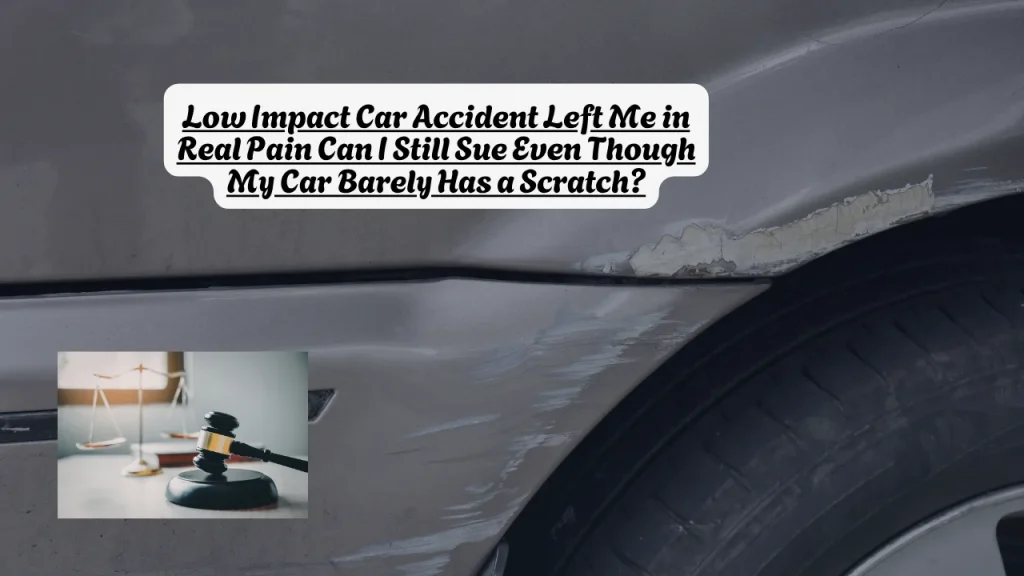
Low Impact Car Accident Left Me in Real Pain Can I Still Sue Even Though My Car Barely Has a Scratch?
Your car looks fine. Maybe a scuffed bumper, a small dent, nothing your neighbor would even notice. But you left that parking lot or that intersection with a stiff neck, a headache that won’t quit, or a back that has kept you up every night since.
And now the insurance adjuster is on the phone telling you, in so many words, that your car barely got touched — so you must be exaggerating.
You are not. And the law is on your side.
Yes, you can sue for injuries from a low-impact car accident. What the adjuster is telling you is a tactic, not a legal standard — and the science they are choosing to ignore directly contradicts them. This article explains why minor vehicle damage does not equal minor injury, exactly how insurance companies fight these claims, and what you need to do right now to protect your case.
Can you file an injury claim for a low-impact car accident with minimal vehicle damage?
Yes. Vehicle damage and occupant injury are two separate things measured by different physical thresholds. The degree of vehicle damage is not a reliable predictor of occupant injury because modern bumper systems may absorb crash energy without transmitting that protection to the occupants — or conversely, may not deform in minor crashes, transmitting the entire crash impulse directly to the vehicle interior. Your car absorbing the impact does not protect your neck, your spine, or your soft tissue from the forces moving through it.
Why a Low-Speed Collision Can Cause Serious Injuries — The Science Insurers Ignore
The insurance adjuster is not a doctor or a physicist. But they will talk to you like they are.
Studies have documented whiplash-type symptoms and soft-tissue injuries in collisions involving relatively low speed changes, including impacts producing minimal visible vehicle damage. For that reason, medical researchers and biomechanical experts caution against using vehicle damage alone to determine whether an occupant was injured.
In other words, the speed at which your body gets hurt is lower than the speed at which your bumper gets dented. A crash that leaves no mark on your car can absolutely leave a mark on you.
Low-severity rear impact accounts for more long-term injury than any other crash mode. The annual cost of whiplash-type injuries is billions of dollars in the U.S. alone.
Many injuries in low-impact collisions occur because the body is not braced for impact. Sudden movement, especially involving the neck and spine, can strain muscles and ligaments at speeds far lower than most people expect. Biomechanical experts can explain how even modest acceleration forces may cause whiplash, back strain, or other soft-tissue injuries — especially when the impact comes from behind.
Even a collision at speeds as low as five miles per hour can cause whiplash, herniated discs, concussions, and other soft-tissue injuries that linger for years.
None of this is fringe science. It is documented in peer-reviewed medical and engineering literature. The insurance company knows it — and is betting you do not.
A personal injury attorney who handles low-impact accident cases can explain how this science applies to your specific situation. Most offer a free legal consultation.
Why Your Symptoms May Not Have Appeared Until Days After the Accident
One of the most common ways insurers attack low-impact claims is the delay between the crash and the pain. If you felt fine at the scene, they will use that against you.
Delayed symptom onset is a well-documented physiological phenomenon. In the immediate post-crash period, elevated adrenaline and other stress hormones suppress pain perception. The acute inflammatory response — the mechanism by which injured tissues signal pain — typically peaks 24 to 72 hours after the injury event.
This is not unusual. It is biology. Your body’s stress response masks pain in the immediate aftermath of an accident. The neck pain that woke you up two days later was caused by the same collision — the timing is expected, not suspicious.
It is common for pain, numbness, stiffness, and limited movement to become worse after the shock of a collision wears off. That does not mean the injury is unrelated.
What this means for your claim: the moment you feel symptoms, see a doctor. Do not wait to see if it gets better. Every day between the accident and your first medical appointment is a gap the insurance company will use to argue something else caused your pain.
Related article: How Much Does a Personal Injury Lawyer Cost and Do You Actually Pay If You Lose?
The Insurance Adjuster’s Playbook — What They Say and Why It’s Wrong
Insurance adjusters use a predictable set of tactics against low-impact injury claims. Knowing them in advance is the single best way to protect yourself.
Tactic 1: “Your car barely has a scratch — you can’t be that hurt.”
Insurance company claim adjusters believe that an individual in a vehicle involved in a collision cannot be injured if the vehicle sustains only minimum structural damage. Yet there is no doubt that individuals involved in minimum structural damage collisions develop symptoms consistent with whiplash-type neck soft-tissue injuries. The adjuster’s position is not based on medicine or physics. It is based on their financial interest in closing your claim for as little as possible.
Tactic 2: “We need a recorded statement from you.”
Adjusters frequently downplay injuries by calling them minor, temporary, or unrelated to the accident — especially when property damage looks limited. If an adjuster contacts you, politely decline to give a recorded statement and speak with an attorney first. Anything you say in a recorded statement can and will be used to minimize your claim. You are not legally required to give one to the other driver’s insurer.
Tactic 3: Hiring their own biomechanical expert.
Insurers hire biomechanical engineers to testify that a vehicle at a certain speed could not have produced enough force to cause the claimed injuries. This ignores the medical reality that occupants can suffer significant injuries in low-speed collisions, particularly to the cervical spine. Your attorney responds by bringing the peer-reviewed science and your own medical expert testimony — evidence the insurer’s hired engineer cannot simply dismiss.
Tactic 4: The early lowball offer.
The Insurance Research Council’s 2024 study reveals that accident victims with legitimate soft-tissue injuries from low-speed collisions receive settlement offers averaging only $8,400 — 72 percent below fair value — because insurance companies successfully exploit the misconception that minor vehicle damage indicates minor injuries. The first offer is almost never fair. It arrives before you know the full extent of your injuries and before you have reached maximum medical improvement.
What Low-Impact Car Accident Injury Claims Actually Pay in 2026
Low vehicle damage does not mean a low-value claim. What drives the value of your claim is the severity of your injury and the quality of your documentation — not how dented your bumper is.
The average settlement for a whiplash injury in a car accident case is between $12,000 and $30,000, assuming no permanent impairments or complications. When the injury is more serious or requires extended treatment, values go significantly higher.
A client involved in a minor fender-bender with minimal vehicle damage initially received an offer of only $3,500. Through complete medical documentation and a six-week physical therapy plan, they secured a $17,500 settlement. That is a fivefold increase — from a low-impact accident with minimal car damage — driven entirely by documentation.
In California, the average whiplash settlement ranges from $10,000 to $75,000, depending on the severity of the injury and the extent of medical treatment required. Cases involving herniated discs, nerve damage, or injuries that prevent return to work push well beyond that range.
What matters to the value of your claim:
- How severe and how long-lasting your injuries are
- Whether you treated consistently without gaps
- Whether imaging — MRI, CT scan — shows objective findings
- How clearly your records connect the injury to the accident
- Whether you missed work and can document it
- Whether you need future medical care
Muscle spasm settlements after a car accident range from $10,000 to over $100,000. Settlement value depends on severity, medical costs, lost wages, and daily life impact. Strong evidence like MRIs and doctor notes is needed to prove soft-tissue damage. Legal representation often increases payout amounts.
If the insurer’s offer does not reflect what your injury has actually cost you, a personal injury attorney can negotiate for the number your case is genuinely worth — most work on contingency, meaning no upfront cost.
How to Build a Strong Low-Impact Accident Injury Claim — Step by Step
The difference between a dismissed claim and a fair settlement is almost always documentation. Here is what to do from the moment you feel symptoms.
See a doctor within 24 to 48 hours. Seeking a medical evaluation within 24 to 48 hours is non-negotiable. A doctor can identify hidden injuries and create an official medical record linking your condition to the crash. This is the single most important step. A medical record created the day after the accident is one the insurer cannot easily challenge.
Get imaging done. X-rays show bones. MRIs show soft tissue damage — ligament tears, herniated discs, spinal cord changes — that X-rays miss entirely. An MRI finding is objective evidence. It is far harder for an insurer to dismiss than your description of pain.
Follow every treatment recommendation without gaps. Every missed appointment or week without treatment is a gap the adjuster will use to argue your injuries were not serious. If your doctor orders physical therapy, go. If they refer you to a specialist, make the appointment.
Start a daily symptom journal. Starting on day one, track your physical symptoms and pain level, emotional and mental state, impact on daily activities and work, and every medical appointment. This consistent record is crucial, especially for injuries that are difficult to measure, such as ongoing pain or psychological distress. Your journal entries become evidence of what your injury has cost you in daily life — evidence that does not show up in a medical record.
Do not give a recorded statement. Politely tell the other driver’s insurer that you will have your attorney contact them. If you do not yet have an attorney, say you are consulting with one. You are not obligated to be interviewed by someone whose job is to minimize your claim.
Request the police report and preserve all photos. The most effective way to prove your injuries were caused by a low-impact car accident is through medical documentation — medical records, medical images, diagnostics, and physical therapy notes. Your photos of the scene and both vehicles, even showing minimal damage, document the event itself and create a timeline.
Do not accept the first offer. A quick settlement offer often arrives before the full extent of injuries is known. Insurance companies know that early offers feel tempting, especially when accident victims are overwhelmed or out of work. These lowball offers usually fail to account for future medical care, ongoing pain and suffering, or the long-term impact of serious injuries.
Frequently Asked Questions About Low-Impact Car Accident Injury Lawsuits
What is the deadline to file a lawsuit after a low-impact car accident injury?
The statute of limitations for personal injury claims in most states is 2 years from the date of the accident. California sets this under California Code of Civil Procedure § 335.1. Texas applies a 2-year deadline under Texas Civil Practice and Remedies Code § 16.003. Florida also sets 2 years under Florida Statute § 95.11(5)(a) after its 2023 reform. Tennessee and Kentucky allow only 1 year. The clock starts the day of the accident, not the day your symptoms appeared. If your injuries were not immediately apparent, some states apply a discovery rule, but this exception is narrow and contested. Do not assume you have more time than you do.
How long does a low-impact car accident injury claim take to settle?
Simple claims with clear liability and well-documented soft-tissue injuries typically settle in 3 to 9 months. Cases where the insurer disputes causation — arguing the impact was too minor to cause injury — take longer, often 12 to 24 months. Cases that go to trial take longer still. Reaching maximum medical improvement before settling is essential, even if it means waiting.
Do I need a lawyer for a low-impact car accident, or can I handle the insurer myself?
You can negotiate directly. But low-impact collision victims who receive fair settlements do so through complete medical documentation and legal pressure on insurers who otherwise pay 72 percent below fair value on these claims. An attorney knows how to counter the “no damage, no injury” argument with biomechanical evidence and medical expert testimony — tools an unrepresented claimant rarely has access to.
Can the insurer use my social media against my low-impact injury claim?
Yes. Adjusters monitor social media for posts, photos, or check-ins that suggest you are more active or less injured than your claim states. A photo of you at a family event two weeks after the accident — even if you were in pain the entire time — can be taken out of context to undermine your credibility. Avoid posting about your activities, your recovery, or the accident itself until your claim is resolved.
What if my pre-existing back or neck condition made the injury worse?
The eggshell plaintiff rule applies to low-impact accidents just as it does to any other collision. A defendant must take you as they find you — including any prior vulnerability. If your pre-existing condition meant you were injured more severely than someone without that history, the at-fault driver is still responsible for the additional harm they caused. You cannot claim for the pre-existing condition itself, only for what the accident made worse. [INTERNAL LINK: pre-existing injury accident claim article on AllAboutLawyer.com]
What if the other driver’s insurance denies my low-impact injury claim entirely?
A denial is not the end. Insurance companies routinely reject valid claims to discourage claimants from pursuing compensation. This can be intimidating and it does work — but this should not be a reason to give up. Have a personal injury attorney review the denial. If the insurer is acting in bad faith — denying a valid claim without a reasonable basis — some states allow additional penalties against the insurer on top of your underlying claim.
Legal Terms Used in Low-Impact Car Accident Injury Claims
Soft-Tissue Injury: Damage to muscles, ligaments, and tendons rather than bones. Whiplash, sprains, and strains fall here. These injuries are real and painful — but harder to see on standard imaging, which is why documentation matters so much.
Causation: The legal requirement to prove the accident caused your injuries. In low-impact cases, this is where insurers concentrate their attack. Medical records, imaging, and biomechanical expert testimony all establish causation.
Maximum Medical Improvement (MMI): The point your doctor determines your condition has stabilized. Settling before MMI risks leaving future medical costs uncompensated. Your attorney will typically wait for this milestone before negotiating.
Biomechanical Expert: An engineer or scientist who analyzes the physics of the crash — force, speed, direction, and impact on the human body — to explain how a low-speed collision caused real injury. Your attorney may hire one to rebut the insurer’s expert.
Recorded Statement: A formal interview recorded by the insurance adjuster. You are not legally required to give one to the other driver’s insurer. Anything you say can be used to minimize your claim.
Comparative Fault: A rule used in most states that reduces your compensation by your percentage of responsibility for the accident. Even in a rear-end collision, insurers sometimes try to assign partial blame to the vehicle in front.
Contingency Fee: Your personal injury attorney gets paid only if you win — a percentage of your settlement. No upfront cost to you.
You now know why vehicle damage and injury severity are measured by different physical thresholds, what the peer-reviewed science says about low-speed impacts and soft-tissue injuries, how insurance adjusters are trained to fight these claims, exactly what steps build a winning case, and what low-impact accident claims actually pay when properly documented.
The adjuster’s argument — “your car barely got touched” — is a financial tactic, not a medical fact. If you are in real pain after what the insurer is calling a minor accident, you have the same legal rights as anyone else hurt by another driver’s negligence. Visit AllAboutLawyer.com to connect with a personal injury attorney who handles low-impact accident claims and can tell you exactly what your case is worth under your state’s personal injury laws, including California Code of Civil Procedure § 335.1 and Texas Civil Practice and Remedies Code § 16.003.
Prepared by the AllAboutLawyer.com Editorial Team and reviewed for factual accuracy against official state statutes, peer-reviewed biomechanical research, and verified legal sources. Last Updated: May 31, 2026
This article is for informational purposes only and does not constitute legal advice. Laws vary by state and individual circumstances differ. For advice about your specific situation, consult a qualified attorney licensed in your state.