
Is a 672 Credit Score Good in 2026? What Lenders See and What It’s Actually Costing You
Is a 672 credit score good?
A 672 credit score sits in the “Good” range under FICO (670–739) and qualifies you for most loans and credit cards. But it sits at the lower end of that range, which means you will get approved — just not at the best rates. The gap between 672 and 740 can cost you thousands of dollars in extra interest over the life of a loan.
If you have a 672 credit score, you are not in bad shape. Most lenders will approve you. You can get a mortgage, an auto loan, and most credit cards. The problem is not approval — it is what approval actually costs you at this score level.
A FICO score of 672 falls within the 670–739 range categorized as Good. A large number of U.S. lenders consider consumers with Good FICO scores “acceptable” borrowers — eligible for a broad variety of credit products, although they may not offer the lowest available interest rates or their most selective products. About 21% of U.S. consumers fall in this range.
The national average FICO score is 714 as of 2025. At 672, you are 42 points below average — and that gap shows up directly in the interest rates lenders quote you. This article breaks down exactly what a 672 score means for every major loan type, what is likely dragging your score down, and what moves it up fastest.
What a 672 Credit Score Means Under FICO and VantageScore in 2026
Not all scoring models read 672 the same way. The model a lender uses changes the label — and sometimes the decision.
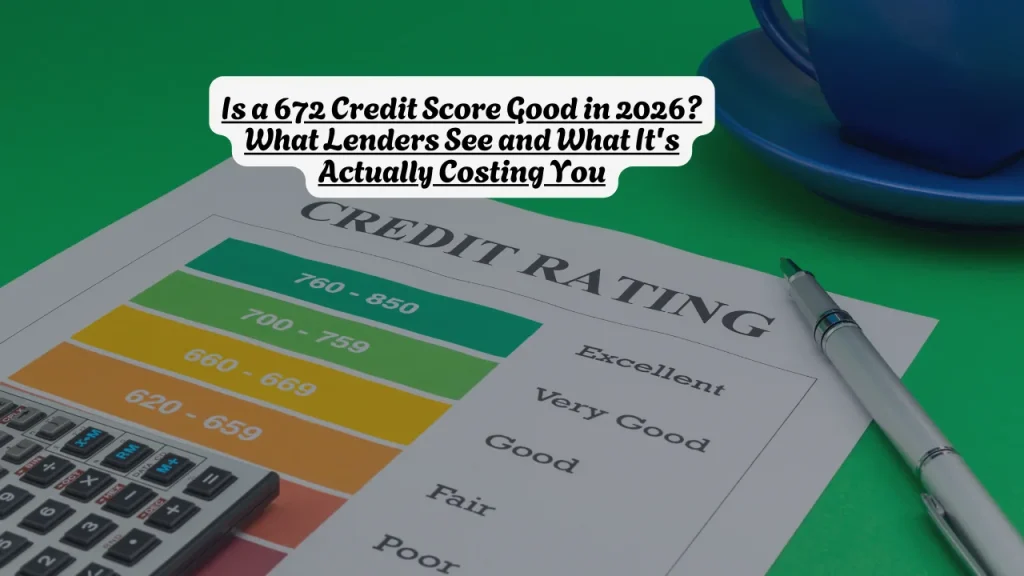
Under FICO, the most widely used model in the US, 672 sits in the “Good” range of 670–739. Under VantageScore, the same number lands in the “Fair” range of 661–780. A 672 is considered “Good” under FICO but falls in the “Fair” range under VantageScore.
Here is where 672 sits across the full FICO scale:
| FICO Range | Category |
| 800–850 | Exceptional |
| 740–799 | Very Good |
| 670–739 | Good ← You are here |
| 580–669 | Fair |
| 300–579 | Poor |
The practical takeaway: 672 keeps you out of the “Fair” danger zone, but you are only 68 points away from “Very Good” — the tier where lenders start offering meaningfully better rates. Every 20-point jump in your score can move you into a cheaper rate tier.
What a 672 Credit Score Gets You on a Mortgage in 2026 — Real Numbers
You can get a mortgage at 672. The question is what it costs you.
A 672 credit score meets the minimum requirements for conventional, FHA, and USDA loans. That covers most buyers. But meeting the minimum and getting the best rate are two very different things.
The current average mortgage rate for someone with a good credit score of 700 is 6.76% as of May 2026, according to Curinos data. You generally need a score of at least 580 to qualify for a mortgage, and a score of 760 or higher to get the best interest rate.
On a $300,000 30-year fixed mortgage, the difference between a rate offered at 672 versus one offered at 760+ can easily run to $50,000 or more in total interest paid over the life of the loan. That is not a rounding error — it is a meaningful financial consequence of sitting at the lower end of “Good.”
Based on Fannie Mae’s latest lending standards, you can get a mortgage with a debt-to-income ratio as high as 45% with a standard 20% down payment if you have a credit score above 720. Below 720, your DTI is capped at 36%. That cap can affect how much home you qualify for.
If you are planning to buy in the next six to twelve months, speak with a consumer rights attorney or financial advisor to review your credit report first. One error on your report — a wrong late payment or an account that is not yours — can be suppressing your score right now, and you have the right to dispute it for free under the Fair Credit Reporting Act, 15 U.S.C. § 1681.
What a 672 Credit Score Means for Auto Loans in 2026
According to MyFICO data from February 2026, the average APR on a 60-month new auto loan for someone with a score in the 660–689 tier is 9.736%, compared to 6.369% for someone with a score of 720 or higher. On a $40,000 new car loan, that gap costs roughly $4,000 more in interest — even though both scores are technically in the “good” range.
That $4,000 difference comes from just one score tier. It is a clear illustration of why 672 is not the finish line — it is a starting point worth building on.
You will get approved for an auto loan at 672. Shop multiple lenders and compare APRs before accepting any offer, because rates vary significantly even for the same score.
Related article: How Rare Is an 830 Credit Score? and What Does It Actually Get You in 2026?
What a 672 Credit Score Gets You on Credit Cards in 2026
A credit score of 672 places you in a position where you will likely qualify for a decent selection of credit cards, but you may not have access to the most premium options with the best rewards or lowest interest rates. Lenders may view your score as indicating a moderate level of risk, potentially leading to higher APRs or lower credit limits.
You can get approved for most standard unsecured cards. Cash-back and travel rewards cards are within reach. Premium cards with the best signup bonuses and lowest rates — those typically require a score above 720 to 740.
The most practical move right now: use the card you have, pay the full balance every month, and keep your utilization below 30%. That single habit, done consistently, moves your score.
A consumer rights attorney can help if your score is being held down by an error — a wrong balance, a duplicate account, or a late payment that was reported incorrectly. Most FCRA disputes can be filed for free, and errors are more common than most people realize.
What Is Likely Holding Your Score at 672 — and How to Fix It
Late payments (past due 30 days) appear in the credit reports of 65% of people with FICO scores of 672. That is the single most common factor suppressing scores in this range. Other common culprits are high credit card balances relative to limits (credit utilization), a short credit history, and too many recent hard inquiries from loan applications.
Here is what moves the needle most — in order of impact:
Pay every bill on time. Payment history accounts for 35% of your FICO score. Late payments can drop your score by 60–110 points each, but a consistent pattern of on-time payments can improve your score within 30 days. Set up autopay for the minimum on every account so you never miss a due date.
Bring credit card balances below 30%. Credit utilization — how much of your available credit you are using — is the second biggest factor in your score. If you have a $5,000 limit and carry a $2,500 balance, that 50% utilization is pulling your score down. Pay it toward 30% or lower and you will see a change within one to two billing cycles.
Dispute any errors on your report. Pull all three reports free at AnnualCreditReport.com. If you discover errors and have them removed, you might see your credit score go up quickly. A good practice is to review each of your credit reports at least once a year, or every few months if you are planning to finance a major purchase soon.
Do not apply for new credit unnecessarily. Every hard inquiry can drop your score a few points. If you are trying to build toward 720 or above, hold off on new applications until you get there.
Keep old accounts open. The age of your credit history matters. Closing an old credit card shortens your average account age and can lower your score. Keep it open even if you rarely use it.
If your score is in the 600–700 range, realistic improvement is 20–50 points within a few months as your profile improves. Changes are more gradual at this level than they are for someone starting from a very low score.
Frequently Asked Questions About a 672 Credit Score
Is a 672 credit score considered good or fair in 2026?
A 672 credit score is considered “good” by both FICO (670–739 range) and VantageScore (661–780 range). This means your chances of being approved for a home or auto loan are higher than someone in a lower range. However, it sits at the lower end of “Good,” so lenders will approve you without offering their best rates.
Can I buy a house with a 672 credit score in 2026?
Yes. A 672 credit score meets the minimum requirements for conventional, FHA, and USDA loans. The challenge is cost — you will pay a higher interest rate than a borrower at 740 or above, which adds up significantly over a 30-year mortgage.
How much does a 672 credit score cost me on a car loan compared to a 720 score?
According to MyFICO data from February 2026, the APR on a 60-month new auto loan for a borrower in the 660–689 range is 9.736%, versus 6.369% for a score of 720 or higher — a difference of roughly $4,000 in interest on a $40,000 loan.
How long does it take to improve a 672 credit score to 720?
There is no guaranteed timeline, but most people in the 670–700 range who pay bills on time, lower their credit card balances, and fix any report errors can reach 720 within three to six months. The biggest single move is lowering credit utilization — it can reflect in your score within one billing cycle.
Can I dispute errors on my credit report that might be lowering my score from 672?
Yes, and it is free. Under the Fair Credit Reporting Act (15 U.S.C. § 1681), you have the right to dispute any inaccurate item directly with the bureau. The bureau must investigate within 30 to 45 days. If it refuses to fix a verified error, you have the right to sue and recover damages, including up to $1,000 in statutory damages and attorney fees under FCRA Section 616.
Does a 672 credit score affect my ability to rent an apartment?
It can. Many landlords pull credit reports as part of the application process. A 672 is generally acceptable for most rentals, but premium properties or property management companies may prefer scores above 700. A landlord cannot pull your report without your consent under the FCRA.
What is the fastest single move to raise a 672 credit score?
Keeping credit card balances below 10% of your limits — for example, under $100 on a $1,000 limit — is the best strategy for reaching scores above 750, and the results can show within one to two billing cycles.
Credit Score Terms From This Article
FICO Score: The most widely used credit scoring model in the US, ranging from 300 to 850. Most lenders use it to make approval and rate decisions.
VantageScore: An alternative scoring model developed jointly by Equifax, Experian, and TransUnion. Also runs 300 to 850 but categorizes ranges differently than FICO.
Credit Utilization: The percentage of your available credit you are currently using. A $2,000 balance on a $4,000 limit equals 50% utilization. Keeping it below 30% helps your score.
Hard Inquiry: A credit check triggered when you apply for a loan or card. Stays on your report for two years and can lower your score by a few points.
Debt-to-Income Ratio (DTI): Your monthly debt payments divided by your gross monthly income. Lenders use it alongside your credit score to decide how much you can borrow.
FCRA (Fair Credit Reporting Act): Federal law at 15 U.S.C. § 1681 that gives you the right to dispute errors on your credit report for free and sue bureaus that refuse to fix verified mistakes.
Where a 672 Credit Score Leaves You — and Your Next Move
You now know that a 672 FICO score gets you approved for mortgages, auto loans, and most credit cards — but costs you more in interest than a score above 720. A 672 FICO score sits at the lower end of the Good range, so managing it carefully to avoid dropping into the more restrictive Fair range (580–669) is important. The path upward is straightforward: pay on time, lower your balances, and check your report for errors.
If something on your credit report is not yours, is inaccurate, or is past its legal reporting window under the FCRA, you do not have to fix it alone. Visit AllAboutLawyer.com to connect with a consumer rights attorney who handles credit report disputes — most FCRA cases are taken at no upfront cost to you.
Sources:
- FICO Score ranges — myfico.com
- Experian: 672 Credit Score overview — experian.com
- MyFICO Auto Loan Rate Data, February 2026 — myfico.com
- Curinos Mortgage Rate Data, May 2026 — experian.com/blogs
- Fannie Mae Lending Standards — fanniemae.com
- Fair Credit Reporting Act, 15 U.S.C. § 1681 — law.cornell.edu
- Consumer Financial Protection Bureau — consumerfinance.gov
This article is for informational purposes only and does not constitute legal or financial advice. Consult a licensed attorney or financial advisor for guidance specific to your situation.
Prepared by the AllAboutLawyer.com Editorial Team. Last Updated: May 26, 2026.