
Dunkin Zero Allulose Lawsuit, Does “Zero Sugar” Really Mean Zero Sugar?
Dunkin’ Brands, Inc. and Inspire Brands, Inc. are facing a putative class action over Dunkin’ Zero energy drinks. An Illinois customer alleges the “zero sugar” and “0g of sugar” marketing is misleading because the drinks contain substantial amounts of allulose, a sweetener that is chemically a sugar. No class has been certified, and there is no settlement or claim form.
Phyllis C. Wells filed the lawsuit on September 30, 2026, in the U.S. District Court for the District of Massachusetts. The case is Wells v. Dunkin Brands, Inc. et al., No. 1:26-cv-14463. It is assigned to Magistrate Judge Jennifer C. Boal.
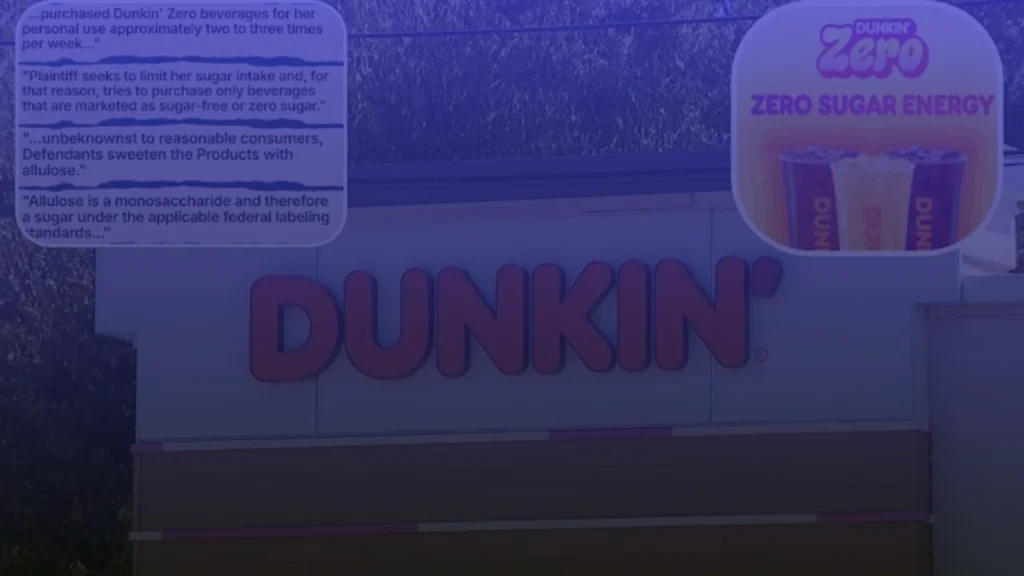
According to reporting on the complaint, a medium Dunkin’ Zero drink contains about 9 grams of allulose and large drinks contain about 11 to 13 grams, even though Dunkin’ markets them as having zero grams of sugar. Wells argues allulose falls within the federal regulatory definition of “sugar,” so the “zero sugar” claims are unlawful and misleading. These are allegations, not findings.
There is an important complication. The FDA has said it will exercise enforcement discretion to let manufacturers leave allulose out of the Total Sugars and Added Sugars lines of the Nutrition Facts label, even though its own guidance recognizes allulose as a monosaccharide. Then, in July 2026, the Seventh Circuit held in Franco v. Chobani that allulose is a sugar under the federal regulation that defines total sugars. The Dunkin’ lawsuit leans heavily on that decision.
The narrow question is: Can Dunkin’ call a drink “zero sugar” when it contains grams of allulose, even though the FDA allows allulose to be omitted from the Total Sugars and Added Sugars declarations? No court has decided that in the Dunkin’ case.
Dunkin’ Zero Allulose Lawsuit: Quick Facts
| Detail | Information |
| Case | Wells v. Dunkin Brands, Inc. et al. |
| Case number | 1:26-cv-14463 |
| Court | U.S. District Court for the District of Massachusetts |
| Judge | Magistrate Judge Jennifer C. Boal |
| Filed | September 30, 2026 |
| Plaintiff | Phyllis C. Wells (Illinois) |
| Defendants | Dunkin’ Brands, Inc. and Inspire Brands, Inc. |
| Products | Dunkin’ Zero energy drinks |
| Product launch | March 4, 2026 |
| Main allegation | “Zero sugar” and “0g of sugar” marketing is misleading because the drinks contain allulose |
| Alleged allulose amount | About 9 grams (medium); about 11 to 13 grams (large) |
| Proposed class | Nationwide purchasers of Dunkin’ Zero beverages since March 4, 2026, plus an Illinois subclass |
| Case type | Putative (proposed) class action |
| Class certified? | No |
| Settlement, claim form or deadline | None |
| Current status | Newly filed; summonses issued to Dunkin’ Brands and Inspire Brands |
Why Is Dunkin’ Brands Being Sued Over Allulose in Dunkin’ Zero Drinks?
Dunkin’ launched Dunkin’ Zero nationwide on March 4, 2026, describing it as a “zero-sugar energy drink.” Its announcement said a medium has 20 calories and zero grams of sugar. The six flavors were Blackberry Tangerine, Tropical Mango, Juicy Peach, Glamberry, Sunzest and Blushpop, sold as lightly carbonated afternoon energy drinks.
The lawsuit does not claim Dunkin’ hid the ingredient. Wells argues that the “zero sugar” marketing combined with significant allulose makes the drinks misleading. According to the complaint as reported, allulose appears in Dunkin’s ingredient materials for the flavored syrups, is a principal ingredient of those syrups and accounts for the carbohydrates in the drinks. The question is whether an ordinary consumer would understand “zero sugar” to mean no sugar at all.
What Does Phyllis Wells Allege About Buying Dunkin’ Zero?
Wells alleges she bought Dunkin’ Zero drinks about two to three times a week at a Chicago-area Dunkin’ location because she was trying to limit her sugar intake and relied on the “zero sugar” claims. She says she would not have bought the drinks, or would have paid less, had she known how much allulose they contained.
That matters because a consumer-deception claim requires more than a label that could theoretically mislead. She must prove the elements of each claim she brings, including a legally recognized injury.
What Is Allulose?
Allulose is a rare sugar found naturally in small amounts in some foods. Chemically it is a monosaccharide, a single sugar unit. The FDA’s guidance explains that the body does not metabolize allulose like conventional sugars and that it contributes far fewer calories, so manufacturers may use 0.4 calories per gram when calculating calories on Nutrition Facts labels.
That is part of why the issue is confusing. There are two related but separate questions:
- What is allulose under the federal regulatory definition of sugar?
- How does the FDA currently let manufacturers show allulose on Nutrition Facts labels?
What Does the Federal “Zero Sugar” Regulation (21 C.F.R. § 101.60(c)) Require?
The rule on sugar-content claims is 21 C.F.R. § 101.60(c). For a “sugar free,” “free of sugar,” “no sugar,” “zero sugar” or similar claim, the food generally must contain less than 0.5 grams of sugars per serving, with “sugars” defined by the Nutrition Facts regulation. The rule also adds conditions about ingredients that are sugars or that consumers generally understand to contain sugars.
Wells argues a drink with about 9 grams of allulose per medium serving cannot qualify for a zero-sugar claim just because the FDA allows allulose to be left out of the Total Sugars line.
What Does 21 C.F.R. § 101.9 Say About Allulose and Total Sugars?
Total Carbohydrate under 21 C.F.R. § 101.9(c)(6) captures carbohydrates in the product, and the FDA’s 2020 allulose guidance says allulose is a carbohydrate that must be included there. Total Sugars, defined in § 101.9(c)(6)(ii), covers free mono- and disaccharides. The FDA acknowledged allulose is a monosaccharide, but in its October 2020 guidance said it would exercise enforcement discretion and not object to excluding allulose from the Total Sugars and Added Sugars declarations while it considered rulemaking.
So the situation is:
- Allulose is included in Total Carbohydrate.
- Allulose may be excluded from Total Sugars and Added Sugars under the FDA’s enforcement discretion.
- The separate “zero sugar” rule in § 101.60(c) refers back to the regulatory definition of sugars.
Wells argues these provisions mean a product cannot be marketed “zero sugar” when it contains substantial allulose.
What Did the Seventh Circuit Decide in Franco v. Chobani?
On July 27, 2026, in Franco v. Chobani, LLC, No. 25-2087, the Seventh Circuit considered a similar dispute over Chobani’s “Zero Sugar” yogurt, which contained about four grams of allulose per serving. A district court had dismissed the case, finding the consumers’ state-law claims preempted because of FDA guidance on allulose. The Seventh Circuit reversed.
The court concluded that allulose is a sugar under the relevant federal regulation, because the definition covers free monosaccharides and allulose is one. It also distinguished the FDA’s enforcement-discretion guidance from the regulation itself: the agency’s decision not to enforce a labeling requirement a certain way does not rewrite the regulation’s text.
This does not decide the Dunkin’ case. The District of Massachusetts is in the First Circuit, so Franco is not binding there. It is highly relevant, though, because it addresses the same legal question.
Why Does the FDA’s Allulose Guidance Not Automatically End the Dunkin’ Case?
The October 2020 document is guidance, not a regulation. The FDA states that guidance does not create legally enforceable responsibilities and describes the agency’s current thinking. It did not amend 21 C.F.R. § 101.60. The Seventh Circuit relied on that distinction in Franco.
Dunkin’ can be expected to argue that its Nutrition Facts panel shows zero Total Sugars and that the FDA allows that. Wells will respond that Nutrition Facts treatment is not permission for a separate “zero sugar” marketing claim. Whether the Massachusetts court agrees is undecided.
What Legal Claims Does the Dunkin’ Zero Lawsuit Make?
According to reporting on the complaint, Wells uses federal labeling standards as the benchmark for state-law claims. The FDCA generally gives private individuals no direct right to sue, so she does not simply allege that Dunkin’ violated an FDA rule.
- Federal labeling framework: The Federal Food, Drug, and Cosmetic Act (21 U.S.C. § 343, misbranding) and 21 C.F.R. Part 101, especially §§ 101.9 and 101.60.
- Illinois Consumer Fraud and Deceptive Business Practices Act (815 ILCS 505/1 et seq.): Prohibits unfair or deceptive acts in trade or commerce. A deception claim generally requires a deceptive act, intent that consumers rely on it, use in trade or commerce, reliance and resulting injury.
- Massachusetts express warranty (G.L. c. 106, § 2-313): Affirmations of fact that become part of the basis of the bargain can create an express warranty. Wells’s theory is that “zero sugar” was such an affirmation.
- Negligent misrepresentation: Supplying false information without reasonable care, on which a plaintiff justifiably relies to her loss.
- Unjust enrichment: That Dunkin’ received money from purchasers because of the challenged claims and it would be inequitable to keep it if the labeling is found unlawful.
- Massachusetts Consumer Protection Act (G.L. c. 93A): The complaint reportedly says Wells intends to add a claim after the statute’s 30-day presuit demand requirement. That does not mean enhanced damages have been awarded. No damages have been awarded.
Could Federal Preemption (21 U.S.C. § 343-1) Defeat the Dunkin’ Lawsuit?
It is one of the likeliest defenses. 21 U.S.C. § 343-1 preempts certain state food-labeling requirements that are not identical to federal ones. In Franco, the Seventh Circuit let the state-law claims proceed because they enforced the same federal standard rather than imposing a different state rule. Wells will argue the same. Dunkin’ may argue the FDA’s guidance supports its labeling. The Massachusetts court is not required to follow Franco.
Why Was the Dunkin’ Lawsuit Filed in Massachusetts by an Illinois Customer?
Wells lives in Illinois, but Dunkin’ has its corporate presence in Massachusetts, and the case is in the District of Massachusetts as a proposed nationwide class action. Which states’ consumer laws apply to a nationwide class could become a major issue.
Which Dunkin’ Zero Customers Does the Lawsuit Try to Represent?
The complaint proposes a nationwide class of consumers who purchased Dunkin’ Zero beverages beginning March 4, 2026, and an Illinois subclass. These are allegations. No court has certified either class, so not every Dunkin’ Zero purchaser is a member of a court-approved class. The definitions could change substantially before certification.
Does Franco v. Chobani Mean Dunkin’ Will Lose?
No. Franco does not mean Dunkin’ violated federal law, does not certify a class, does not establish damages and does not bind the Massachusetts court. The Dunkin’ case still has to survive motions, prove each state-law claim and obtain class certification. The court could follow Franco, distinguish it or reach a different result.
Is the Dunkin’ Case Related to the WK Kellogg Special K Allulose Lawsuit?
Yes, at a high level. Both involve “zero sugar”-style marketing, allulose and federal labeling regulations. See AllAboutLawyer’s coverage: WK Kellogg Special K Allulose Lawsuit, Were You Affected? The Dunkin’ case differs in that it concerns Dunkin’ Zero energy drinks and is pending in Massachusetts.
Is There a Dunkin’ Zero Settlement, and Can I Join the Lawsuit?
No settlement exists, and you cannot join at this time. The case was filed September 30, 2026. There is no settlement agreement, administrator, claim form or payment program, and no certified class. Be cautious of any website advertising a “Dunkin’ Zero settlement claim.” If a class or settlement is ever approved, official court notice would explain who is included and what to do.
What Should Dunkin’ Zero Customers Do Now?
There is no claim to file. If you want to preserve information in case it becomes relevant later:
- Keep paper receipts, card statements and Dunkin’ app order history.
- Take dated screenshots of “zero sugar” marketing and the drink’s nutrition and ingredient information.
- Do not pay anyone to “join” the lawsuit.
Does the Lawsuit Claim Allulose Is Unhealthy?
No. The dispute is about labeling and consumer deception, not a claim that allulose is unsafe. The FDA’s guidance discusses its low caloric value and metabolic characteristics. Anyone monitoring sugar or carbohydrates for medical reasons should rely on individual medical advice, not this lawsuit.
What Happens Next in Wells v. Dunkin Brands?
The case is at its earliest stage. Likely steps include service on the defendants, Dunkin’s and Inspire Brands’ responses, motions to dismiss (including preemption arguments), possible amended complaints, discovery and, if the case survives, a class-certification motion under Federal Rule of Civil Procedure 23. That requires numerosity, commonality, typicality, adequacy and, for damages classes, predominance and superiority. A nationwide class also raises questions about differences among state consumer laws. The case could be dismissed, settle or go to trial, and the outcome cannot be predicted from the complaint alone.
Dunkin’ Zero Allulose Lawsuit Timeline
| Date | Event |
| March 4, 2026 | Dunkin’ launches Dunkin’ Zero nationwide |
| July 27, 2026 | Seventh Circuit decides Franco v. Chobani |
| September 30, 2026 | Wells files suit in the District of Massachusetts; summonses issued |
| October 2026 | Early stage; no class certification or settlement |
Frequently Asked Questions About the Dunkin’ Zero Allulose Lawsuit
Is there a Dunkin’ lawsuit over allulose?
Yes. Phyllis C. Wells filed Wells v. Dunkin Brands, Inc. et al., No. 1:26-cv-14463, on September 30, 2026, in the District of Massachusetts, challenging “zero sugar” marketing on Dunkin’ Zero drinks.
How much allulose does Dunkin’ Zero allegedly contain?
About 9 grams in medium drinks and about 11 to 13 grams in large drinks, according to the complaint as reported. A court has not established those figures.
When did Dunkin’ launch Dunkin’ Zero?
March 4, 2026. Dunkin’s announcement described a medium as 20 calories and zero grams of sugar.
Is allulose a sugar?
Chemically it is a monosaccharide. The Seventh Circuit held in Franco v. Chobani that it is a sugar under the relevant federal regulation, while the FDA lets manufacturers exclude it from Total Sugars and Added Sugars on Nutrition Facts labels under enforcement discretion.
Did the Seventh Circuit rule against Dunkin’?
No. Franco involved Chobani, and the Seventh Circuit’s decision does not bind the Massachusetts court.
Is the Dunkin’ Zero lawsuit a class action?
It is a putative class action. A nationwide class and an Illinois subclass are proposed, but none is certified.
Is there a Dunkin’ Zero settlement or claim form?
No. There is no settlement and no claim form.
What federal rule sets the “zero sugar” threshold?
21 C.F.R. § 101.60(c), which generally requires less than 0.5 grams of sugars per serving for “sugar free” and similar claims.
Does “zero sugar” mean the same as “zero calories”?
No. Dunkin’ says a medium Dunkin’ Zero has 20 calories and zero grams of sugar. Allulose contributes calories at a much lower rate than conventional sugar.
Can I still buy Dunkin’ Zero drinks?
Yes. The lawsuit does not ban the product.
Will Dunkin’ Zero customers get money?
Unknown. The lawsuit seeks damages and restitution, but no court has awarded money and no settlement exists.
Sources and Legal Authorities
- Wells v. Dunkin Brands, Inc. et al., No. 1:26-cv-14463 docket (Justia Dockets)
- Dunkin’ announcement of Dunkin’ Zero, March 4, 2026
- FDA Guidance: The Declaration of Allulose and Calories from Allulose on Nutrition and Supplement Facts Labels
- FDA Guidance (October 2020, PDF)
- FDA: Dear Manufacturer Letter Regarding Sugar Free Claims
- Franco v. Chobani, LLC, No. 25-2087 (7th Cir. July 27, 2026) (Justia)
- Boston 25 News: Dunkin’ faces a potential class-action lawsuit for alleged deceptive marketing
- Mass Legal Resources: Dunkin’ Zero “0g of Sugar” Lawsuit
- 21 C.F.R. §§ 101.9 and 101.60; 21 U.S.C. §§ 343 and 343-1; 815 ILCS 505; G.L. c. 106, § 2-313; G.L. c. 93A
The docket confirms the case, parties and filing date. The complaint’s specific allegations above are as described in the Boston 25 News and Mass Legal Resources reporting.
Disclaimer: For informational purposes only; not legal advice. The allegations against Dunkin’ Brands, Inc. and Inspire Brands, Inc. have not been proven in court.
Researched and written by Israr Ahmad, legal content researcher and founder of AllAboutLawyer.com. All facts checked against the federal court docket in Wells v. Dunkin Brands (Justia Dockets), Dunkin’s March 4, 2026 announcement, the FDA’s allulose guidance, 21 C.F.R. Part 101 and the Seventh Circuit’s Franco v. Chobani opinion, as of October 8, 2026. Last Updated: October 8, 2026.
About the Author
Israr Ahmad is a legal content researcher with 4+ years of experience covering class action settlements and consumer rights cases. He has researched and published coverage of 2,500+ settlements using verified court records, settlement administrator filings, and government sources. Learn more about Israr.