
Federal Judge Throws Out DOJ Lawsuit Against Maine Over Voter Registration Data
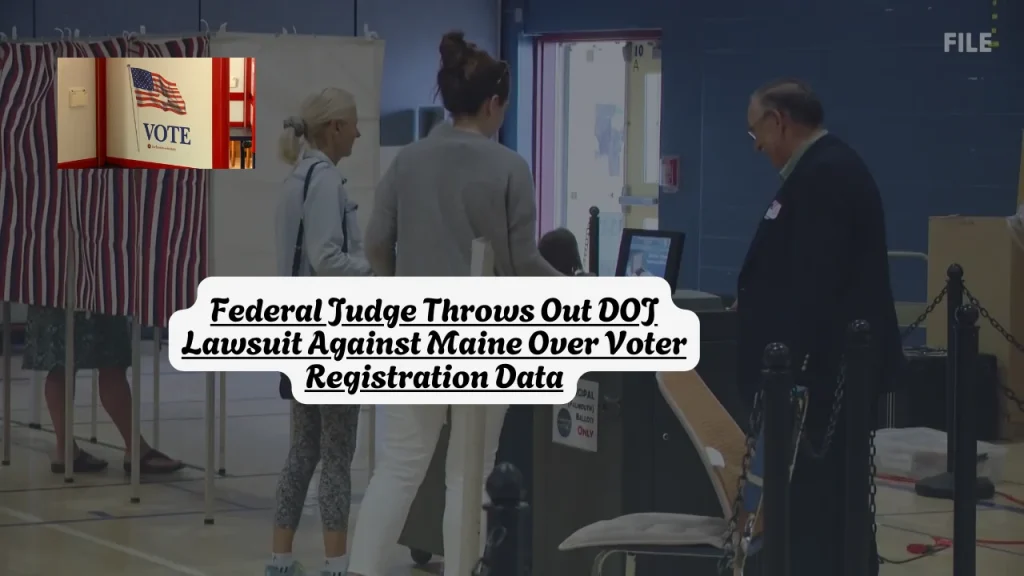
Federal judges in Maine and Wisconsin on Thursday dismissed lawsuits filed by the U.S. Department of Justice seeking to compel the states to hand over detailed voter registration information. In Maine, Chief U.S. District Judge Lance Walker granted the state’s motion to dismiss, concluding that the government’s stated purpose for the request — to ensure compliance with federal voter laws — is insufficient. The ruling is a significant defeat for the Trump administration’s push to collect voter roll data from states across the country — and a direct win for Maine voters whose sensitive personal information was at stake.
Quick Facts: United States v. Maine, U.S. District Court for Maine
| Field | Detail |
| Ruling Date | May 21, 2026 |
| Presiding Judge | Chief U.S. District Judge Lance Walker, U.S. District Court for Maine |
| Plaintiff | U.S. Department of Justice |
| Defendant | Maine Secretary of State Shenna Bellows |
| Outcome | DOJ lawsuit dismissed — Maine’s motion to dismiss granted |
| Legal Basis Argued by DOJ | National Voter Registration Act (NVRA); Help America Vote Act (HAVA); Civil Rights Act of 1960 |
| Data at Issue | Voter registration lists including Social Security numbers, driver’s license numbers, and party affiliations |
| DOJ Response | TBD — no response to appeal questions confirmed as of May 22, 2026 |
| Last Updated | May 22, 2026 |
What Is the Maine Voter Data Lawsuit About?
The DOJ sued Maine Secretary of State Shenna Bellows, alleging she violated the National Voter Registration Act, the Help America Vote Act, and the Civil Rights Act of 1960 by refusing to provide data regarding the removal of ineligible voters and to produce an unredacted, computerized statewide voter registration list.
The voter registration lists at issue include sensitive personal information — voters’ Social Security numbers, driver’s license numbers, and party affiliations. Maine refused to hand that data over, and the DOJ went to court to force compliance.
The lawsuit was part of the Trump administration’s broader push for a national voter list. Maine and 29 other states refused on grounds that the U.S. Constitution grants states the authority to run elections. The Justice Department subsequently brought lawsuits against the 30 states asking courts to compel their secretaries of state to turn over the records.
The DOJ’s Civil Rights Division, led by Assistant Attorney General for Civil Rights Harmeet Dhillon, argued that the NVRA requires states to maintain accurate voter lists and produce them upon request, HAVA mandates states modernize and safeguard voter registration systems, and the Civil Rights Act of 1960 authorizes the government to inspect and copy certain election records.
What Did the Judge Actually Decide?
Chief U.S. District Judge Lance Walker affirmed in his ruling that “states are the primary regulators and administrators of elections for federal office, unless Congress passes legislation that preempts that framework. And Congress’s power to do even that is itself subject to limitations.”
Walker described the government’s claim as “half-hearted” and granted the state’s motion to dismiss. That phrase is significant — a federal judge is not just saying the DOJ lost on legal technicalities. He is saying the government did not even mount a serious legal argument.
Related article: Super Retail Group and Rebel Underpayment Class Action Lawsuit, Were You Underpaid as a Store Manager?
In Wisconsin, U.S. District Judge James Pederson said the state’s voter registration list is not a record that can be requested under the Civil Rights Act of 1960, as the Trump administration argued. The two rulings together reinforce the same core conclusion: the legal tools the DOJ used to demand these voter rolls do not actually give the federal government the authority it claimed.
Both the League of Women Voters of Maine and two Maine voters — John Schneck and Marpheen Chann — intervened in the case to join Bellows in her defense. League spokesperson Jen Lancaster said the organization viewed the DOJ’s request as an attempt to “seize” private citizen data. “The intent behind it was never clearly articulated in court,” Lancaster said. “There was no clear reason why they needed to seize the data.”
How Many States Have Now Beaten the DOJ on This?
In addition to Maine and Wisconsin, judges have also rejected similar DOJ attempts in Arizona, California, Massachusetts, Michigan, Oregon, and Rhode Island. In Georgia, a judge dismissed a DOJ lawsuit because it had been filed in the wrong city, prompting the government to refile elsewhere.
Thursday’s ruling is the eighth in which a judge has sided with states, according to the Maine Secretary of State’s office. The Trump administration filed lawsuits against at least 30 states and the District of Columbia in this campaign. The string of courtroom defeats raises serious questions about whether the DOJ’s legal theory was ever sound — and whether the administration will continue pursuing these cases in the face of consistent judicial rejection.
What Does This Mean for Maine Voters?
If you are a registered voter in Maine, here is what this ruling means for you directly.
Your personal voter registration data — including your Social Security number, driver’s license number, and party affiliation — stays with the state, not the federal government. The court backed Maine’s position that this information is yours, and that the state is the appropriate custodian of it.
Maine Secretary of State Shenna Bellows responded: “Let me be clear — Trump and the DOJ may continue to try to interfere with free and fair elections run by the states. We will not let them.”
The DOJ has not confirmed whether it will appeal the Maine ruling. If it does appeal, the case would move to the U.S. Court of Appeals for the First Circuit. Even if the DOJ refiles or appeals, the consistent pattern of judicial rejection across eight states makes a different outcome far from certain.
What Comes Next?
| Milestone | Status |
| Maine Federal Court Ruling | Issued May 21, 2026 — DOJ lawsuit dismissed |
| Wisconsin Federal Court Ruling | Issued May 21, 2026 — DOJ lawsuit dismissed |
| States Where DOJ Has Now Lost | 8 — Arizona, California, Maine, Massachusetts, Michigan, Oregon, Rhode Island, Wisconsin |
| DOJ Appeal in Maine | TBD — no response confirmed as of May 22, 2026 |
| DOJ Lawsuits Still Pending | TBD — at least 22 states and D.C. have active or pending DOJ actions |
Frequently Asked Questions
Why did the DOJ sue Maine over voter data in the first place?
The Trump administration argued that the NVRA, HAVA, and the Civil Rights Act of 1960 require states to make voter registration lists available for federal inspection to ensure accurate voter rolls and compliance with federal election law. Maine rejected the request, the DOJ sued, and the court sided with Maine.
What data was the DOJ trying to get from Maine?
The DOJ sought access to Maine’s full voter registration lists, which include voters’ Social Security numbers, driver’s license numbers, and party affiliations. Maine refused to provide unredacted data containing that level of personal information.
Why did the judge dismiss the DOJ’s case?
Judge Walker affirmed that states are the primary regulators of elections for federal office under the Constitution, unless Congress passes legislation that specifically overrides that — which it has not done in a way that supports the DOJ’s demands here. He called the government’s legal argument half-hearted and granted Maine’s motion to dismiss.
Is this ruling final? Can the DOJ appeal?
The dismissal is final at the district court level. The DOJ could appeal to the U.S. Court of Appeals for the First Circuit. As of May 22, 2026, the DOJ has not confirmed whether it will appeal the Maine ruling.
Does this ruling affect other states too?
The Maine ruling only directly covers Maine. However, it is now the eighth federal court ruling against the DOJ on essentially the same legal theory. Courts in Arizona, California, Massachusetts, Michigan, Oregon, Rhode Island, and Wisconsin have reached similar conclusions. Those rulings are persuasive — though not binding — on courts in other states still facing DOJ lawsuits.
What happens to the DOJ lawsuits against the other 22+ states?
Those cases continue in their respective federal district courts. Each state’s case will be decided on its own facts and arguments, though the growing body of rulings against the DOJ significantly weakens the administration’s legal position going forward.
Sources & References
- Associated Press, May 21, 2026: Judges in Maine and Wisconsin Dismiss Justice Department’s Attempts to Force Turnover of Voter Rolls — usnews.com
- U.S. Department of Justice press release, September 24, 2025: Justice Department Sues Oregon and Maine for Failure to Provide Voter Registration Rolls — justice.gov
- National Voter Registration Act of 1993 (NVRA), 52 U.S.C. § 20501 et seq.
- Help America Vote Act of 2002 (HAVA), 52 U.S.C. § 20901 et seq.
- Civil Rights Act of 1960, 52 U.S.C. § 20701 et seq.
Prepared by the AllAboutLawyer.com Editorial Team and reviewed for factual accuracy against AP reporting, the Bangor Daily News, and the U.S. Department of Justice’s official press release. Last Updated: May 22, 2026
Disclaimer: This article is for informational purposes only and does not constitute legal advice. Legal claims and outcomes depend on specific facts and applicable law. For advice regarding a particular situation, consult a qualified attorney.
About the Author
Israr Ahmad is a legal content researcher with 4+ years of experience covering class action settlements and consumer rights cases. He has researched and published coverage of 2,500+ settlements using verified court records, settlement administrator filings, and government sources. Learn more about Israr.