
DK Metcalf Faces Defamation Lawsuit After Lions Fan Altercation: What Ryan Kennedy’s Legal Team Says About False Racism Claims
Breaking down the lawsuit: Lions fan Ryan Kennedy is preparing to sue Pittsburgh Steelers wide receiver DK Metcalf for defamation after allegedly being falsely accused of using racial slurs during their December 21, 2025 altercation at Ford Field. Kennedy’s lawyers—Shawn Head and Sean Murphy from Head Murphy Law Firm—say their client never used the N-word, C-word, or any hate speech, and that false accusations have led to death threats, business damage, and harassment of Kennedy’s family. No lawsuit has been filed yet as of December 29, 2025, but Kennedy’s legal team is “evaluating all options” and has reached out to Metcalf’s representatives demanding he correct the record.
You know that moment when you’re watching a football game and something happens that makes you think, “This is going to get messy”? That’s exactly what went down on December 21, 2025, at Ford Field in Detroit. And now, a week later, we’re watching it turn into what could be one of the most expensive legal battles an NFL player has faced off the field.
Let me walk you through this story, because it’s got everything—a two-game suspension, $45 million in voided guarantees, accusations flying both directions, and a Lions fan who just held a press conference with two lawyers sitting next to him.
What Actually Happened at Ford Field
Here’s the scene: Pittsburgh Steelers versus Detroit Lions, second quarter. The Lions’ offense is on the field. DK Metcalf, the Steelers’ star wide receiver, is standing on the sideline when he suddenly walks over to the stands.
There’s a guy sitting in the front row wearing a blue wig. His name is Ryan Kennedy, and he’s been a Lions season ticket holder for 15 years. Video shows Metcalf approach Kennedy, grab him by the shirt collar, pull him closer, then shove him back hard. Metcalf also appears to take a swing—it’s unclear whether the punch actually connected, but the intent was there.
Kennedy throws his hands up after Metcalf makes contact. The whole thing is caught on the CBS broadcast. Officials don’t see it because it happens off the field of play, so Metcalf isn’t penalized or ejected. He finishes the game with four catches for 42 yards.
The Steelers win 29-24 in controversial fashion—the Lions score a last-second touchdown that gets taken off the board due to a penalty.
But nobody’s talking about that game anymore. They’re talking about what happened between Metcalf and Kennedy, and what each side says was said before Metcalf snapped.
The Two Competing Stories
Here’s where this gets complicated. There are two completely different versions of what happened.
Metcalf’s side (according to media reports):
Shortly after the game, word started spreading that Kennedy had used racial slurs toward Metcalf. Former NFL star Chad Johnson went on his Nightcap podcast with Shannon Sharpe and claimed Kennedy had used the N-word and made inappropriate comments about Metcalf’s mother. Tom Pelissero from NFL Media later reported similar claims, saying sources close to Metcalf alleged the fan used offensive language.
The narrative became: Metcalf was provoked by racist hate speech, lost his cool, and reacted.
Kennedy’s side:
Kennedy says that’s completely, totally, categorically false. According to Kennedy and his lawyers, he never used any racial slurs, never used the N-word, never used the C-word, never used any misogynistic or hate-based language at all.
So what did Kennedy say? According to his attorney Shawn Head, Kennedy called Metcalf by his first name—DeKaylin—and asked him for an autograph on a Steelers jersey he was holding.
That’s it. No slurs. No hate speech. Just a fan calling out a player’s government name and asking for an autograph.
Related article: Derek Dixon Lawsuit, Everything About the Tyler Perry $260M Sexual Harassment Case You Must Know in 2025-2026
Why a Lawsuit Is Coming
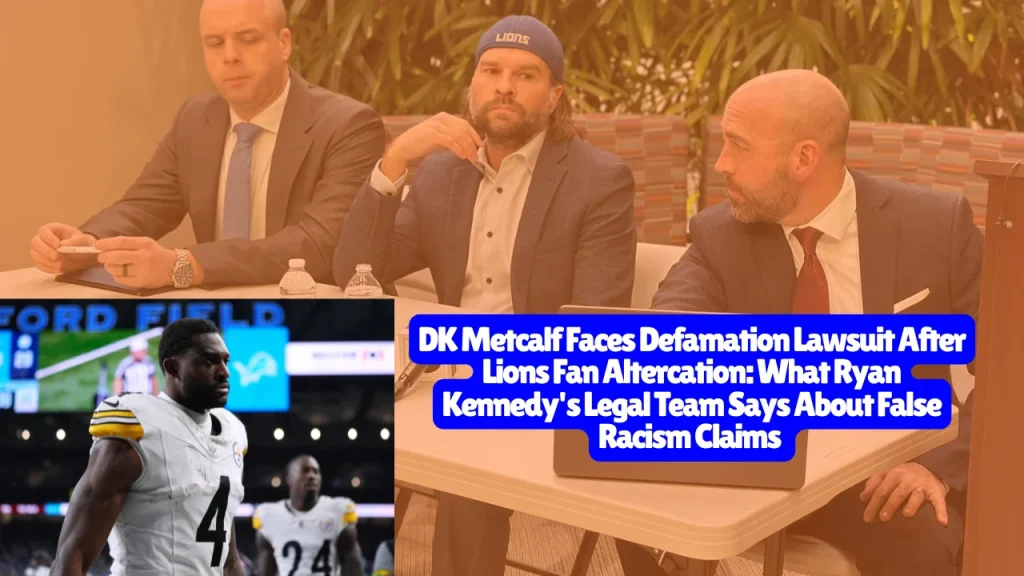
On Friday, December 26, 2025, Kennedy sat down at a press conference with his two lawyers—both wearing suits, Kennedy wearing a backward Lions hat. And Kennedy made his position crystal clear.
“It is really hard to get me upset, but there’s two things, animal abuse, racism, like, I get hot right away,” Kennedy said. “Like, I can feel with my face. It gets all warm. So I guess I want to be crystal clear about one thing: I didn’t use any racial slurs, no hate speech. I mean, none of that stuff at the game. Actually, never — 15 years, season ticker holder for the Lions, I’ve never done that, at all.”
Then Kennedy looked directly into the camera and addressed Metcalf: “So, DeKaylin, if you’re watching this man, just — if you could just say that please, like, my family’s getting threats and stuff, it’s not cool.”
Attorney Shawn Head didn’t mince words about what’s coming next.
“After that assault, false accusations of racism and racial slurs were made publicly,” Head said. “As a result, Ryan Kennedy and his family have received threats, they’ve been harassed, and his business has been damaged. His business has received negative online reviews and negative comments based on those false accusations of racist statements.”
Head continued: “Being falsely branded as a racist is one of the most damaging accusations that a private citizen can endure. It’s dangerous, and it causes very real consequences and very real damage.”
When asked directly whether a lawsuit has been filed, Head said: “Right now, we’re evaluating all of our options, of course, and we’re gonna make sure that we use any legal remedies available to help protect Ryan Kennedy and his family.”
Translation: A lawsuit is coming. It’s just a matter of when.
The Legal Claims Kennedy’s Team Is Building
Kennedy’s lawyers are building two separate legal claims, and understanding both of them is key to understanding why this could cost Metcalf millions.
Claim #1: Assault and Battery
This one’s straightforward. The video evidence is clear—Metcalf walked into the stands, grabbed Kennedy by the shirt, and took a swing at him. That’s textbook assault and battery under Michigan law.
Now, Kennedy wasn’t seriously injured. He didn’t need medical attention. He was interviewed by Ford Field security and allowed to return to his seat to watch the rest of the game. So the damages on an assault/battery claim would likely be minimal—maybe a few thousand dollars at most.
But that’s not where the real money is. The assault/battery claim is almost a secondary issue here.
Claim #2: Defamation
This is the big one. This is where Kennedy’s lawyers see the potential for serious damages, possibly including punitive damages.
Here’s how defamation works in Michigan: If someone makes a false statement about you that harms your reputation, and that statement is published (meaning shared with other people), you can sue for defamation.
But there’s a key distinction. If you’re a public figure—like an NFL player—it’s really hard to win a defamation case. You have to prove the person making the false statement knew it was false or acted with “reckless disregard” for whether it was true or false. That’s called the “actual malice” standard, and it’s a high bar.
Kennedy, however, is not a public figure. He’s a private citizen. A Lions season ticket holder with a business (he wouldn’t say what kind) who sits in the front row and cheers for his team.
For a private citizen, the standard for proving defamation is much, much lower. Kennedy just has to prove:
- Someone made a false statement about him
- That statement was published (shared with others)
- The statement harmed his reputation
- The person making the statement acted negligently (didn’t bother to check if it was true)
And Kennedy’s lawyers are arguing they can prove all four elements easily.
Who Could Get Sued
This is where things get really interesting—and really expensive for multiple people.
Kennedy’s legal team hasn’t filed the lawsuit yet, but their public statements make it clear they’re considering suing several parties:
DK Metcalf: Obviously the primary target. If Metcalf told people Kennedy used racial slurs, and Kennedy can prove that’s false, Metcalf is liable for defamation.
Metcalf’s representatives: If Metcalf’s agent, PR team, or anyone in his camp pushed this narrative to the media, they could be liable too.
Chad Johnson and Shannon Sharpe: Johnson was the first person to publicly claim Kennedy used racial slurs, on the Nightcap podcast he co-hosts with Sharpe. Kennedy’s lawyers specifically mentioned this in their statements. Johnson didn’t cite a source—he just stated it as fact. That’s a problem.
Tom Pelissero and NFL Media: Pelissero from NFL Network reported the same claims about Kennedy using slurs, citing sources close to Metcalf. Kennedy’s lawyers argue NFL Media published these allegations without properly vetting them, without seeking comment from Kennedy, and without mentioning Kennedy’s side of the story (which he’d already given to the Detroit Free Press).
The NFL itself: The league’s in-house media operation published potentially false claims that could now expose them to liability.
Mike Florio from NBC Sports ProFootballTalk explained it perfectly: “The incident itself created little if any true liability. The effort to stave off a suspension and/or to justify Metcalf’s actions could become a very expensive proposition, for Metcalf, his representative(s), and/or multiple media outlets.”
The Damages Kennedy Is Claiming
Kennedy’s lawyers laid out exactly what damage the false accusations have caused:
Death threats and harassment: Kennedy and his family have received threats and messages “advocating violence.” His lawyers say this has created “serious concern for his and his family’s personal safety and well-being.”
Business damage: Kennedy owns a business (he wouldn’t specify what kind). That business has received negative online reviews and negative comments directly tied to the false accusations that he’s a racist.
Reputational harm: “Being falsely branded as a racist is one of the most damaging accusations that a private citizen can endure,” Head said. “It’s dangerous, and it causes very real consequences and very real damage.”
In a defamation case, Kennedy can seek compensation for all of these harms. He can also potentially seek punitive damages—extra money designed to punish the defendants and deter similar conduct in the future.
How much could that be? Hard to say. But defamation cases involving false accusations of racism have resulted in six-figure and even seven-figure verdicts in the past.
What Metcalf Has Already Lost
Before we even get to a potential lawsuit, Metcalf has already paid a steep price for this altercation.
Suspension: The NFL suspended Metcalf for two games for “conduct detrimental to the league.” Metcalf appealed. On December 24, 2025, NFL commissioner designee Chris Palmer upheld the suspension.
Metcalf will miss the Steelers’ final two regular-season games—Week 17 against the Cleveland Browns and Week 18 against the Baltimore Ravens.
Salary forfeiture: Metcalf will forfeit $277,778 per game, for a total of $555,556 in lost salary.
Voided guarantees: Here’s the killer. Metcalf signed a four-year, $132 million extension with the Steelers in March 2025 after being traded from the Seattle Seahawks. That contract included $60 million in guaranteed money.
But there’s a clause in the contract that says if Metcalf “fails to practice or play with the Club for any reason,” including a suspension for “Conduct Detrimental,” his guarantees “will be NULL AND VOID.”
That means $45 million in future guarantees just disappeared:
- $25 million fully guaranteed for 2026
- $20 million injury guarantee for 2027
Metcalf can still earn that money if he stays healthy and productive. But it’s no longer guaranteed. If the Steelers wanted to cut him, they could do so without owing him that money.
The Steelers have publicly said they’re committed to Metcalf for 2026 and beyond. But a commitment isn’t a contract. And if Metcalf gets hit with a massive defamation judgment? That could change everything.
The Backstory: They Have History
Here’s a twist that makes this even messier: Metcalf and Kennedy apparently have history.
According to NFL Network’s Tom Pelissero, Metcalf and Kennedy had a previous interaction in 2024, when Metcalf was still playing for the Seattle Seahawks. The Seahawks traveled to Detroit to play the Lions in Week 4 of the 2024 season.
During that game, Metcalf allegedly reported Kennedy to Seahawks security. We don’t know exactly what happened, but it suggests this wasn’t a random one-time thing.
When Metcalf walked over to Kennedy on December 21, 2025—now playing for the Steelers—it’s possible he recognized Kennedy from that previous encounter.
Kennedy’s lawyer acknowledged that Kennedy “was excited to get the attention of a player” and asked for an autograph. “That’s not unusual,” Head said. “It’s not unusual for a spectator to cheer, jeer or try to get the attention of a professional athlete.”
“What is unusual,” Head continued, “is when a professional athlete reacts. What’s even more unusual is when a professional athlete reacts, walks to the stands, reaches into the stands and then grabs a spectator. That’s what’s unusual here.”
How Defamation Law Works in This Case
Let me break down exactly why Kennedy’s defamation case could be so strong—and so expensive for Metcalf and anyone else who gets sued.
Kennedy Is a Private Citizen
This is huge. The Supreme Court has established different standards for defamation depending on whether the plaintiff is a public figure or a private citizen.
Public figures—like NFL players, celebrities, politicians—have to meet the “actual malice” standard. They have to prove the defendant either knew the statement was false or acted with reckless disregard for the truth. It’s a very high bar, designed to protect free speech and robust debate about public figures.
Private citizens like Kennedy just have to prove negligence—that the defendant failed to exercise reasonable care in determining whether the statement was true or false.
That’s a much lower bar. And Kennedy’s lawyers are already laying out the case:
- Chad Johnson stated as fact that Kennedy used racial slurs, without citing any source
- Tom Pelissero repeated the claims without seeking Kennedy’s side of the story
- Nobody verified whether Kennedy actually said what Metcalf claimed he said
- Nobody mentioned Kennedy’s denial to the Detroit Free Press
That’s textbook negligence in defamation law.
Publication Requirement
For defamation, the false statement has to be “published”—meaning shared with third parties. We’re not talking about a newspaper here. “Publication” in defamation law just means the statement was communicated to someone other than the person it’s about.
In this case:
- Metcalf apparently told people (directly or through representatives) what Kennedy allegedly said
- Johnson repeated it on a podcast with millions of viewers
- Pelissero reported it on NFL Network
- It spread across social media
That’s publication. Check.
Falsity
Kennedy categorically denies using any racial slurs, misogynistic language, or hate speech. He’s stated this publicly, through his lawyers, multiple times.
If Kennedy is telling the truth—and his lawyers say they can prove it—then the statements about him are false. Check.
Harm
Kennedy’s lawyers have documented specific harms:
- Death threats and harassment
- Messages advocating violence
- Damage to his business
- Negative online reviews
- Reputational damage
Those are all compensable harms in a defamation case. Check.
Defamation Per Se
Here’s one more legal concept that’s important: “defamation per se.” In Michigan and most other states, certain types of false statements are considered so damaging that harm is presumed—you don’t have to prove actual damages.
False accusations of criminal conduct or serious sexual misconduct fall into this category. So do false statements that harm someone’s business or profession.
Calling someone a racist who used the N-word could potentially qualify as defamation per se, because it accuses them of conduct that’s both morally reprehensible and potentially criminal (depending on the circumstances).
If Kennedy’s lawyers can successfully argue this is defamation per se, they don’t have to prove specific dollar amounts of damage. The law presumes damage occurred.
What Metcalf’s Team Could Argue
Of course, Metcalf and any other defendants would have defenses. Here are the most likely arguments they’d make:
Truth is an Absolute Defense
If Metcalf can prove Kennedy actually did use racial slurs, the defamation case collapses immediately. Truth is an absolute defense to defamation.
The problem: There’s no video or audio evidence of what Kennedy said. The CBS broadcast doesn’t capture it. No witnesses have come forward to corroborate Metcalf’s version.
Kennedy was interviewed by Ford Field security after the incident and was allowed to return to his seat. That suggests security didn’t find evidence he violated the fan code of conduct.
Opinion vs. Fact
Defendants might argue they were expressing opinions, not stating facts. Opinion is generally protected speech.
But that’s a tough argument here. Saying “I think Kennedy used a slur” is opinion. Saying “Kennedy used the N-word” is a statement of fact. And the reports didn’t frame this as opinion—they stated it as fact.
Qualified Privilege for Media
Media defendants like Pelissero and NFL Network might argue they have qualified privilege to report newsworthy information, even if it turns out to be false, as long as they acted responsibly.
But Kennedy’s lawyers are already laying the groundwork to defeat that defense by arguing the media published these claims without seeking Kennedy’s comment, without verifying the facts, and without presenting both sides.
Kennedy’s Own Actions
Defendants might point to video that shows Kennedy saying “That was the goal” after the altercation. Kennedy didn’t deny this through his lawyers—they said he doesn’t deny the video evidence.
But saying “that was the goal” could mean a lot of things. Maybe Kennedy’s goal was to get Metcalf’s attention for an autograph. Maybe it was to rattle Metcalf. That’s a far cry from using racial slurs.
The NFL’s Investigation Continues
Here’s where things stand with the league itself.
Initially, Tom Pelissero reported on December 24, 2025, that neither the NFL nor the Lions planned to punish Kennedy, saying the league found “no violation of the fan code of conduct.”
But the very next day, the NFL contradicted that report. On December 25, 2025, NFL senior vice president Michael Signora announced that Pelissero’s report was “not accurate” and that the fan’s conduct is still under review.
Why the reversal? During Metcalf’s appeal hearing on December 23, 2025, Metcalf apparently provided more information about what Kennedy allegedly said. The NFL is now following up on those claims.
Kennedy’s lawyers see this as a problem. They argue Metcalf repeated false claims during his appeal hearing, and now the NFL is acting on those false claims.
“What’s even more unfortunate is, then, the false accusations later that Mr. Kennedy used racial slurs,” Head said at the press conference.
The NFL’s continuing investigation means this story isn’t over yet. If the league disciplines Kennedy based on Metcalf’s claims, and Kennedy can prove those claims are false, that could strengthen his defamation case even further.
What Kennedy’s Lawyers Have Done Right
From a legal strategy perspective, Kennedy’s team has played this smart.
They went public quickly: On December 23, 2025—just two days after the incident—Kennedy’s lawyers issued a strong statement denying the accusations. They didn’t wait weeks. They got ahead of the narrative.
They demanded a retraction: Head said Kennedy’s lawyers reached out to Metcalf’s representatives asking him to “correct the record” about what Kennedy did or didn’t say. Metcalf hasn’t responded.
That’s important because it shows they tried to resolve this without litigation. If it goes to court, Kennedy’s lawyers can tell the jury: “We gave Metcalf a chance to fix this. He refused.”
They held a press conference: On December 26, 2025, Kennedy sat down with reporters, flanked by his two lawyers. Kennedy made a brief statement, then his lawyers answered questions.
This accomplished several things:
- It put Kennedy’s denial on the record in a formal setting
- It showed Kennedy is serious about fighting this
- It generated media coverage that started to shift the narrative
- It put pressure on Metcalf to respond
They’re building the damages case: Kennedy’s lawyers have been specific about the harms—death threats, business damage, harassment. They’re not just saying “this hurt his feelings.” They’re documenting concrete, measurable damage.
They haven’t filed yet: As of December 29, 2025, no lawsuit has been filed. Kennedy’s lawyers are “evaluating all options.”
This is smart. By threatening a lawsuit but not filing yet, they give Metcalf a chance to settle. Settlement negotiations often happen before a lawsuit is filed. Once you file, everyone’s positions harden and it becomes a public court battle.
If Metcalf were smart, he’d reach out and try to settle this now—issue a statement saying he never heard Kennedy use racial slurs, pay Kennedy some money for his trouble, and move on.
But Metcalf hasn’t done that. And the longer he waits, the stronger Kennedy’s case becomes.
The Financial Stakes
Let’s talk numbers, because this is where things could get really ugly for Metcalf and anyone else who gets sued.
Metcalf has already lost $555,556 in salary and $45 million in guaranteed money (though he can still earn that if he stays with the Steelers).
If Kennedy files a defamation lawsuit and wins, here’s what could happen:
Compensatory damages: These are meant to compensate Kennedy for his actual losses—business damage, emotional distress, reputational harm. This could easily be in the six-figure range, possibly higher depending on how much Kennedy can prove his business suffered.
Punitive damages: These are meant to punish the defendant and deter similar conduct. Michigan law allows punitive damages in cases involving malice, fraud, or willful misconduct.
If a jury believes Metcalf knowingly made false accusations about Kennedy, or acted with reckless disregard for the truth, punitive damages could be substantial—potentially millions of dollars.
Attorneys’ fees: In some defamation cases, the losing party has to pay the winner’s attorneys’ fees. That could add hundreds of thousands more to the bill.
Multiple defendants: If Kennedy sues Metcalf, Chad Johnson, Shannon Sharpe, Tom Pelissero, NFL Media, and potentially others, the total damages across all defendants could be enormous.
And remember: Defamation cases go to juries. Juries are unpredictable. They’re made up of regular people—people who might identify more with Kennedy, the season ticket holder, than with Metcalf, the multi-millionaire NFL star.
A sympathetic plaintiff, a clear video of an assault, documented death threats, business damage, and a defendant who refused to correct the record? That’s a plaintiff’s lawyer’s dream case.
What Happens Next
Based on Kennedy’s lawyers’ statements, here’s the likely timeline:
Now through early January 2026: Settlement negotiations. Kennedy’s team has made it clear they want Metcalf to “correct the record.” If Metcalf reaches out and offers a settlement—money plus a public statement clearing Kennedy’s name—this could end quietly.
If no settlement: Kennedy’s lawyers file a defamation lawsuit, probably in Michigan state court (since that’s where the incident happened and where Kennedy lives). The lawsuit would name Metcalf as a defendant, and possibly others.
Discovery: This is where things get interesting. Kennedy’s lawyers would subpoena Metcalf’s phone records, text messages, emails, and communications with his representatives. They’d depose Metcalf under oath. They’d try to find out exactly what Metcalf said about Kennedy and to whom.
They’d also depose Chad Johnson, Tom Pelissero, and anyone else who published the claims about Kennedy.
Trial: If the case doesn’t settle (and most cases do settle), it would go to trial. A jury would hear both sides and decide: Did Kennedy use racial slurs or not? Did Metcalf and others make false statements about Kennedy? How much damage did those false statements cause?
This could be 12-18 months from now, possibly longer.
Verdict and appeals: If Kennedy wins, there would likely be appeals. This could drag on for years.
But here’s the thing: Most defendants don’t want this going to trial. Trials are expensive, unpredictable, and public. Metcalf’s lawyers would likely advise him to settle—pay Kennedy some money, issue a statement, and move on with his life.
The Broader Implications
This case raises some really important questions about fan-athlete interactions and the modern media landscape.
Should athletes be allowed to confront fans? The NFL’s policy is clear: Players cannot enter the stands or confront fans. If a player makes physical contact with a fan, they face discipline.
Steelers coach Mike Tomlin acknowledged the challenge: “I just think volatile rhetoric is a component of our business today, unfortunately. It just is. But not only our business, college, youth sport parents. I think it’s just a component of sport that’s developed, and developed in a big way in recent years, and it’s unfortunate.”
Tomlin’s right. Fans say terrible things to players. Social media has made it worse. Athletes hear vile, racist, sexist, hateful comments constantly.
But the line is clear: No matter what a fan says, a player can’t put hands on them. That’s assault. That’s illegal. There are other ways to handle it—report it to security, have the fan ejected, file a complaint with the team or league.
How should media handle these situations? Chad Johnson and Tom Pelissero both reported that Kennedy used racial slurs, but neither of them apparently verified it with Kennedy first.
That’s journalism 101: If you’re publishing serious allegations about someone, especially a private citizen, you contact them for comment. You give them a chance to respond. You present both sides.
Johnson and Pelissero didn’t do that. And now they could be facing a lawsuit because of it.
The power of false accusations: Kennedy’s lawyers are right about one thing—being falsely accused of racism is devastating in today’s world. It can destroy your reputation, your business, your family’s safety.
The internet doesn’t forgive. Once you’re labeled a racist online, that label sticks, even if it’s false.
That’s why defamation law exists—to give people like Kennedy a way to fight back against false statements and restore their reputation.
Metcalf’s Side of the Story
It’s worth noting: We haven’t heard directly from Metcalf. He didn’t speak to reporters after the game. He hasn’t issued a public statement. His camp has leaked information to the media through intermediaries, but Metcalf himself hasn’t said anything on the record.
That’s probably on advice of counsel. His lawyers are likely telling him: “Don’t say anything. Don’t post anything. Don’t engage.”
But that silence is also hurting him. Kennedy has publicly asked Metcalf to “just say that please”—to clarify whether Kennedy actually used racial slurs.
Metcalf’s silence allows the narrative to shift in Kennedy’s favor. People are starting to wonder: If Kennedy really did use slurs, why won’t Metcalf just say so clearly and publicly? Why is he hiding behind unnamed sources and media leaks?
The longer Metcalf stays silent, the more credible Kennedy’s story becomes.
What This Means for Future Cases
If Kennedy follows through and files this lawsuit, it could set an important precedent for future fan-athlete incidents.
Athletes need to know: If you confront a fan, you’d better be able to prove they said what you claim they said. Because if you can’t prove it, and your accusations damage that fan’s reputation, you could be on the hook for serious money.
Media outlets need to know: If you’re going to report serious allegations about a private citizen, you need to verify those allegations and get their side of the story. Otherwise, you could end up as a defendant in a defamation case.
And fans need to know: If someone falsely accuses you of using racial slurs or hate speech, you don’t have to just accept it. You have legal remedies. You can fight back.
The Bottom Line
As of December 29, 2025, here’s where things stand:
DK Metcalf:
- Suspended for 2 games
- Lost $555,556 in salary
- Voided $45 million in guarantees
- Facing a potential defamation lawsuit that could cost millions more
Ryan Kennedy:
- Denied using any racial slurs or hate speech
- Says he just called Metcalf by his first name and asked for an autograph
- Has received death threats and harassment
- His business has been damaged
- His lawyers are preparing to sue
The lawsuit:
- Not filed yet as of December 29, 2025
- Kennedy’s lawyers are “evaluating all options”
- They’ve reached out to Metcalf asking him to correct the record
- Metcalf hasn’t responded
- A lawsuit appears inevitable unless Metcalf settles
Potential defendants:
- DK Metcalf
- Metcalf’s representatives
- Chad Johnson
- Shannon Sharpe
- Tom Pelissero
- NFL Media
- Possibly others
The key question: Did Ryan Kennedy use racial slurs toward DK Metcalf on December 21, 2025?
Kennedy says absolutely not. Metcalf, through intermediaries, says yes. There’s no video or audio evidence either way.
If this goes to trial, a jury will decide. And based on the evidence available right now—video of Metcalf assaulting Kennedy, no proof of what Kennedy said, Kennedy’s credible denials, documented harm to Kennedy—I’d much rather be Kennedy’s lawyer than Metcalf’s.
This is a case Metcalf should settle. The longer he waits, the more expensive it’s going to get.
Disclaimer: This article is based on publicly available information including official NFL statements, court filings, news reports, press conference transcripts, and statements from Kennedy’s legal team as of December 29, 2025. The allegations regarding what Kennedy did or did not say have not been adjudicated in court. This article presents both sides’ claims but does not make a determination of factual truth. The legal analysis provided is for informational purposes only and does not constitute legal advice.
Sources:
- NBC Sports ProFootballTalk (Mike Florio)
- ESPN (Brooke Pryor)
- NFL.com official statements
- CBS Sports (Jonathan Jones)
- Head Murphy Law Firm official statements
- Detroit Free Press
- Fox News
- Yahoo Sports
- Nightcap podcast (Chad Johnson, Shannon Sharpe)
- NFL Network (Tom Pelissero)
- The Athletic
- Detroit News
- Heavy.com
Frequently Asked Questions About the DK Metcalf Lawsuit
Has Ryan Kennedy filed a lawsuit against DK Metcalf yet?
No. As of December 29, 2025, no lawsuit has been filed. Kennedy’s attorneys—Shawn Head and Sean Murphy from Head Murphy Law Firm—have stated they are “evaluating all options” and will use “any legal remedies available” to protect Kennedy. The press conference on December 26, 2025, strongly indicated a lawsuit is coming, but nothing has been filed yet. The lawyers have reached out to Metcalf’s representatives asking him to correct the record, and Metcalf has not responded.
What would Ryan Kennedy sue DK Metcalf for?
Kennedy’s legal team is building two potential claims: (1) Assault and battery, based on video evidence showing Metcalf grabbing Kennedy and taking a swing at him, and (2) Defamation, based on allegedly false accusations that Kennedy used racial slurs, which Kennedy categorically denies. The defamation claim is likely the bigger issue because Kennedy has documented specific harms—death threats, business damage, and harassment of his family—that resulted from being falsely labeled a racist.
What did Ryan Kennedy actually say to DK Metcalf?
According to Kennedy’s attorney Shawn Head, Kennedy called Metcalf by his first name—”DeKaylin”—and asked him for an autograph on a Steelers jersey Kennedy was holding. Kennedy categorically denies using the N-word, C-word, or any racial, misogynistic, or hate-based slurs. Multiple media reports claimed Kennedy used racial slurs, but there is no video or audio evidence supporting those claims. Kennedy was interviewed by Ford Field security after the incident and was allowed to return to his seat, suggesting security found no violation of the fan code of conduct.
Could DK Metcalf go to jail over this?
No. This is a civil matter, not a criminal one. Kennedy would be suing for money damages in civil court. Metcalf wouldn’t face jail time. However, assault and battery are technically crimes, and Kennedy could theoretically file a criminal complaint with police. But given that Kennedy suffered no significant physical injuries, it’s unlikely prosecutors would pursue criminal charges. The real risk for Metcalf is financial—a defamation judgment could cost him millions of dollars on top of the money he’s already lost.
Who else could get sued besides DK Metcalf?
Kennedy’s lawyers have indicated they’re considering suing multiple parties who published or repeated the allegations that Kennedy used racial slurs: (1) Chad Johnson, who claimed on his Nightcap podcast that Kennedy used the N-word and made comments about Metcalf’s mother, without citing any source, (2) Shannon Sharpe, Johnson’s co-host, (3) Tom Pelissero from NFL Network, who reported similar claims citing “sources close to Metcalf,” (4) NFL Media itself, for publishing the claims without vetting them or seeking Kennedy’s comment, and (5) Metcalf’s representatives, if they leaked false information to the media.
About the Author

Sarah Klein, JD, is a licensed attorney and legal content strategist with over 12 years of experience across civil, criminal, family, and regulatory law. At All About Lawyer, she covers a wide range of legal topics — from high-profile lawsuits and courtroom stories to state traffic laws and everyday legal questions — all with a focus on accuracy, clarity, and public understanding.
Her writing blends real legal insight with plain-English explanations, helping readers stay informed and legally aware.
Read more about Sarah