
CVS Caremark Will Cover Eli Lilly’s Zepbound Weight Loss Drug Again Starting October 2026 Here Is What Changes for Patients
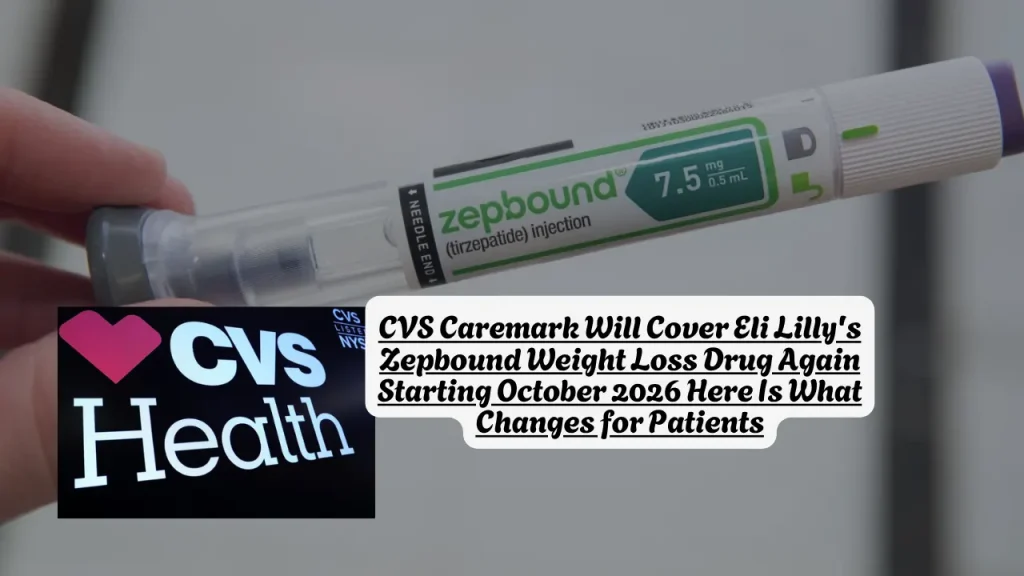
CVS Caremark will resume covering the weight loss drug Zepbound this year after it removed it from its list of covered medications last year, drugmaker Eli Lilly said Thursday. Zepbound will return to CVS Caremark’s formulary by October 1, and some patients with private insurance could pay as little as a $25 copay. The reversal ends a nearly 15-month gap in coverage that sparked patient protests, lawsuits, and a national debate about whether pharmacy benefit managers should be able to force patients off medications that are working for them.
CVS Caremark Zepbound Coverage Restoration — Key Facts
| Field | Detail |
| Drug Name | Zepbound (tirzepatide) — made by Eli Lilly |
| Coverage Removed | July 1, 2025 |
| Coverage Restored | By October 1, 2026 |
| Minimum Copay | As low as $25/month for eligible privately insured patients |
| Formulary Affected | CVS Caremark standard formulary |
| Members Affected | Approximately 25–30 million people |
| Additional Drug Added | Foundayo (Lilly’s weight loss pill, FDA-approved April 2026) — added starting June 2026 |
| Active Lawsuit Status | Class action filed September 2025 — remains active |
| Source | Eli Lilly announcement, May 28, 2026; NBC News |
What CVS Caremark Is and Why Its Formulary Decisions Affect Tens of Millions of Americans
CVS Caremark is one of the country’s largest pharmacy benefit managers, deciding which medications millions of people in the U.S. can get through insurance and how much they pay out of pocket. A pharmacy benefit manager — or PBM — sits between drug manufacturers, insurers, and patients, negotiating prices and determining which drugs employers and health plans will cover. Most Americans covered through employer-sponsored health insurance never interact with a PBM directly, but PBMs control what shows up at the pharmacy counter and what the copay will be. The coverage change CVS Caremark made in July 2025 applied to its most common formulary template, which represents between 25 and 30 million individuals overall.
For a full picture of legal challenges facing CVS Caremark’s PBM practices, see our coverage of CVS class action lawsuits and how they affect pharmacy benefit management.
Why CVS Caremark Dropped Zepbound in July 2025 — and Why Patients Were Furious
CVS Caremark stopped coverage for Eli Lilly’s weight loss drug Zepbound, blaming drugs like it for driving up overall plan costs. GLP-1 products are “significantly contributing to overall plan costs,” the company stated, and removing coverage would result in an estimated client savings of 10% to 15% year over year in the anti-obesity medication space.
The timing was not a coincidence. CVS Caremark announced it had partnered with Novo Nordisk to “significantly increase access to Wegovy for members at a more affordable price,” removing Zepbound from its Standard, Advanced Control, and Value formularies and giving preferred status to Wegovy instead. PBMs negotiate rebates — essentially, payments from drug manufacturers in exchange for preferred formulary placement. The decision to drop Zepbound appeared to reflect a better rebate deal from Wegovy maker Novo Nordisk rather than any clinical determination.
Patients responded with outrage. CVS Caremark stopped covering Zepbound on July 1 after reaching a deal with Novo Nordisk, with the lawsuit saying some 200,000 people were impacted by the decision. One plaintiff in the class action switched from Zepbound to Wegovy in August after exhausting all appeals to Caremark, then experienced the return of Gastroesophageal Reflux Disease, stomach pain, hunger, and, most notably, weight gain.
The core patient argument was simple: Zepbound and Wegovy are not the same drug. Because of their different methods of action, different clinical outcomes, and different side effects for individual patients, Zepbound and Wegovy are not clinically interchangeable — and as studies have proven, Zepbound is more effective than Wegovy in achieving weight loss, and only Zepbound has been proven effective and approved by the FDA for treating sleep apnea in patients with obesity.
This decision is part of a broader battle over who controls drug access in America — the same dynamic that led to the Blue Cross Blue Shield $2.67 billion health insurance antitrust class action settlement over allegations that insurers conspired to limit competition and raise costs for members.
Related article: Performix SST Metabolism Supplement Lawsuit, Did You Buy It Without a Required FDA Warning on the Label? Gonzalez v. Performix LLC, No. 1:21-cv-01271
What Changes for Zepbound Patients Starting October 2026
Lilly said Thursday that Zepbound will return to CVS Caremark’s formulary by October 1 and that some patients with private insurance could pay as little as a $25 copay.
A CVS Caremark spokesperson said the change applies to its standard formulary, affecting about 25 million to 30 million people.
There is one important caveat every patient needs to understand. Being added to the formulary does not guarantee the drugs will be covered by every insurance plan, since employers often make the final decision about whether to pay for the medications. But being on the list can make coverage more widely available.
In plain English: CVS Caremark’s standard formulary is a template. Your actual coverage depends on whether your specific employer adopted that template or customized their own plan. If your employer previously opted out of covering GLP-1 weight loss drugs entirely, that decision does not automatically change on October 1. You will need to check with your HR department or benefits administrator to confirm your plan’s specific coverage for Zepbound going forward.
Foundayo — Lilly’s New Weight Loss Pill — Is Also Being Added to CVS Caremark
Foundayo, Lilly’s weight loss pill that was approved in April 2026, will also be added to the CVS Caremark formulary starting Monday. Foundayo is significant because it is an oral pill rather than a weekly injection, potentially making weight loss treatment more accessible for patients who cannot or prefer not to use injectable medications. Its addition to the CVS Caremark formulary alongside Zepbound’s reinstatement marks a significant shift in how the largest PBM in the country covers Lilly’s obesity portfolio.
Where the CVS Caremark Zepbound Class Action Lawsuit Stands Now
A class-action lawsuit challenging the decision to drop Zepbound was filed in September 2025 and remains active. The plaintiffs in the class action, filed in New York’s Southern District Court, said the PBM was shirking its fiduciary duty under the Employee Retirement Income Security Act, as their providers had deemed Zepbound medically necessary for them.
The restoration of Zepbound to the formulary does not automatically resolve the lawsuit. Patients who lost coverage between July 1, 2025 and October 1, 2026 — and who suffered documented harm, weight regain, side effects from forced medication switches, or out-of-pocket costs — may still have viable claims for that period of lost access. The lawsuit seeks to restore coverage of Zepbound for people on CVS Caremark plans and award other appropriate equitable relief. Whether the formulary restoration affects the scope of relief the court can award remains to be seen.
If you lost Zepbound coverage through CVS Caremark between July 2025 and October 2026 and suffered health or financial consequences as a result, a free consultation with a consumer rights lawyer can help you assess whether you have a claim before any statute of limitations issues arise.
CVS Caremark and Zepbound — Timeline
| Milestone | Date |
| Zepbound FDA approved for chronic weight management | November 2023 |
| CVS Caremark announces Zepbound removal, Wegovy preferred | May 2025 |
| Zepbound coverage dropped from CVS Caremark standard formulary | July 1, 2025 |
| Class action lawsuit filed in New York’s Southern District Court | September 2025 |
| CVS Caremark confirms no GLP-1 formulary changes for January 2026 | Late 2025 |
| Foundayo (Lilly oral weight loss pill) FDA approved | April 2026 |
| Eli Lilly announces Zepbound returning to CVS Caremark formulary | May 28, 2026 |
| Foundayo added to CVS Caremark formulary | June 2, 2026 |
| Zepbound returns to CVS Caremark standard formulary | October 1, 2026 |
| Class action lawsuit status | Active — Southern District of New York |
Frequently Asked Questions — CVS Caremark Zepbound Coverage 2026
Does CVS Caremark cover Zepbound again?
Yes. Zepbound will return to CVS Caremark’s standard formulary by October 1, 2026, according to an announcement by Eli Lilly on May 28, 2026. It is not yet covered — the effective date is October 1. If you need Zepbound before then, check with your specific plan for formulary exceptions.
How much will Zepbound cost under CVS Caremark in 2026?
Some patients with private insurance could pay as little as a $25 copay. Your actual cost depends on your specific employer plan design, your deductible status, and whether you use Lilly’s savings card. Zepbound has a monthly list price of $1,086, although Lilly offers discounts for patients paying in cash.
Does the formulary change mean my employer plan will automatically cover Zepbound?
Not necessarily. Being added to the formulary does not guarantee the drugs will be covered by every insurance plan, since employers often make the final decision about whether to pay for the medications. Contact your HR department or benefits administrator to confirm your specific plan’s coverage before October 1.
What is Foundayo and when is it covered?
Foundayo is Lilly’s weight loss pill that was approved by the FDA in April 2026. It will be added to the CVS Caremark formulary starting June 2, 2026. It is the first oral GLP-1 class weight loss medication to be added to the CVS Caremark standard formulary, offering an injection-free option for patients.
Are Express Scripts and Optum Rx also covering Zepbound?
The country’s two other major PBMs — Express Scripts and Optum Rx — already cover Zepbound. CVS Caremark was the only major PBM that had excluded it from its standard formulary.
What happens to the class action lawsuit now that Zepbound is coming back?
The class-action lawsuit remains active as of May 28, 2026. Patients who suffered documented harm during the coverage gap — including health consequences from forced medication switches or out-of-pocket costs — may still have claims for that period. If this applies to you, consult a consumer rights lawyer to understand your options.
Why did CVS Caremark reverse its decision?
CVS Caremark has not publicly detailed the specific terms of its new agreement with Lilly. The decision follows more than a year of patient backlash, multiple federal lawsuits, clinical trial results showing Zepbound’s superior weight loss outcomes compared to Wegovy, and competitive pressure as both Express Scripts and Optum Rx continued to cover Zepbound throughout the period CVS Caremark did not.
Sources Used in This CVS Caremark Zepbound Coverage Article
- NBC News — CVS Caremark will cover Lilly’s weight loss drug Zepbound once again, May 28, 2026: https://www.nbcnews.com/health/health-news/cvs-caremark-will-cover-lillys-weight-loss-drug-zepbound-rcna347253
- CNN — CVS Caremark stopped covering a GLP-1 for obesity, class action filed, September 2025: https://www.cnn.com/2025/09/05/health/cvs-caremark-glp-1-lawsuit
Prepared by the AllAboutLawyer.com Editorial Team and reviewed for factual accuracy against the NBC News report by Berkeley Lovelace Jr. published May 28, 2026, and cross-referenced with CVS Caremark’s official formulary page and court filings in the Southern District of New York. Last Updated: May 28, 2026.
This article is for informational purposes only and does not constitute legal advice. Laws vary by state and individual circumstances differ. For advice about your specific situation, consult a qualified attorney.
About the Author
Israr Ahmad is a legal content researcher with 4+ years of experience covering class action settlements and consumer rights cases. He has researched and published coverage of 2,500+ settlements using verified court records, settlement administrator filings, and government sources. Learn more about Israr.