
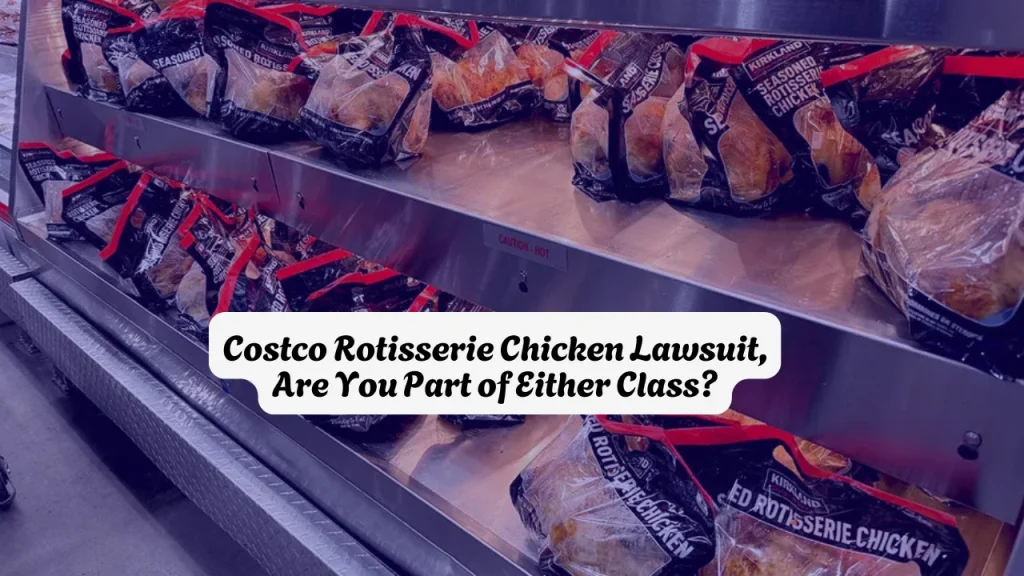
Costco Rotisserie Chicken Lawsuit, Are You Part of Either Class?
The Costco rotisserie chicken lawsuits are two separate proposed class actions targeting Costco’s iconic $4.99 Kirkland Signature Seasoned Rotisserie Chicken, where consumers who purchased the product may have legal standing to participate. The first case, filed January 22, 2026, alleges Costco falsely advertised the chicken as containing “no preservatives.” The second, filed February 12, 2026, alleges Costco knowingly sold chickens from a poultry plant with chronic Salmonella contamination. Both cases are in early litigation — no settlements exist, no claim deadlines apply, and no payouts are confirmed.
Quick Facts: Two Active Costco Chicken Lawsuits
| Field | Preservatives Case | Salmonella Case |
| Case Name | Chernov v. Costco Wholesale Corp. | Taylor v. Costco Wholesale Corp., No. 2:26-cv-00528 |
| Filed | January 22, 2026 | February 12, 2026 |
| Court | U.S. District Court, Southern District of California | U.S. District Court, Western District of Washington |
| Settlement Status | Litigation Phase — No Settlement | Litigation Phase — No Settlement |
| Current Stage | Early litigation | Costco’s motion to dismiss filed April 14, 2026; ruling due May 11, 2026 |
| Claim Deadline | TBD — No settlement reached; no claim form exists | TBD — No settlement reached; no claim form exists |
| Payout Per Person | TBD — No damages confirmed | TBD — No damages confirmed |
| Lead Plaintiffs | Anatasia Chernov & Bianca Johnston (California) | Lisa Taylor (Missouri) |
| Plaintiffs’ Counsel | Almeida Law Group / Wesley M. Griffith | TBD — confirm via PACER docket |
| Last Updated | April 23, 2026 | April 23, 2026 |
Current Status & What Happens Next
- Salmonella case — most urgent update: Costco filed a motion to dismiss the Salmonella lawsuit on April 14, 2026. The judge will rule on Costco’s motion to dismiss by May 11, 2026. That ruling will determine whether the case proceeds or gets thrown out at this early stage.
- Preservatives case: After the lawsuit was filed, Costco stated it had “removed statements concerning preservatives” from signs advertising the chicken — a significant concession that plaintiffs’ attorneys will likely point to as an acknowledgment that the marketing claim was problematic.
- Neither case has reached class certification, discovery, or settlement negotiations. Both are in their earliest procedural stages.
What Are the Costco Rotisserie Chicken Lawsuits About?
Lawsuit 1 — False “No Preservatives” Advertising: Chernov v. Costco Wholesale Corp. (S.D. Cal., January 2026)
On January 22, 2026, two California consumers filed a nationwide class action lawsuit against Costco Wholesale Corporation in the U.S. District Court for the Southern District of California, alleging the retail giant misled millions of shoppers by falsely advertising its popular Kirkland Signature Seasoned Rotisserie Chicken as containing “no preservatives,” despite formulating the product with added preservatives that extend shelf life and maintain texture.
The lawsuit alleges the chicken contains both sodium phosphate and carrageenan — additives used as preservatives. According to the complaint, sodium phosphate and carrageenan are added to inhibit spoilage, stabilize proteins, and extend shelf stability. The plaintiffs argue that Costco prominently displayed “No Preservatives” messaging in stores and online, and that they would not have purchased the product — or would have paid less — had they known about these ingredients.
The legal theories at the center of this case include violations of California’s Consumer Protection Act, California’s False Advertising Law, unjust enrichment, and breach of implied warranty. The complaint asserts that Costco has “systemically cheated customers out of tens — if not hundreds — of millions of dollars” through its false advertising.
Costco’s response to the lawsuit was swift and telling. In a statement to USA Today, the company said it had “removed statements concerning preservatives” from signs advertising the chicken. Removing marketing language immediately after a lawsuit is filed can be cited by plaintiffs as evidence the company knew the claim was problematic.
Related article: American District Telegraph ADT Agrees to $1.3 Million SCRA Settlement What Servicemembers Need to Know
Lawsuit 2 — Chronic Salmonella Contamination: Taylor v. Costco Wholesale Corp., No. 2:26-cv-00528 (W.D. Wash., February 2026)
A proposed class action alleges that Costco’s desire to minimize costs has sparked a “chronic, uncontrolled and unresolved” Salmonella contamination problem within its Kirkland Signature rotisserie chicken supply, exposing consumers to a significant risk of foodborne illness.
The 37-page lawsuit says that Costco’s poultry operation, based at the Lincoln Premium Poultry facility in Nebraska, has earned the USDA’s worst food safety rating — Category 3 — in nearly all reporting periods since 2019. Category 3 is the USDA’s lowest performance band for poultry processor Salmonella compliance — it means a facility has failed to meet federal performance standards. According to the suit, the plant failed every monthly Salmonella test from late 2023 through mid-2025, “reflecting chronic, uncontrolled and unresolved contamination levels.”
Plaintiff Lisa Taylor claims Costco consciously decided to keep its chicken at the $4.99 price point, even if it meant failing to control Salmonella in its chicken supply. The complaint includes claims under the Washington Consumer Protection Act, as well as unjust enrichment and breach of implied warranty of merchantability. Taylor demands a jury trial and requests compensatory, treble, and restitution damages for herself and all class members.
Costco’s defense — April 2026: In its motion to dismiss, Costco said the claims were speculative, emphasizing that properly cooked chicken eliminates Salmonella risk and that the plaintiff did not allege her product was contaminated. The company also argued the “USDA Grade A” label reflects physical quality standards, not food safety or pathogen levels, and therefore was not misleading. Costco further contended the plaintiff’s economic harm argument was inconsistent with her own allegations, noting she described the chicken’s $4.99 price as “impossibly low” compared with competitors. Costco asked the court to dismiss the case with prejudice.
Who Is Eligible for the Costco Rotisserie Chicken Lawsuits?
For the Preservatives Lawsuit (Chernov, S.D. Cal.):
- You may qualify if you purchased a Kirkland Signature Seasoned Rotisserie Chicken from any Costco location in the United States based on the “No Preservatives” claim displayed in-store or on Costco’s website.
- You may qualify if you paid a premium price for the product specifically because you believed it contained no preservatives.
- You may qualify if you are a U.S. resident who purchased the product at any time while the “No Preservatives” marketing was active — California residents have additional statutory protections under state consumer protection law.
For the Salmonella Lawsuit (Taylor, W.D. Wash.):
- The plaintiff seeks to represent a class of all persons in the United States who purchased, for personal or household use, any Kirkland Signature branded rotisserie chicken or raw chicken product sold by Costco from January 1, 2019 to the present.
- You may qualify if you purchased either a prepared Kirkland Signature Rotisserie Chicken or raw Kirkland Signature chicken products from Costco during this period.
- You may qualify if you experienced foodborne illness symptoms after consuming these products — though the current complaint focuses on economic injury (overpaying for a product whose safety risks were not disclosed), not physical injury claims.
Important note: The complaint does not allege that any specific consumer contracted Salmonella illness from a Costco rotisserie chicken. Plaintiff Lisa Taylor alleges economic injury — she claims she overpaid for a product whose safety risks were not disclosed to her.
Potential Recovery & Legal Theory
No individual payout is confirmed for either case. Here is what each lawsuit is pursuing.
Preservatives case: Plaintiffs seek injunctive relief (forcing Costco to change its marketing), restitution, actual damages representing the price premium consumers paid based on the false “no preservatives” claim, and disgorgement of Costco’s profits from the alleged false advertising. The complaint asserts Costco has “systemically cheated customers out of tens — if not hundreds — of millions of dollars.”
Salmonella case: If the case survives Costco’s dismissal bid and ultimately wins class certification, Taylor is asking for payments to shoppers, treble damages, and a permanent injunction that could force changes to how Costco labels or sources its chickens. Treble damages means a court could award up to three times the actual damages found — a significant multiplier that makes this case potentially high-value if it survives dismissal.
The critical near-term gate for the Salmonella case is the May 11, 2026 ruling on Costco’s motion to dismiss. If the court dismisses the case, it could be refiled with amended allegations. If the court denies dismissal, the case advances to discovery and potential class certification — a major milestone for eligible consumers.
How to Join the Costco Rotisserie Chicken Lawsuit
No claim form exists for either case. Both are in early litigation. Here is what eligible consumers should do now:
Step 1 — Document your purchase history. If you purchased Kirkland Signature Rotisserie Chicken or raw Kirkland chicken products from Costco, note the approximate dates, store location, and any receipts. Costco membership records tied to your account may automatically document purchases.
Step 2 — If you experienced foodborne illness after consuming Costco chicken products, preserve all medical records, receipts, and any documentation of your symptoms and treatment.
Step 3 — Contact Almeida Law Group (preservatives case) or the plaintiffs’ attorneys in the Taylor case (Western District of Washington docket) directly to register your interest. Both firms offer free consultations for potential class members.
Step 4 — Monitor the U.S. District Court for the Western District of Washington PACER docket for Case No. 2:26-cv-00528 for the May 11, 2026 ruling on Costco’s motion to dismiss — that decision will determine whether the Salmonella case moves forward.
Step 5 — Monitor the U.S. District Court for the Southern District of California PACER docket for the preservatives case for class certification filings and scheduling orders.
Step 6 — Do not discard any Costco chicken packaging, receipts, or related records. Even without a claim form open, documentation strengthens your eventual claim.
Case Timeline
| Event | Date |
| Lincoln Premium Poultry Plant Opens (Nebraska) | 2019 |
| Plant Begins Earning USDA Category 3 (Worst) Rating | 2019 — nearly continuous since |
| Plant Fails Every Monthly Salmonella Test | Late 2023 – Mid-2025 |
| Consumer Reports Names Plant Among “Most Contaminated” | October 2025 |
| Preservatives Lawsuit Filed (Chernov v. Costco, S.D. Cal.) | January 22, 2026 |
| Costco Removes “No Preservatives” Signs and Website Claims | Late January 2026 |
| Salmonella Lawsuit Filed (Taylor v. Costco, W.D. Wash.) | February 12, 2026 |
| Costco Files Motion to Dismiss Salmonella Case | April 14, 2026 |
| Court Ruling on Motion to Dismiss (Salmonella Case) | On or before May 11, 2026 |
| Class Certification Hearings (Both Cases) | TBD — pending procedural progress |
| Potential Settlement Discussions | TBD — neither case near settlement stage |
Frequently Asked Questions
Do I need a lawyer to join either Costco chicken lawsuit?
Yes — neither case has an open claim form. To participate, you need to contact one of the plaintiffs’ law firms directly. The Almeida Law Group handles the preservatives case and offers free consultations. For the Salmonella case in the Western District of Washington, contact the firm listed on the PACER docket for Case No. 2:26-cv-00528. Both firms work on contingency — no upfront cost to you.
Are these Costco rotisserie chicken lawsuits legitimate?
Yes. Both are active federal court filings. The Salmonella case, Lisa Taylor v. Costco Wholesale Corp., Case No. 2:26-cv-00528, was filed in the U.S. District Court for the Western District of Washington. The preservatives case was filed in the U.S. District Court for the Southern District of California on January 22, 2026. Both are verifiable on PACER at pacer.gov.
When will I receive a payment?
No payment timeline exists for either case. Both lawsuits must clear class certification, survive any motions to dismiss, complete discovery, and either settle or go to trial before any money reaches consumers. That process typically takes two to five years in federal court. The immediate milestone is the Salmonella case ruling expected by May 11, 2026.
What if I missed the deadline to join?
No filing deadline currently exists because neither case has settled. If classes are certified, most eligible consumers will be automatically included. No action is required to preserve your right to participate at this stage — contact a plaintiffs’ firm if you want to be proactive.
Will any settlement affect my taxes?
Potentially. The IRS generally treats class action payments as taxable income unless they compensate for physical injury or illness. Payments for economic damages — such as overpaying for a mislabeled product — are typically treated as ordinary income. Consult a tax professional once any settlement is confirmed. No payment is imminent.
What are sodium phosphate and carrageenan, and why does it matter?
According to the preservatives lawsuit, sodium phosphate and carrageenan are added to the chicken to inhibit spoilage, stabilize proteins, and extend shelf stability. The FDA recognizes both as safe for general consumption. The legal issue is not whether they are harmful — it is whether Costco’s “No Preservatives” claim was truthful. Plaintiffs argue it was not, and Costco’s removal of the claim from stores and its website after the lawsuit was filed strengthens that argument.
What is USDA Category 3 and why does the Salmonella lawsuit rely on it?
The USDA rates poultry processors on a three-tier scale based on Salmonella test results. Category 3 is the worst rating — it means a facility exceeds the federal performance standard for Salmonella contamination. According to the lawsuit, Costco’s Lincoln Premium Poultry plant earned Category 3 in roughly 92% of reporting periods since 2019 and failed every monthly Salmonella test from late 2023 through mid-2025. Costco argues this is irrelevant because the rotisserie chickens are fully cooked before sale, which kills Salmonella bacteria.
Could Costco win the motion to dismiss?
Possibly. Costco’s motion argues the claims are speculative, that properly cooked chicken eliminates Salmonella risk, that plaintiff Taylor did not allege her chicken was improperly cooked or that she suffered any illness, and that the USDA Grade A label was not misleading. These are legally substantive arguments. If the judge agrees, the case could be dismissed — though plaintiffs would likely have the option to file an amended complaint. The May 11, 2026 ruling is the next critical milestone.
Sources & References
- U.S. District Court, Western District of Washington — Case No. 2:26-cv-00528 (Taylor v. Costco): https://pacer.gov
- U.S. District Court, Southern District of California — (Chernov v. Costco): https://pacer.gov
- Almeida Law Group — Official case announcement, preservatives lawsuit (January 22, 2026): https://www.almeidalawgroup.com/updates/costco-rotisserie-preservative-lawsuit/
Prepared by the AllAboutLawyer.com Editorial Team and reviewed for factual accuracy against official U.S. District Court filings, the Almeida Law Group complaint announcement, Meatingplace industry reporting on Costco’s April 14, 2026 motion to dismiss, and USDA FSIS inspection records on April 23, 2026. Last Updated: April 23, 2026
Disclaimer: This article is for informational purposes only and does not constitute legal advice. Legal claims and outcomes depend on specific facts and applicable law. For advice regarding a particular situation, consult a qualified attorney.
About the Author
Israr Ahmad is a legal content researcher with 4+ years of experience covering class action settlements and consumer rights cases. He has researched and published coverage of 2,500+ settlements using verified court records, settlement administrator filings, and government sources. Learn more about Israr.