
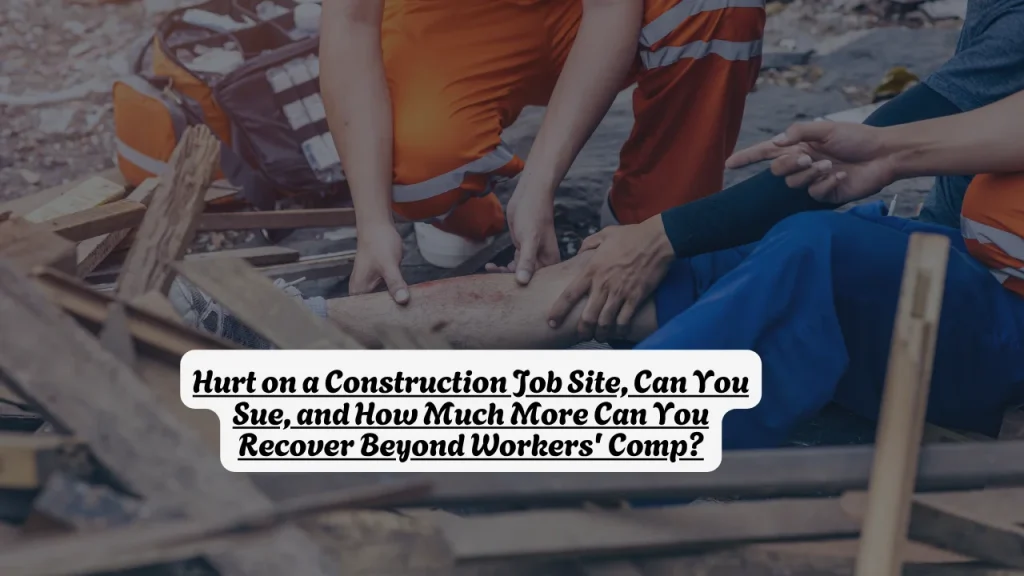
Hurt on a Construction Job Site, Can You Sue, and How Much More Can You Recover Beyond Workers’ Comp?
Can you sue if you were hurt on a construction job site?
Yes — but usually not your employer directly. Workers’ compensation covers your medical bills and a portion of lost wages, but it never pays for pain and suffering. If a general contractor, subcontractor, equipment manufacturer, or property owner contributed to your accident, you can file a third-party lawsuit on top of your workers’ comp claim. Many seriously injured construction workers collect from both at the same time.
How Dangerous Construction Work Really Is — and Why Most Injured Workers Do Not Know Their Full Rights
Construction is the most dangerous major industry in America by death count. In 2022, nearly 1 in 5 workplace deaths occurred in the construction industry, and 38.4 percent of those deaths were caused by falls, slips, and trips alone.
According to the Bureau of Labor Statistics, construction and extraction workers experienced 1,032 fatalities in 2024, with fatal falls among those workers accounting for 370 deaths.
Falls from elevation continue to be the leading cause of death for construction employees, accounting for 389 of the 1,034 construction fatalities recorded in 2024 — and according to OSHA, those deaths were preventable.
Most construction workers who survive these accidents do what their employer tells them: file a workers’ comp claim and wait. What they do not know — and what this article explains clearly — is that workers’ comp is often just the starting point, not the ceiling.
What Workers’ Compensation Covers — and the Major Gap It Leaves Behind
Workers’ compensation is a no-fault system. You do not have to prove your employer was negligent to get benefits. That makes it faster and easier to access. But it comes at a price.
Workers’ comp pays for medical bills and wage loss — but not for pain and suffering. The system does not recognize everyday stress, inconvenience, or emotional frustration as something you can be compensated for.
Wage replacement through workers’ comp is also capped well below your actual earnings. Most states pay two-thirds of your average weekly wage up to a state-set maximum — which in many states leaves seriously injured workers thousands of dollars short of what they actually earned.
Here is what workers’ comp cannot pay you, no matter how bad your injuries are:
- Pain and suffering — past, present, and future
- Full lost wages beyond the state cap
- Emotional distress
- Loss of enjoyment of life
- Punitive damages for reckless conduct by another party
A third-party claim allows injured workers to seek compensation beyond what workers’ compensation provides, covering pain and suffering, full lost wages, and additional medical expenses.
That is the gap a construction accident lawsuit can fill — and in serious injury cases, it is often worth far more than the workers’ comp claim itself. A personal injury attorney can tell you in a free consultation whether you have a third-party claim on top of your workers’ comp benefits.
Who You Can Actually Sue After a Construction Accident — the Third-Party Defendants
Here is the rule most injured workers never hear: you generally cannot sue your direct employer because workers’ comp shields them from lawsuits. But a construction job site almost always involves people and companies beyond your direct employer — and those parties are not shielded.
Common third-party defendants in construction accident lawsuits include general contractors or subcontractors who failed to maintain a safe work environment, equipment manufacturers when defective or malfunctioning equipment caused the injury, and property owners when unsafe property conditions contributed to the accident.
Here is how each works in practice:
General contractors and subcontractors. Most construction sites have multiple employers working at the same time. If a subcontractor’s crew left an unsafe condition that injured you — an uncovered hole, an unsecured load, a missing guardrail — that subcontractor can be sued even if they do not employ you.
Equipment and tool manufacturers. If a tool, machine, or piece of protective gear malfunctions due to a design or manufacturing defect, the injured worker can pursue a claim against the maker. Defective scaffolding, faulty power tools, and failed fall protection equipment have all been the basis for large construction accident verdicts.
Property owners. The owner of the land or building where construction is happening owes a duty to maintain safe conditions. If they knew about a hazard and failed to address it, they can face liability alongside the contractor.
Vehicle and delivery drivers. When a delivery truck or outside vehicle causes an on-site accident, the at-fault driver and their employer may face liability. Our full breakdown of truck accident liability explains how employer liability for commercial drivers works in detail.
The Four Most Common Construction Accidents That Lead to Lawsuits
OSHA identifies four hazard categories that cause the majority of construction deaths. Each one regularly leads to third-party lawsuits.
Falls from height. Falls remain the number one most cited OSHA violation, with 6,557 citations and over $48 million in penalties issued in fiscal year 2024. Under OSHA rules, fall protection is mandatory at elevations of 6 feet or higher in construction. When a contractor fails to provide required guardrails, safety nets, or harnesses, that failure is the foundation of a negligence lawsuit.
Struck-by incidents. Workers hit by falling tools, swinging loads, or moving vehicles on site. Struck-by hazards are the second leading cause of construction fatalities. If a crane operator from a separate company dropped a load, or a delivery driver was not watching for workers on foot, those parties face direct liability.
Caught-in/between accidents. Caught-in/between incidents involve workers being crushed between equipment, materials, or collapsing structures, and often occur in trenching, excavation, and heavy equipment operations. Trench collapses — which are entirely preventable under OSHA’s strict excavation standards — have resulted in some of the largest construction verdicts in U.S. history.
Electrocution. Electrocutions result from contact with overhead power lines, exposed wiring, or improperly grounded equipment and remain a significant contributor to construction fatalities. Utility companies and electrical subcontractors are common defendants when live lines are inadequately marked or protected near workers.
What a Construction Accident Lawsuit Can Recover That Workers’ Comp Never Will
When you file a third-party lawsuit alongside your workers’ comp claim, the damages available expand dramatically.
A successful construction accident lawsuit can recover:
Full lost wages — not the capped two-thirds rate workers’ comp pays, but your actual income loss, including overtime you regularly worked and future earning capacity if you cannot return to the same work.
Pain and suffering — compensation for the physical pain, trauma, and life changes caused by your injury. In serious cases, this is often the largest item in a settlement.
Emotional distress and loss of enjoyment of life — third-party settlements often include damages for emotional distress, ongoing therapy, or loss of enjoyment of life, which workers’ compensation cannot cover.
Future medical costs — surgery, rehabilitation, assistive devices, and long-term care that your doctors say you will need years from now.
Punitive damages — in cases of extreme recklessness, courts can add extra money specifically to punish the responsible party.
The numbers in real cases reflect how large these recoveries can be. In 2025, the 2016 Tribeca crane collapse was resolved for a $272.5 million settlement — the largest construction accident settlement in U.S. history. A $53.5 million jury verdict was awarded for a worker who suffered paralysis from the waist down after falling on the job at a Brooklyn construction site.
Historical settlement data shows construction accident cases in New York generally range from $50,000 to $150,000 for minor injuries like fractures and soft tissue damage, and $150,000 to $500,000 for injuries requiring surgery or extended recovery. Catastrophic injuries — spinal cord damage, traumatic brain injury, amputation — regularly produce seven-figure results.
Related article: Traumatic Brain Injury Lawsuit Settlement, What Your Case Is Actually Worth
How Workers’ Comp and a Third-Party Lawsuit Work Together
You do not have to choose one or the other. You can generally pursue a third-party lawsuit while maintaining your workers’ compensation benefits — but there are rules. Your workers’ comp insurer may seek reimbursement from third-party settlements to recover benefits already paid. Coordinating claims ensures you do not unintentionally reduce compensation from either source.
In practical terms, this means an attorney experienced in both workers’ comp and personal injury law can structure your claims to maximize your total recovery. There is no legal prohibition on filing a third-party claim alongside a workers’ comp case. Your employer cannot fire you for pursuing a personal injury lawsuit — retaliation is prohibited under workers’ compensation law in every state.
If your employer’s workers’ comp insurer tries to deny your claim or reduce your benefits after you file a lawsuit, the rights covered in our guide on what to do when insurance denies your injury claim apply directly to your situation.
What to Do Right After a Construction Site Injury to Protect Your Lawsuit
The steps you take in the first hours and days after a construction accident directly affect what you can recover. Here is what matters most:
Step 1 — Report the injury to your employer immediately. Failing to report can affect your workers’ comp claim and give defendants ammunition to dispute when and how the injury happened.
Step 2 — Get medical attention the same day. Even if you think the injury is minor, see a doctor. Gaps in medical treatment are the first thing defense attorneys use to minimize your case.
Step 3 — Document everything at the scene. Photograph the hazard that caused the injury, the equipment involved, the site conditions, and your injuries. Document the accident thoroughly — take photos, gather witness statements, and record the date, time, and circumstances.
Step 4 — Identify every party on the site. Get the names of the general contractor, every subcontractor present, and the property owner. This becomes your list of potential defendants.
Step 5 — Do not give recorded statements to anyone’s insurance adjuster. Insurers for contractors and property owners will call quickly. Anything you say can be used to limit what they pay you.
Step 6 — Contact a construction accident attorney immediately. Third-party construction claims involve multiple defendants, complex insurance coverage, and OSHA violation records. Collect every piece of paperwork related to the accident, including accident reports, medical records, and all communications with your employer and their insurer — this documentation is necessary for a comprehensive case review.
How Long You Have to File a Construction Accident Lawsuit — Deadlines That Permanently Close Your Case
Your workers’ comp claim has its own short reporting deadlines — most states require you to report a workplace injury within 30 to 90 days.
Your third-party personal injury lawsuit operates on the standard personal injury statute of limitations in your state. Kentucky and Tennessee give you just one year from the date of injury. California and Texas give you two years. New York gives you three years.
If a government entity — a city-owned road, a public transit authority’s construction project — is involved, you may face a notice-of-claim deadline as short as 90 days to preserve your right to sue. These deadlines run at the same time as your workers’ comp claim, and missing either one can permanently end your right to recover.
Frequently Asked Questions About Construction Accident Lawsuits
Can I sue if I was hurt on a construction job site while receiving workers’ compensation?
Yes. Workers’ compensation typically shields your direct employer from lawsuits, but you may have the right to bring a claim against another responsible party — such as a subcontractor, property owner, or equipment manufacturer — who contributed to the accident. Filing a third-party lawsuit does not affect your workers’ comp benefits.
What does a construction accident lawsuit cover that workers’ comp does not?
Workers’ comp pays for medical bills and wage loss — but not for pain and suffering. A third-party lawsuit can recover full pain and suffering, full lost wages beyond the workers’ comp cap, emotional distress, loss of enjoyment of life, future medical costs, and in extreme cases punitive damages.
How long does a construction accident lawsuit take to resolve?
Straightforward cases with clear liability often settle within six to eighteen months. Cases involving multiple defendants, catastrophic injuries, or disputed fault can take two to four years. Most construction accident attorneys negotiate settlements before trial — a settlement avoids the uncertainty of a jury verdict while still recovering significant compensation.
What if OSHA already cited the contractor for the violation that caused my injury?
An OSHA citation is powerful evidence in your lawsuit. It shows the defendant knew about the hazard and failed to fix it. Courts treat OSHA citations as strong indicators of negligence, and defendants with active citations often settle faster and for more money to avoid trial exposure.
What if I was partially at fault for my own construction accident?
In states that follow comparative negligence rules, your compensation is reduced by your percentage of fault — not eliminated entirely. If you were found 20 percent at fault for a $500,000 claim, you would still recover $400,000. Only a small number of states with contributory negligence rules bar recovery entirely if you share any blame.
Do construction accident attorneys charge upfront fees?
No. Construction accident attorneys work on contingency — they only get paid if you recover money. There is no upfront cost to consult, investigate your case, or file a lawsuit.
Legal Terms Used in Construction Accident Lawsuits
Workers’ Compensation: A no-fault insurance system that pays your medical bills and a portion of lost wages after a work injury, regardless of who was at fault. It does not pay for pain and suffering and generally prevents you from suing your direct employer.
Third-Party Claim: A personal injury lawsuit filed against someone other than your direct employer — a contractor, equipment maker, or property owner — whose negligence contributed to your injury. You can pursue this alongside workers’ compensation.
OSHA Fatal Four: The four hazard categories that cause the majority of construction deaths — falls, struck-by incidents, caught-in/between accidents, and electrocutions. OSHA violations in any of these categories are powerful evidence in a lawsuit.
Negligence: Failing to act with the care a reasonable person or company would use, causing injury to someone else. A contractor who skips required fall protection is negligent.
Subrogation: When your workers’ comp insurer recovers money from a third-party settlement to reimburse itself for benefits it already paid you. An experienced attorney structures your claims to minimize how much the insurer takes back.
Statute of Limitations: The legal deadline to file your lawsuit — as short as one year in some states, three years in others. Missing it permanently ends your right to recover from any third party.
Punitive Damages: Extra money courts can award to punish a party for extreme recklessness — such as a contractor who repeatedly ignored OSHA fall protection violations.
Contingency Fee: Your attorney only gets paid if you win. Standard practice for construction accident cases.
What Injured Construction Workers Need to Know Right Now
Falls from elevation alone accounted for 389 of the 1,034 construction fatalities recorded in 2024 — and according to OSHA, those deaths were preventable. When preventable accidents happen because a contractor skipped required safety measures, the law gives injured workers a path to recover far more than workers’ compensation alone can provide.
You now know that workers’ comp is the floor, not the ceiling. A third-party lawsuit against a general contractor, subcontractor, equipment maker, or property owner can recover pain and suffering, full wages, and future medical costs that workers’ comp will never pay — and you can pursue both at the same time.
The most important thing you can do today is talk to an attorney before any deadlines pass. Visit AllAboutLawyer.com to connect with a construction accident attorney. Consultations are free, and there is no fee unless you recover money.
Prepared by the AllAboutLawyer.com Editorial Team and reviewed for factual accuracy against Bureau of Labor Statistics Census of Fatal Occupational Injuries (2024), OSHA official data, and verified court records. Last Updated: June 1, 2026
This article is for informational purposes only and does not constitute legal advice. Laws vary by state and individual circumstances differ. For advice about your specific situation, consult a qualified attorney licensed in your state.