
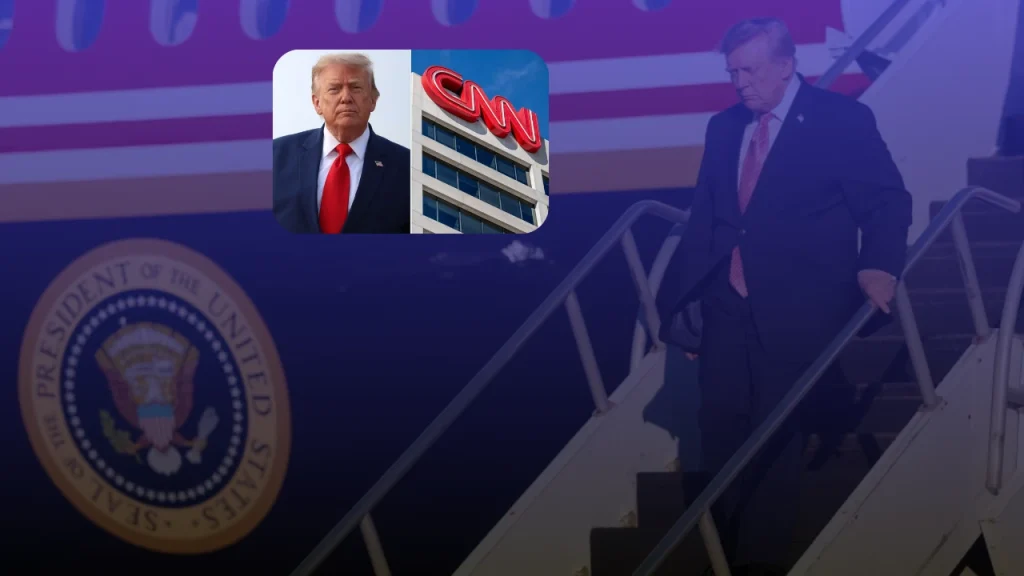
CNN Warns Trump White House, Restore Air Force One Access or Face New Legal Action
CNN is telling the Trump administration it will go back to court if the White House keeps excluding its journalists from Air Force One and other presidential press events. In an October 19, 2026 letter to the Justice Department, CNN’s outside attorney, Theodore J. Boutrous Jr., demanded written confirmation that the administration will stop restricting the network’s access, and warned that CNN will seek further judicial relief if it does not.
The letter came six days after U.S. District Judge Timothy J. Kelly issued a preliminary injunction protecting CNN, MS NOW and Politico journalists from the administration’s effort to revoke their White House press credentials. Judge Kelly found the news organizations likely to succeed on their First Amendment and Fifth Amendment claims.
But getting White House credentials back has not meant getting back onto Air Force One. CNN says the White House has kept it out of the rotating television press pool for presidential trips, including a recent trip to Georgia and Florida. CNN’s October 20 report says its attorney gave the White House until Thursday, October 22, 2026, at 5 p.m. Eastern Time to confirm in writing that it will stop the exclusions.
The question underneath the dispute reaches well beyond one network. Can the federal government limit who covers the president because it dislikes the coverage, or does its control over secure, space-limited settings let it choose which reporters take part? No court has finally answered that. The October 13 injunction is an important interim win for the news organizations, but the Air Force One dispute may need its own ruling.
Quick Facts: CNN v. Trump White House Air Force One Access Dispute
| Detail | Verified information |
| News organizations suing | CNN, MS NOW and Politico |
| Individual journalist plaintiffs | Akayla Gardner, Cheyenne Haslett and Betsy Klein |
| Defendant | President Donald J. Trump and other federal officials |
| Court | U.S. District Court for the District of Columbia |
| Case name | Cable News Network, Inc., et al. v. Donald J. Trump, et al. |
| District court case number | 1:26-cv-03287-TJK |
| District judge | Timothy J. Kelly |
| Government appeal | D.C. Circuit Case No. 26-5356 |
| Ban announced | September 18, 2026 |
| Lawsuit filed | September 21, 2026 |
| Temporary restraining order | September 24, 2026 |
| Preliminary injunction | October 13, 2026 |
| Government appeal filed | October 14, 2026 |
| Latest development | CNN demand letter to the Justice Department, October 19, 2026 |
| CNN’s response deadline | October 22, 2026, 5 p.m. Eastern Time |
| Constitutional claims | First Amendment retaliation and viewpoint discrimination; Fifth Amendment procedural due process |
| Does the order guarantee Air Force One access? | No. It addresses restoration of White House hard-pass credentials and does not expressly guarantee a seat on Air Force One |
| Is there a claim form or payout? | No. This is ongoing constitutional litigation, not a consumer compensation program |
Sources: the October 13 federal court opinion, the public D.C. Circuit docket and CNN’s October 20 report on its lawyer’s letter.
What Did CNN’s October 19, 2026 Letter to the Justice Department Say?
CNN’s outside counsel wrote to the Justice Department alleging that the administration is still discriminating against the network despite Judge Kelly’s October 13 order.
The letter argues that the exclusions are retaliation for CNN’s news coverage and are unlawful. It asks the administration to confirm in writing that it will drop any policy of excluding CNN from the Oval Office and Air Force One, and that it will stop preventing CNN from carrying out its assigned press-pool duties.
According to CNN, the exclusions have happened several times since the court ordered its credentials restored. CNN describes occasions when it was next in the rotating television pool but was left off the list of outlets assigned to cover the president’s travel. The most recent example involved the president’s trip to Georgia and Florida over the preceding weekend.
The letter is not a court filing. It is a compliance demand and a warning. CNN reported on October 20 that the Justice Department had not responded to its request for comment by Tuesday morning. The White House has previously argued that the outlets can report from outside the White House grounds.
Why Did President Trump Ban CNN, MS NOW and Politico From the White House?
On September 18, 2026, President Trump announced on social media that CNN, MS NOW and Politico were banned from the White House. The next morning, journalists from the three organizations found their White House hard passes deactivated and were turned away at the complex.
Trump’s public criticism centered on coverage he called false, inaccurate or unfair. Those statements became key evidence in the lawsuit, because the plaintiffs argued the ban punished their editorial viewpoint instead of applying a neutral rule.
The White House Press Office later sent letters to the outlets citing alleged violations of professionalism and decorum standards, including reporting said to involve falsehoods about national security and the publication of sensitive or classified information. Administration lawyers relied on national security and professional standards to defend the revocations. The news organizations rejected that explanation, pointing to the timing and the president’s own remarks.
The difference matters legally. Government can adopt reasonable rules to protect security and manage access to restricted facilities. If those rules are used to punish journalists because officials disapprove of their views, the First Amendment applies.
What Did Judge Timothy Kelly Order in CNN v. Trump?
Judge Kelly has issued two major orders.
September 24, 2026: Temporary Restraining Order (ECF No. 24)
The first order directed the named administration officials, other than President Trump himself, and those acting with them, to restore the White House hard-pass credentials of CNN, MS NOW and Politico employees that were revoked around September 18. It was temporary, initially lasting 14 days, and addressed the immediate harm of barring journalists from the White House press area while the court considered a full request for preliminary relief.
October 13, 2026: Preliminary Injunction (ECF No. 50)
After hearing arguments on October 8, Judge Kelly granted the plaintiffs’ motion for a preliminary injunction. It keeps the protection in place while the lawsuit proceeds, unless the order is changed or an appeals court steps in.
The judge found the plaintiffs likely to succeed on three theories:
- Fifth Amendment procedural due process: The journalists held a protected interest in their existing White House hard passes and were likely denied adequate procedures when those passes were revoked.
- First Amendment retaliation: The evidence suggested the ban was likely imposed because the president disapproved of the organizations’ reporting.
- First Amendment viewpoint discrimination: The restrictions likely targeted the outlets’ particular views instead of applying neutral rules.
He also found that the plaintiffs would likely suffer irreparable harm without relief, and that the balance of equities and the public interest favored keeping their access in place.
A preliminary injunction is not a final judgment. It rests on the record available at this early stage, and it does not mean the whole case has been tried. The ruling also does not hold that every criticism of the president is well-founded, or that the government cannot act when classified information is unlawfully disclosed. The narrower point was that the evidence at this stage did not adequately support the national security explanation for revoking these hard passes, while the record suggested disagreement with the reporting was a likely reason.
Why Is CNN Still in a Dispute Over Air Force One After Winning in Court?
The October 13 injunction covers White House hard-pass credentials and access to the White House press area. Air Force One is a different setting: limited seating, operational and security constraints, and a rotating group of journalists who report on behalf of the whole press corps.
The order does not expressly give CNN a right to a seat on Air Force One, and it does not automatically resolve every question about press-pool assignments. That gap is the heart of the new dispute.
CNN argues the White House is using its control over presidential travel and the pool to keep excluding the network despite the ruling, which empties the practical value of its restored credentials. CNN’s attorney cited a tally of presidential press interactions during Trump’s second term. As described in CNN’s report, the president had answered more than 4,700 questions in the Oval Office, aboard Air Force One and on the tarmac. Through September 2026, he had appeared in the White House briefing room only four times, compared with 43 Oval Office press events and 51 occasions involving Air Force One or the tarmac. These numbers are CNN counsel’s reported tally, not findings by a court.
The administration’s likely answer is that seats on presidential aircraft are a controlled privilege, not something every qualified journalist is constitutionally entitled to. That raises a narrower question than the one Judge Kelly decided: what limits, if any, does the Constitution place on how the government allocates access to restricted presidential spaces?
What Laws Apply to CNN’s White House Press Access Lawsuit?
First Amendment: Retaliation and Viewpoint Discrimination Against CNN
The First Amendment protects freedom of speech and of the press. As a rule, government officials cannot use their authority to punish protected expression because they disagree with it.
Three lines of Supreme Court authority frame the claim:
- Viewpoint discrimination. In Rosenberger v. Rector and Visitors of the University of Virginia, 515 U.S. 819 (1995), the Supreme Court described viewpoint discrimination as an especially serious form of content-based restriction, even where the government controls the forum or resource.
- Retaliation. In Houston Community College System v. Wilson, 595 U.S. 468 (2022), and Hartman v. Moore, 547 U.S. 250 (2006), the Court addressed claims that officials took adverse action because of protected speech. CNN, MS NOW and Politico point to the president’s public criticism of their reporting before the ban as evidence of that motive.
- No general right of special access. In Branzburg v. Hayes, 408 U.S. 665 (1972), and Houchins v. KQED, Inc., 438 U.S. 1 (1978), the Court said the press has no constitutional right to special access to government sources or facilities beyond what the public gets. The administration can be expected to rely on this line for Air Force One.
Put together, the government does not have to give every journalist a seat everywhere. The constitutional problem arises when access decisions are used to suppress a viewpoint instead of serving a legitimate operational purpose.
Fifth Amendment: Procedural Due Process and White House Hard Passes
The Fifth Amendment bars the federal government from depriving a person of a protected liberty or property interest without due process of law. The balancing test comes from Mathews v. Eldridge, 424 U.S. 319 (1976).
For White House credentials, the key authority is Sherrill v. Knight, 569 F.2d 124 (D.C. Cir. 1977). The D.C. Circuit held that once the White House opens press facilities to journalists, it cannot deny a hard pass arbitrarily. A denial must rest on a compelling reason, and the journalist must be told the factual basis, given a chance to respond and receive a written decision.
Judge Kelly also decided the 2018 credential dispute between CNN and the Trump White House over reporter Jim Acosta’s hard pass (Cable News Network, Inc. v. Trump, No. 1:18-cv-02610 (D.D.C.)). In that case he granted a temporary restraining order on due process grounds, and the White House later restored the pass and adopted written rules for press conduct. That history matters because it shows the due process framework used in the current case is not new to this court. In the present case, the judge found the plaintiffs likely to succeed because their hard passes were deactivated before they received an adequate chance to contest the decision.
None of this prevents the White House from revoking a credential for a lawful reason. It requires fair procedures when a protected interest is at stake.
Preliminary Injunction Standard and Federal Rule of Civil Procedure 65
To win a preliminary injunction, a party must show a likelihood of success on the merits, likely irreparable harm without relief, a favorable balance of equities and that the injunction serves the public interest (Winter v. Natural Resources Defense Council, Inc., 555 U.S. 7 (2008)). Judge Kelly applied those factors on October 13.
Two procedural rules matter for what happens next:
- Federal Rule of Civil Procedure 65(d) requires an injunction to state its terms specifically and describe the acts restrained. It also determines who is bound by the order. That is why the exact wording of the October 13 order, which addresses hard-pass credentials, will be central to whether Air Force One exclusions fall inside it.
- 28 U.S.C. § 1292(a)(1) allows an immediate appeal from an order granting an injunction. This is the basis for the government’s appeal to the D.C. Circuit.
Does the First Amendment Require CNN to Be on Air Force One?
That specific question is unresolved. The First Amendment does not give any journalist an automatic right to board Air Force One, enter the Oval Office or join every limited-space event. The harder issue is whether the rules for scarce space can be used to exclude one outlet because officials dislike its editorial approach. CNN says that is what is happening. The White House has not publicly accepted that description, and the preliminary injunction does not expressly place CNN on the Air Force One pool schedule. A further motion may be needed to decide whether the existing order reaches these exclusions or whether CNN needs a separate basis for relief.
How Does the Associated Press 2025 Air Force One Case Affect CNN’s Argument?
The Associated Press dispute with the Trump administration is the closest recent precedent on this question, because it involved the Oval Office and Air Force One.
In 2025, White House officials restricted the AP after it kept using “Gulf of Mexico” instead of the administration’s preferred “Gulf of America.” The AP sued, arguing that excluding it from presidential events over its terminology violated the First Amendment. A district court issued an injunction covering several restricted presidential spaces, including Air Force One. On June 6, 2025, a D.C. Circuit panel in Associated Press v. Budowich, No. 25-5109, granted part of the government’s request to stay that injunction pending appeal. The stay left protection for the East Room in place while pausing other parts. The panel’s order and the accompanying judicial statements raised a hard question: are restricted spaces like Air Force One places where journalists can claim First Amendment access rights, or does the president have broad discretion over who enters?
CNN’s lawyer says the AP panel’s ruling was nonbinding and nonprecedential. CNN also argues the Oval Office and Air Force One have become central venues for presidential press interaction, not merely private or symbolic spaces.
The comparison does not decide CNN’s case, since the AP litigation has its own procedural history and the scope of each order matters. But it shows why the line between ordinary hard-pass access and a seat in a restricted travel pool may define the next phase.
For earlier background and the first credential-restoration order, see Trump Press Access Lawsuit, Judge Restores CNN, MS NOW, Politico. That article covers the September ban and the first court order, while this update focuses on the separate dispute over presidential travel access and CNN’s October 19 demand.
What Happens After CNN’s October 22, 2026 Deadline?
CNN has asked the administration to confirm in writing by Thursday, October 22, 2026, at 5 p.m. Eastern Time that it will abandon any policy of excluding CNN from the Oval Office and Air Force One. Several outcomes are possible, and none is certain.
The White House could agree to restore CNN’s access. That could resolve the immediate dispute without a new order, though questions about future pool selection might remain.
CNN could return to Judge Kelly. If CNN concludes the exclusions violate the existing injunction or are a new form of unconstitutional retaliation, it could ask the court for clarification, enforcement or additional relief. The court would first need to decide whether the matter falls within the existing order or needs separate proceedings.
The court could treat Air Force One differently from hard passes. The administration may argue that the injunction covers credentials for the White House press area and creates no right to enter restricted presidential spaces. CNN would have to answer that distinction in any new motion.
The D.C. Circuit could change the injunction. The government filed its appeal on October 14, 2026, in Case No. 26-5356. The appeal seeks review of the preliminary injunction, which remains in force unless a court modifies or stays it. The public docket lists initial submissions due November 13 and dispositive motions due November 30, subject to later scheduling orders.
The district court could eventually rule on the constitutional claims, and the losing side could seek further appellate review. The case could also end in an agreement on press access. As of October 20, no final trial date on the merits has been verified.
What Does the CNN Press Access Dispute Mean for the Public and Other News Outlets?
This is not a typical claim against a private business. It concerns how the federal government manages access for journalists who cover the president.
When an outlet is left out of a limited-space event, its reporters can lose the chance to ask questions, observe events firsthand and gather information that would otherwise reach the public. The rotating television pool widens the issue beyond one network. A small group of journalists travels with the president and shares information and footage with outlets that cannot all fit on the plane. If the assigned outlet is excluded and others decline to substitute for it, the amount and variety of firsthand coverage available to everyone else can change. CNN says the other major television networks have declined to fill its slot, as a show of solidarity.
A ruling for the news organizations would not mean every journalist must be admitted to every presidential space. A ruling for the administration could give the White House more room to choose who attends tightly restricted events. The scope of any decision will depend on the court’s reasoning and the facts before it.
For other constitutional litigation against federal actions, see NPR Lawsuit Against Trump, First Amendment Case Heads to December Trial After $36M Settlement Win. That case involves alleged First Amendment retaliation tied to public media funding, not access to the White House or presidential aircraft.
For a wider view of federal litigation, read Trump Lawsuits 2026, Every Major Case, What Happened, and Where Things Stand. Each case has its own claims and procedural posture, so a ruling in one does not automatically decide another.
Key Dates in the CNN, MS NOW and Politico Press Access Case
| Date | Event |
| September 18, 2026 | President Trump announces that CNN, MS NOW and Politico are banned from the White House. |
| September 19, 2026 | Journalists with deactivated hard passes are denied entry to the White House complex. |
| September 21, 2026 | CNN, MS NOW and Politico file their federal lawsuit alleging First and Fifth Amendment violations. |
| September 22, 2026 | White House Press Office letters cite alleged professionalism and national security violations. |
| September 24, 2026 | Judge Kelly grants a temporary restraining order directing restoration of the hard passes. |
| October 8, 2026 | The district court hears arguments on a preliminary injunction. |
| October 13, 2026 | Judge Kelly grants a preliminary injunction protecting access while the case proceeds. |
| October 14, 2026 | The government files its appeal, D.C. Circuit Case No. 26-5356. |
| October 19, 2026 | CNN’s attorney sends a demand letter on Air Force One and Oval Office access. |
| October 22, 2026, 5 p.m. ET | CNN’s deadline for the administration to confirm in writing it will stop the exclusions. |
| November 13, 2026 | Initial appellate submissions listed as due in the D.C. Circuit docket. |
| November 30, 2026 | Dispositive motions listed as due under the initial appellate schedule. |
Dates are based on CNN’s October 20 report, the October 13 district court opinion and the public appellate docket.
Frequently Asked Questions About CNN’s Air Force One Dispute With the Trump White House
Is CNN still banned from the White House?
CNN’s journalists regained their White House hard passes under Judge Kelly’s orders. CNN says it is still being excluded from some presidential travel and restricted press-pool opportunities, including Air Force One. Those are separate access questions from hard-pass credentials.
Why is CNN threatening another lawsuit against the Trump administration?
CNN says the White House has kept excluding it from Air Force One despite the preliminary injunction restoring its hard passes. CNN’s attorney says the exclusions are retaliation for its reporting and violate constitutional protections.
What did Judge Timothy Kelly rule on October 13, 2026 in CNN v. Trump?
Judge Kelly issued a preliminary injunction extending the protection already given to CNN, MS NOW and Politico. He found the plaintiffs likely to succeed on Fifth Amendment due process and First Amendment retaliation and viewpoint-discrimination claims. The order is preliminary, not a final judgment.
Does Judge Kelly’s October 13 order guarantee CNN a seat on Air Force One?
No express guarantee appears in the opinion reviewed for this article. The order protects restoration of the outlets’ White House hard passes. CNN is now asking the administration to stop excluding it from Air Force One and the Oval Office as well.
What is the Trump administration’s position on Air Force One access?
The administration has maintained that access to the Oval Office and other restricted presidential spaces is a privilege subject to operational and security limits. The legal question is whether those decisions can lawfully be used to punish outlets for their reporting.
What case from 2018 involved CNN and the Trump White House?
In Cable News Network, Inc. v. Trump, No. 1:18-cv-02610 (D.D.C.), CNN challenged the revocation of Jim Acosta’s White House hard pass. Judge Timothy Kelly, the same judge presiding over the current case, granted a temporary restraining order on due process grounds, and the White House later restored the pass.
Can CNN go back to court if the White House ignores the October 22 deadline?
CNN has said it will seek further judicial relief if the exclusions continue. It could ask Judge Kelly for clarification, enforcement or additional relief. Any outcome would depend on the exact motion, the wording of the injunction under Federal Rule of Civil Procedure 65(d) and the court’s response.
Does the CNN case apply to every news outlet?
No. The injunction covers the specific organizations and reporters in the lawsuit. It does not automatically give any other outlet access or create an unlimited right to enter all presidential facilities.
Is the CNN, MS NOW and Politico lawsuit over?
No. The district court has issued a preliminary injunction and the government has appealed. The case is still pending, and the Air Force One dispute may lead to more filings before a final decision.
Official Court Records and Sources
- CNN, October 20, 2026: “CNN warns Trump White House: Restore Air Force One access or face further legal action.” Describes the October 19 letter from attorney Theodore J. Boutrous Jr., the October 22 deadline and the continuing exclusion from presidential travel coverage. Read CNN’s report. A syndicated version is also available through CNN Newsource at KESQ.
- U.S. District Court for the District of Columbia, October 13, 2026: Cable News Network, Inc., et al. v. Donald J. Trump, et al., No. 1:26-cv-03287-TJK, Memorandum Opinion supporting the preliminary injunction, ECF No. 50. Read the court opinion.
- U.S. Court of Appeals for the D.C. Circuit, Case No. 26-5356: Government notice of appeal filed October 14, 2026, with initial appellate deadlines. View the appellate docket.
- U.S. Court of Appeals for the D.C. Circuit, June 6, 2025: Associated Press v. Budowich, No. 25-5109, order granting in part a motion to stay the district court’s preliminary injunction pending appeal. Read the official D.C. Circuit order and accompanying statements.
- U.S. District Court for the District of Columbia, September 24, 2026: Cable News Network, Inc., et al. v. Donald J. Trump, et al., No. 1:26-cv-03287-TJK, Temporary Restraining Order, ECF No. 24. Read the temporary restraining order.
- Legal authorities cited: Sherrill v. Knight, 569 F.2d 124 (D.C. Cir. 1977); Cable News Network, Inc. v. Trump, No. 1:18-cv-02610 (D.D.C. 2018); Rosenberger v. Rector and Visitors of the University of Virginia, 515 U.S. 819 (1995); Houston Community College System v. Wilson, 595 U.S. 468 (2022); Hartman v. Moore, 547 U.S. 250 (2006); Branzburg v. Hayes, 408 U.S. 665 (1972); Houchins v. KQED, Inc., 438 U.S. 1 (1978); Mathews v. Eldridge, 424 U.S. 319 (1976); Winter v. Natural Resources Defense Council, Inc., 555 U.S. 7 (2008); Fed. R. Civ. P. 65(d); 28 U.S.C. § 1292(a)(1).
Disclaimer: This article is for informational purposes only and is not legal advice. The preliminary injunction is not a final judgment, and CNN’s demand letter is not a court order. The Air Force One access dispute was unresolved as of October 20, 2026. AllAboutLawyer.com is a legal information website, not a law firm.
Researched and written by Israr Ahmad, legal content researcher and founder of AllAboutLawyer.com. All facts verified against the October 13, 2026 court opinion, the D.C. Circuit appellate docket and CNN’s October 20, 2026 report, as of October 20, 2026. Last Updated: October 20, 2026.
About the Author
Israr Ahmad is a legal content researcher with 4+ years of experience covering class action settlements and consumer rights cases. He has researched and published coverage of 2,500+ settlements using verified court records, settlement administrator filings, and government sources. Learn more about Israr.