
Clearwater’s $7.5 Million Cemetery Settlement With Crum Properties II LLC Won’t Pay Descendants While Hundreds of Graves Remain Beneath the FrankCrum Property
Clearwater, Florida, is moving to settle a contract lawsuit for $7,500,000 with the company that owns a business property where hundreds of graves from a historic African American cemetery remain buried. The money goes to the property owner. It does not pay descendants, require a memorial, or set up a plan to relocate the remains.
The Clearwater Community Redevelopment Agency (CRA) agreed to resolve its lawsuit with Crum Properties II LLC, the owner associated with the FrankCrum human resources business. The dispute comes from a 1998 development agreement in which the CRA gave assurances about the removal of cemetery remains before the property changed hands.
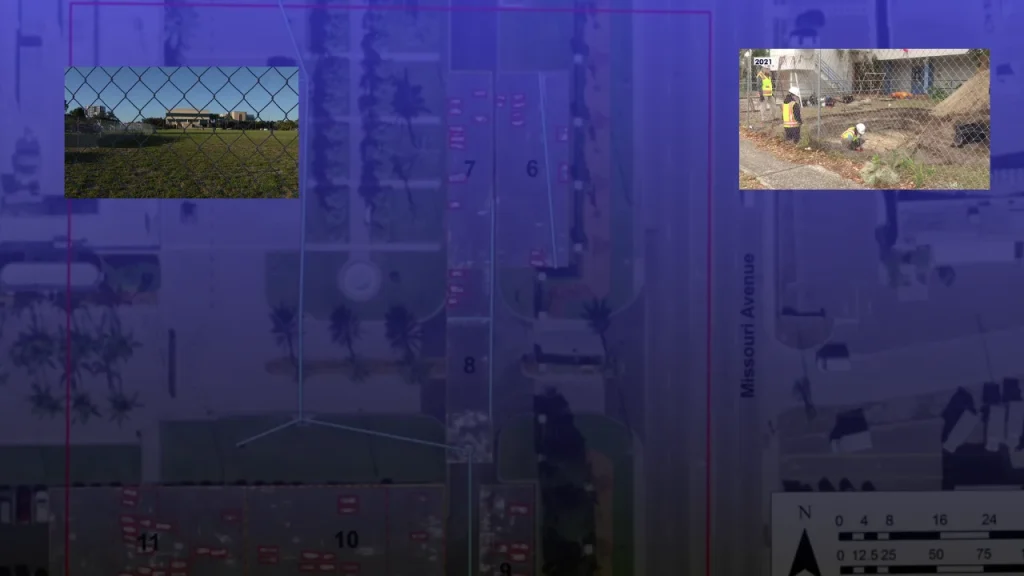
Ground investigations in 2020 found evidence of graves from the former St. Matthew’s Baptist Church Cemetery at 100 South Missouri Avenue. That discovery undercut the earlier assurances that the cemetery had been cleared.
The settlement resolves a contract dispute between a private owner and a public agency. It does not settle the separate question of what happens to the people still buried at the site.
The CRA’s October 12, 2026 meeting is reported to have approved the agreement. The settlement is still subject to approval by the Pinellas County Circuit Court, and the city’s public agenda record showed no posted final-action entry for the item as of October 21, 2026.
The case is Crum Properties II, LLC v. Community Redevelopment Agency of the City of Clearwater, Case No. 23-008557-CI.
Official source: City of Clearwater’s settlement agenda item.
Clearwater CRA and Crum Properties II LLC Cemetery Settlement: Quick Facts
| Detail | Verified information |
| Proposed settlement amount | $7,500,000 |
| Company receiving payment | Crum Properties II LLC |
| Public agency paying | Clearwater Community Redevelopment Agency |
| Case | Crum Properties II, LLC v. Community Redevelopment Agency of the City of Clearwater |
| Case number | 23-008557-CI |
| Court | Circuit Court for Pinellas County, Florida (Sixth Judicial Circuit) |
| Disputed property | 100 South Missouri Avenue, Clearwater |
| Historic cemetery | St. Matthew’s Baptist Church Cemetery |
| Graves discovered | 2020 |
| Lawsuit filed | September 29, 2023 |
| CRA meeting | October 12, 2026 |
| Final court approval | Not independently confirmed as of October 21, 2026 |
| Separate litigation-cost reimbursement | $381,555.06 (approved September 28, 2026) |
| Payment to descendants | None specified |
| Public claim form, website or deadline | None |
| Settlement type | Individual contract settlement, not a class action |
The city’s settlement memo describes a full release for the CRA and the city, with dismissal of the pending civil action with prejudice.
What Is the St. Matthew’s Baptist Church Cemetery in Clearwater, Florida?
The property at 100 South Missouri Avenue was once part of St. Matthew’s Baptist Church Cemetery, a historic African American burial ground established in the early 1900s.
According to the City of Clearwater’s litigation summary, the cemetery was sold to private parties in 1955. A Montgomery Ward store was built on the land in the 1960s. The city acquired the property in the 1980s and remodeled it for municipal offices, then transferred it to the CRA in 1998. Crum Properties II LLC acquired it in 2004 through a chain of transactions and took over rights under the earlier development agreement.
The history matters because the graves were not a vague possibility. Investigations found evidence that human remains were still there despite earlier assurances. Local reporting has described more than 300 graves. The city’s settlement memo confirms African American gravesites were discovered in 2020 but gives no definitive final count.
How Were the Graves Discovered Beneath the FrankCrum Property in Clearwater?
Ground investigations in 2020 identified evidence consistent with burials. Ground-penetrating radar can detect underground anomalies that may be graves, and archaeological work can then help confirm whether remains are present.
The discovery created two separate problems: the physical presence of human remains, and the question of whether the contractual assurances from the 1998 development agreement were accurate. The settlement addresses only the second problem, and only as between Crum Properties II LLC and the CRA.
Why Did Crum Properties II LLC Sue the Clearwater Community Redevelopment Agency?
Crum filed suit on September 29, 2023, naming both the City of Clearwater and the CRA. It alleged the public entities breached obligations in a development agreement tied to the property’s sale, including warranties that no cemetery remains were on the property and that the cemetery had previously been moved.
The city argued it was not a party to that agreement. On March 22, 2024, Crum voluntarily dismissed the city without prejudice, leaving the CRA as the sole defendant.
Crum’s amended complaint, filed June 27, 2024, alleged five claims:
- Breach of contract
- Common-law breach of warranty
- Contractual indemnification
- Negligent misrepresentation
- Fraudulent inducement
This was a contract dispute between a landowner and a public agency. It was not a class action brought by descendants.
What Did the Pinellas County Circuit Court and Florida’s Second District Court of Appeal Decide Before the Settlement?
On March 20, 2025, the Pinellas County Circuit Court denied the CRA’s motion for summary judgment. On March 31, 2025, it granted Crum’s motion for partial summary judgment on three claims: breach of contract, common-law breach of warranty and contractual indemnification.
Those rulings gave Crum a major advantage on its contract theories. They did not resolve every issue, including the remaining tort claims and the final amount of damages.
The CRA appealed a related ruling. On January 14, 2026, Florida’s Second District Court of Appeal affirmed in Community Redevelopment Agency of the City of Clearwater v. Crum Properties II, LLC, No. 2D2025-1042, leaving the trial court’s ruling in place.
The parties then reached a $7.5 million agreement shortly before a trial scheduled for October 2026.
Sources: Official Clearwater litigation summary and Florida Second District Court of Appeal opinion.
Why Could Crum Properties II LLC Sue Clearwater’s CRA Under Florida Contract and Sovereign Immunity Law?
Florida public agencies are generally protected by sovereign immunity, but that protection has a well-known limit for written contracts. Under Pan-Am Tobacco Corp. v. Department of Corrections, 471 So. 2d 4 (Fla. 1984), the Florida Supreme Court held that sovereign immunity does not shield the state or its agencies from suits on express, written contracts. That is the reason Crum could sue the CRA over a written development agreement.
Tort claims are different. Florida’s waiver of sovereign immunity for torts, Fla. Stat. § 768.28, comes with notice requirements and damage caps, so Crum’s negligent misrepresentation and fraudulent inducement claims faced more legal hurdles than its contract claims did. This is one reason a contract-based victory carried so much weight.
Florida’s limitations statute, Fla. Stat. § 95.11, also sets deadlines for suing on a written contract. Timing is a standard defense in disputes like this one, which is why the date the graves were discovered (2020) and the date the lawsuit was filed (September 29, 2023) matter to the case.
Who Receives Clearwater’s $7.5 Million Cemetery Settlement?
The money goes to Crum Properties II LLC, not to descendants of the people buried at the former cemetery. It resolves the company’s claims against the CRA and is not a compensation fund for families.
A settlement can end one legal dispute without answering the questions that caused it. Here, the agreement covers the financial responsibilities of the CRA and the property owner. It creates no application process for descendants and no court-supervised distribution to the community. According to the city’s stated position, it is also not an admission of fault by either party.
Why Are Descendants Concerned After the Clearwater Settlement?
Descendants and community advocates have spent years seeking recognition for the people buried at St. Matthew’s Baptist Church Cemetery. The settlement may bring the lawsuit closer to an end, but the burial site’s condition and future are separate questions.
The agreement described in the city’s litigation memo does not require the owner to build a memorial, relocate remains, or consult descendants formally. No final public plan covering these issues has been verified as of October 21, 2026. Open questions include:
- Will the graves remain beneath the business property?
- Will the owner conduct further archaeological work?
- Will descendants have a formal role in decisions about the site?
- Will the community receive a memorial or other recognition?
- What process will govern any future disturbance or relocation of remains?
The city has said that because the property is privately owned, decisions about the remains rest with Crum Properties. The owner has indicated it intends to work toward a resolution with the community, but no binding memorial or relocation obligation appears in the proposed terms.
Does Florida Statute § 872.05 Protect Unmarked Graves Like Those at St. Matthew’s Cemetery?
Yes. Florida law protects unmarked human burials on public and private land. Under Florida Statutes § 872.05, the Legislature states that human burials and skeletal remains must receive equal treatment and respect regardless of ethnic origin, cultural background or religious affiliation.
The statute sets procedures for discovered unmarked burials, including notice to the district medical examiner and the State Archaeologist. If the state takes jurisdiction, the law provides for efforts to determine the burial’s historical, archaeological or scientific significance and to identify people with direct kinship or community ties to the remains. It also provides for consultation with appropriate family members or community leaders when possible.
These protections do not, by themselves, decide what happens to the Clearwater graves. Their application depends on the facts, the agencies involved and any required authorizations. The $7.5 million settlement does not override them.
What Does Florida Statute § 872.02 Say About Disturbing Graves at the Clearwater Site?
Florida Statutes § 872.02 addresses the knowing and willful disturbance of graves, tombs and certain memorial structures, subject to the statute’s exceptions and authorizations. Any future excavation or construction at 100 South Missouri Avenue that touches the burial area would have to be evaluated under this law and § 872.05. A private owner does not have unlimited freedom to disturb human remains simply because it holds title to the land.
Do the Florida Historical Resources Act and Cemetery Regulation Laws Apply to the St. Matthew’s Cemetery Site?
Two other bodies of Florida law are worth knowing, with limits on how far they reach.
Florida Historical Resources Act (Chapter 267, Florida Statutes). This law governs archaeological and historic resources and gives the Division of Historical Resources a central role. Its strongest permit and penalty provisions focus on state-owned or state-controlled lands, so it may not directly control a purely private parcel. It still shapes how the State Archaeologist and state agencies approach significant burial sites.
Florida Funeral, Cemetery, and Consumer Services Act (Chapter 497, Florida Statutes). This chapter regulates licensed cemeteries and related businesses. Whether a long-abandoned burial ground that was sold and built over falls under this regulatory framework depends on its legal status, which the public record does not settle.
On the federal side, Section 106 of the National Historic Preservation Act applies only when a project involves federal funding, permits or approvals. Nothing in the public record reviewed for this article shows that kind of federal involvement here.
What Is the Community Redevelopment Act, and Why Does the CRA Pay the Clearwater Settlement?
The Clearwater CRA operates under the Community Redevelopment Act, Part III of Chapter 163, Florida Statutes. These agencies use tax increment financing to fund redevelopment inside a designated area, and the money sits in a redevelopment trust fund. Settlement money for the Crum case therefore comes from redevelopment dollars, not from a typical general-fund line.
The city’s settlement memo says the $7.5 million payment would be funded through a future budget amendment transferring money from various CRA capital projects to its operating fund. The CRA is a public body, so its meetings and records fall under Florida’s Sunshine Law (§ 286.011) and Public Records Act (Chapter 119). Anyone tracking the settlement can request records directly from the city.
What Happens Next in the Clearwater Cemetery Lawsuit?
1. Court approval. The Pinellas County Circuit Court must consider the agreement and enter any needed approval order. As of October 21, 2026, a final order had not been independently verified.
2. Dismissal with prejudice. Under the proposed terms, the lawsuit is dismissed with prejudice once the settlement process is complete. That generally bars the released claims from being brought again, subject to the agreement and applicable law.
3. Payment to Crum Properties II LLC. If the settlement becomes final, the CRA is expected to pay the $7.5 million under the agreed terms. None of it is earmarked for descendants.
4. Decisions about the graves. Preservation, relocation, memorialization and archaeological work remain separate issues. They may involve the private owner, state authorities, descendants and community representatives.
How Much Has the Clearwater Cemetery Litigation Cost Public Agencies Beyond the $7.5 Million?
The $7.5 million is not the only public expense. On September 28, 2026, the CRA approved a $381,555.06 transfer to reimburse the city for costs tied to the Crum Properties litigation.
These are separate financial items. The reimbursement should not be added to the $7.5 million and described as part of the payment to Crum. For the public financial picture, the official CRA records are the best starting point.
Sources: Crum Properties settlement item and September 28 reimbursement action.
Is the Clearwater Settlement Taxable, and Do Attorney Fees Affect Anyone Other Than Crum Properties II LLC?
This is a payment to a business entity resolving contract claims, so any tax treatment is a matter for Crum Properties II LLC and its advisers. Nothing in the public record shows a consumer tax-reporting event for descendants or residents, because no money goes to them. Attorney fees in the private litigation are not disclosed in the official records reviewed, so no figure is stated here.
Does the Clearwater Cemetery Settlement Create a Claim Form or Payment Deadline for Descendants?
No. No public claim form, claims administrator, website or deadline has been identified. The agreement resolves an individual contract lawsuit and does not create a class of descendants who can claim a share.
Descendants who want updates can contact the City of Clearwater, the CRA, the property owner and relevant state authorities. Be careful with third-party sites that claim to offer a claim form for this settlement. Any separate legal claim a descendant might have would need individual review under the facts and applicable law.
How the Clearwater Cemetery Settlement Compares With Other Public-Funds Settlements
Government settlements are structured very differently. Some pay defined groups of residents, while others resolve a dispute between a public entity and a single business.
Benton Harbor $25 Million Lead Water Settlement, Insurers Face Fight Over Resident Payments shows why a large headline number does not always mean residents receive checks quickly.
SPS Technologies Fire Settlement, Check If You Qualify — Cottrell v. SPS Technologies, LLC, No. 2026-14052 shows a settlement with eligibility rules for affected owners, residents and businesses. Clearwater’s cemetery agreement has no comparable claims process.
Hope Florida Grand Jury Report Expunged $10M Ruling Explained involves different facts, but it shows why the source and legal purpose of public payments matter.
Key Dates in the Clearwater CRA and Crum Properties II LLC Cemetery Case
| Date | Event |
| Early 1900s | St. Matthew’s Baptist Church Cemetery established |
| 1955 | Cemetery sold to private parties, per the city’s litigation summary |
| 1960s | Montgomery Ward store built on the property |
| 1980s | City acquires the property and remodels it for municipal offices |
| 1998 | CRA enters the development agreement and acquires the property from the city |
| 2004 | Crum acquires the property and receives rights under the development agreement |
| 2020 | African American gravesites discovered |
| September 29, 2023 | Crum Properties II LLC files suit |
| March 22, 2024 | Crum voluntarily dismisses the City of Clearwater without prejudice |
| June 27, 2024 | Amended complaint filed |
| March 20, 2025 | Circuit court denies the CRA’s summary judgment motion |
| March 31, 2025 | Circuit court grants Crum partial summary judgment on three claims |
| January 14, 2026 | Second District Court of Appeal affirms |
| September 28, 2026 | CRA approves $381,555.06 reimbursement to the city |
| October 1, 2026 | Settlement reportedly reached |
| October 12, 2026 | CRA meeting reportedly approves the $7.5 million settlement |
| As of October 21, 2026 | Final court approval and any cemetery plan remain unconfirmed |
Frequently Asked Questions About the Clearwater Cemetery Settlement With Crum Properties II LLC
Is the $7.5 million Clearwater cemetery settlement final?
The CRA’s October 12, 2026 meeting is reported to have approved it, but final Pinellas County Circuit Court approval has not been independently verified as of October 21, 2026.
Will descendants of St. Matthew’s Baptist Church Cemetery receive part of the $7.5 million?
No direct payment to descendants is specified. The payment resolves the contract dispute between the CRA and Crum Properties II LLC.
Can descendants file a claim for money from the Clearwater cemetery settlement?
No. No public claims website, administrator, form or deadline has been identified, and this is not a public compensation program.
How many graves remain beneath the FrankCrum property at 100 South Missouri Avenue?
Reporting describes more than 300 graves. The city’s settlement memo confirms African American gravesites were found in 2020 but gives no definitive final count.
Does the Clearwater settlement require a memorial?
No memorial requirement appears in the terms described in the city’s litigation memo. The future of the graves is a separate issue.
Why did Crum Properties II LLC sue the Clearwater CRA?
Crum alleged the 1998 development agreement contained false assurances that cemetery remains had been removed. It pleaded contract, warranty, indemnification, negligent misrepresentation and fraudulent inducement claims.
Did the court find that the Clearwater CRA committed fraud?
No. The circuit court granted partial summary judgment on three claims: contract, warranty and indemnification. The settlement carries no admission of fault by either party, so it should not be described as a judicial finding of fraud.
Can the graves at 100 South Missouri Avenue legally be moved from private property?
Any relocation would have to comply with applicable law and authorization requirements, including Fla. Stat. §§ 872.02 and 872.05. The settlement does not establish a relocation plan.
Why can a Florida agency like the Clearwater CRA be sued over a contract?
Under Pan-Am Tobacco Corp. v. Department of Corrections, 471 So. 2d 4 (Fla. 1984), sovereign immunity does not bar suits on express written contracts. Tort claims fall under § 768.28 and its limits.
Where can readers find the official Clearwater cemetery lawsuit records?
Start with the City of Clearwater’s settlement agenda item and the Florida Second District Court of Appeal opinion.
Official Sources and Legal References for the Clearwater Cemetery Settlement
- City of Clearwater: Crum Properties II, LLC v. Community Redevelopment Agency, Settlement Authority, Case No. 23-008557-CI
- Florida Second District Court of Appeal: Community Redevelopment Agency of the City of Clearwater v. Crum Properties II, LLC, No. 2D2025-1042 (January 14, 2026)
- City of Clearwater: September 28, 2026 reimbursement action, $381,555.06
- Fla. Stat. § 872.05: Unmarked human burials
- Fla. Stat. § 872.02: Disturbance of graves and tombs
- Other authorities cited: Fla. Stat. Chapter 267; Chapter 497; Part III of Chapter 163; §§ 95.11, 286.011, 768.28; Chapter 119; Pan-Am Tobacco Corp. v. Department of Corrections, 471 So. 2d 4 (Fla. 1984)
Disclaimer: This article is for general information only and is not legal advice. AllAboutLawyer.com is a legal information website, not a law firm.
Researched and written by Israr Ahmad, legal content researcher and founder of AllAboutLawyer.com. All facts verified against the City of Clearwater’s official settlement agenda record, the Florida Second District Court of Appeal opinion and the official Florida Statutes website, as of October 21, 2026. Last Updated: October 21, 2026.
About the Author
Israr Ahmad is a legal content researcher with 4+ years of experience covering class action settlements and consumer rights cases. He has researched and published coverage of 2,500+ settlements using verified court records, settlement administrator filings, and government sources. Learn more about Israr.