
$1.25M Carter Page vs. DOJ and FBI FISA Surveillance Lawsuit, The Full Story and Final Outcome
Carter Page vs. the United States Department of Justice and FBI is a civil rights lawsuit in which Carter Page, a former foreign policy adviser to Donald Trump’s 2016 presidential campaign, alleged unlawful government surveillance under the Foreign Intelligence Surveillance Act (FISA) and the case settled in April 2026 for $1,250,000. Page alleged that FBI and DOJ officials submitted false and misleading applications to the Foreign Intelligence Surveillance Court (FISC) to obtain secret wiretap warrants targeting him. He was never charged with any crime.
Quick Facts
| Field | Detail |
| Plaintiff | Carter Page |
| Defendant | United States Department of Justice; Federal Bureau of Investigation |
| Case Type | Civil Rights / Unlawful Government Surveillance |
| Court | U.S. District Court for the District of Columbia (original filing) |
| Date Filed | November 27, 2020 |
| Legal Claim | Violations of FISA, the Fourth Amendment, and related constitutional rights |
| Damages Originally Sought | $75,000,000 |
| Outcome | Settled — $1,250,000 paid to Carter Page |
| Settlement Amount | $1,250,000 |
| Attorneys of Record | TBD — counsel of record not confirmed in available public sources as of April 23, 2026 |
| Last Updated | April 23, 2026 |
Case Timeline
| Date | Event |
| 2016–2017 | FBI obtains four FISA warrants to surveil Carter Page during Operation Crossfire Hurricane |
| November 27, 2020 | Carter Page files $75 million lawsuit against DOJ, FBI, and named officials in U.S. District Court, Washington, D.C. |
| September 1, 2022 | U.S. District Judge Dabney L. Friedrich dismisses the lawsuit |
| 2023–2024 | Page appeals to the U.S. Court of Appeals; appellate court upholds dismissal citing statute of limitations |
| 2024–2025 | Page petitions the U.S. Supreme Court for review |
| April 22, 2026 | DOJ announces $1,250,000 settlement with Carter Page, resolving all claims |
What Is the Carter Page vs. DOJ and FBI Lawsuit About?
Carter Page asserted in his 2020 lawsuit that he was the victim of “unlawful spying” by an FBI agency investigating whether Trump’s 2016 campaign had conspired with Russia to affect the outcome of the election. The lawsuit alleged a series of omissions and errors by FBI and DOJ officials in applications they submitted in 2016 and 2017 to the Foreign Intelligence Surveillance Court to eavesdrop on Page on suspicion that he was a Russian agent.
The suit argued that “four false and misleading warrant applications” permitted government officials to “engage in electronic surveillance” of Page — and that the defendants “fabricated or intentionally disregarded critical evidence” and misled the FISC to obtain those warrants. The Foreign Intelligence Surveillance Act (FISA) is the federal law governing how the U.S. government can conduct surveillance on individuals suspected of acting as foreign agents on American soil.
Two of the four surveillance warrants granted by the FISA court have since been declared invalid. A DOJ inspector general report found that the process used to secure the warrants was riddled with errors, mistakes, and overall sloppiness. Investigators also relied in part on material from the Trump-Russia dossier compiled by a retired British spy, which has since been largely discredited.
Who Are Carter Page and the DOJ and FBI?
Carter Page served as a foreign policy adviser to the Trump 2016 presidential campaign. At the time of the FBI’s investigation, Page was a former Moscow-based investment banker. The FBI wiretapped him for a year under suspicion that Russian intelligence agents had targeted him for recruitment, following allegations in a dossier compiled by Christopher Steele. Page was never charged with any crime and denied any improper ties to Russia throughout the entire legal saga.
The U.S. Department of Justice and the Federal Bureau of Investigation are the federal agencies that Page sued, along with a number of named individuals. Named defendants included former FBI Director James Comey, former top counterintelligence official Peter Strzok, and former FBI lawyer Kevin Clinesmith, who was convicted of doctoring an email related to the FISA application. Understanding [how FISA surveillance warrants work under U.S. law] is essential context for this case, as the entire dispute turns on whether those warrant applications met the legal standard required by the statute.
Related article: Ben Pasternak Believe Token Class Action, Are You a Class Member? If Yes, How Can You Claim Your Money?
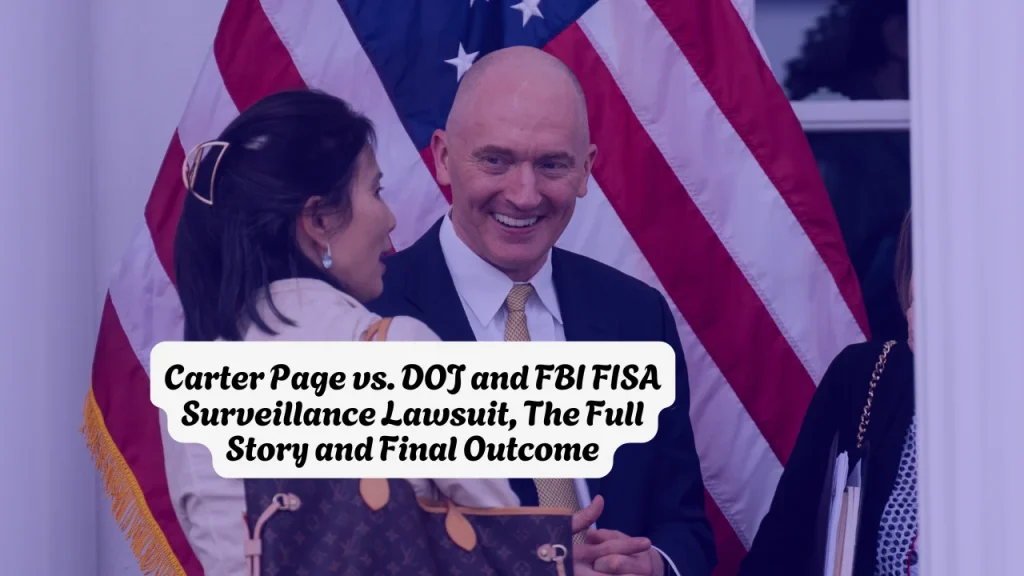
How Did the Carter Page vs. DOJ Lawsuit End?
The Justice Department settled for $1.25 million the lawsuit brought by Carter Page, who was the target of secret surveillance during the FBI’s Russia investigation. The settlement was announced on April 22, 2026, and resolves all claims Page brought against the federal government.
Page appealed to the Supreme Court after lower courts dismissed his suit, with appellate judges ruling that he had waited too long to file — a statute of limitations issue. A statute of limitations is the legal deadline by which a plaintiff must file a lawsuit after the harm occurs; miss it, and the court can dismiss the case regardless of whether the underlying claim has merit. Despite those dismissals, the DOJ under the current administration agreed to resolve the matter through a direct settlement rather than continue litigation.
The settlement amount of $1,250,000 represents a fraction of the $75,000,000 Page originally sought. No admission of wrongdoing has been confirmed in available public sources as of the time of publication. The DOJ in March 2026 settled a separate lawsuit with Michael Flynn — the former Trump national security adviser who pleaded guilty to lying to the FBI about his conversations with a top Russian diplomat and was later pardoned — for roughly $1.2 million.
What Does the Carter Page vs. DOJ Case Mean for Civil Liberties and FISA Reform?
The settlement carries significance beyond the dollar amount. The Durham report concluded that the FBI “did not and could not corroborate any of the substantive allegations” in the Steele dossier used to support the warrants, characterizing the Page surveillance as a “dry hole.” A government payment of $1,250,000 to a surveillance target — even through settlement rather than a court verdict — signals a formal acknowledgment that the conduct that triggered the lawsuit caused compensable harm, regardless of any admission of liability.
The case also raises ongoing questions about FISA court oversight. Two of the four surveillance warrants obtained against Page have been declared invalid. Civil liberties advocates have pointed to this case as evidence that the FISA court’s closed, non-adversarial process needs reform to prevent future misuse of surveillance authority against U.S. citizens.
The settlement follows a broader pattern of the current DOJ resolving Russia-probe-related civil claims. Both Page and Flynn received seven-figure settlements within weeks of each other in early 2026, marking a significant policy shift from the prior administration’s position in the same litigation.
Frequently Asked Questions
Who filed the Carter Page lawsuit and why?
Carter Page filed the lawsuit on November 27, 2020, in U.S. District Court in Washington, D.C. Page alleged that FBI and DOJ officials submitted false and misleading applications to the Foreign Intelligence Surveillance Court to obtain wiretap warrants targeting him during the 2016 Russia investigation. He sought $75,000,000 in damages.
What court handled the Carter Page case?
The lawsuit was originally filed in the U.S. District Court for the District of Columbia. District Judge Dabney L. Friedrich dismissed the case on September 1, 2022. Page then appealed through the federal appellate court system and ultimately sought Supreme Court review before the DOJ agreed to settle.
Has the case been resolved?
Yes. The DOJ announced a $1,250,000 settlement with Carter Page on April 22, 2026. The settlement resolves all claims Page brought against the federal government arising from the FISA surveillance conducted during Operation Crossfire Hurricane.
How much money was involved?
Page originally sought $75,000,000 in his 2020 complaint. The case settled for $1,250,000 — paid by the federal government to Page — according to the AP report dated April 22, 2026. No admission of wrongdoing has been confirmed in available public sources.
Can I read the court documents?
The original complaint and related filings are available through PACER — the federal court’s public access system — under the U.S. District Court for the District of Columbia. The AP reported on April 22, 2026, that court papers confirming the settlement have been filed, though the full settlement terms may not be publicly detailed.
Was Carter Page ever charged with a crime?
No. Page vigorously denied any improper ties to Russia and was never charged with any wrongdoing. The FBI’s surveillance of him during Operation Crossfire Hurricane did not result in any criminal case against him.
What is FISA and why does it matter in this case?
FISA — the Foreign Intelligence Surveillance Act — is the federal law that authorizes the U.S. government to conduct secret surveillance of individuals suspected of acting as foreign agents on American soil. The entire Carter Page lawsuit turns on whether FBI and DOJ officials complied with FISA’s legal requirements when they submitted four warrant applications to the FISA court to surveil him between 2016 and 2017.
Sources & References
- Associated Press via ClickOrlando — Justice Department reaches $1.25 million settlement with Trump 2016 campaign aide over Russia probe, April 22, 2026: https://www.clickorlando.com/news/politics/2026/04/22/justice-department-reveals-settlement-with-trump-2016-campaign-aide-over-russia-probe-surveillance/
- U.S. Department of Justice Official Website — FISA and SCRA enforcement resources: https://www.justice.gov
- PACER — U.S. District Court, District of Columbia (original docket for Carter Page v. United States et al., filed November 27, 2020): https://pacer.uscourts.gov
Prepared by the AllAboutLawyer.com Editorial Team and reviewed for factual accuracy against the Associated Press report dated April 22, 2026, and publicly available court records. Last Updated: April 23, 2026
Disclaimer: This article is for informational purposes only and does not constitute legal advice. Information about this concluded legal case is based on publicly available court records and verified reporting. Allegations described in this article reflect claims made in court filings and have not necessarily been proven in court. For advice regarding a particular legal situation, consult a qualified attorney.
About the Author
Israr Ahmad is a legal content researcher with 4+ years of experience covering class action settlements and consumer rights cases. He has researched and published coverage of 2,500+ settlements using verified court records, settlement administrator filings, and government sources. Learn more about Israr.