
Are Radar Detectors Legal in California? Here’s What the Actual Law Says
Yes. You can own, buy, and use a radar detector in a private passenger vehicle in California. No statute bans the device. But almost every article you’ll find on this topic mixes that simple fact with two other laws that have nothing to do with owning a detector — and at least one popular “13 California laws” listicle circulating online cites vehicle code sections that don’t exist. Here’s what’s actually on the books.
California Radar Detector Laws — Key Facts
| Question | Answer |
| Legal to own/use in a private car? | Yes — no California statute bans radar detectors |
| Can you mount it on the windshield? | No — Vehicle Code § 26708 bans it, same rule that governs window tint and dash cams |
| Are laser/radar jammers legal? | No — Vehicle Code § 28150 bans jamming, scrambling, or interfering devices |
| Legal in commercial trucks/buses? | No — federal rule (49 CFR § 392.71) bans them in vehicles over 10,001 lbs GVWR |
| Legal for taxis/rideshare drivers specifically? | No confirmed California statute says so — this is a widely repeated but unverified claim (see below) |
| Fine for windshield-mounting violation | $25 base, roughly $197 with penalty assessments; correctable (“fix-it”) violation |
| Do city or county laws add extra restrictions? | No — vehicle equipment law is set at the state level; there’s no California city with its own radar detector ordinance |
| Legal on military bases? | No — banned on all U.S. military installations, federal property, regardless of state |
| Last Updated | September 15, 2026 |
The Law People Think Bans Radar Detectors (It Doesn’t)
Vehicle Code § 28150 gets cited constantly as “California’s radar detector law.” It isn’t. Read the actual text and it’s about jamming devices only: nothing shall be “designed for, or is capable of, jamming, scrambling, neutralizing, disabling, or otherwise interfering with radar, laser, or any other electronic device used by a law enforcement agency to measure speed.” A passive detector doesn’t jam anything — it just listens. A laser jammer, by contrast, actively fights back against a police LIDAR gun, and that’s squarely illegal here. First offense is an infraction; get caught with four or more jamming devices and it becomes a misdemeanor. There’s a narrow exception if you hold a valid federal license for the device and carry it in the vehicle — which realistically applies to almost nobody reading this.
So what does that mean for you? If your device only detects and alerts, § 28150 doesn’t touch you. If it actively transmits a signal to defeat a radar or laser gun, it does — and that’s true everywhere in the state, not just certain cities.
The Law That Actually Trips People Up
Vehicle Code § 26708 is the one that generates real tickets. It has nothing to do with what the device does — it’s about where you stick it. The statute bars driving with “any object or material placed, displayed, installed, affixed, or applied upon the windshield or side or rear windows,” plus a broader ban on anything anywhere in the car that “obstructs or reduces the driver’s clear view.” It’s the same code section that governs illegal window tint and improperly mounted dash cams.
The statute does carve out specific exceptions — a GPS unit in a defined corner square, a video event recorder, certain toll transponders, small stickers in marked zones. Radar detectors aren’t on that exception list. A suction-cup mount stuck to the glass, even tucked near the mirror, is a citable windshield violation regardless of whether the detector itself is legal.
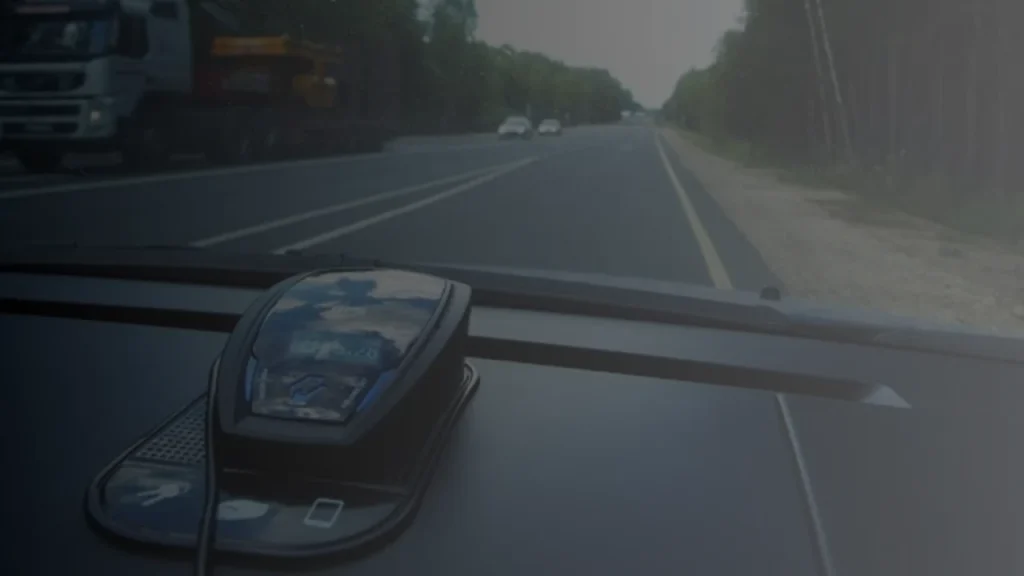
Here’s the part that actually matters: dashboard mounting, a visor clip, or a beanbag mount on top of the dash all sidestep this entirely. That’s a five-minute fix that eliminates the only real legal exposure most drivers have.
Commercial Vehicles: A Federal Rule, Not a State One
If you drive anything over 10,001 pounds GVWR — most straight trucks, semis, and buses — federal law bans radar detectors outright, and California Highway Patrol enforces that federal rule on state highways the same as any other FMCSR requirement. This isn’t a California invention; it’s 49 CFR § 392.71, and it applies whether you’re hauling freight through Bakersfield or Ohio. Get caught, and you’re looking at a citation plus points against your CDL, not just a fix-it ticket.
Related article: What Is Synthetic Identity Theft?
The Taxi and Rideshare Claim You’ll See Everywhere — and Why It’s Shaky
A lot of radar-detector retailer blogs state flatly that California bans radar detectors for taxi and rideshare drivers. We looked for the California statute that supposedly says this and didn’t find one. The federal commercial-vehicle rule (49 CFR § 392.71) applies to vehicles over 10,001 lbs or those designed to carry nine or more passengers for compensation — a standard sedan doing Uber or Lyft runs doesn’t meet either threshold. It’s possible this claim traces back to individual TNC or taxi company policies rather than state law, or it’s simply gotten repeated so often online that it now reads as settled fact. If you drive for a rideshare or taxi company and want certainty, check your company’s own driver policy — but don’t take “it’s illegal in California” at face value without a cited statute, because we couldn’t find one.
No, California Cities Don’t Each Have Their Own Rule
Several sites imply a patchwork of local ordinances — different rules in Los Angeles versus San Diego versus Sacramento. That’s not how vehicle equipment law works in California. The Vehicle Code applies uniformly statewide; cities generally can’t layer on stricter equipment rules for something like this. If you’re legal under §§ 26708 and 28150 in Fresno, you’re legal under the same sections in Los Angeles.
Watch Out for Fabricated “California Radar Detector Laws”
Worth calling out directly: at least one widely shared “13 California radar detector laws” article cites a “Vehicle Code § 27602.5” banning permanent installation, a “California Military Code § 305,” a DMV firmware-reporting requirement, and a 2026 ballot measure expanding detector bans to electric vehicles. None of that exists in the actual Vehicle Code, and no such ballot measure is on record. If a website’s radar detector law page reads like it was generated to fill space rather than researched from the actual code, that’s because a fair number of them likely are. Stick to the two real statutes — §§ 26708 and 28150 — and you’ve covered the actual legal exposure.
What About Apps Like Waze?
Crowdsourced police-location apps are a different category entirely and are legal in California, since they’re not “devices used for” radar or laser detection — they rely on other drivers reporting locations, not on picking up radar signals. This is worth knowing if you’re comparing options: an app carries none of the windshield-mounting exposure a physical detector does, since your phone mount likely already falls under the GPS exception in § 26708.
If You Do Get Cited Under § 26708
It’s a correctable, or “fix-it,” violation in most cases. The base fine is $25, but California’s penalty assessments push the real cost to roughly $197 for a first offense. Get proof of correction — moving the detector off the windshield — signed off by an officer or the court within the timeframe on your citation, and the fine typically drops back down substantially. Repeat violations within 12 months may not qualify as correctable.
Frequently Asked Questions
Are radar detectors legal in California?
Yes, for private passenger vehicles. No California statute prohibits owning or using one.
Can I mount my radar detector on my windshield in California?
No. Vehicle Code § 26708 prohibits objects on the windshield outside a few narrow exceptions, and radar detectors aren’t among them. Use a dashboard or visor mount instead.
Are laser jammers legal in California?
No. Vehicle Code § 28150 bans devices that jam, scramble, or interfere with police radar or laser equipment, separate from the rule governing plain detectors.
Can truck drivers use radar detectors in California?
No, if the vehicle is a commercial motor vehicle over 10,001 lbs GVWR. That’s a federal rule (49 CFR § 392.71) enforced on California highways, not a state-specific ban.
Is it true that California bans radar detectors for Uber and Lyft drivers?
We couldn’t find a California statute confirming this widely repeated claim. It may reflect individual company policy rather than state law — check with your platform directly if it matters for your situation.
What happens if I get a ticket for a windshield-mounted radar detector?
It’s typically a correctable violation: a $25 base fine that runs about $197 with assessments, reducible with proof you moved the device before the deadline on your citation.
Do any California cities have their own radar detector laws?
No. Vehicle equipment law is set at the state level and applies uniformly across California.
Sources Used in This Article
- California Legislative Information — Vehicle Code § 26708, official text: https://leginfo.legislature.ca.gov/faces/codes_displaySection.xhtml?lawCode=VEH§ionNum=26708
- Justia — California Vehicle Code § 28150, Jamming Devices, statutory text: https://law.justia.com/codes/california/2005/veh/28150.html
- FindLaw — California Vehicle Code § 26708 and § 28150, statutory text: https://codes.findlaw.com/ca/vehicle-code/veh-sect-26708/ and https://codes.findlaw.com/ca/vehicle-code/veh-sect-28150/
- Shouse Law Group — Vehicle Code 26708 penalty breakdown ($25 base / $197 total): https://www.shouselaw.com/ca/defense/vehicle-code/26708/
Researched and written by Israr Ahmad, legal content researcher and founder of AllAboutLawyer.com. All facts verified against the official California Vehicle Code text via the California Legislative Information website and cross-checked against Justia and FindLaw’s statutory databases, as of September 15, 2026. Last Updated: September 15, 2026.
This article is for informational purposes only and does not constitute legal advice. Laws vary by state and individual circumstances differ. For advice about your specific situation, consult a qualified traffic attorney.
About the Author
Israr Ahmad is a legal content researcher with 4+ years of experience covering class action settlements and consumer rights cases. He has researched and published coverage of 2,500+ settlements using verified court records, settlement administrator filings, and government sources. Learn more about Israr.