
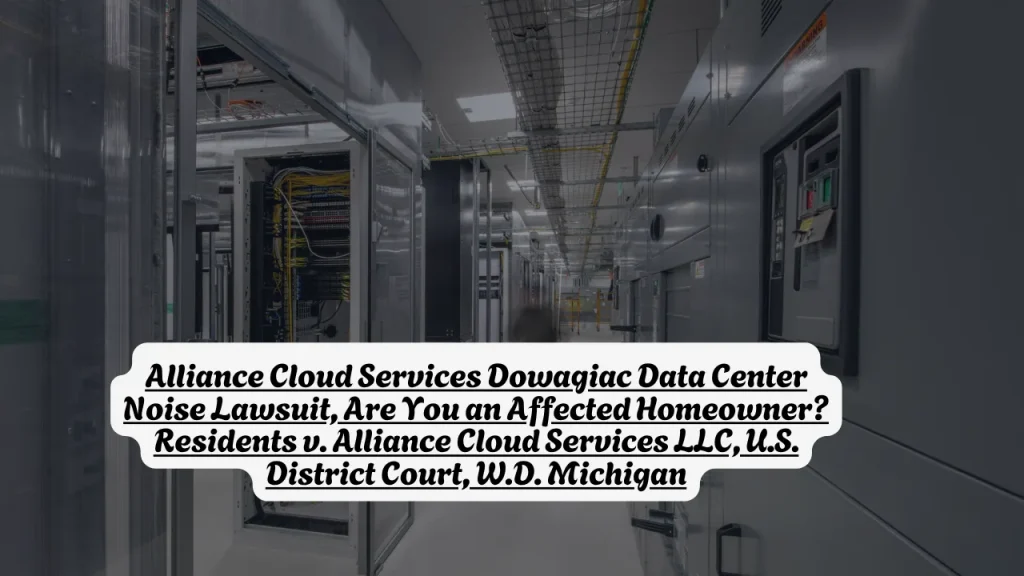
Alliance Cloud Services Dowagiac Data Center Noise Lawsuit, Are You an Affected Homeowner? Residents v. Alliance Cloud Services LLC, U.S. District Court, W.D. Michigan
Alliance Cloud Services LLC is facing a federal class action lawsuit filed in the U.S. District Court for the Western District of Michigan, alleging that the company’s AI and high-performance computing data center at 415 E. Prairie Ronde St. in Dowagiac generates constant, excessive noise 24 hours a day, seven days a week — destroying the ability of nearly 1,300 neighboring households to use and enjoy their own properties and driving down residential property values. Attorneys call it the first data center noise class action lawsuit ever filed in the United States. If you own or rent a home within one mile of the Dowagiac Hyperscale Data Center, this lawsuit may directly affect you.
Alliance Cloud Services Dowagiac Data Center Noise Lawsuit — Key Facts
| Field | Detail |
| Defendant | Alliance Cloud Services LLC (subsidiary of Hyperscale Data Inc., Las Vegas, NV) |
| Facility Address | 415 E. Prairie Ronde St., Dowagiac, Michigan |
| Court | U.S. District Court for the Western District of Michigan |
| Case Number | TBD — not yet published in court records or primary news sources as of May 28, 2026 |
| Date Filed | May 27, 2026 |
| Named Plaintiffs | Lindy Valenzuela and one additional Dowagiac resident |
| Filing Law Firm | Liddle Sheets P.C., Detroit, Michigan |
| Alleged Harm | Constant, excessive industrial noise; loss of use and enjoyment of property; property value damage |
| Specific Law Alleged | Michigan common law private nuisance; property damage — specific statutes not yet published |
| Who Is Affected | Owners of approximately 1,300 residential properties within one mile of the data center |
| Remedies Sought | Compensatory damages; injunctive relief requiring adequate soundproofing; jury trial |
| Settlement Status | No settlement — lawsuit just filed |
| Historic Significance | Attorneys say this is the first data center noise class action ever filed in the U.S. |
| Last Updated | May 28, 2026 |
Who Is Alliance Cloud Services and Why Are They Facing a Noise Nuisance Lawsuit?
Las Vegas-headquartered artificial intelligence data center company Hyperscale Data Inc., through its subsidiary Alliance Cloud Services, owns and operates a data center at 415 E. Prairie Ronde St. near W. Railroad Street in Dowagiac, Michigan. The company provides AI and high-performance computing services, Bitcoin mining, colocation, and hosting — operations that require enormous banks of cooling systems, fans, and server hardware running without interruption around the clock.
The Dowagiac operation was initially used for Bitcoin mining before Hyperscale Data announced plans in 2024 to shift those activities to Montana and expand the Michigan location for artificial intelligence and high-performance computing operations. Earlier this year, Hyperscale Data announced an agreement to acquire an additional 48.5 acres near the existing site, more than doubling its land holdings in Dowagiac to 83 acres.
That expansion announcement — made as residents were already fighting the noise from the existing facility — is what pushed the dispute from city council chambers to federal court. If you live within a mile of the Dowagiac data center, the question of whether that facility keeps expanding is no longer just a local zoning matter. It is now the subject of a federal lawsuit with your neighborhood at the center of it.
What Did Alliance Cloud Services Do to Dowagiac Residents?
Two southwest Michigan residents have filed what their attorneys are calling the first class-action lawsuit in the country over noise from a data center, alleging a Dowagiac facility has created a constant nuisance that has disrupted daily life and hurt property values. The complaint alleges that roughly 1,300 residential properties within one mile of the facility have been affected by noise from the site, which operates around the clock.
The complaint accuses the data center of emitting noise that is both excessive and constant — “at all hours of the day, every day of the week.”
Named plaintiff Lindy Valenzuela stated in the complaint: “My husband and I have been unable to use our yard since this facility began operating. It is impossible to stay outside for longer than 10 minutes at a time before succumbing to headaches. The noise also penetrates the inside of our house even with the windows closed.”
The complaint states that Alliance Cloud Services has “failed to implement adequate soundproofing equipment at its Data Center that properly absorbs, captures, and/or prevents the escape” of noise from the facility.
Residents have begun measuring the noise themselves. Billy Finn, who has lived across the street from the data center since 2009, bought a decibel reader when he started to notice the noise. Finn said the highest reading he has gotten is 84 decibels — equivalent to the sound of loud city traffic, a vacuum cleaner, or a blender. With enough exposure, that level could cause hearing loss. Ambient readings without conversation ran between 58 and 62 decibels.
Another resident described the effect at night: “It used to be at nighttime we’d turn our air off, open our windows and have the breeze come through, and we always enjoyed that at nighttime, and now you can’t be doing this at night. You get this continuous sound all the way through here all the time.”
This is not a case about occasional industrial noise. The core allegation is that a facility running 24 hours a day, every single day, has permanently changed what it means to live near this neighborhood — and that the company chose not to install the soundproofing that would have prevented it.
Data center noise cases like this one, and related data privacy class actions arising from the broader AI infrastructure buildout, are an emerging area of consumer and property law that has received little judicial attention in the U.S. until now.
Related article: National Debt Relief Spam Email and Tracking Pixel Class Action Lawsuit, Were You Targeted? Castrillo v. National Debt Relief LLC, No. 3:26-cv-04481
Are You Part of the Alliance Cloud Services Data Center Noise Class Action?
Here is exactly how to know whether this lawsuit covers you.
You likely qualify if:
- You own or live in a residential property within one mile of the Hyperscale Data Center at 415 E. Prairie Ronde St., Dowagiac, Michigan
- You have experienced noise from the facility that affects your ability to use and enjoy your property — indoors or outdoors
- You have suffered or are suffering from constant noise penetrating your home, yard, or outdoor spaces
- Your property value has declined or is threatened by the facility’s noise
You do NOT qualify if:
- Your property is located more than one mile from the data center address
- You are a commercial property owner without a residential use claim (the class as described covers residential properties)
- You are employed by, own, or have a financial interest in Alliance Cloud Services LLC or Hyperscale Data Inc.
Dowagiac Noise Lawsuit — Are Residents Outside Cass County Still Covered?
The class as described covers residential properties within one mile of the specific facility at 415 E. Prairie Ronde St. in Dowagiac. This is a geographic class defined by proximity to the noise source, not by state or county residency. If you own a residential property within that one-mile radius — even if you do not currently live there full time — you may be included. The complaint was filed in federal court and does not appear to be limited by state residency.
If you are unsure whether your property falls within the class definition or whether you qualify for the Alliance Cloud Services nuisance class action, a free consultation with a consumer rights lawyer or property damage attorney can help you assess your situation before any deadlines are set by the court.
What Are Dowagiac Residents Asking the Court to Award in the Data Center Noise Lawsuit?
The complaint seeks compensatory damages for the loss of use and enjoyment of property and for property value decline — two distinct categories of harm under Michigan nuisance law. Residents are also asking the court for injunctive relief: a court order requiring Alliance Cloud Services to install adequate soundproofing or other noise mitigation measures at the facility.
A trial by jury is being requested by the nearby residents.
No specific dollar amount has been stated in the complaint as reported by primary sources. In nuisance class actions, compensatory damages are typically calculated based on the measurable decline in property values and the duration and severity of the interference with the use and enjoyment of property. With approximately 1,300 residential properties allegedly affected, the aggregate damages pool could be substantial — but no recovery amount is predictable at this stage. No money is available yet. No claim form exists.
What Could Dowagiac Homeowners Receive If the Noise Case Settles?
Actual recovery depends entirely on the court’s class certification ruling, the strength of property value evidence, the number of validated class members, and what the parties negotiate. Nuisance settlements can include cash payments to affected homeowners, funded remediation of the noise source, or both. It is impossible to predict any of these outcomes at the lawsuit’s current stage. If you believe your property has suffered documented decline in value or rental income because of the data center noise, preserving that documentation now is important.
What Should Dowagiac Homeowners Do Right Now?
- You do not need to do anything immediately to be part of the class. If your property falls within one mile of the facility, you are likely already within the class definition. No claim form or registration is required at this stage of the lawsuit.
- Document the noise starting today. Use a free decibel meter app on your smartphone or purchase an inexpensive meter. Record readings at multiple times of day and night, inside and outside your home. Note the date, time, weather conditions, and your distance from the facility. Video recordings with audio capturing the noise alongside normal sounds — a conversation, a bird, traffic — are especially useful evidence.
- Preserve records of impact. Write down specific dates and times when the noise prevented you from sleeping, working from home, spending time outdoors, or using your property as you normally would. This kind of contemporaneous log is far more credible than recollection months later.
- Document any property value impact. If you have received a lower appraisal, had difficulty selling, or had a buyer back out citing the data center, keep every related email, appraisal report, and real estate communication.
- Monitor the case docket. Once the case number is assigned by the Western District of Michigan, the docket will be publicly available at PACER (pacer.gov). The court will also issue formal class notice if the class is certified — that notice will include any deadlines to opt out or file a claim.
- Contact Liddle Sheets P.C. The filing firm — Liddle Sheets P.C. of Detroit — is actively representing plaintiffs in this case. If you want to share your experience or discuss your specific situation, they are the lawyers who filed this lawsuit.
Alliance Cloud Services Dowagiac Data Center Noise Lawsuit Timeline
| Milestone | Date |
| Data center begins Bitcoin mining operations in Dowagiac | ~2022 |
| Hyperscale Data announces shift to AI/HPC; Bitcoin mining moved to Montana | 2024 |
| Data center begins AI/HPC operations in Dowagiac | Early 2025 |
| Resident noise complaints begin | Early 2025 |
| Hyperscale Data announces agreement to acquire 48.5 additional acres | Late March 2026 |
| Dowagiac Mayor Patrick Bakeman sends open letter objecting to expansion without city approval | April 1, 2026 |
| Federal class action complaint filed by Liddle Sheets P.C. on behalf of two named plaintiffs | May 27, 2026 |
| Case number assigned by Western District of Michigan | TBD — pending court docketing |
| Defendant response deadline | TBD — typically 21 days after service in federal court |
| Class certification motion | TBD — early litigation stage |
| Expected resolution | TBD — class actions of this type typically take 2–4 years |
Alliance Cloud Services Data Center Noise Lawsuit — Frequently Asked Questions, U.S. District Court, W.D. Michigan
1. Is there really a class action lawsuit against the Dowagiac Hyperscale Data Center for noise right now?
Yes. Liddle Sheets P.C., a law firm based in Detroit, announced a federal class-action lawsuit against Alliance Cloud Services LLC on Tuesday, May 27, 2026, filed in the U.S. District Court for the Western District of Michigan, representing residents living within one mile of the company’s data center in Dowagiac. The case was filed this week and is in its earliest stage. No rulings have been made and all allegations remain unproven.
2. Do I need to do anything right now to be included in the Dowagiac data center noise class action?
No. At this stage, residents within one mile of the facility are likely included in the class definition automatically. You do not need to register or file anything right now. The court will issue formal class notice with any deadlines after the class is certified. Watch for official mail or email from the court administrator.
3. When will the Alliance Cloud Services data center noise case settle?
It is far too early to predict. The lawsuit was filed May 27, 2026 — Alliance Cloud Services has not yet responded to the complaint. Class certification has not been granted. Nuisance class actions of this type can take years to resolve. No settlement talks have been reported.
4. Can I file my own individual lawsuit against Alliance Cloud Services for data center noise instead of joining the class?
Yes. Michigan nuisance law allows individual property owners to sue for damages independent of a class action. An individual suit gives you more direct control over your case and potential recovery, but also requires you to fund your own litigation or find an attorney who will take it on contingency. For most homeowners, the class action is the simpler and more cost-effective path. Consult a property damage attorney if you are considering an individual claim.
5. How will I find out if the Alliance Cloud Services noise case settles?
Once the case number is assigned by the Western District of Michigan, you can monitor the docket on PACER at pacer.gov. If the class is certified and a settlement is proposed, the court will require formal notice be sent to all class members at their last known address. You can also check for updates directly with Liddle Sheets P.C. in Detroit.
6. Is this really the first data center noise class action in the United States?
The lawsuit was filed by Liddle Sheets P.C., a Detroit-based class-action law firm that says it focuses on cases involving residents harmed by neighboring environmental polluters. The firm said this is the first of its kind in the country, and that it is also investigating claims involving water contamination and odors from other data centers across the country. That “first of its kind” characterization has not been independently verified by a court, but no prior precedent for a data center noise class action has been reported in legal news sources.
7. What specific laws does Alliance Cloud Services allegedly violate?
The complaint alleges Michigan common law private nuisance — a legal claim that says a defendant unreasonably interfered with a plaintiff’s use and enjoyment of their property — and property damage. Private nuisance does not require the defendant to have broken a specific statute; it requires proof that the interference was substantial and unreasonable. Plaintiffs are also seeking injunctive relief, asking the court to order Alliance Cloud Services to install adequate soundproofing. The full legal theories will become clearer once the complaint is publicly docketed.
8. How much could affected Dowagiac homeowners receive from the noise nuisance lawsuit?
No money is available yet and no claim form exists. Potential damages in nuisance cases include compensation for the measurable decline in property values, the loss of use and enjoyment of property over the period of the noise, and potentially punitive damages if the court finds the company’s failure to soundproof was particularly egregious. With approximately 1,300 residential properties in the class, the aggregate damages pool is potentially significant — but predicting individual recoveries at this stage is not possible. A consumer rights lawyer or property damage attorney can help you estimate the value of your specific situation.
Sources Used in This Alliance Cloud Services Dowagiac Data Center Noise Lawsuit Article
- Michigan Advance — “Federal class-action lawsuit filed over Dowagiac data center noise,” May 27, 2026: https://michiganadvance.com/2026/05/27/federal-class-action-lawsuit-filed-over-dowagiac-data-center-noise/
- Detroit Metro Times — “Michigan residents file class action over data center noise as AI projects face growing backlash,” May 27, 2026: https://www.metrotimes.com/news/michigan-residents-file-class-action-over-data-center-noise-as-ai-projects-face-growing-backlash/
Prepared by the AllAboutLawyer.com Editorial Team and reviewed for factual accuracy against WNDU, Michigan Advance, Detroit Metro Times, and WOOD TV primary reporting on May 28, 2026. Last Updated: May 28, 2026.
This article is for informational purposes only and does not constitute legal advice. All allegations in the Alliance Cloud Services data center noise lawsuit remain unproven in a court of law. Laws vary by state and individual circumstances differ. For advice about your specific property damage or nuisance situation, consult a qualified attorney.
About the Author
Israr Ahmad is a legal content researcher with 4+ years of experience covering class action settlements and consumer rights cases. He has researched and published coverage of 2,500+ settlements using verified court records, settlement administrator filings, and government sources. Learn more about Israr.