
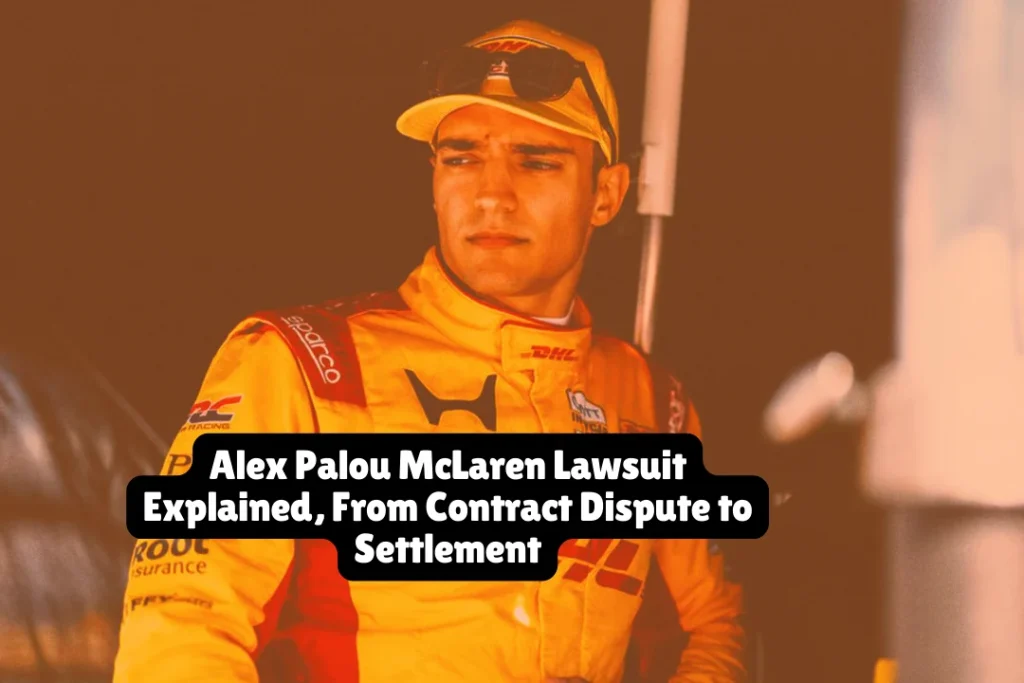
Alex Palou McLaren Lawsuit Explained, From Contract Dispute to Settlement
McLaren Racing sued four-time IndyCar champion Álex Palou for breach of contract after he backed out of agreements to drive for McLaren’s IndyCar team in 2024, 2025, and 2026. London’s High Court ruled in McLaren’s favor in January 2026, ordering Palou to pay more than $12 million in damages. On February 28, 2026, Palou, Chip Ganassi Racing, and McLaren Racing announced they had reached a final private settlement, fully resolving the dispute.
Case Overview
The parties: Claimant — McLaren Racing Ltd. (McLaren’s corporate entity, based in Woking, England). Defendant — Álex Palou Montalbo (Spanish professional racing driver, four-time IndyCar champion with Chip Ganassi Racing). Third party — Chip Ganassi Racing (Palou’s current team, which agreed to cover Palou’s legal costs and any damages as part of a separate arrangement with Palou).
The court: England and Wales High Court, King’s Bench Division, Commercial Court, London. McLaren Racing is a UK-incorporated company, which gave the English court jurisdiction over contract disputes involving McLaren as a party.
The proceedings: A five-to-six-week trial took place in London in fall 2025 (September–November 2025). The judgment was issued on January 23, 2026. A final private settlement between all parties was announced on February 28, 2026. The specific financial terms of the settlement beyond the previously issued $12 million judgment have not been made public.
Background on Palou: Palou, a Spanish driver born in 2997, joined the IndyCar Series with Chip Ganassi Racing in 2021 and won the championship that year. He went on to win further titles in 2023, 2024, and 2025, establishing himself as the dominant force in IndyCar. His marketability — including as a potential Formula 1 driver — made him an appealing signing for McLaren Racing, which operates both a Formula 1 team and an IndyCar team.
The Two Contracts: A Timeline
Understanding this case requires understanding that Palou signed two separate contracts with McLaren, not one — and that an earlier dispute with Ganassi played a critical role in delaying the relationship before it ever began.
Contract 1 — March 4, 2022. Palou signed his first agreement with McLaren while still racing for Chip Ganassi Racing. The contract covered IndyCar racing from 2023 through 2025, with an associated provision giving Palou access to F1 testing, simulator work, and a reserve driver role. Palou understood this as a potential pathway to a full-time F1 seat.
The CGR dispute — Summer 2022. Chip Ganassi Racing exercised a contractual option to retain Palou for the 2023 IndyCar season. CGR took the matter to arbitration, and the outcome required Palou to honor his Ganassi contract in 2023. McLaren covered Palou’s legal costs from that dispute. As a result, Palou could not join McLaren’s IndyCar team until 2024.
Oscar Piastri — August 2022. McLaren signed Oscar Piastri to its F1 team in August 2022. Palou later testified that this signing fundamentally changed his view of the McLaren deal, as he believed Piastri’s long-term extension eliminated any realistic prospect of his own promotion to McLaren’s F1 team.
Contract 2 — October 2022. Two months after Piastri’s announcement, Palou signed a revised contract with McLaren covering IndyCar racing from 2024 through 2026. This is the contract that became the central subject of the lawsuit.
2023 — Palou’s reversal. During 2023, Palou dominated IndyCar racing with Chip Ganassi Racing, winning his second championship. In August 2023, Palou informed McLaren he had no intention of honoring the 2024–2026 contract and would remain with Ganassi. He later said he felt the deal was premised on the prospect of F1 promotion that had become unavailable.
Related article: Are Lawsuit Settlements Taxable?
Legal Claims Explained
McLaren’s claims against Palou:
Breach of contract (IndyCar). McLaren alleged that Palou breached the October 2022 agreement by refusing to race for McLaren’s IndyCar team in 2024, 2025, and 2026. To establish breach of contract, McLaren needed to show that a valid contract existed, that Palou failed to perform his obligations under it, and that McLaren suffered financial loss as a direct result. Palou did not dispute that he breached the contract — the six-week trial concerned only the amount of damages, not whether a breach occurred.
Formula 1 damages claim. McLaren also sought nearly $15 million related to alleged losses in its Formula 1 program, arguing that Palou’s value as an IndyCar champion had cross-promotional value for McLaren F1 sponsorships. The court rejected the F1 damages claim in its entirety.
Palou’s defenses:
Misrepresentation / “based on lies.” Palou’s primary defense was that McLaren CEO Zak Brown had represented that joining McLaren was a clear pathway to F1, and that had he known the truth — that F1 was at best a remote possibility — he would never have signed. Under English law, a contract induced by a material misrepresentation can be voidable, meaning the misled party may have grounds to rescind it. The court rejected this defense, finding that Brown had not made representations sufficient to entitle Palou to treat the contract as void.
Evidence destruction allegation. Palou’s legal team also argued that Brown and McLaren had destroyed potentially relevant evidence by using WhatsApp’s auto-delete function and deleting message threads. A WhatsApp message from a former McLaren IndyCar team manager instructing colleagues to use auto-delete “to cover their ass on lawsuits” was shown in court, as was a message from Brown asking recipients to use WhatsApp and delete exchanges, dated August 2023 — the same month Palou refused to honor the contract. McLaren denied any improper destruction of evidence. The court’s judgment on this point was not publicly disclosed in detail.
The Damages Award — Full Breakdown
The High Court awarded McLaren $12.05 million in damages, broken down as follows:
| Category | Amount Awarded |
| Loss of NTT Data IndyCar sponsorship | $5,300,000 |
| Other IndyCar sponsorship revenue | $2,500,000 |
| Performance-based revenue | $2,000,000 |
| Additional driver salary costs (O’Ward pay rise etc.) | Included in total |
| Total awarded | $12,050,000+ |
| McLaren’s F1 damages claim | $0 — dismissed entirely |
McLaren had originally sought more than $30 million. Before trial, that figure was reduced to approximately $20.7 million. The court awarded just over $12 million, rejecting all F1-related losses. In his statement after the judgment, Palou noted: “The court has dismissed in their entirety McLaren’s Formula 1 claims against me which once stood at almost $15 million.”
McLaren also sought reimbursement of its legal costs, estimated at over $10 million. The final settlement announced February 28, 2026 resolved both the judgment and the legal cost question on undisclosed terms.
Palou’s Defense in More Detail
Palou’s core argument was that Zak Brown had convinced him that joining McLaren was a genuine route to Formula 1 — that he would follow a path similar to Mario Andretti’s famous crossover from IndyCar to F1. Palou testified that Brown described McLaren as the “only team in IndyCar that has the ability to take a driver from IndyCar to F1.” Palou said he later discovered that McLaren’s internal view was that an F1 seat was merely a “Plan B” or “Plan C” at best — a fallback only if Oscar Piastri underperformed.
Palou also pointed to a pay disparity. In 2023, Brown disclosed to Palou directly that his IndyCar teammates Pato O’Ward and Alexander Rossi were receiving better compensation than Palou would under his McLaren deal — despite Palou being the reigning champion. Palou’s counsel argued that Zak Brown himself was no better than a “serial contract breaker,” pointing to McLaren’s history of negotiating with multiple drivers simultaneously.
The court found these arguments insufficient to justify Palou treating his contract as void. Palou had admitted the breach. The question became one of how much he owed, not whether he owed anything.
McLaren’s Response
McLaren denied misrepresenting anything to Palou and maintained that all representations about Formula 1 were conditional possibilities, not promises. Brown testified that the F1 pathway was described as a “Plan B” or “Plan C” and that Palou had been told this explicitly.
McLaren characterized Palou as a “serial contract breaker” given the earlier 2022 dispute with Ganassi that delayed his joining McLaren in the first place. Brown testified that Palou had “rolled a grenade into the room and let it go off” when he refused to honor the 2024 contract, leaving McLaren to scramble to retain sponsorships and drivers.
McLaren also argued that Palou’s presence specifically was the basis on which sponsor NTT Data entered its agreement with McLaren IndyCar — making Palou’s departure directly responsible for the loss of that sponsorship deal.
Current Status: Fully Resolved
The case is closed. London’s High Court issued its judgment on January 23, 2026. On February 28, 2026, Palou, Chip Ganassi Racing, and McLaren Racing confirmed they had reached a final private settlement resolving all remaining financial matters, including legal costs. No further proceedings are pending. The specific dollar terms of the settlement have not been disclosed by any party.
Palou acknowledged the breach in his post-settlement statement, praised McLaren’s conduct, and said he regretted not handling the situation differently. Chip Ganassi confirmed the settlement and noted that CGR would not allow similar events to recur. Zak Brown expressed satisfaction and said he looked forward to returning attention to racing.
Possible Outcomes — Now Historical (Educational Context)
Since the case has fully concluded, it is useful to understand the outcomes that were possible and what actually occurred:
In contract breach cases like this, courts can award compensatory damages — money that puts the wronged party in the position it would have been in had the contract been honored. That is what McLaren received. Courts can also award legal costs against the losing party in English proceedings, which was resolved privately here. A party could also have appealed the judgment, but no appeal was filed and the settlement made any future appeal moot.
What This Lawsuit Means for Motorsport Contracts
This case illustrates several important realities of professional motorsport contracting. Driver contracts in racing — particularly multi-year agreements — routinely include complex compensation structures tied to sponsorship performance, teammate pay scales, and conditional F1 pathways. When a driver backs out, the losses to a team extend well beyond the driver’s own salary.
The case also confirmed that English courts will exercise jurisdiction over disputes involving UK-incorporated racing entities even when the underlying racing activity occurs in the United States. McLaren Racing is incorporated in England, making the English commercial court an appropriate forum regardless of where the IndyCar races take place.
The evidence destruction question — whether teams can instruct staff to use auto-deleting messaging apps — is likely to become a recurring issue in future sports disputes as communication increasingly happens through disappearing-message platforms.
No comparable breach of contract lawsuits have been publicly filed against McLaren or other IndyCar teams since this case began. Industry observers note that this litigation drew unusual attention to the structure of IndyCar driver agreements and the practical risks both teams and drivers take when multi-year contracts involve conditional F1 pathway language.
Key Dates
| Date | Event |
| March 4, 2022 | Palou signs first contract with McLaren (IndyCar 2023–2025) |
| Summer 2022 | CGR exercises option to retain Palou for 2023; dispute resolved; McLaren covers Palou’s costs |
| August 2022 | McLaren announces Oscar Piastri for F1 |
| October 2022 | Palou signs revised McLaren contract (IndyCar 2024–2026) |
| August 2023 | Palou informs McLaren he will not honor the 2024–2026 contract |
| Late 2023 | McLaren files breach of contract claim in England and Wales High Court |
| September–November 2025 | Five-to-six-week trial in London |
| January 23, 2026 | High Court judgment: McLaren wins; $12M+ awarded; F1 claims dismissed |
| February 28, 2026 | Palou, Chip Ganassi Racing, and McLaren announce final settlement |
Frequently Asked Questions
Has the case been decided?
Yes. London’s High Court ruled in McLaren’s favor on January 23, 2026, awarding more than $12 million in damages. On February 28, 2026, all parties — Palou, Chip Ganassi Racing, and McLaren — confirmed a final private settlement resolving all remaining issues, including legal costs. The case is fully closed.
What claims did McLaren make against Palou?
McLaren alleged breach of contract after Palou refused to drive for its IndyCar team in 2024, 2025, and 2026. McLaren sought damages for lost sponsorship revenue, increased driver salary costs, and lost performance bonuses. McLaren also sought nearly $15 million for alleged F1 losses, which the court rejected entirely.
Did Palou deny breaching the contract?
No. Palou did not dispute that he breached the October 2022 contract. His defense was that McLaren misled him about his prospects of reaching Formula 1, which he argued entitled him to treat the contract as void. The court rejected that defense.
What was McLaren’s response to Palou’s F1 deception claims?
McLaren denied making any firm promise of an F1 seat. CEO Zak Brown testified that an F1 drive was described as a possibility — a “Plan B” or “Plan C” — not a guarantee. The court agreed with McLaren’s position and dismissed all F1-related damages claims.
Who paid the $12 million judgment?
Chip Ganassi Racing agreed to cover Palou’s legal costs and any damages as part of a separate arrangement between the team and its driver. Palou took a reduced salary from CGR in exchange for this support. The final settlement terms — covering both the judgment and McLaren’s legal costs — were not publicly disclosed.
What happened to McLaren’s claim for legal costs?
After the January 2026 judgment, McLaren indicated it intended to seek additional recovery of its legal costs, estimated at over $10 million. Those costs were resolved as part of the February 28, 2026 final settlement, but no specific amounts were disclosed.
Why was this case heard in a London court?
McLaren Racing Ltd. is incorporated in England and Wales. Under English contract law and civil procedure rules, English courts have jurisdiction over disputes involving UK-incorporated companies. Both contracts Palou signed were with McLaren Racing Ltd., giving the King’s Bench Division Commercial Court proper jurisdiction even though the races at issue were IndyCar events in the United States.
What did Palou say after the settlement?
In a public statement, Palou said he respects the court’s ruling, regrets how the situation unfolded, and acknowledged he had “the wrong people around me” in 2023 who gave him poor advice. He praised McLaren’s conduct, saying the team “fulfilled every obligation” and that he was “never misled by McLaren” — a notable shift from his trial testimony that the deal was “based on lies.”
Last Updated: March 1, 2026
This article is for informational purposes only and does not constitute legal advice. Legal claims and outcomes depend on specific facts and applicable law. For advice regarding a particular situation, consult a qualified attorney.
About the Author

Sarah Klein, JD, is a licensed attorney and legal content strategist with over 12 years of experience across civil, criminal, family, and regulatory law. At All About Lawyer, she covers a wide range of legal topics — from high-profile lawsuits and courtroom stories to state traffic laws and everyday legal questions — all with a focus on accuracy, clarity, and public understanding.
Her writing blends real legal insight with plain-English explanations, helping readers stay informed and legally aware.
Read more about Sarah