
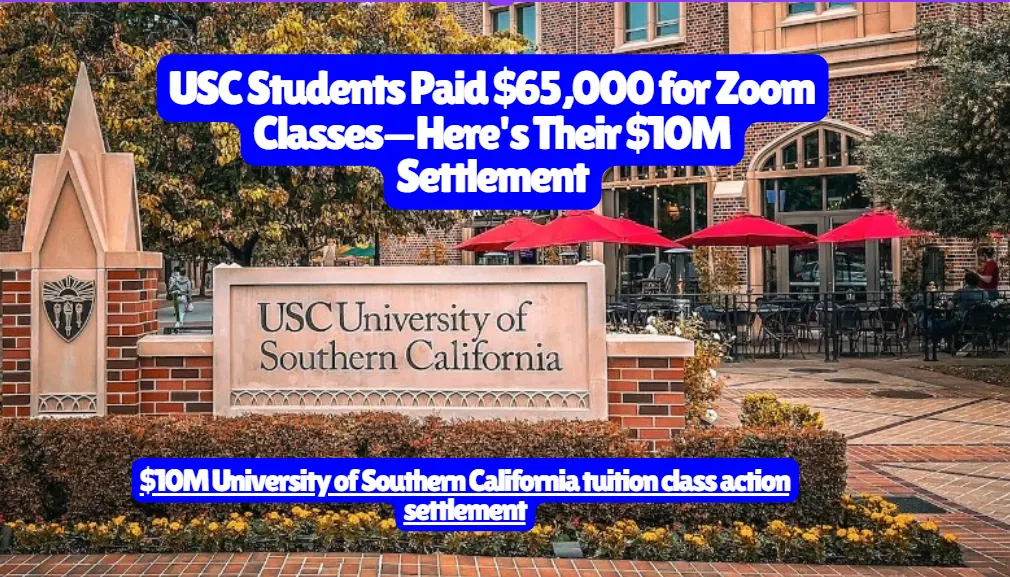
USC $10M University of Southern California Tuition Class Action Lawsuit, Students Paid $65,000 for Zoom Classes
USC agreed to a $10 million class action settlement for Spring 2020 students who paid full tuition but got remote instruction when COVID-19 shut down campus. U.S. District Judge Dolly M. Gee granted preliminary approval on October 22, 2025, covering approximately 18,000 students who paid or owed tuition and fees during the Spring 2020 semester when USC transitioned to online learning mid-semester without reducing costs.
The case, filed in May 2020, alleged breach of contract, unjust enrichment, conversion, and violations of California consumer protection law. Students argued they paid premium tuition for an in-person USC experience but received inferior remote instruction worth far less.
What Is the USC Tuition Settlement About?
The lawsuit centers on a simple question: Should students who paid $32,500 per semester for in-person USC education get refunds when the university switched to remote learning in March 2020?
The allegations:
- USC charged the same tuition for remote instruction as in-person classes
- Students lost access to campus facilities, libraries, labs, and in-person instruction
- The online experience delivered inferior educational value
- USC continued collecting full fees despite reduced operational costs
- No partial refunds were offered despite the dramatic change in service delivery
USC’s position:
- The university continued providing education and awarded credits
- Costs remained high despite campus closure (faculty salaries, technology infrastructure, student support)
- The transition was an unprecedented emergency response
- Students received the same degree and academic credits they contracted for
- Remote learning was mandated by California state orders, not USC’s choice
This case mirrors dozens of similar lawsuits filed against universities nationwide following COVID-19 campus closures, including actions brought against institutions examined in cases like the Harvard class action lawsuit data breaches and admissions controversies where students challenged institutional practices.
The Reality Behind the USC Tuition Claims
Spring 2020 timeline:
- January 2020: Spring semester begins with in-person instruction
- March 11, 2020: USC announces transition to remote instruction
- March 13, 2020: Last day of in-person classes
- March 23-27, 2020: Spring break (originally planned travel week)
- March 30, 2020: Remote instruction begins
- May 2020: Semester ends entirely online
What students paid:
- Undergraduate tuition: Approximately $32,500 per semester (2019-2020 rate)
- Graduate tuition: Varies by program, often $40,000-$60,000+ per year
- Campus fees: $1,000-$2,000 per semester
- Housing: Many students had paid for spring housing but couldn’t access it
Related article: 273,000 Fords Won’t Lock Into Park—Your Car Could Roll Away While You’re Shopping
What students got instead:
- Zoom lectures with hundreds of students
- Limited or no lab access
- No in-person office hours or mentoring
- Closed libraries, recreation centers, student centers
- No campus activities, clubs, or networking events
- Inferior clinical placements for professional programs
- Self-directed learning replacing hands-on instruction
The financial math: USC’s Spring 2020 undergraduate enrollment was approximately 20,000 students. At $32,500 per semester, that’s $650 million in tuition revenue for a semester delivered 60% remotely. The $10 million settlement represents about 1.5% of that revenue.
Case Number and Court Details
Official case name: In re University of Southern California Tuition and Fees COVID-19 Refund Litigation
Case number: 2:20-cv-04066
Court: U.S. District Court for the Central District of California
Judge: Hon. Dolly M. Gee
Filing date: May 7, 2020
Preliminary approval: October 22, 2025
Settlement amount: $10 million
Lead plaintiff: Christina Diaz (originally filed as Jane Doe)
Class counsel: Hagens Berman Sobol Shapiro LLP
The same law firm that represented USC students achieved a landmark $215 million settlement in the Dr. George Tyndall sexual abuse scandal, demonstrating their track record with complex university litigation similar to other education institution cases like the University of Phoenix class action lawsuit settlements and FTC actions.
Who Qualifies for the USC Settlement?
Settlement class definition: All students who paid or were obligated to pay tuition, fees, or other costs to USC for the Spring 2020 academic term.
This includes:
- Undergraduate students enrolled Spring 2020
- Graduate students enrolled Spring 2020
- Professional school students (law, medicine, etc.) enrolled Spring 2020
- Part-time and full-time students
- Students who withdrew mid-semester
- Students who paid with financial aid, scholarships, or student loans
- International students who paid USC tuition
This excludes:
- Students enrolled only in Fall 2019 or earlier
- Students who started in Fall 2020 or later
- Faculty and staff (unless also enrolled as students)
- Auditing students who didn’t pay tuition
Estimated class size: Approximately 18,000 class members
How Much Will USC Students Receive?
The final payout depends on several deductions from the $10 million settlement fund:
Settlement fund allocation:
- Attorney fees: Up to 33% ($3.3 million) subject to court approval
- Administrative costs: Settlement notice, claims processing, website maintenance (estimated $200,000-$500,000)
- Service awards: Lead plaintiffs may receive $5,000-$10,000 each for representing the class
- Net settlement fund: Approximately $6 million-$6.5 million for class members
Individual payments: With 18,000 class members, average payout will be $330-$360 per person assuming all class members submit valid claims.
No claim form required. Unlike many class actions examined in articles about settlements like the Stanford class action lawsuit whistleblower retaliation, USC students don’t need to file claims. Payments will be automatic if the settlement receives final approval.
Payment method options:
- Check mailed to last known address
- Venmo payment
- PayPal payment
Students can update their payment preferences and contact information through the settlement website when it becomes available.
What the Lawsuit Alleged: Legal Claims Explained
Breach of contract: Students paid for in-person education, campus access, and facilities. USC failed to deliver these contracted services or provide refunds when services became unavailable.
Unjust enrichment: USC benefited financially by collecting full tuition while providing diminished services and reducing operational costs through campus closure.
Conversion: USC kept money (tuition payments) that rightfully belonged to students given the substantial change in educational delivery.
California Business & Professions Code violations: USC’s practices violated California consumer protection laws prohibiting unfair and deceptive business practices.
The legal theory is straightforward: When you pay for a Mercedes and get a Honda, you’re entitled to a refund for the price difference. Students paid for premium in-person USC education but received online instruction worth substantially less.
USC’s Defense Arguments
USC denied all allegations and maintained several defenses that are common in higher education consumer protection cases:
Force majeure: The COVID-19 pandemic was an unforeseeable event outside USC’s control. California state orders mandated campus closures.
Substantial performance: USC continued educating students, awarding credits, and providing degrees. Students received what they contracted for—a USC education and diploma.
Cost continuity: Faculty salaries, technology infrastructure, student support services, and administrative costs continued at similar levels despite remote instruction.
No alternative: Allowing students to remain on campus would have violated public health orders and endangered lives.
Contractual flexibility: USC’s terms and conditions reserve the right to modify instruction methods when necessary.
Benefit received: Students still gained knowledge, credits toward degrees, and USC credentials valuable in the job market.
These arguments mirror defenses raised in similar education litigation, though courts have been split on whether they justify keeping full tuition for remote instruction.
Timeline of USC Tuition Settlement Developments
May 7, 2020: Initial complaint filed by anonymous “Jane Doe” plaintiff seeking class action status and tuition refunds.
November 15, 2021: Court issues scheduling order setting trial date for July 25, 2023. Case ordered to private mediation with deadline of July 1, 2022.
July 2022: Early mediation occurs but doesn’t result in settlement. Parties continue discovery.
2023: Discovery continues through depositions, document production, and expert witness preparation. Trial preparation intensifies.
2024-2025: Settlement negotiations resume. Parties reach agreement on $10 million settlement.
October 22, 2025: Judge Dolly M. Gee grants preliminary approval of $10 million settlement. Settlement administrator begins preparing class notice.
December 2025-January 2026 (projected): Settlement administrator sends email and mail notice to approximately 18,000 class members.
Spring 2026 (projected): Final approval hearing. Judge decides whether to grant final approval.
Summer 2026 (projected): If approved, settlement payments distributed to class members.
Comparison to Other COVID-19 University Refund Lawsuits
USC’s settlement is one of dozens filed against universities nationwide:
University of San Diego: $1.4 million settlement for Spring 2020 tuition refunds. Approximately 8,000 class members. Individual payouts around $175 each.
Boston University: Lawsuit dismissed. Court ruled students received substantial educational value despite remote instruction.
Brown University: Case ongoing. University fighting class certification.
George Washington University: Settlement discussions ongoing.
Vanderbilt University: Case ongoing in Middle District of Tennessee.
Columbia University: Dismissed. Court found no breach of contract because university reserved right to modify instruction methods.
Cornell University: $12 million settlement in October 2022. One of the larger university COVID refund settlements.
Liberty University: $11 million settlement in September 2023 for keeping campus open during pandemic while charging COVID fees.
Settlement amounts vary widely based on enrollment size, tuition costs, settlement negotiation strategies, and judicial willingness to approve claims. Most settlements range from $50-$500 per student—far less than the thousands many students hoped to recover.
What Legal Experts Say About the USC Settlement
Education law attorney Michael Thompson told Inside Higher Ed in 2024: “These COVID tuition cases are difficult for plaintiffs. Courts generally defer to universities’ academic judgments. Getting any settlement is a win for students, even if it’s pennies on the dollar.”
Consumer protection attorney Sarah Mitchell notes: “The $10 million USC settlement averages $550 per student before fees. Students paid $32,500 for in-person education and got perhaps $10,000 worth of online instruction. The settlement captures maybe 2% of the actual value difference.”
Professor of higher education law Jennifer Walsh explained: “Universities have successfully argued that force majeure—acts of God—excuse non-performance. Courts buy the argument that COVID was unprecedented and universities did their best. But that ignores the financial windfall universities received by collecting full tuition while slashing operational costs.”
Former university general counsel Robert Chen: “The settlement math works for USC. $10 million is a rounding error compared to litigation costs if the case went to trial. Plus, winning at trial risks a much larger judgment and setting precedent that could invite more lawsuits.”
Consumer Protection Laws at Play
California Business & Professions Code § 17200 (Unfair Competition Law): Prohibits unfair, unlawful, or fraudulent business practices. Plaintiffs argued USC’s refusal to refund tuition when services changed substantially violated this statute.
California Civil Code § 1692 (Unjust Enrichment): Requires parties who benefit from another’s expense to make restitution. Students claimed USC was unjustly enriched by keeping full tuition while providing diminished services.
Contract law principles: When one party fails to deliver contracted services, the other party is entitled to damages or refund. Students contracted for in-person education; USC provided remote instruction.
Consumer expectation doctrine: Consumers are entitled to receive what they reasonably expected based on representations and industry standards. USC marketed itself as providing world-class in-person education; students expected that’s what they’d receive.
These same consumer protection principles apply across industries, from education to retail, as seen in other consumer rights cases like those involving class action lawsuit participation and consumer rights.
What USC Students Should Do Now
If you attended USC Spring 2020:
Update your contact information. The settlement administrator will send notice via email and mail. Check your USC email and the address you had on file in Spring 2020. Update your information on the settlement website when it launches.
Watch for settlement notice. Notice should arrive December 2025-January 2026. Don’t ignore it—even though you don’t need to file a claim, you should review the terms.
Choose your payment method. When the settlement website launches, you can elect to receive payment via Venmo, PayPal, or check. Choose the method most convenient for you.
Mark objection and opt-out deadlines. If you disagree with the settlement terms, you have the right to object or opt out. Deadlines will be in the settlement notice.
Keep documentation. Save any notice you receive. If you later have issues receiving payment, you’ll need proof you were a class member.
No action required for payment. Unlike many settlements that require claim forms, this settlement provides automatic payment to class members if approved.
Your Rights: Object, Opt-Out, or Accept
Accept the settlement (do nothing): If you do nothing, you’ll automatically receive your share of the settlement if the court grants final approval. You’ll release all claims against USC related to Spring 2020 tuition.
Object to the settlement: If you think the settlement amount is too low or terms are unfair, you can file an objection with the court. Deadlines for objections will be in the settlement notice. You remain in the class and receive payment if the court approves despite your objection.
Opt out of the settlement: If you want to pursue your own individual lawsuit against USC, you must opt out by the deadline in the settlement notice. If you opt out, you won’t receive any settlement payment but preserve your right to sue USC independently.
Attend the final approval hearing: The court will hold a fairness hearing in Spring 2026 (exact date TBD) to decide whether to approve the settlement. Class members can attend and speak, though most don’t.
Most class members accept settlements by doing nothing. Objecting or opting out requires active steps and often legal assistance if you want to pursue individual claims.
Surprising Facts About University COVID Lawsuits
Over 400 COVID-19 tuition lawsuits were filed against colleges and universities nationwide between March 2020 and December 2021. Most are still pending or were dismissed.
Settlement rates are under 10%. Only about 35-40 universities have reached settlements. The vast majority of cases were dismissed or are still litigating years later.
Average settlement is $50-$300 per student. Despite students paying $20,000-$60,000 per semester, most settlements provide minimal per-person recovery.
Universities saved billions during COVID. With campuses closed, universities slashed costs for utilities, dining services, maintenance, events, and athletics while collecting full tuition. Few returned these savings to students.
Spring 2020 was most litigated. Lawsuits focused primarily on Spring 2020 when campuses suddenly closed mid-semester. Fall 2020 cases were weaker because students enrolled knowing instruction would be remote.
Housing refunds were more successful. Students who paid for on-campus housing but couldn’t live there saw higher refund rates than tuition claims. Many universities voluntarily provided prorated housing refunds.
What This Means for Higher Education
Precedent for future emergencies: The settlements establish that universities may face legal liability if they collect full tuition during emergencies while providing diminished services.
Contract clarity: Universities are updating enrollment agreements to explicitly state they reserve the right to modify instruction methods during emergencies without tuition refunds.
Insurance implications: Some universities now carry pandemic insurance or force majeure coverage to protect against future similar events.
Pricing transparency: The litigation highlighted that tuition pays for far more than instruction—campus access, facilities, networking, and the complete college experience matter.
Online program pricing: The cases raise questions about why online programs charge similar tuition to in-person programs if online delivery is supposedly equivalent in value.
FAQ: USC Tuition Settlement Questions
Do I need to file a claim to get paid?
No. This settlement provides automatic payments to class members. You’ll receive payment if the court grants final approval without filing any claim form.
How much money will I receive?
Estimated $330-$360 per class member based on the $10 million settlement fund minus attorney fees, administrative costs, and service awards.
When will I receive payment?
If the court grants final approval in Spring 2026, payments should be distributed Summer 2026.
Does this settlement cover Fall 2020 or later semesters?
No. Only Spring 2020 semester is covered. Later semesters aren’t included because students enrolled knowing instruction would be remote.
What if I paid with student loans?
You still qualify. Settlement payments go to students who paid tuition, regardless of payment method (personal funds, financial aid, scholarships, or loans).
What if I graduated or transferred?
You still qualify if you were enrolled at USC for Spring 2020. Graduating, transferring, or withdrawing doesn’t affect your class membership.
Can I sue USC separately if I opt out?
Theoretically yes, but individual lawsuits face the same legal challenges and cost tens of thousands in attorney fees. Most class members accept the settlement.
What if I don’t receive notice?
Check the settlement website when it launches. You can also contact the settlement administrator if you think you’re a class member but didn’t receive notice.
Is the $10 million taxable?
Potentially. Consult a tax professional. Settlement payments may be taxable income depending on how the IRS classifies the payment.
What happens if the judge doesn’t approve the settlement?
The case would continue to litigation or the parties would negotiate a new settlement. But judges approve most settlements that reach preliminary approval.
Action Steps for USC Spring 2020 Students
Right now:
- Note that you’re a potential class member
- Save any emails or mail from USC or the settlement administrator
- Update your contact information with USC if you’ve moved
When notice arrives (December 2025-January 2026):
- Read the settlement notice carefully
- Review objection and opt-out deadlines
- Decide whether to accept, object, or opt out
- Visit the settlement website to choose payment method
Before final approval hearing (Spring 2026):
- Ensure your payment information is current on the settlement website
- File any objections by the deadline if you disagree with the settlement
- Mark your calendar for the final approval hearing if you want to attend
After final approval (Summer 2026):
- Watch for payment via your chosen method
- Contact settlement administrator if payment doesn’t arrive within 60 days
- Keep payment documentation for your records
Bottom Line: What the USC Settlement Really Means
USC students who paid $32,500 per semester for in-person education got Zoom classes for 60% of Spring 2020 and will receive approximately $350 in compensation. That’s 1% of one semester’s tuition for a semester that was 60% remote.
The settlement isn’t about making students whole—it’s about avoiding the cost and risk of trial for USC while giving students token compensation. At $550 per student before attorney fees, the settlement barely covers textbooks, let alone the thousands in value lost from inferior remote instruction.
For students, it’s $350 you didn’t have yesterday. The alternative was likely years more litigation with uncertain outcome. Most COVID tuition cases were dismissed entirely, so getting anything is better than nothing.
For USC, it’s cheap insurance. $10 million is roughly 1.5% of Spring 2020 undergraduate tuition revenue. The university avoids precedent-setting trial verdict and puts the issue behind them.
For higher education, it’s a warning shot. Universities can’t completely ignore students’ financial interests during emergencies. But it also shows universities can collect full tuition for remote instruction and settle claims for pennies on the dollar.
The real lesson: Read your enrollment agreement. Universities reserve broad rights to modify instruction methods, and courts generally defer to academic institutions’ judgments about educational delivery. If you want guaranteed in-person instruction, you’ll need explicit contractual language—which no university currently offers.
This settlement, like other education-related legal actions affecting students, demonstrates that while consumer protection laws theoretically protect students, recovering substantial damages from well-funded institutions with sophisticated legal teams remains extremely difficult. The $10 million USC settlement is simultaneously a victory (students got something) and a disappointment (they got almost nothing compared to their losses).
About the Author

Sarah Klein, JD, is a licensed attorney and legal content strategist with over 12 years of experience across civil, criminal, family, and regulatory law. At All About Lawyer, she covers a wide range of legal topics — from high-profile lawsuits and courtroom stories to state traffic laws and everyday legal questions — all with a focus on accuracy, clarity, and public understanding.
Her writing blends real legal insight with plain-English explanations, helping readers stay informed and legally aware.
Read more about Sarah