
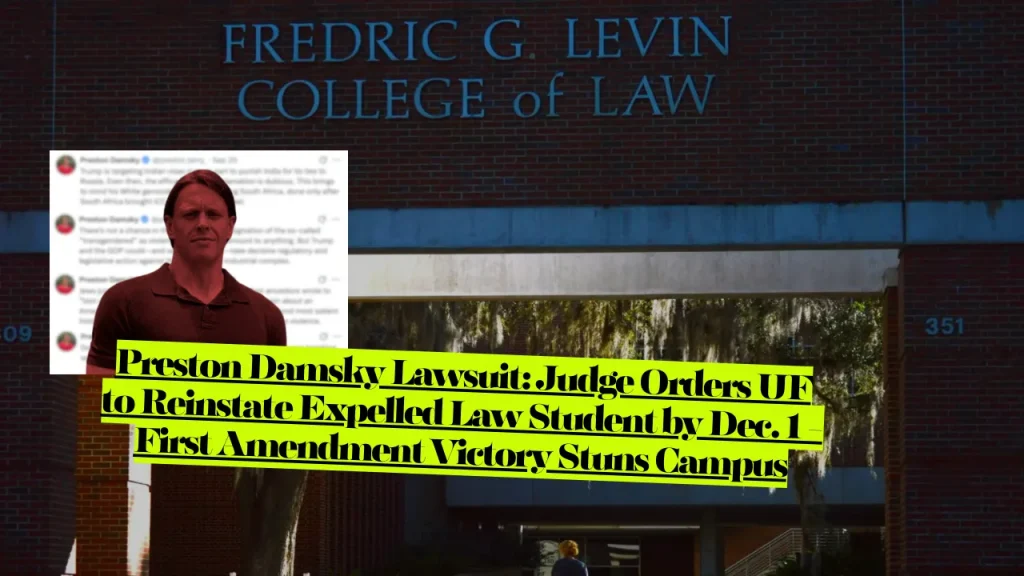
Preston Damsky Lawsuit, Judge Orders UF to Reinstate Expelled Law Student by Dec. 1 – First Amendment Victory Stuns Campus
Federal Judge Allen Winsor ruled November 24, 2025, that the University of Florida must reinstate Preston Damsky by December 1, granting a preliminary injunction that found UF failed to prove his antisemitic social media posts constituted a true threat or unprotected speech. The 29-year-old law student was expelled in August 2025 after posting “Jews must be abolished by any means necessary” on X, sparking a campus-wide free speech battle.
What Is the Preston Damsky Lawsuit?
Damsky filed a federal lawsuit in September 2025 against UF and Dean of Students Chris Summerlin, claiming his expulsion violated his First Amendment rights. The case centers on whether UF, a public university, overstepped constitutional bounds by expelling a student for off-campus social media posts the school deemed threatening and disruptive.
The lawsuit specifically challenges UF’s August 2025 expulsion decision and the April 3, 2025 trespass warning that banned Damsky from campus for three years.
The Social Media Posts That Led to Expulsion
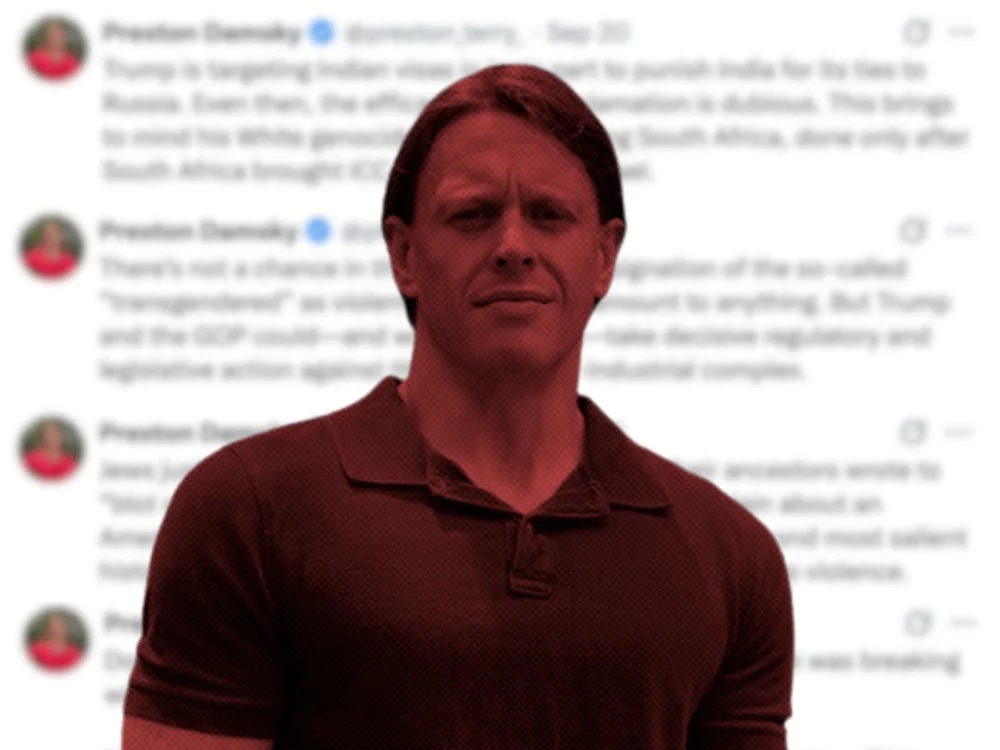
On March 21, 2025, Damsky posted on X to approximately 25 followers: “My position on Jews is simple: whatever Harvard professor Noel Ignatiev meant by his call to ‘abolish the White race by any means necessary’ is what I think must be done with Jews. Jews must be abolished by any means necessary”.
About a week later, UF law professor Lyrissa Lidsky, who is Jewish, replied asking if Damsky would murder her and her family. Damsky responded: “Did Ignatiev want Whites murdered? If so, were his words as objectionable as mine? If Ignatiev sought genocide, then surely a genocide of all Whites would be an even greater outrage than a genocide of all Jews, given the far greater number of Whites”.
From February to April 2025, Damsky made dozens of X posts describing Jewish people as “parasitizing the West,” calling Jews the “common enemy of humanity,” labeling immigrants as “invaders,” and advocating for a white ethnostate.
Related lawsuit: Amazon Alexa Class Action Lawsuit, Millions Can Now Sue After July 2025 Court Ruling – Here’s How to Join
Judge Winsor’s Preliminary Injunction Ruling
Judge Winsor wrote that UF did not show how “Damsky’s speech constituted a true threat or was otherwise proscribable,” noting that even though Damsky’s posts were “hateful and offensive,” he offered “no indication that he will act on his ‘position’ or do anything at all”.
Winsor cited the U.S. Supreme Court’s 2003 decision in Virginia v. Black, emphasizing that even deeply offensive expression like cross burning cannot be categorically banned simply because it is upsetting.
“Vindication of First Amendment rights always serves the public interest,” Winsor wrote, adding that “the public has no interest in enforcing unconstitutional penalties or restrictions on speech”.
The Court’s Key Findings
Winsor found that Damsky’s March 21 post had no connection to UF at all, as it did not name any UF administrators, students, or professors. The judge also determined that Damsky’s response to Professor Lidsky wasn’t a “serious expression of a real intent to harm”.
“The University, of course, has an interest in maintaining order, but it has no interest in violating the First Amendment to achieve that goal,” Winsor wrote.
UF’s Defense: Substantial Disruption and Safety Concerns
UF’s attorney Christopher Bartolomucci argued that Damsky’s posts caused substantial disruption on campus, noting that students skipped class, chose not to enroll in certain courses, and one professor quit. A professor who replied to Damsky’s post said she slept with a baseball bat next to her bed.
Professor Lidsky hadn’t initially felt threatened by the post, but that changed after several students came to her office expressing fear for her safety and concern that Damsky might come to the law school armed.
Bartolomucci argued that Damsky’s tweet targeted UF’s large Jewish student population—the university is home to the largest Jewish student population of any public university in the United States—by disrupting campus and engaging recklessly with the professor.
UF told Damsky he had “created a material and substantial disruption to the academic operation of the UF College of Law,” increased security, and barred him from campus after receiving reports of safety concerns from other students.
The White Supremacist Seminar Paper
In Spring 2024, Damsky submitted a seminar paper titled “National Constitutionalism” arguing that “We the People” in the U.S. Constitution referred exclusively to white Americans. The paper proposed disenfranchising non-white citizens and included language advocating “shoot-to-kill orders” for non-white migrants.
The paper received a “book award” for earning the highest grade in the class taught by Judge John L. Badalamenti, though the university later clarified the award was automatically given based on grades and did not reflect endorsement of the views expressed.
After Damsky received the book award, Badalamenti informed him there were anonymous demands that the school retract his book award and denounce his work.
Related article: Is Polygamy Legal in Utah? 2025 Law Update – It’s an Infraction Now, But There’s a Big Catch
UF Initially Defended the Paper
UF College of Law Interim Dean Merritt McAlister initially defended the seminar in February 2025, stating Damsky’s opinions were protected by the First Amendment. It wasn’t until Damsky took to X in March 2025 that his future at the University of Florida was put into question.
According to a recording obtained by The Alligator, McAlister said the law school’s reputation was a “foremost concern,” adding that “The college isn’t going to express a viewpoint on any particular student speech. Our job as a community is to have dialogue and discussion and debate on these issues and let the marketplace of ideas drown out a particularly odious idea”.
Who Are the Parties in the Lawsuit?
Plaintiff: Preston Damsky, a 29-year-old former UF law student who confirmed in an NBC News interview he has Jewish ancestry. His great-grandparents were labeled “Hebrew” by border control agents when they immigrated to the U.S., and his grandparents are buried in a Jewish cemetery in Hollywood Hills, though he was not raised Jewish and has never visited a synagogue.
Defendant: Chris Summerlin, UF Dean of Students, who notified Damsky of his expulsion on August 8, 2025.
Damsky’s Attorney: Anthony Sabatini, a former Republican representative in the Florida House of Representatives.
The Judge: Chief Judge Allen Winsor, who was nominated by President Donald Trump in 2019.
Timeline of the Preston Damsky Case
Spring 2024: Damsky submits “National Constitutionalism” seminar paper advocating white supremacist views and receives a book award
February 2025: UF Interim Dean McAlister defends Damsky’s seminar paper as protected First Amendment speech
February-April 2025: Damsky makes dozens of antisemitic and racist posts on X
March 21, 2025: Damsky posts “Jews must be abolished by any means necessary” to approximately 25 followers on X
Late March 2025: Professor Lyrissa Lidsky replies to Damsky’s post, asking if he would murder her and her family
April 3, 2025: UF issues a trespass warning banning Damsky from campus for three years, citing threatening nature of his statements and safety concerns
August 8, 2025: Dean Summerlin notifies Damsky of his expulsion from the university
September 2025: Damsky appeals the expulsion; UF appeal panel denies the appeal
September 14, 2025: Damsky files federal lawsuit against UF claiming First Amendment violations
October 10, 2025: UF responds by arguing the expulsion did not violate his rights
October 29, 2025: Federal hearing held with Judge Winsor hearing arguments from both sides
November 24, 2025: Judge Winsor grants preliminary injunction ordering UF to return Damsky to normal standing by December 1
What the Preliminary Injunction Means
The judge granted a temporary injunction to keep Damsky from being expelled, ruling that his posts on X are protected by the First Amendment. The case will continue to trial on its merits; however, Damsky will be allowed to return to class in the meantime.
According to Reuters, UF can choose to appeal the preliminary injunction and the trial is set for May 2026.
The preliminary injunction is not the case’s final decision—it’s meant to preserve the status quo, returning Damsky to school in this case, until a judgment is made.
Legal Analysis: True Threats vs. Protected Speech
First Amendment experts say speech could only be punished if it crosses the line into a threat of violence, which is currently in question in this federal lawsuit in the Northern District of Florida.
What Constitutes a True Threat?
Kevin Goldberg, an attorney and First Amendment expert at the Freedom Forum, said that “true threats are a narrow category” and “it’s not about the actions or feelings of the listener, it’s about the intent of the speaker”.
Goldberg also said that although discomfort may arise from Damsky’s comments, discomfort is not enough to combat free speech claims.
The Substantial Disruption Standard
First Amendment scholars express concern about UF’s arguments, particularly referencing a Supreme Court ruling from the 1960s that set the standard for substantial disruption, allowing schools to regulate speech only if it interfered with the functioning or operations.
Goldberg said he didn’t believe this standard applied in this case because it was set for K-12 public schools, not higher education. Goldberg also noted that other First Amendment cases may protect Damsky’s speech further, since he posted off campus.
Academic Freedom Expert Weighs In
Jane Bambauer, a UF professor of law and First Amendment expert, said Damsky’s speech was allowed as long as he didn’t incite violence or make threats, stating “It’s not good speech, but it is protected”. However, she added that if there was any instance of threat, his words would no longer be protected by the First Amendment.
Bambauer noted that many of Damsky’s online posts quote other individuals like historians, creating a potential legal gray area.
ACLU Involvement
The American Civil Liberties Union filed an amicus curiae brief, also known as a “friends of the court” brief, for the case. This type of brief is written by a person or organization that is not a party to a case to give insight that may help the court make a decision.
Campus Response and Criticism
UF, home to the largest Jewish student population of any public university in the U.S., has since increased security around the law school with added police patrols, stricter event protocols, and restricted building access.
UF Hillel posted a statement on Instagram in response to the ruling, stating it “disregards violent threats made toward the Jewish community” and that “UF must be a safe space where Jewish students can live and learn free from threats of hateful and antisemitic violence”.
Law School Faculty Criticism
A law professor, granted anonymity for fear of jeopardizing his job, said the issue with Damsky is part of a broader pattern of inaction among law school professors against instances of discrimination, calling the law school’s handling of Damsky’s case “fundamentally opaque” and a “failure of leadership”.
“We’ve known about the student. We’ve known about his problematic statements…over the course of years,” the professor said. “The administration did nothing… they hid behind student privacy and this supposed principle of corporate neutrality”.
The professor said rankings shaped the law school’s response, with administrators avoiding addressing the situation to preserve the school’s reputation—a key factor in U.S. News & World Report rankings.
What Happens Next?
UF has until December 1, 2025, to return Damsky to normal standing. The university declined to comment, stating it does not comment on ongoing litigation.
According to Reuters, UF can choose to appeal the preliminary injunction and the trial is set for May 2026.
Possible next steps:
UF Appeals: The university could appeal Judge Winsor’s preliminary injunction to a higher court.
May 2026 Trial: The case will proceed to trial on the merits to determine whether UF’s expulsion violated Damsky’s constitutional rights.
Settlement: The parties could potentially reach a settlement agreement before trial.
Final Ruling: If the case goes to trial, a final ruling would determine whether Damsky’s expulsion was constitutional and whether he can be permanently reinstated or if UF has grounds to expel him.
Implications for Free Speech on College Campuses
Sabatini said the case will play a big role in interpreting what students in higher education are allowed to say, noting that “These are adults. This is a graduate school. These were his political opinions. I think everybody knew that”.
Middle and high school speech is more restricted, Sabatini said, but students at colleges and universities have the same rights as they would anywhere else.
At a time when the DeSantis administration has touted the university to be a pivotal model of free speech, this federal lawsuit in the Northern District of Florida may demonstrate new legal territory for how far a public institution could go in disciplining a student for speech.
Balancing Campus Safety and Free Speech
This case highlights the difficult tension universities face between:
Protecting Campus Safety: Universities have obligations to maintain safe learning environments free from threats and substantial disruption.
Upholding First Amendment Rights: Public universities must respect constitutional free speech protections, even for offensive or hateful views.
Off-Campus Speech: The case raises questions about when universities can discipline students for social media posts made off campus.
Graduate vs. Undergraduate Standards: The ruling suggests courts may apply different standards to law students than to younger college students.
Similar Cases and Legal Precedents
The Preston Damsky case joins several high-profile campus free speech disputes:
Virginia v. Black (2003): The Supreme Court case Judge Winsor cited, emphasizing that even hateful expression like cross burning cannot be categorically banned simply because it is upsetting.
Tinker v. Des Moines (1969): The substantial disruption standard that courts referenced, though experts note it was designed for K-12 schools.
Recent Campus Speech Cases: Universities nationwide have faced similar challenges balancing free speech with campus safety concerns, particularly regarding antisemitic and racist speech.
Frequently Asked Questions About the Preston Damsky Lawsuit
What did Preston Damsky post that got him expelled?
On March 21, 2025, Damsky posted on X: “My position on Jews is simple: whatever Harvard professor Noel Ignatiev meant by his call to ‘abolish the White race by any means necessary’ is what I think must be done with Jews. Jews must be abolished by any means necessary”.
Did the judge rule in Damsky’s favor?
Yes, on November 24, 2025, Judge Allen Winsor granted a preliminary injunction ordering UF to return Damsky to normal standing by December 1. However, the case will continue to trial in May 2026.
What was the judge’s reasoning?
Judge Winsor found that UF did not prove Damsky’s speech constituted a true threat or was otherwise unprotected, noting that even though his posts were hateful and offensive, he offered no indication he would act on his position.
Can UF still expel Damsky?
Yes, the preliminary injunction is temporary and the case will continue to trial on its merits. UF can also choose to appeal the preliminary injunction.
What is Damsky’s background?
Damsky is a 29-year-old law student who has Jewish ancestry—his great-grandparents were labeled “Hebrew” when they immigrated to the U.S. and his grandparents are buried in a Jewish cemetery—though he was not raised Jewish and has never visited a synagogue.
What was the white supremacist paper about?
In Spring 2024, Damsky submitted a seminar paper arguing that “We the People” in the Constitution referred exclusively to white Americans and proposed disenfranchising non-white citizens with “shoot-to-kill orders” for non-white migrants. The paper received the highest grade in the class.
When is the trial scheduled?
According to Reuters, the trial is set for May 2026.
Did UF increase security because of Damsky?
Yes, UF increased security around the law school with added police patrols, stricter event protocols, and restricted building access. Some students feared Damsky would come to classes armed, and one professor slept with a baseball bat next to her bed.
Is this case related to other campus free speech issues?
Yes, this case is part of broader debates about free speech on college campuses, particularly regarding antisemitic and racist speech, and how universities balance safety concerns with First Amendment protections.
What does this mean for other students?
Attorney Sabatini said the case will play a big role in interpreting what students in higher education are allowed to say, noting that college students have the same free speech rights as they would anywhere else.
Related Articles:
- Understanding Your First Amendment Rights on College Campuses
- Student Conduct Code Violations: When Can Universities Discipline Students?
- True Threats vs. Protected Speech: Legal Standards Explained
Disclaimer: This article provides information about the Preston Damsky lawsuit and does not constitute legal advice. If you’re facing similar issues involving free speech rights or university discipline, consult with a qualified attorney licensed in your jurisdiction.
About the Author

Sarah Klein, JD, is a licensed attorney and legal content strategist with over 12 years of experience across civil, criminal, family, and regulatory law. At All About Lawyer, she covers a wide range of legal topics — from high-profile lawsuits and courtroom stories to state traffic laws and everyday legal questions — all with a focus on accuracy, clarity, and public understanding.
Her writing blends real legal insight with plain-English explanations, helping readers stay informed and legally aware.
Read more about Sarah