
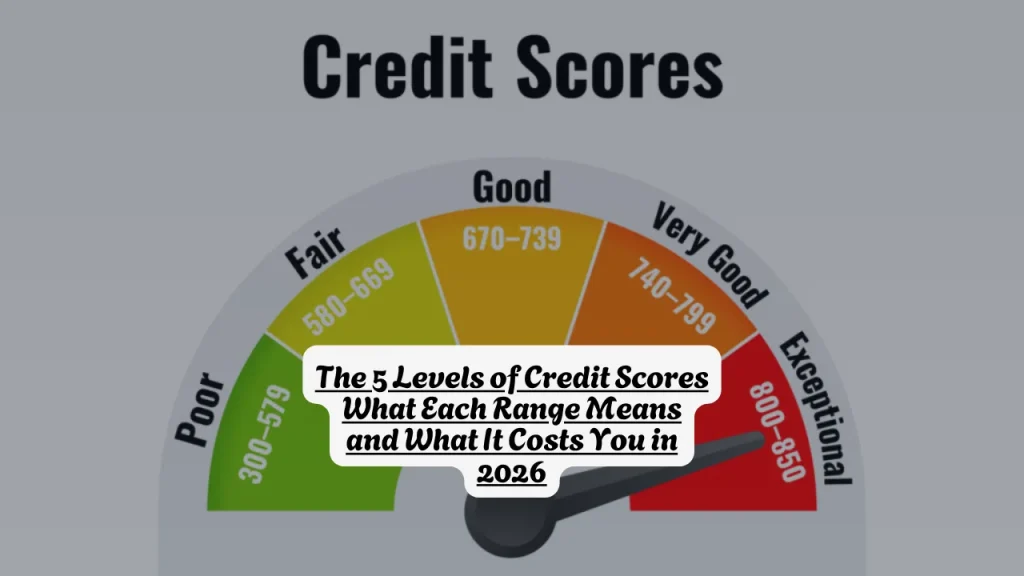
The 5 Levels of Credit Scores What Each Range Means and What It Costs You in 2026
What are the 5 levels of credit scores?
Under the FICO model — used by 90% of top lenders — credit scores run from 300 to 850 and fall into five levels: Poor (300–579), Fair (580–669), Good (670–739), Very Good (740–799), and Exceptional (800–850). Each level changes what loans you qualify for, what interest rate you pay, and how much money you spend over a lifetime of borrowing.
Your credit score does not just decide whether you get approved. It decides how much everything costs you. The difference between the lowest tier and the highest can mean paying tens of thousands of dollars more in interest on a single mortgage. Most people know their score — fewer people know exactly what tier they are in and what that tier is actually costing them.
90% of top lenders use FICO scores to help make billions of credit-related decisions every year. Most credit scores have a 300–850 range — the higher the score, the lower the risk to lenders.
Here is every level explained plainly — what lenders see, what you can get, and what each tier is worth fighting for.
Level 1 — Poor Credit (300–579): What You Can and Cannot Get With the Lowest FICO Scores
A poor credit score is the hardest place to borrow from. It signals to lenders that you have had serious problems repaying debt in the past — missed payments, collections, judgments, or possibly a bankruptcy.
A poor credit score signals serious risk to lenders. Expect to be denied for most traditional loans or charged very high interest rates if approved. Secured credit cards — which require a cash deposit — are usually your best option at this level.
On mortgages, your options narrow sharply. FHA loans allow credit scores as low as 500, but borrowers with scores between 500 and 579 must put down 10%. Scores of 580 and above qualify for the more favorable 3.5% down payment. Conventional loans from Fannie Mae and Freddie Mac require a minimum of 620 — so scores below that are locked out entirely.
On auto loans, you can still get approved — but the cost is steep. As of January 2026, the average borrower with a 720+ score paid 6.369% APR on a 60-month new car loan, compared to 16.74% for someone in the 500–589 range. On a $40,000 loan, that gap adds up to more than $12,300 in extra interest.
If something on your credit report is inaccurate — a wrong late payment, a duplicate collection account, or an item past its legal reporting window — that error may be suppressing your score unfairly. Under the Fair Credit Reporting Act (15 U.S.C. § 1681), you have the right to dispute it for free. A consumer rights attorney can help if the bureau refuses to fix it, and many take FCRA cases at no upfront cost.
Level 2 — Fair Credit (580–669): The Range Where Approval Gets Easier but Rates Stay High
Fair credit gets you through more doors than poor credit — but the terms you walk out with are still expensive. This is the tier where most people feel stuck. You can get approved, but what you are approved for still costs significantly more than it should.
In the fair range, approval is possible but you may face higher rates, stricter terms, or a larger down payment requirement.
In late 2024 and into 2025 — a trend continuing into 2026 — lenders tightened underwriting standards. Mortgage approvals for scores between 620 and 679 dropped by 18% compared to 2023. Auto loan interest rates for scores between 580 and 669 increased by an average of 1.2%. Being in this range in 2026 is harder than it was two years ago.
The single most important move at this level: bring your credit card balances below 30% of your limit and make sure every bill gets paid on time. Those two habits alone can push a fair score into the good range within three to six months. Fair credit generally puts you near the middle of credit score ranges. It may give you more credit opportunities than poor credit, but improving your score could help you get significantly better terms.
Related article: How to Read a TransUnion Credit Report Every Section Explained As You Reading Credit Report First Time
Level 3 — Good Credit (670–739): The Range Most Americans Aim For — and Its Hidden Cost
Good credit is where most Americans land, and it is where most people stop pushing. The average credit score in America is 715 as of 2026 — right in the middle of this tier. You can get approved for almost any loan at this level, which makes it easy to feel like you have arrived. But good credit is not the finish line — it is the starting point for acceptable terms, not the best ones.
A good credit score indicates you are on par with most borrowers and likely to fulfill your debt obligations. You can get approved for almost any loan you apply for and will usually get good credit card and personal loan rates — but not the most attractive mortgage rates.
The gap between the bottom of good (670) and the top (739) matters too. A score of 672 and a score of 738 are both “good” — but lenders treat them very differently in terms of the rate they offer. Every 20-point jump can move you into a cheaper pricing tier.
In the good range, you are seen as a reasonable borrowing risk. Most credit products are available to you, though you will not get the absolute best rates. With consistent on-time payments, you can climb to the very good range.
If your score is stuck in this tier and you suspect an error is holding it back, you have the right under FCRA § 611 to dispute any inaccurate item directly with the bureau. The bureau must investigate within 30 to 45 days.
Level 4 — Very Good Credit (740–799): Where Lenders Start Competing for You
This is the tier where the financial picture changes meaningfully. At very good credit, you stop chasing lenders — they start chasing you.
Very good credit gets you competitive rates and favorable terms. Lenders trust you significantly. You have multiple options and can sometimes negotiate better deals.
With a very good credit score, you are dependable and likely to make your payments on time. You can usually get approved for most loans at competitive rates and terms.
On mortgages, 740 is the key threshold. A score of 740 typically guarantees the lowest interest rates available to most borrowers. Even a few points can bump you into a new tier and save you money. On auto loans, hitting 720 drops you into the top rate tier. On credit cards, you now have access to the highest signup bonuses, the lowest APRs, and the best balance transfer offers.
Based on a $300,000 30-year fixed mortgage, improving from 620 to 760 or higher can save $156 per month and $56,103 in total interest over 30 years. That single jump in score tier is worth more than most people realize.
Level 5 — Exceptional Credit (800–850): The Top Tier and What It Really Gets You
Exceptional credit puts you in a group that fewer than one in four Americans reach. At this level, lenders offer you their best rates without hesitation — and you have maximum negotiating power on every financial product.
With an exceptional credit score, lenders view you as being at very low risk of defaulting on your debts. As long as you meet income requirements, you will likely be approved for any loan and get the best possible interest rate and terms.
About 24% of Americans have achieved exceptional credit status in the 800–850 range — these consumers qualify for the best interest rates and most favorable loan terms available.
The honest truth at this level: there is almost no financial difference between an 800 and an 850. Those with exceptional FICO scores of 800 and above typically receive the same loan terms as someone with a perfect score of 850 — all else being equal. Once you cross 800, you have unlocked everything the credit system offers.
At this tier, your main job is protecting the score you have built. Check your credit report at least once a year at AnnualCreditReport.com. One inaccurate late payment can drop an exceptional score by 60 to 100 points overnight — and you have the right under the FCRA to get it removed.
How the 5 FICO Credit Score Levels Compare Side by Side
| Level | Score Range | % of Americans | What You Get |
| Poor | 300–579 | ~16% | Denied or very high rates |
| Fair | 580–669 | ~17% | Approved with limited options |
| Good | 670–739 | ~21% | Most loans, not best rates |
| Very Good | 740–799 | ~25% | Competitive rates, lender choice |
| Exceptional | 800–850 | ~24% | Best rates, every product |
Frequently Asked Questions About the 5 Credit Score Levels
What are the 5 levels of credit scores under FICO in 2026?
FICO groups credit scores into five categories: Poor, Fair, Good, Very Good, and Exceptional. They run from 300 at the bottom to 850 at the top. Each level signals a different level of risk to lenders and unlocks different rates and products.
Which credit score level do most Americans fall into?
The average credit score in America is 715 as of 2026 — which places the typical American squarely in the “Good” range of 670–739. About 71% of Americans have a score of 670 or above.
What is the most important credit score level to reach?
A score of 740 typically guarantees the lowest interest rates available to most borrowers. Moving from Good to Very Good — crossing 740 — is the single most impactful jump in terms of real dollar savings on mortgages, auto loans, and credit cards.
Can I dispute a credit report error that is keeping me in a lower score level?
Yes, and it is free. Under the Fair Credit Reporting Act (15 U.S.C. § 1681), you have the right to dispute any inaccurate item with the credit bureau directly. The bureau must investigate within 30 to 45 days. If it refuses to fix a verified error, you can file a complaint with the CFPB and sue for damages, including up to $1,000 in statutory damages and attorney fees under FCRA Section 616.
How long does it take to move up one credit score level?
It depends on your starting point. Those starting in the 600–700 range can realistically gain 20–50 points within a few months with consistent on-time payments, lower balances, and corrected report errors. Moving from Poor to Fair can take six to twelve months of steady effort. Moving from Good to Very Good, if your habits are already solid, can happen in three to six months.
Does a fair or poor credit score affect anything besides loans?
Yes. A credit score affects loan approvals, interest rates, insurance costs, and more. Many auto and homeowners insurers use credit-based scores to price premiums. Landlords use your score in rental decisions. Some employers in certain states also review credit reports during hiring.
Credit Score Terms From This Article
FICO Score: The most widely used credit scoring model in the US, created by Fair Isaac Corporation. Runs from 300 to 850 and is used by 90% of top lenders for mortgages, auto loans, and credit cards.
VantageScore: An alternative model created jointly by Equifax, Experian, and TransUnion. Also runs 300 to 850 but uses four tiers instead of five, with slightly different range boundaries than FICO.
Credit Utilization: How much of your available credit you are using. A $3,000 balance on a $10,000 limit equals 30% utilization. Keeping it below 30% — ideally below 10% — raises your score.
Subprime: A lender’s term for borrowers in the poor or fair range. Subprime loans come with significantly higher rates and stricter terms to offset the lender’s perceived risk.
FCRA (Fair Credit Reporting Act): Federal law at 15 U.S.C. § 1681 that gives you the right to access your credit report for free, dispute errors at no cost, and sue bureaus that refuse to correct verified mistakes.
Hard Inquiry: A credit check triggered by a loan or card application. Stays on your report for two years. Too many in a short period can lower your score slightly.
Finding Your Level — and Your Next Move
You now know all five FICO credit score levels, what each one means to lenders, and what each level is actually costing you in real dollars. The difference between “good” and “great” credit is separated by real money — thousands of dollars per year in interest charges, insurance premiums, and deposit requirements. The jump that matters most is crossing 740 — that is where lenders stop limiting your options and start competing for your business.
If an error on your credit report is holding you back from the next level, you do not have to fight it alone. Visit AllAboutLawyer.com to connect with a consumer rights attorney who handles FCRA disputes — most are taken at no upfront cost to you.
Sources:
- FICO Score ranges and tier data — myfico.com
- Experian Consumer Credit Review 2025 — experian.com
- MyFICO Auto Loan APR data, February 2026 — myfico.com
- ConsumerAffairs Mortgage Rate by Credit Score, January 2026 — consumeraffairs.com
- CFPB Borrower Risk Profiles, March 2026 — consumerfinance.gov
- Fair Credit Reporting Act, 15 U.S.C. § 1681 — law.cornell.edu
- CNBC Select: 5 Credit Score Ranges, April 2026 — cnbc.com
This article is for informational purposes only and does not constitute legal or financial advice. Consult a licensed attorney or financial advisor for guidance specific to your situation.
Prepared by the AllAboutLawyer.com Editorial Team. Last Updated: May 26, 2026.