
4.3 Million Brush Buddies, Evo and ARU Toothpaste Tubes Recalled, Full Product List, FDA Warning Letter Findings, Lot Numbers and Your Legal Rights
More than 4.3 million tubes of toothpaste sold under the Brush Buddies, BB, evo and ARU brands are part of a nationwide recall. The FDA classified the recall as Class II on October 19, 2026. A warning letter dated October 27, 2026 then described serious manufacturing, testing and record-keeping failures at the company that makes the products.
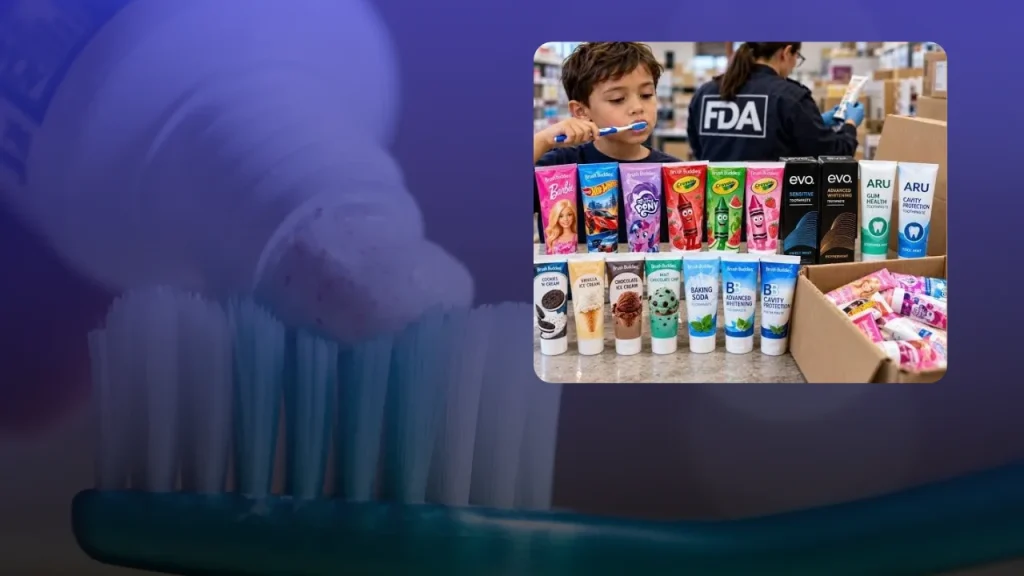
The recall covers 17 toothpaste varieties made by Pritam International Private Limited of India and distributed in the United States by Ashtel Studios Inc. The list includes children’s Barbie, Hot Wheels, Crayola and My Little Pony toothpastes, along with adult whitening, sensitivity, gum-health and cavity-protection products.
The FDA’s findings include inadequate testing of incoming ingredients for diethylene glycol (DEG) and ethylene glycol (EG), unreliable laboratory records, weak quality-control oversight, and a color additive in one children’s toothpaste that the FDA delisted in 1966.
Important: The FDA has not confirmed that the recalled toothpaste contained DEG or EG, and the warning letter does not establish that any consumer was poisoned by these products. The documented problem is that the manufacturer could not show, through adequate testing and reliable records, that its ingredients and products met federal safety and quality standards.
This guide explains which products are affected, how to check your lot number, what the FDA found, what to do now, and whether you can seek a refund or compensation.
Quick Facts: Brush Buddies, Evo and ARU Toothpaste Recall
| Detail | Information |
| Total tubes recalled | 4,301,700 |
| Number of recalled products | 17 |
| Recall initiated by company | September 10, 2026 |
| FDA classification date | October 19, 2026 |
| FDA enforcement report | October 28, 2026 |
| FDA warning letter | October 27, 2026 (MARCS-CMS 738079) |
| FDA enforcement report event ID | 99849 |
| Recall numbers | D-0053-2027 through D-0069-2027 |
| Manufacturer | Pritam International Private Limited (Haridwar, India) |
| U.S. distributor | Ashtel Studios Inc. (Ontario, California) |
| Brands | Brush Buddies, BB, evo and ARU |
| Recall class | Class II |
| Reason listed | Deviations from current good manufacturing practice (CGMP) |
| Distribution | Nationwide, shipped September 2024 to August 2026 |
| Confirmed DEG/EG contamination | Not established by the FDA warning letter |
| Reported injuries | None identified in available FDA enforcement information |
| Verified class action | None identified as of November 4, 2026 |
| Official consumer refund or claim program | None confirmed as of November 4, 2026 |
1. Which Toothpaste Products Are Recalled?
The recall covers 17 product varieties sold in 3.5-ounce and 4-ounce tubes, plus one two-pack. Many are children’s products with popular characters and flavors. Others are adult formulas for whitening, sensitivity, cavity protection or gum health.
| FDA recall number | Recalled product | Quantity |
| D-0053-2027 | Brush Buddies Barbie Bubble Gum, 4 oz | 409,800 |
| D-0054-2027 | Brush Buddies Hot Wheels Strawberry, 4 oz | 411,600 |
| D-0055-2027 | Brush Buddies Crayola Silly Scents Bubble Gum, 4 oz | 320,232 |
| D-0056-2027 | Brush Buddies Crayola Silly Scents Watermelon, 4 oz | 320,232 |
| D-0057-2027 | Brush Buddies Crayola Silly Scents Strawberry, 4 oz | 320,232 |
| D-0058-2027 | Brush Buddies My Little Pony Bubble Gum, 4 oz | 17,400 |
| D-0059-2027 | evo Advanced Whitening Peppermint, 3.5 oz | 405,336 |
| D-0060-2027 | evo Sensitive Sweet Mint, 3.5 oz | 389,880 |
| D-0061-2027 | Brush Buddies Vanilla Ice Cream, 3.5 oz | 112,092 |
| D-0062-2027 | Brush Buddies Mint Chocolate Chip Ice Cream, 3.5 oz | 112,092 |
| D-0063-2027 | Brush Buddies Cookies ‘n Cream Ice Cream, 3.5 oz | 112,092 |
| D-0064-2027 | Brush Buddies Chocolate Ice Cream, 3.5 oz | 112,092 |
| D-0065-2027 | Brush Buddies Whitening with Baking Soda Cool Mint, 3.5 oz | 797,868 |
| D-0066-2027 | BB Cavity Protection Cool Mint, two-pack | 231,936 |
| D-0067-2027 | BB Advanced Whitening Peppermint, 3.5 oz | 198,288 |
| D-0068-2027 | ARU Gum Health Soothing Mint (9 Ingredients), 3.5 oz | 15,264 |
| D-0069-2027 | ARU Cavity Protection Cool Mint (9 Ingredients), 3.5 oz | 15,264 |
| Total | 17 products | 4,301,700 |
The largest single recall is Brush Buddies Whitening Anticavity Fluoride Toothpaste with Baking Soda in Cool Mint, at 797,868 tubes. The Barbie and Hot Wheels products each exceed 400,000 tubes.
Important: This table lists recalled product varieties. It does not mean every tube sold under these brands is recalled. Only specific lot numbers and expiration dates are affected.
2. How to Check Whether Your Toothpaste Is Recalled
Do not rely on the brand name alone. A Brush Buddies tube is not automatically recalled just because of its brand.
- Identify the brand and exact variety (for example, Hot Wheels Strawberry).
- Check the package size (3.5 oz, 4 oz or two-pack).
- Find the lot number and expiration date printed on the tube or carton.
- Compare the UPC or National Drug Code (NDC), lot number and expiration date against the FDA enforcement report entry for that product.
Affected lot numbers generally begin with LWP. For example, the Barbie Bubble Gum entry includes lots such as LWP250031810502A and LWP250037812105. The Hot Wheels Strawberry entry includes different lots, such as LWP250031810502B and LWP260052231401. Similar packaging does not mean two products share the same affected batches.
Expiration dates on recalled lots generally run from November 2026 into 2028, but you should match the specific date for your product rather than assume.
Official source: The FDA Enforcement Report for Event ID 99849 is the authoritative list: https://www.accessdata.fda.gov/scripts/ires/?Event=99849
3. Why Was Toothpaste Recalled by the FDA?
Most people think of toothpaste as a cosmetic. Fluoride (anticavity) toothpaste is actually regulated as an over-the-counter drug under the Federal Food, Drug, and Cosmetic Act (FD&C Act), and its labeling and active ingredients are governed by the FDA’s anticaries drug monograph at 21 CFR Part 355. That is why drug manufacturing rules apply.
The recall reason listed in the FDA record is CGMP deviations. Current Good Manufacturing Practice (CGMP) rules, found mainly in 21 CFR Parts 210 and 211, set minimum standards for how drugs are made, tested, packaged and controlled so that they have the correct identity, strength, quality and purity.
Timeline
- September 1, 2026: The FDA held a teleconference with Pritam International and recommended that it remove its toothpaste drug products within expiration from the U.S. market.
- September 3, 2026: The FDA placed Pritam International drug products on Import Alert 66-40.
- September 10, 2026: Pritam International initiated a voluntary recall of in-date toothpaste shipped to the United States between September 2024 and August 2026.
- October 19, 2026: The FDA classified the recall as Class II.
- October 27, 2026: The FDA issued a warning letter to the company.
- October 28, 2026: The recall appeared in the FDA enforcement report.
The warning letter did not start the recall. It explained, in detail, the deficiencies that led to FDA intervention.
4. What the FDA Warning Letter Found
The October 27 warning letter identified problems in several areas:
- Inadequate testing of incoming ingredients.
- Insufficient testing for possible DEG and EG contamination.
- Incomplete or unreliable laboratory records.
- Problems with microbiological testing and sample identification.
- Weak quality-unit oversight.
- Inadequate evaluation of manufacturing and water systems.
- Use of a delisted color additive in one toothpaste formulation.
A warning letter is an official FDA notice that the agency believes a company has violated the law. It is not a final agency determination or a court judgment, and the company has the opportunity to respond and correct the violations.
5. Sorbitol, DEG and EG Testing Failures
Sorbitol solution is commonly used in drug and personal-care products as a sweetener, humectant and texture agent. The FDA considers sorbitol, glycerin, propylene glycol, maltitol solution and similar ingredients to be at higher risk of contamination with diethylene glycol (DEG) or ethylene glycol (EG).
What are DEG and EG?
DEG and EG are industrial solvents that can cause severe poisoning when swallowed in meaningful quantities. Effects can include kidney injury, metabolic complications and death. Contaminated pharmaceutical ingredients have caused deadly poisoning outbreaks worldwide, which is why the FDA expects manufacturers to test for them.
What investigators found
The FDA found that Pritam International did not adequately test incoming high-risk components for DEG and EG before using them in manufacturing. The company supplied only one certificate of analysis with independent identity testing (including DEG and EG) out of a much larger number of sorbitol solution shipments. The exact shipment count is redacted in the public letter.
Under CGMP, identity testing, including DEG and EG testing where applicable, is required for each incoming lot of high-risk components. The relevant requirement is 21 CFR 211.84, and the FDA’s May 2023 guidance on testing high-risk drug components for DEG and EG explains the agency’s expectations.
The company proposed testing incoming sorbitol before use and destructive testing of finished-product reserve samples. The FDA found the response inadequate because the company had not shown that incoming sorbitol had actually been properly tested. It also did not address whether other high-risk ingredients, such as glycerin and polyethylene glycol, were adequately tested.
The FDA asked for DEG and EG results on retained samples of high-risk components. Where component samples were unavailable, it asked for testing of retained finished-product batches. It also required a broader assessment of products that might contain affected ingredients.
Does this mean the toothpaste contains poison?
No, not according to the FDA’s published findings. The FDA identified failures to conduct and document required testing. It did not state in the warning letter that it confirmed DEG or EG in the recalled tubes. The concern is that safety could not be established, which is a different finding from confirmed contamination.
Consumers should take the recall seriously without assuming every tube is toxic.
6. Delisted Color Additive in Brush Buddies Cookies ‘n Cream Toothpaste
The FDA reviewed batch records and labeling for Brush Buddies Cookies ‘n Cream Ice Cream Flavored Toothpaste and identified the color additive CI 14720. The warning letter identified other names for it, including Ext. D&C Red No. 10, Acid Red No. 14, Food Red 3, Carmoisine, Azorubine and E122.
The FDA explained that it cancelled certification of, and delisted, Ext. D&C Red No. 10 in 1966 because manufacturers had not supplied adequate safety data. Under 21 CFR 81.30(d), use of a delisted color additive after October 4, 1966 causes the drug to be considered adulterated. The FDA determined the Cookies ‘n Cream toothpaste was adulterated under Section 501(a)(4)(A) of the FD&C Act. It also said the finding showed the company’s quality unit had not adequately reviewed raw-material qualification and formulation procedures.
- Was it found in all 17 products? No. The finding concerns the Cookies ‘n Cream product. The other products were recalled because of the broader CGMP concerns.
- Is this the same as the FD&C Red No. 3 revocation? No. The warning letter separately mentions the FDA’s revocation of FD&C Red No. 3 authorization in ingested drugs. That is a different regulatory issue from the CI 14720 / Ext. D&C Red No. 10 finding.
7. Laboratory Records and Data-Integrity Concerns
Investigators observed microbiological sample plates showing visible microbial growth. When the laboratory read and recorded the plates the next day, the records showed no visible growth. The FDA also found inconsistencies in handwritten sample identification labels. The manufacturer’s own investigation reportedly concluded that a microbiologist had deliberately transposed plates to circumvent the testing procedure.
The company described corrective measures: more training, tamper-evident plate seals, color coding of sample and control plates, and two-person review of plate readings. The FDA found these inadequate because they did not address the seriousness of the data-integrity problem or show the quality unit could reliably oversee manufacturing.
This matters because laboratory records are the evidence that a product meets specifications. When results cannot be trusted, the company cannot reliably show that its raw materials and finished products are safe. The relevant rules include 21 CFR 211.160 (laboratory controls) and 21 CFR 211.194 (laboratory records). The FDA asked for independent assessments of laboratory procedures, documentation, personnel competency and sample handling.
8. Quality-Unit and Water-System Findings
Under 21 CFR 211.22, a drug manufacturer’s quality-control unit must have authority over, and responsibility for, approving or rejecting components, in-process materials and finished products, and for ensuring specifications are met. The FDA found the unit failed to adequately oversee:
- Supplier and component qualification.
- Employee training and competency.
- Laboratory testing procedures.
- Data integrity.
- Manufacturing controls.
- Quality review before release.
The FDA also asked for a comprehensive assessment of the manufacturing water system, covering design, maintenance, control and microbiological monitoring. This does not mean the FDA confirmed contaminated water in the recalled toothpaste. It means the company must evaluate whether its water system and controls could affect product quality. The FDA recommended hiring a qualified CGMP consultant, independent reviews of data-integrity problems, and annual audits to confirm corrective actions work.
9. Import Alert 66-40 and Other Regulatory Consequences
The warning letter states the FDA placed drugs and drug products from Pritam International on Import Alert 66-40 on September 3, 2026. Import Alert 66-40 allows detention without physical examination of drugs from firms that have not met CGMP standards. Under Section 801(a)(3) of the FD&C Act (21 U.S.C. § 381(a)(3)), drugs that appear adulterated can be refused admission into the United States.
The FDA also warned it may withhold approval of new applications or supplements that list the company as a drug manufacturer until the violations are corrected and compliance is verified. This shows FDA scrutiny extends beyond the 17 toothpaste varieties to the company’s broader ability to make drug products in compliance with federal law.
10. What Does a Class II Recall Mean?
Under 21 CFR 7.3(m), the FDA classifies recalls by the health risk involved.
| Class | Meaning |
| Class I | Reasonable probability that use or exposure will cause serious adverse health consequences or death |
| Class II | Use or exposure may cause temporary or medically reversible adverse health consequences, or the probability of serious consequences is remote |
| Class III | Use or exposure is not likely to cause adverse health consequences |
This is a Class II recall. It does not mean every tube is dangerous or that anyone who used one will become ill. It does mean you should follow the recall and stop using matching products.
This was also a voluntary recall. Companies conduct recalls under FDA’s recall policy in 21 CFR Part 7, Subpart C, which covers health hazard evaluation, recall strategy and classification. The FDA monitors the recall but a voluntary recall does not mean the company has admitted liability.
11. What Parents and Consumers Should Do Now
- Stop using any matching product. If the brand, variety and lot number match the FDA list, stop using it, even if it has not expired.
- Check every tube at home. Families often have several flavors bought at different times. Check each one.
- Document before you discard. Photograph the front, UPC/NDC, lot number and expiration date. Keep the receipt or order confirmation.
- Dispose of it safely. Follow local disposal guidelines or any instructions from the retailer or distributor. Keep it out of reach of children while it is still in the home.
- Ask about a refund. Contact the retailer or Ashtel Studios. Do not assume an official refund program exists.
- Watch for symptoms and get medical advice if concerned. If you or your child has symptoms or you are worried about exposure, contact a healthcare professional and provide the exact product and lot information. For emergencies involving swallowing, call Poison Control at 1-800-222-1222 (U.S.) or emergency services.
- Report problems to the FDA. Adverse reactions can be reported through the FDA’s MedWatch program.
Children may swallow more toothpaste than intended, so take particular care with young children’s products. Fluoride toothpaste labels already instruct users to keep it out of reach of children under 6 and to contact Poison Control if more than a pea-sized amount for brushing is swallowed.
12. Can You Get a Refund or Compensation?
As of November 4, 2026, the FDA recall record and warning letter do not establish an official consumer settlement, claims administrator, claim form or deadline. A recall does not automatically entitle every purchaser to cash compensation.
Whether you have a legal claim depends on the product, the purchase, any exposure, any actual harm and your state’s law. Someone who simply bought a recalled tube is in a different position from someone with a documented medical injury. Start with the retailer or distributor about returns or refunds.
Be cautious of websites claiming a Brush Buddies settlement already exists or that everyone can claim a fixed payment. None has been verified.
13. Is There a Brush Buddies Toothpaste Class Action Lawsuit?
As of November 4, 2026, no verified class action or federal court case specifically over this recall has been identified, and there is no confirmed settlement. The FDA’s actions are regulatory proceedings, not a class action.
A class action requires one or more plaintiffs to file a lawsuit on behalf of a proposed group, and the court must decide whether the case meets class certification requirements under Rule 23 of the Federal Rules of Civil Procedure or the equivalent state rule.
Could consumers bring individual claims?
Possibly, depending on the facts. If a person suffered a documented injury allegedly caused by a defective product, state law may provide theories such as:
- Manufacturing defect (strict product liability).
- Negligence.
- Failure to warn.
- Breach of express or implied warranty.
- State consumer-protection law violations.
Each claim has its own elements, including causation and damages. An FDA recall or warning letter alone does not prove a particular consumer was injured or that the company is liable. Consumers who paid for a product but suffered no injury may face additional hurdles, including proving economic injury and standing, and outcomes vary by state.
Federal-law limits consumers should understand
- No private right of action under the FD&C Act. Section 337(a) (21 U.S.C. § 337(a)) generally reserves enforcement of the Act to the United States. A consumer cannot sue simply for violation of the FD&C Act. Claims typically have to rest on state law.
- Preemption of state requirements for OTC drugs. Section 751 of the FD&C Act (21 U.S.C. § 379r) generally preempts state requirements for nonprescription drugs that are different from or in addition to federal requirements. However, Section 751(e) preserves state product liability actions, so ordinary injury claims are generally not barred by this provision.
- Claims that depend only on proving FDA violations. In Buckman Co. v. Plaintiffs’ Legal Committee, 531 U.S. 341 (2001), the Supreme Court held that certain state-law claims that exist solely because of the FDCA’s disclosure requirements to the FDA are impliedly preempted. Courts apply this limit in different ways, so the specific facts matter.
- Statutes of limitations and repose. Deadlines vary by state and claim type and may be short. Anyone with a possible claim should speak with a licensed attorney promptly.
14. Laws and Regulations Behind the FDA’s Findings
Federal Food, Drug, and Cosmetic Act
| Provision | What it does | Relevance here |
| 21 U.S.C. § 351(a)(2)(B) (FD&C Act § 501(a)(2)(B)) | A drug is adulterated if manufacturing, processing, packing or holding does not follow current good manufacturing practice | Basis for CGMP findings on testing, records and quality oversight |
| 21 U.S.C. § 351(a)(4) (FD&C Act § 501(a)(4)) | A drug is adulterated if it contains an unsafe color additive used for coloring | Basis for the CI 14720 finding in Cookies ‘n Cream toothpaste |
| 21 U.S.C. § 379e (FD&C Act § 721) | Governs the listing and safe use of color additives | Explains why a delisted additive makes a drug adulterated |
| 21 U.S.C. § 331(a) (FD&C Act § 301(a)) | Prohibits introducing or delivering adulterated or misbranded drugs into interstate commerce | Prohibited act cited by the FDA |
| 21 U.S.C. § 381(a) (FD&C Act § 801(a)) | Allows refusal of admission of imported drugs that appear adulterated | Legal basis for import refusals under the import alert |
| 21 U.S.C. § 337(a) (FD&C Act § 310(a)) | Reserves enforcement of the Act to the United States | Limits private suits based directly on FDCA violations |
| 21 U.S.C. § 379r (FD&C Act § 751) | Preempts certain state requirements for OTC drugs, preserving product liability actions | Frames what state-law claims may be brought |
FDA regulations
| Regulation | Subject | Relevance here |
| 21 CFR Part 210 | CGMP in manufacturing, processing, packing or holding of drugs | General CGMP framework |
| 21 CFR § 211.22 | Responsibilities of the quality-control unit | Quality oversight failures |
| 21 CFR § 211.25 | Personnel qualifications | Training and competency |
| 21 CFR § 211.84 | Testing and approval of components | Ingredient identity and DEG/EG testing |
| 21 CFR § 211.100 | Written production and process-control procedures | Documented manufacturing procedures |
| 21 CFR § 211.160 | General requirements for laboratory controls | Scientifically sound testing |
| 21 CFR § 211.194 | Laboratory records | Complete, accurate test records |
| 21 CFR § 81.30(d) | Delisted color additives | Ext. D&C Red No. 10 / CI 14720 |
| 21 CFR Part 355 | Anticaries drug products (fluoride) monograph | Why fluoride toothpaste is an OTC drug |
| 21 CFR § 7.3(m) | Recall classification definitions | Class I, II and III meanings |
| 21 CFR Part 7, Subpart C | Voluntary recall policy and procedures | How the recall process works |
Consumer and warranty law
Depending on the state, purchasers may also look to state consumer-protection statutes, state implied-warranty law and the federal Magnuson-Moss Warranty Act (15 U.S.C. § 2301 et seq.). These laws vary widely and are not triggered automatically by a recall.
15. How This Compares With Other Consumer Product Cases
The Brush Buddies recall belongs to a broader group of family-product safety disputes. All About Lawyer has also covered:
- Colgate Hello Kids Toothpaste Lawsuit 2026: What Every Parent Needs to Know About the Lead Allegations
- Sterling Pharmaceutical Services Eye Drop Recall: Walgreens, AvKare and Other Brands, Lot Numbers and What to Do
- Natural Grocers Mung Beans Recall: Glass Contamination Warning
Those cases involve different products and legal issues: lead allegations and marketing claims, sterility concerns, and potential glass contamination. The Brush Buddies matter is distinctive because the FDA warning letter provides unusually detailed findings about ingredient testing, laboratory-record integrity and manufacturing controls.
16. What Happens Next?
Next steps depend on Pritam International’s response to the warning letter and the FDA’s evaluation of its corrective actions. The company must show its laboratory systems, ingredient testing, data-integrity controls and quality unit are adequate. The FDA may re-inspect the facility. Further FDA notices, test results, company refund announcements or court filings could change the picture, and this article will be updated as official information is released.
Frequently Asked Questions
How many toothpaste tubes are affected?
The 17 FDA recall records cover approximately 4,301,700 tubes of Brush Buddies, BB, evo and ARU toothpaste distributed nationwide.
Which children’s toothpastes are recalled?
The children’s products include Brush Buddies Barbie, Hot Wheels, Crayola Silly Scents and My Little Pony toothpastes, plus four ice-cream-flavored varieties: Vanilla, Mint Chocolate Chip, Cookies ‘n Cream and Chocolate.
Why did the FDA recall this toothpaste?
The FDA record lists CGMP deviations. The October 27 warning letter described inadequate ingredient testing, concerns about possible DEG and EG contamination, unreliable laboratory records, quality-control failures and an unauthorized color additive in one product.
Does the toothpaste contain diethylene glycol?
The FDA found inadequate testing of high-risk ingredients for DEG and EG. It did not establish in the warning letter that the recalled toothpaste contained these substances.
Which product had the unauthorized color additive?
Brush Buddies Cookies ‘n Cream Ice Cream Flavored Toothpaste.
Are all Brush Buddies products recalled?
No. Only the 17 listed varieties and specific lot numbers are recalled. Compare your product’s details with the FDA record.
Is this a Class I or Class II recall?
Class II. That means exposure may cause temporary or medically reversible health consequences, or the probability of serious consequences is remote.
Have injuries or poisonings been confirmed?
No injuries or illnesses linked to the recalled products have been identified in the FDA enforcement information or warning letter reviewed. If you believe you have had a reaction, report it through MedWatch.
Can I get a refund?
No official consumer refund or compensation program has been confirmed as of November 4, 2026. Contact the retailer or Ashtel Studios about returns or refunds.
Is there a class action lawsuit?
None has been verified as of November 4, 2026. The FDA recall and warning letter are regulatory actions, not a court-approved settlement.
What should I do if my child used recalled toothpaste?
Stop using any matching product, keep the packaging and purchase information, and contact a healthcare professional if your child has symptoms or you have concerns. For swallowing emergencies, call Poison Control at 1-800-222-1222.
Where can I see the full lot list?
Use the FDA Enforcement Report for Event ID 99849: https://www.accessdata.fda.gov/scripts/ires/?Event=99849
Final Takeaway
This recall matters for more than its size. The FDA’s warning letter documents failures in ingredient testing, high-risk chemical screening, laboratory records, quality oversight and color-additive compliance. Importantly, the FDA has identified serious safety-control failures without confirming that every recalled tube contained a toxic substance or caused injury.
For consumers, the immediate step is to check the product and lot number and stop using any matching tube. As of November 4, 2026, there is no verified class action, settlement, claim form or guaranteed compensation program.
Official Recall Information
- Manufacturer: Pritam International Private Limited
- U.S. distributor: Ashtel Studios Inc.
- FDA recall event: 99849
- Recall numbers: D-0053-2027 through D-0069-2027
- Total products: 17
- Total tubes: 4,301,700
- FDA classification: Class II
- FDA warning letter: MARCS-CMS 738079, October 27, 2026
Sources and Legal References
- FDA Warning Letter to Pritam International Private Limited, October 27, 2026 (MARCS-CMS 738079)
- FDA Enforcement Report, Event 99849
- FDA: Recalls Background and Definitions
- FDA: Current Good Manufacturing Practice Regulations
- FDA Guidance: Testing of High-Risk Drug Components for DEG and EG (May 2023)
- 21 U.S.C. § 351, Adulterated Drugs
- 21 U.S.C. § 331, Prohibited Acts
- 21 U.S.C. § 337, Proceedings in Name of United States
- 21 U.S.C. § 379e, Color Additives
- 21 CFR § 81.30
- 21 CFR § 211.84, Component Testing
- 21 CFR § 211.194, Laboratory Records
Disclaimer: All About Lawyer is an independent legal information website, not a law firm. This article is for general informational and educational purposes only and is not individual medical or legal advice. FDA findings and recall information are distinct from allegations of individual injury or legal liability. No attorney-client relationship is created by reading this article. If you believe you were harmed, consult a licensed healthcare professional and a licensed attorney in your state.
About the Author
Israr Ahmad is a legal content researcher with 4+ years of experience covering class action settlements and consumer rights cases. He has researched and published coverage of 2,500+ settlements using verified court records, settlement administrator filings, and government sources. Learn more about Israr.