
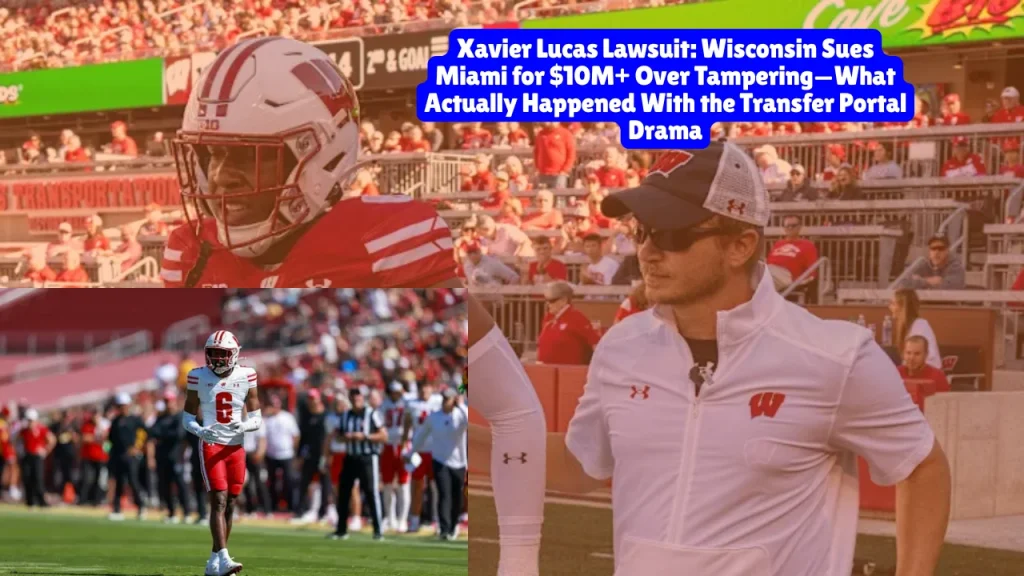
Xavier Lucas Lawsuit, Wisconsin Sues Miami for $10M+ Over Tampering—What Actually Happened With the Transfer Portal Drama
There is no Xavier Lucas lawsuit against Wisconsin—instead, Wisconsin sued Miami on June 20, 2025, for allegedly tampering with Lucas and tortious interference after he transferred to the Hurricanes without entering the transfer portal. Wisconsin claims Miami made impermissible contact with Lucas in December 2024 despite his two-year revenue-sharing NIL contract with the Badgers. Lucas is playing for Miami in 2025, and the lawsuit between the two universities is ongoing.
Here’s what shocked college football: a freshman cornerback signed a two-year deal with Wisconsin worth hundreds of thousands of dollars, then left for Miami three weeks later without ever entering the transfer portal—and now it’s turned into a landmark legal battle that could reshape how NIL contracts work.
What Actually Happened With Xavier Lucas and Wisconsin
On December 2, 2024, Xavier Lucas signed a binding two-year revenue-sharing NIL agreement with Wisconsin that included substantial financial compensation contingent on the pending House v. NCAA settlement. Just 15 days later, everything fell apart.
The timeline of events:
- December 2, 2024: Lucas signs two-year revenue-share deal with Wisconsin Athletics
- December 17, 2024: Lucas texts a Wisconsin coach asking about his jersey number for 2025 (showing he planned to stay)
- Same day, hours later: Lucas tells his position coach he wants to enter the transfer portal
- December 19, 2024: Lucas publicly announces his intention to transfer on X (Twitter)
- December 27, 2024: Lucas posts that Wisconsin is refusing to enter him into the portal despite meeting NCAA requirements
- January 7, 2025: Sports attorney Darren Heitner announces Lucas retained him, threatens litigation against Wisconsin
- January 17, 2025: Lucas withdraws from Wisconsin and enrolls at Miami without entering the portal
- June 20, 2025: Wisconsin files lawsuit against Miami for tampering and tortious interference
Lucas requested a transfer after learning while home over the holidays that his father suffered a “serious, life-threatening illness,” according to Heitner. But Wisconsin questioned this rationale, noting Lucas provided “inconsistent” information to coaches.
Why Wisconsin Refused to Enter Lucas Into the Portal
The university argues that Lucas signed a binding two-year Name, Image, and Likeness agreement on December 2, 2024, which included financial compensation contingent on the pending House v. NCAA settlement.
Wisconsin’s position:
- Lucas signed a legally binding two-year contract just weeks before requesting a transfer
- The revenue-share agreement granted Wisconsin “exclusive license” to Lucas’s NIL rights for two years
- The contract stated Lucas agreed not to play for another school during the two-year term
- Wisconsin believed the agreement was enforceable and that a portal request violated the contract
NCAA bylaws mandate that universities must enter players into the transfer portal within two business days of a request. Wisconsin refused, creating a standoff that trapped Lucas in “purgatory”—he couldn’t officially transfer because Wisconsin wouldn’t process his request, but schools couldn’t contact him without risking NCAA tampering violations.
Related article: Tyra Sanchez Lawsuit, Drag Race Winner Says She’s Suing RuPaul Over Years of Career Sabotage
How Lucas Got to Miami Without Using the Transfer Portal
Lucas and his attorney found a workaround that stunned the college sports world:
The unprecedented move:
- Lucas withdrew from Wisconsin as a regular student (not an athlete transfer)
- He simply unenrolled from classes in January 2025
- He then enrolled academically at Miami as a regular student
- The NCAA confirmed its rules cannot prevent a student-athlete from withdrawing and enrolling elsewhere
This is a groundbreaking move that may have significant ramifications for the ability of schools to enforce revenue-sharing agreements and for players to transfer at any time, even outside portal windows or without entering the portal.
Lucas enrolled at Miami for the spring 2025 semester (despite Miami’s transfer deadline being November 1, 2024) and is eligible to play for the Hurricanes in fall 2025.
What Wisconsin’s Lawsuit Against Miami Alleges
The University of Wisconsin sued the University of Miami on June 20, 2025, for alleged tampering and tortious interference with Lucas’s two-year agreement with the Badgers.
Wisconsin’s allegations:
- Miami made “multiple impermissible contacts” with Lucas in December 2024 and January 2025
- A Miami coach and prominent Miami alumnus visited Lucas’s Florida home in December with a “compensation commitment”
- Miami’s offer was “more lucrative” than Wisconsin’s revenue-share deal
- Miami “knowingly induced” Lucas to breach his contract with Wisconsin
- Miami’s interference was “intentional” and “not justified or privileged”
Wisconsin claims Miami communicated with Lucas despite knowing he had entered a contract with the school, terming it as “intentional” interference that caused Lucas to “breach” his contract.
The lawsuit refers to Lucas as “Student-Athlete A” but all details match his situation. Wisconsin is seeking damages for:
- Loss of a student-athlete with valuable NIL rights
- Loss of a player Wisconsin anticipated having for 2025 and beyond
- Tortious interference with contractual relations
- Compensation for breach of the revenue-share agreement
The Big Ten Conference is supporting Wisconsin’s lawsuit against Miami.
What Lucas’s Attorney Says About the Allegations
Sports attorney Darren Heitner has vigorously defended Lucas and denied Wisconsin’s tampering claims:
Heitner’s position:
- Lucas was not bound by an active contract since he received no compensation yet (payments were contingent on House settlement approval)
- There was no impermissible contact with Miami before the transfer
- Lucas independently chose to enroll at Miami
- This was a necessary workaround to Wisconsin’s failure to follow NCAA portal rules
- Wisconsin blatantly violated NCAA rules by not entering Lucas into the portal within two business days
Heitner told Yahoo Sports in January that he planned to file an antitrust lawsuit against Wisconsin if Lucas was unable to complete his move to Miami. He accused Wisconsin of illegally blocking Lucas’s transfer.
Heitner maintains that the tampering allegations are “flat-out false” and Lucas’s intention remains to play for Miami in fall 2025.
What This Case Means for College Athletics
This lawsuit represents a critical test case for the post-House v. NCAA era of college sports:
The bigger questions:
- Are revenue-share contracts enforceable? If courts rule they aren’t binding, it could “open the floodgates” for players to leave despite signing deals
- Can players transfer by simply withdrawing and re-enrolling? Lucas’s workaround could become a common tactic
- Do NIL contracts create employment relationships? Legal experts note that contracts explicitly based on playing for a school strengthen the argument that players are employees
- What’s considered tampering? Schools are terrified of the transfer portal becoming a free-for-all
If a judge rules that the revenue share agreements aren’t binding and enforceable, it could open up the floodgates for players to sign deals, then leave before receiving any money.
Current Status of the Lawsuit
As of January 2026:
- The lawsuit is in active litigation in Wisconsin state court
- Xavier Lucas is enrolled at Miami and preparing for the 2025 season
- Miami has not officially commented on the allegations
- Wisconsin is not suing Lucas himself—only Miami
- No trial date has been set yet
- No settlement discussions have been publicly reported
The case could take months or years to resolve through litigation, or the parties could settle privately.
How This Compares to Other Transfer Portal Disputes
The Xavier Lucas case is unprecedented in several ways:
What makes this unique:
- First major lawsuit between schools over a revenue-share contract
- First known case of a player transferring by withdrawing and re-enrolling
- First time the Big Ten has supported a member school in suing another school
- Involves the new revenue-share model contingent on House settlement
Previous transfer portal disputes typically involved:
- Individual players suing their schools for blocking transfers
- Schools denying transfer requests based on in-conference transfer restrictions
- Players fighting for immediate eligibility waivers
The Wisconsin-Miami case represents school-vs-school litigation over a player, which is rare in college athletics.
What the Big Ten and ACC Have Said
Wisconsin and the Big Ten released statements calling out Miami regarding Xavier Lucas’s transfer.
Wisconsin’s official statement:
“We have credible information indicating impermissible contact between Xavier and University of Miami football program personnel prior to Xavier’s request to enter the transfer portal. We are committed to ensuring integrity and fundamental fairness in the evolving landscape of college athletics.”
The Big Ten is backing Wisconsin’s lawsuit, viewing it as a test case for whether revenue-share contracts will have any teeth in the new college sports landscape.
Miami and the ACC have not issued formal responses beyond standard legal filings.
What Happens Next
Several potential outcomes exist:
Possible resolutions:
- Wisconsin wins: Miami could face damages, potentially millions of dollars, plus restrictions on Lucas playing
- Miami wins: Could establish precedent that revenue-share contracts aren’t enforceable if no money was paid
- Settlement: The schools could reach a financial agreement, with Miami possibly compensating Wisconsin
- Lucas plays regardless: Even if Wisconsin wins the lawsuit, Lucas may continue playing for Miami while the case proceeds
With House v. NCAA set to reshape how athletes are compensated, cases like this will likely shape future policies, with schools, athletes, and legal experts closely watching how governance adapts to the shifting landscape.
Frequently Asked Questions
Did Xavier Lucas sue Wisconsin?
No. Lucas did not sue Wisconsin. Instead, Wisconsin sued Miami for allegedly tampering with Lucas and interfering with his contract.
Is Xavier Lucas playing for Miami?
Yes. Lucas enrolled at Miami in January 2025 and is on the roster for the 2025 season.
Did Lucas ever enter the transfer portal?
No. He got to Miami by withdrawing from Wisconsin as a regular student and enrolling at Miami, bypassing the transfer portal entirely.
Why didn’t Wisconsin let Lucas transfer?
Wisconsin believed his two-year revenue-share contract was binding and that he couldn’t leave without breaching it.
How much was Lucas’s Wisconsin contract worth?
The exact amount hasn’t been disclosed, but Wisconsin gave him one of the largest revenue-share deals on the team, reportedly worth hundreds of thousands over two years.
Did Miami illegally recruit Lucas?
Wisconsin alleges Miami made impermissible contact and tampered with Lucas. Miami and Lucas’s attorney deny these claims.
Can other players use this same transfer method?
Potentially yes. The NCAA confirmed its rules can’t prevent students from withdrawing and re-enrolling elsewhere, which could set a precedent.
Will Lucas have to sit out a year?
No. Because he’s enrolled at Miami, he’s eligible to play immediately in 2025.
Key Takeaways
Wisconsin sued Miami (not Lucas) on June 20, 2025, for tampering and tortious interference
Lucas transferred to Miami without using the transfer portal by withdrawing from Wisconsin and re-enrolling
Wisconsin claims Lucas signed a binding two-year contract on December 2, 2024, worth significant money
Lucas’s attorney denies tampering and says Wisconsin violated NCAA rules by blocking his portal entry
The lawsuit is ongoing—no trial date or settlement has been announced
Lucas is playing for Miami in 2025 regardless of the lawsuit’s outcome
This case could reshape college sports—determining whether revenue-share contracts are enforceable
The Xavier Lucas saga represents a watershed moment for college athletics. As schools transition to revenue-sharing models and players gain more power through NIL rights, this legal battle will help define whether contracts can actually bind players to schools—or if the transfer portal era means athletes can leave anytime, regardless of what they signed.
Following College Sports Legal Developments?
For NCAA transfer portal rules, visit the NCAA Transfer Portal Resource Center
For NIL rights information, visit Opendorse NIL Education
For student-athlete advocacy, visit the National College Players Association
About the Author

Sarah Klein, JD, is a licensed attorney and legal content strategist with over 12 years of experience across civil, criminal, family, and regulatory law. At All About Lawyer, she covers a wide range of legal topics — from high-profile lawsuits and courtroom stories to state traffic laws and everyday legal questions — all with a focus on accuracy, clarity, and public understanding.
Her writing blends real legal insight with plain-English explanations, helping readers stay informed and legally aware.
Read more about Sarah