
Wrongful Death Truck Accident, How Much Can Families Get?
A wrongful death truck accident settlement compensates surviving family members for lost income, funeral costs, medical bills, and emotional loss. Settlement amounts typically range from $500,000 to several million dollars depending on the victim’s age, earning potential, and case facts. Trucking companies carry large commercial policies that often make substantial recovery possible
What is a wrongful death truck accident settlement?
A wrongful death settlement is compensation a family receives when a truck accident kills a loved one due to another party’s negligence. It covers lost wages, funeral expenses, medical bills, and emotional loss like grief and loss of companionship. Amounts typically range from $500,000 to several million dollars depending on the victim’s age, earning potential, and case circumstances.
Losing a family member in a truck accident is devastating. The grief is immediate. The financial pressure follows quickly—funeral costs, unpaid bills, and the sudden loss of income your family depended on.
A wrongful death truck accident settlement cannot undo that loss. What it can do is provide financial stability for the people left behind. It can cover every expense tied to the death, compensate for the income your loved one would have earned over a lifetime, and recognize the emotional void their absence creates.
Families often don’t know what they’re entitled to—or how large these claims can actually be. Trucking companies carry commercial liability policies far larger than standard auto insurance, and multiple parties can be held liable in a fatal truck accident.
This article explains who can file a wrongful death claim, what damages families can recover, what settlement amounts look like by situation, and how to avoid the mistakes that reduce compensation. Speaking with a wrongful death attorney from the start protects your family’s full claim.
Learn how a truck accident lawyer builds a wrongful death case and fights for maximum family compensation
Who Can File a Wrongful Death Claim After a Truck Accident?
Wrongful death laws vary by state, but most states limit who can file a claim to a defined group of surviving family members. Filing the right claim, with the right parties, is the first critical step.
In most states, those eligible to file include:
- Surviving spouse or domestic partner
- Dependent children, including minor and adult children in some states
- Parents of an unmarried deceased adult
- Siblings, in states that allow extended family claims
- Financial dependents who relied on the deceased for support
- The estate of the deceased, which may file on behalf of beneficiaries
The surviving spouse and dependent children typically receive the largest share of any settlement. Parents of a child killed in a truck accident also have strong claims, particularly for emotional loss and loss of companionship.
It’s important to act quickly. Most states give families two years from the date of death to file a wrongful death lawsuit—and some states allow as little as one year. Missing this deadline almost always means losing the right to any compensation.
Additionally, the truck driver, the trucking company, a cargo loader, or a vehicle manufacturer may all share liability. Understand how trucking company liability works in fatal crash cases
What Damages Can a Family Recover?
Wrongful death claims cover two broad categories of damages: economic and non-economic. Together, they represent the full scope of what the family lost.
Economic Damages
These are the measurable financial losses tied directly to the death:
- Lost future income and earning potential — the wages, salary, and benefits the deceased would have earned over their remaining working years
- Medical expenses incurred before death from injuries sustained in the crash
- Funeral and burial costs, which typically range from $10,000 to $25,000 or more
- Loss of household services the deceased provided, such as childcare, home maintenance, and financial management
- Loss of inheritance the family would have received
Non-Economic Damages
These cover the emotional and relational losses that have no price tag:
- Grief and emotional suffering of surviving family members
- Loss of companionship, love, and affection
- Loss of parental guidance for dependent children
- Loss of consortium for a surviving spouse
- Pain and suffering the deceased experienced before death
In cases involving extreme negligence—such as a truck driver who falsified logbooks, drove under the influence, or violated FMCSA hours-of-service rules—courts may also award punitive damages. These go beyond compensation and are designed to punish the wrongdoer. Punitive awards in fatal truck accident cases have reached into the millions.
According to NHTSA data, large trucks were involved in 5,837 fatal crashes in 2022. Cases involving commercial carriers consistently produce larger verdicts due to the severity of injuries and the size of commercial insurance policies.
Related article: Truck Accident Insurance Limits, How Much Can You Recover?
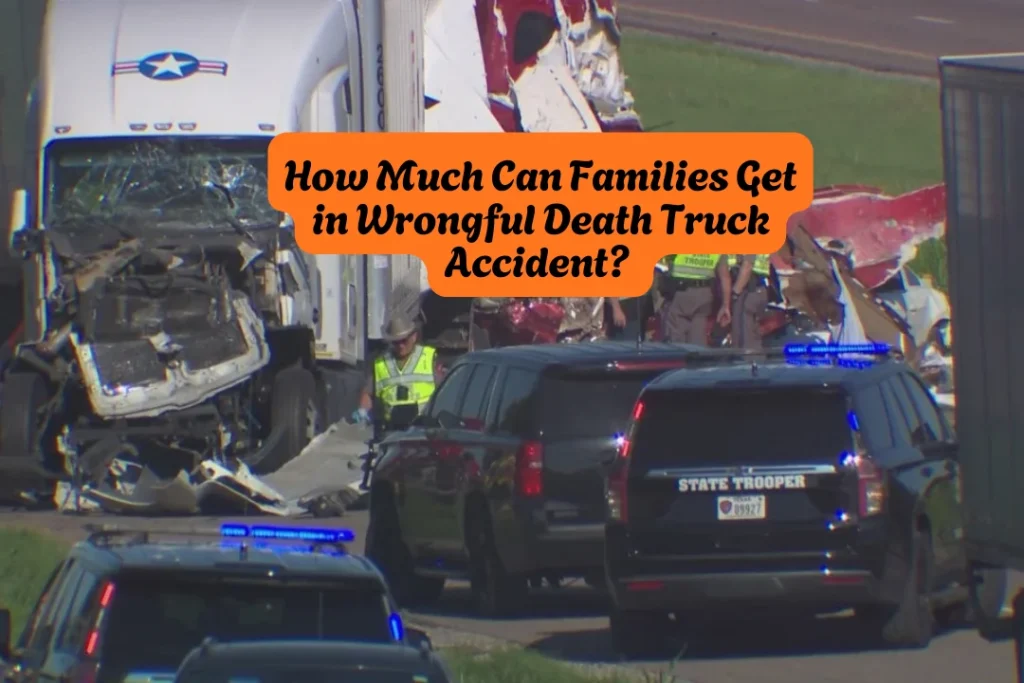
How Much Is a Wrongful Death Truck Accident Settlement Worth?
There is no fixed amount. Settlement value depends on who was killed, what they earned, who they left behind, and how strong the liability case is. However, real case data provides useful benchmarks.
The table below shows typical wrongful death truck accident settlement ranges based on victim profile and circumstances:
| Victim Profile & Circumstances | Typical Settlement Range |
| Young adult with no dependents, clear liability | $500,000 – $1,500,000 |
| Working parent with dependent children | $1,000,000 – $4,000,000 |
| High-earning professional, spouse and children | $2,000,000 – $8,000,000+ |
| Elderly victim, retired, no dependents | $300,000 – $800,000 |
| Cases involving gross negligence or FMCSA violations | $3,000,000 – $15,000,000+ |
| Cases resolved at trial with punitive damages | $5,000,000 – $30,000,000+ |
These ranges reflect documented verdicts and settlements in fatal truck accident cases. Trucking companies are required under 49 CFR Part 387 to carry minimum liability coverage of $750,000 for general freight carriers—and many large fleets carry $1 million to $5 million in coverage. This is why fatal truck accident claims often produce significantly higher recoveries than passenger vehicle cases.
Factors that increase settlement value include the victim’s young age, high income, number of dependents, clear fault by the truck driver or carrier, and documented FMCSA violations such as hours-of-service breaches.
How to File a Wrongful Death Claim: Step by Step
Filing a wrongful death claim after a fatal truck accident follows a clear process. Each step protects your family’s recovery.
- Consult a wrongful death attorney immediately — Evidence fades quickly after fatal crashes; an attorney preserves it through immediate investigation
- Identify all liable parties — The truck driver, trucking company, cargo loader, and vehicle manufacturer may all share responsibility
- Gather all financial records — Tax returns, pay stubs, employment contracts, and benefit statements establish the deceased’s earning history
- Document all expenses — Funeral bills, final medical invoices, and out-of-pocket costs are recoverable and must be preserved
- File the lawsuit within your state’s statute of limitations — Most states allow two years; some allow only one year from the date of death
- Engage in discovery and depositions — Your attorney collects driver logs, black box data, maintenance records, and company safety histories
- Negotiate a full settlement or proceed to trial — Most cases settle; your attorney presents a detailed demand accounting for all economic and non-economic losses
Speaking with a wrongful death attorney can help your family understand your rights and ensure full compensation is pursued from all responsible parties at no cost.
Common Mistakes That Reduce Wrongful Death Settlement Value
Families grieving a loss are vulnerable to errors that permanently reduce what they recover. Avoiding these protects your claim.
- Accepting an early settlement offer — Insurers move fast after fatal crashes to lock in low payouts before families understand full case value
- Signing any release or document without attorney review — One signature can eliminate your right to future compensation
- Failing to preserve evidence — Truck black boxes overwrite data within days; acting fast is critical
- Not accounting for future income losses — Many families only consider immediate expenses and miss decades of projected earnings
- Overlooking punitive damage potential — If the driver or carrier violated FMCSA safety rules, punitive damages may dramatically increase the award
- Missing the statute of limitations — Grief makes time pass differently; missing the legal deadline ends the case permanently
See how wrongful death settlement values compare to serious injury truck accident claims
Frequently Asked Questions
How long do I have to file a wrongful death claim after a truck accident?
Most states allow two years from the date of death to file a wrongful death lawsuit, but some states set the deadline as short as one year. A few states start the clock from the date the cause of death was discovered rather than the death itself. Missing this deadline almost always permanently eliminates your family’s right to compensation.
How much is the average wrongful death settlement after a truck accident?
Settlement amounts vary widely based on the victim’s age, income, number of dependents, and strength of the liability case. Working parents with young children typically see settlements ranging from $1 million to $4 million or more. Cases involving reckless conduct or FMCSA violations have produced verdicts exceeding $10 million. There is no single average—every case is unique.
Does comparative fault reduce a wrongful death settlement?
Yes, in most states. If the deceased was partially at fault for the accident, the settlement is reduced by their percentage of responsibility. For example, if your loved one was found 20% at fault and the total damages are $2 million, the family would recover $1.6 million. A small number of states use contributory negligence rules that can bar recovery entirely if the deceased shared any fault.
How long does a wrongful death truck accident case take to resolve?
Most wrongful death truck accident cases settle within one to three years. Cases with clear liability and cooperative insurers may resolve faster. Cases that go to trial—especially those involving punitive damages or disputed liability—can take three to five years. Your attorney can give a more specific estimate based on the facts of your case.
Who receives the wrongful death settlement money?
Settlement funds are distributed to the legal beneficiaries named in the wrongful death claim, typically the surviving spouse and dependent children first. If there is no spouse or children, parents or siblings may be next in line depending on your state’s law. When multiple family members are involved, the court may oversee distribution to ensure fairness, particularly when minor children are beneficiaries.
Legal Terms Used in This Article
Wrongful Death: A legal claim filed when someone dies due to another party’s negligence or wrongful act. It allows surviving family members to seek financial compensation for their loss.
Compensatory Damages: Money awarded to cover actual losses suffered by the family, including both economic losses like income and non-economic losses like grief. These are designed to make the family as financially whole as possible.
Punitive Damages: Additional compensation awarded on top of compensatory damages when the defendant’s conduct was especially reckless or intentional. In truck accident deaths, FMCSA violations or falsified logbooks often support punitive damage claims.
Loss of Consortium: Compensation for the surviving spouse’s loss of companionship, love, and the marital relationship. It recognizes the emotional and relational damage the death caused to the surviving partner.
Statute of Limitations: The legal deadline for filing a wrongful death lawsuit. Missing it almost always permanently bars the family from recovering any compensation, regardless of how strong the case is.
Negligence: A failure to exercise reasonable care that causes harm to another person. In truck accident deaths, negligence may include speeding, distracted driving, fatigue violations, or improper cargo loading.
Policy Limits: The maximum amount an insurance policy will pay. Commercial trucking carriers are required to carry substantial liability coverage, which is why fatal truck accident cases often produce larger recoveries than standard vehicle accidents.
Comparative Fault: A legal standard that reduces a family’s compensation by the percentage of fault attributed to the deceased. Most states follow this rule, meaning partial fault doesn’t eliminate the claim entirely.
Conclusion
No settlement can replace a person. What a wrongful death truck accident settlement can do is give your family financial security, hold the responsible parties accountable, and ensure the economic future your loved one worked to build is not lost.
Trucking companies carry large insurance policies and employ defense attorneys who start protecting their interests immediately. Your family deserves the same level of preparation on your side.
If your family has lost a loved one in a truck accident, do not wait. Contact a wrongful death truck accident attorney today for a free case evaluation. Our team will review the circumstances and help you recover the full compensation your family deserves.
Start by understanding what a full truck accident claim looks like before your first attorney consultation
Disclaimer
The information in this article is for general educational purposes only and does not constitute legal advice. Every truck accident case is unique. Laws vary by state and change over time. Reading this article does not create an attorney-client relationship. Do not make legal decisions based solely on this content. Always consult a licensed truck accident attorney in your state for advice specific to your situation.
About the Author

Sarah Klein, JD, is a former civil litigation attorney with over a decade of experience in contract disputes, small claims, and neighbor conflicts. At All About Lawyer, she writes clear, practical guides to help people understand their civil legal rights and confidently handle everyday legal issues.
Read more about Sarah