What Is a Litigation Hold? Legal Duties, Sanctions & How to Implement One
A litigation hold is a legal directive suspending normal document retention/destruction policies to preserve all potentially relevant evidence when litigation is reasonably anticipated or pending. Federal Rule of Civil Procedure 37(e) governs preservation failures for electronically stored information (ESI), requiring parties to take reasonable steps to preserve evidence or face sanctions including adverse inference instructions, monetary penalties, or case dismissal. Courts can impose severe sanctions—including default judgment—when parties act with intent to deprive opponents of evidence, as demonstrated in recent 2024-2025 rulings where text message deletion resulted in case dismissal with prejudice.
What Is a Litigation Hold?
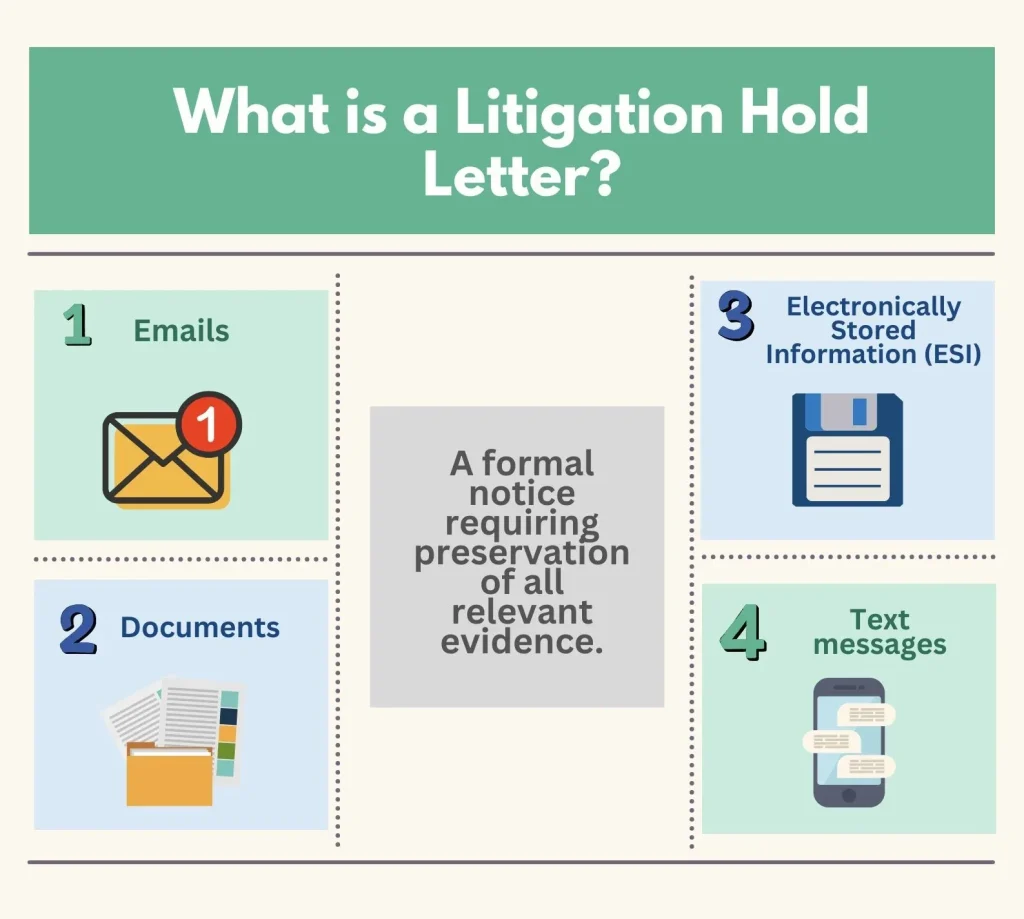
A litigation hold, also called a “legal hold” or “preservation hold,” is a process organizations implement to preserve all documents, data, and information relevant to pending or reasonably anticipated litigation. The hold suspends routine document retention and destruction policies, preventing evidence from being altered, deleted, or destroyed.
The duty to preserve evidence arises when a party “reasonably anticipates litigation”—a flexible, fact-specific standard that courts apply case-by-case. This obligation exists independent of whether litigation has been formally filed and applies to all parties: plaintiffs, defendants, and third parties possessing relevant evidence.
Judge Shira A. Scheindlin’s landmark Zubulake v. UBS Warburg decisions (S.D.N.Y. 2003) established modern litigation hold standards, stating: “Once a party reasonably anticipates litigation, it must suspend its routine document retention/destruction policy and put in place a ‘litigation hold’ to ensure preservation of relevant documents.”
The Sedona Conference, a leading nonpr ofit institute focused on legal issues, defines reasonable anticipation as arising “when an organization is on notice of a credible threat it will become involved in litigation or anticipates taking action to initiate litigation.”
Related article: Honeypot Pads Lawsuit: Allegations Over “Plant-Derived” Claims Head to Federal Court
When Must a Litigation Hold Be Issued?
The duty to preserve evidence triggers when litigation becomes “reasonably anticipated”—not when a lawsuit is actually filed. This earlier timing creates preservation obligations before formal legal proceedings begin.
Clear Triggers:
- Receipt of complaint and summons
- Government subpoena or investigation notice
- Cease-and-desist letter from opposing party
- Demand letter from attorney threatening litigation
- EEOC charge or administrative complaint
- Internal investigation revealing potential legal exposure
- Contract breach with anticipated claims
Fact-Intensive Triggers:
- Serious workplace incidents (accidents, injuries, terminations)
- Product failures causing injury or property damage
- Business relationships souring with payment disputes
- Industry-wide litigation affecting similar companies
- Media coverage of incidents involving the organization
- Internal discussions about potential claims
- Receipt of preservation letters from potential adversaries
Courts examine whether a “reasonable party, under similar conditions, would have anticipated litigation” based on the totality of circumstances. Knowledge can be imputed to organizations when employees or agents learn facts suggesting litigation may follow.
In Phillip M. Adams & Assocs. v. Samsung Electronics Co. (D. Utah 2009), the court held defendants had a duty to preserve evidence years before plaintiff threatened suit because defendants knew others in their industry were being sued for the same alleged patent infringement.
When Anticipation Arises for Specific Situations:
Employment Terminations: The duty may arise when an employer uses privileged communication headers on emails about an employee’s termination, signaling awareness of litigation risk months before EEOC charges are filed.
Contractual Disputes: When a business relationship deteriorates and one party takes significant assets without payment (e.g., $2.3 million in goods), reasonable anticipation attaches immediately.
Government Investigations: Companies marketing products subject to regulatory scrutiny should anticipate investigations when government agencies issue subpoenas to industry competitors.
Personal Injury: Preservation obligations arise immediately upon serious accidents, even before victims retain counsel or file claims.
What Triggers the Duty to Preserve Evidence?
The touchstone is “reasonable anticipation” of litigation, determined through multi-factor analysis including:
Credibility and Specificity of Threat: Written notices from law firms carry more weight than verbal comments from unrepresented individuals. Threats identifying specific claims, potential damages, and legal theories demonstrate heightened credibility.
Industry Context: Awareness that competitors or similarly situated parties face litigation over the same issues creates anticipation. Patent holders suing multiple companies for infringement put other potential infringers on notice.
Internal Knowledge: Employee discussions about potential claims, privilege assertions on communications, or legal department involvement signal anticipation. Organizations cannot claim ignorance when agents acting within their authority possess relevant knowledge.
Preliminary Actions: EEOC charges, insurance claims, workers’ compensation filings, warranty disputes, and customer complaints may trigger preservation duties depending on severity and likelihood of escalation.
Not Sufficient to Trigger Duty:
- Vague threats without specificity
- Industry chatter or blog posts from plaintiffs’ firms
- FDA adverse event reports without other litigation indicators
- Internet speculation about potential claims
- Routine customer service complaints
In In re Pradaxa Products Liability Litigation (S.D. Ill. 2016), the court refused to sanction a pharmaceutical company for destroying documents after settlement, rejecting plaintiffs’ arguments that “internet chatter” and safety announcements created perpetual litigation holds. The court stated: “if this were the standard, pharmaceutical companies would be in a perpetual litigation hold.”
What Must Be Preserved Under a Litigation Hold?
All potentially relevant evidence must be preserved, including documents, ESI, physical objects, and tangible materials that could lead to admissible evidence or support claims and defenses.
Electronically Stored Information (ESI):
- Emails (active accounts and archives)
- Text messages and instant messages (WhatsApp, Slack, Teams)
- Social media posts and direct messages
- Voicemail and recorded phone calls
- Documents (Word, Excel, PowerPoint, PDF)
- Databases and structured data
- Cloud storage (Dropbox, Google Drive, OneDrive)
- Backup tapes and disaster recovery systems
- Server logs and audit trails
- Metadata (creation dates, modification history, authorship)
- Mobile device data (phones, tablets, laptops)
- Video and audio files
- Photographs and images
- CAD drawings and technical specifications
- Source code and software versions
Physical Evidence:
- Paper documents and files
- Product samples and prototypes
- Machinery and equipment
- Surveillance footage and security recordings
- Medical records and test results
- Contracts and signed agreements
- Financial records and receipts
Metadata Requirements:
Metadata—data about data—must be preserved along with substantive content. Metadata includes creation dates, modification dates, author information, file paths, email transmission data, and edit history. Courts have sanctioned parties for producing documents in formats that strip metadata, rendering evidence less probative.
Scope Limitations:
While preservation duties are broad, they’re not unlimited. Courts recognize parties need not “preserve every shred of paper, every e-mail or electronic document, and every backup tape” (Zubulake IV). Reasonable preservation focuses on information likely relevant to claims and defenses, guided by discovery scope principles—information “reasonably calculated to lead to the discovery of admissible evidence.”
Organizations must balance preservation obligations against business operational needs, considering factors like burden, cost, accessibility, and likelihood of relevance.

What Is Spoliation of Evidence?
Spoliation is the destruction, alteration, or failure to preserve property for another’s use as evidence in pending or reasonably foreseeable litigation. West v. Goodyear Tire & Rubber Co., 167 F.3d 776, 779 (2d Cir. 1999).
Spoliation undermines the adversarial system’s fundamental assumptions, preventing parties from adequately proving or defending claims. Courts view spoliation as striking at the justice system’s integrity, warranting sanctions to deter misconduct and remedy prejudice.
Types of Spoliation:
Intentional Spoliation: Deliberate destruction of evidence with knowledge of its relevance. Examples include deleting emails after receiving litigation hold notices, destroying surveillance footage showing accidents, or selectively preserving only favorable information while deleting harmful evidence.
Negligent Spoliation: Failure to take reasonable preservation steps despite knowing litigation is anticipated. Examples include not suspending automatic email deletion policies, failing to preserve backup tapes, or neglecting to notify IT departments of preservation obligations.
Gross Negligence: Reckless indifference to preservation obligations demonstrating willful disregard for duty. Courts find gross negligence when parties ignore obvious preservation needs or display “conscious indifference” to responsibilities.
Recent Case Examples:
Jones v. Riot Hospitality Group, 95 F.4th 730 (9th Cir. 2024): The Ninth Circuit affirmed dismissal with prejudice after finding plaintiff intentionally deleted text messages with coworkers and coordinated with witnesses to destroy evidence. The court found plaintiff acted with intent to deprive defendants of critical information about employment claims.
Armstrong v. Holmes, 2024 BL 107764 (D. Nev. Mar. 29, 2024): Court sanctioned defendant for continuing to delete text messages after receiving preservation letter. While finding intentional spoliation, the court imposed adverse inference instruction rather than dismissal, stating “the remedy should fit the wrong” and noting plaintiff could still present his case despite spoliation.
Ferrer v. Go New York Tours Inc., 2024 WL 2925599 (1st Dep’t 2024): After bus accident, tour company employees reviewed six camera videos, forwarded two to their insurer, and deleted the rest. Court imposed adverse inference sanction, finding defendant’s unilateral determination of relevance constituted spoliation requiring jury instruction.
Buffalo Biodiesel, Inc. v. Blue Bridge Fin., LLC, 2024 WL 2986597 (4th Dep’t 2024): Court struck plaintiff’s complaint and dismissed action with prejudice after plaintiff failed to halt routine email purges, constituting “grossly negligent spoliation of evidence.” The court rejected ignorance of technology as a defense.
What Are the Legal Consequences of Failing to Preserve Evidence?
Spoliation sanctions range from monetary penalties to case-terminating sanctions depending on culpability, prejudice, and whether lesser remedies adequately address harm.
Monetary Sanctions:
- Payment of opposing party’s attorneys’ fees and costs
- Fines payable to the court
- Reimbursement for expenses incurred recovering or reconstructing evidence
- Expert fees for forensic analysis of spoliation
Evidentiary Sanctions:
- Preclusion of testimony or evidence
- Adverse inference instructions (jury may presume destroyed evidence was unfavorable)
- Limiting issues or claims the spoliator can pursue
- Prohibiting defenses based on destroyed evidence
- Admitting evidence of spoliation at trial
Case-Terminating Sanctions:
- Dismissal of plaintiff’s complaint with prejudice
- Default judgment against defendant
- Summary judgment for opposing party
- Entry of judgment on specific issues
Criminal Penalties:
Under the Sarbanes-Oxley Act, 18 U.S.C. § 1519, willfully destroying records to obstruct federal investigations carries fines and up to 20 years imprisonment. This applies beyond public companies—any organization subject to federal proceedings faces criminal exposure for intentional evidence destruction.
Recent Sanctions Examples:
Maziar v. City of Atlanta, 2024: Court denied defendant’s summary judgment motion and imposed monetary sanctions after finding negligent spoliation of relevant evidence, though stopping short of terminating sanctions absent bad faith.
Gregory v. State of Montana, 118 F.4th 1069 (9th Cir. 2024): Ninth Circuit reversed severe sanctions imposed against Montana for failing to preserve surveillance footage through automatic deletion. Court held Rule 37(e) forecloses reliance on inherent authority for severe sanctions absent specific intent to deprive, rejecting recklessness as sufficient culpability.
What Does Federal Rule of Civil Procedure 37(e) Require?
Rule 37(e), amended effective December 1, 2015, establishes a uniform standard for sanctions when electronically stored information that should have been preserved is lost because a party failed to take reasonable steps to preserve it, and it cannot be restored or replaced through additional discovery.
Rule 37(e) Text:
(e) Failure to Preserve Electronically Stored Information. If electronically stored information that should have been preserved in the anticipation or conduct of litigation is lost because a party failed to take reasonable steps to preserve it, and it cannot be restored or replaced through additional discovery, the court:
(1) upon finding prejudice to another party from loss of the information, may order measures no greater than necessary to cure the prejudice; or
(2) only upon finding that the party acted with the intent to deprive another party of the information’s use in the litigation may:
- (A) presume that the lost information was unfavorable to the party;
- (B) instruct the jury that it may or must presume the information was unfavorable to the party; or
- (C) dismiss the action or enter a default judgment.
Key Requirements:
ESI Must Be “Lost”: The rule applies only when ESI cannot be recovered. If evidence can be restored through forensic tools, data recovery, or other means, Rule 37(e) doesn’t apply. However, courts may use inherent authority to sanction attempted spoliation even when recovery succeeds.
Failure to Take Reasonable Steps: Courts evaluate reasonableness based on circumstances including litigation’s nature, ESI’s importance, proportionality of preservation efforts to case stakes, and good faith measures taken.
Cannot Be Restored or Replaced: Parties must attempt recovery through additional discovery, forensic examination, or alternative sources before seeking sanctions.
Two-Tiered Sanction Framework:
Subsection (e)(1) – Curative Measures: Requires finding prejudice to opposing party. Courts may order measures “no greater than necessary to cure the prejudice,” including additional discovery, cost-shifting, evidentiary limitations, or preclusion of claims/defenses. These measures focus on remedying harm rather than punishing misconduct.
Subsection (e)(2) – Severe Sanctions: Requires finding party “acted with the intent to deprive another party of the information’s use in the litigation.” Only upon this finding may courts impose adverse inference instructions, dismissal, or default judgment. The 2015 amendments specifically rejected imposing severe sanctions for mere negligence or gross negligence.
Advisory Committee Notes Guidance:
The Committee Notes explain Rule 37(e) “forecloses reliance on inherent authority or state law to determine when” severe sanctions should be imposed for ESI loss. Courts must follow Rule 37(e)’s framework rather than pre-amendment standards that varied across circuits.
“Negligent or even grossly negligent behavior does not logically support” adverse inference instructions, which were “developed on the premise that a party’s intentional loss or destruction of evidence to prevent its use in litigation gives rise to a reasonable inference that the evidence was unfavorable.”
What Is the “Intent to Deprive” Standard?
Rule 37(e)(2)’s “intent to deprive” requirement has generated significant case law as courts interpret what mental state satisfies this standard.
Not Sufficient for Intent Finding:
- Mere negligence in preservation efforts
- Gross negligence or recklessness
- Failure to implement litigation hold
- Allowing automatic deletion policies to continue
- Inadequate supervision of preservation efforts
Factors Supporting Intent Finding:
- Selective preservation (saving favorable evidence while deleting harmful information)
- Destruction continuing after litigation hold notice
- Coordination with others to destroy evidence
- Concealment of destruction efforts
- Dishonest explanations for evidence loss
- Prior knowledge of evidence’s importance
- Pattern of destruction targeting specific evidence
- Defiance of court preservation orders
Circuit Split Resolved:
Pre-2015, circuits applied divergent standards. The Second Circuit allowed adverse inferences for ordinary or gross negligence (Residential Funding Corp. v. DeGeorge Financial, 306 F.3d 99 (2d Cir. 2002)). The Third, Seventh, Eighth, and Tenth Circuits required bad faith. Rule 37(e) established the uniform “intent to deprive” standard, ending the circuit split.
Recent Interpretations:
Courts generally require demonstrating the spoliator’s willful, intentional act that destroyed relevant ESI plus subjective awareness the destruction would harm the opposing party’s case. Circumstantial evidence can establish intent, including selective deletion, continuing destruction after notice, and implausible explanations.
In Ronnie Van Zant, Inc. v. Pyle, 270 F. Supp. 3d 656 (S.D.N.Y. 2017), the court found intent to deprive based on selective preservation after the defendant replaced his phone post-filing and backed up only certain content, excluding relevant text messages with third parties.
Trend Away from Severe Sanctions:
Research shows Rule 37(e)(2) sanctions motions are denied in whole or in part in over 80% of cases, with overall spoliation sanctions declining 35% since pre-2015 peaks. The intent requirement creates a significant hurdle, with courts requiring clear evidence of bad faith before imposing case-terminating sanctions.
What Should a Litigation Hold Notice Contain?
A comprehensive litigation hold notice must clearly identify preservation obligations, explain their importance, and provide specific guidance on what to preserve and how to preserve it.
Essential Components:
1. Clear Identification of Legal Matter:
- Description of claims, parties, and factual circumstances
- Case caption and docket number if filed
- Background explaining why litigation is anticipated
- Timeline of relevant events
2. Preservation Directive:
- Explicit instruction to suspend document retention/destruction policies
- Statement that automatic deletion must cease
- Clear prohibition on altering, destroying, or modifying relevant materials
- Explanation that preservation is a legal obligation, not optional
3. Scope of Materials to Preserve:
- Specific document types (emails, contracts, reports, etc.)
- Relevant time periods for coverage
- Custodians and employees whose materials must be preserved
- Systems and repositories containing relevant data
- Physical evidence requiring preservation
- Third-party information within the party’s control
4. Practical Preservation Instructions:
- Steps to disable automatic deletion for emails and files
- Instructions for preserving mobile device data
- Cloud storage preservation procedures
- Backup tape retention requirements
- Physical evidence handling protocols
- Metadata preservation requirements
5. Point of Contact:
- Designated person to answer questions
- Contact information for legal counsel
- IT department contact for technical issues
- Process for seeking clarification on scope
6. Consequences of Non-Compliance:
- Explanation of potential sanctions
- Statement about personal liability for destruction
- Emphasis on preserving questionable materials rather than deleting
- Instruction to consult counsel before deleting anything
7. Duration Statement:
- Explanation that hold remains until released by counsel
- Statement that periodic reminders will be issued
- Process for eventual release notification
Best Practices:
Issue holds in writing, not via voicemail or casual conversation. Avoid vague instructions like “save everything”—provide concrete guidance. Disseminate to all key players, not just official record custodians. Include employees who created, received, or handled relevant information.
Send periodic reminders, especially as litigation progresses. Update holds when new claims, parties, or issues emerge. Document all hold issuances, reminders, and releases for future defensibility.
What Steps Must Organizations Take to Implement a Litigation Hold?
Effective litigation hold implementation requires coordinated action across legal, IT, records management, and operational departments.
Step 1: Identify Trigger
Assign responsibility to designated personnel (general counsel, compliance officer, records manager) for recognizing preservation triggers. Establish clear reporting procedures ensuring threat information reaches decision-makers promptly.
Step 2: Assess Scope
Conduct preliminary investigation identifying: relevant time periods, potentially relevant data types, key custodians, systems containing responsive information, third parties with relevant evidence, and litigation’s likely claims and defenses.
Step 3: Issue Written Hold Notice
Draft comprehensive hold notice covering all essential components. Obtain legal counsel review before distribution. Send via tracked methods (email with read receipts, certified mail, hand delivery with signatures).
Step 4: Identify and Notify Custodians
Determine all individuals likely possessing relevant information. Cast wide net initially—better to over-include than miss critical custodians. Consider employees directly involved, managers with oversight, IT personnel, third-party contractors, and former employees with retained access.
Step 5: Suspend Automatic Deletion
Disable auto-delete functions for emails, files, backups, and databases. Suspend routine document destruction schedules. Override data retention policies for covered materials. Ensure backup tape rotation ceases for relevant systems.
Step 6: Preserve ESI
Collect and segregate relevant data from active systems. Create forensic images of hard drives for key custodians. Preserve mobile devices and cloud accounts. Maintain backup tapes containing relevant information. Document chain of custody for all preserved materials.
Step 7: Monitor Compliance
Require custodian acknowledgments of hold receipt and understanding. Conduct follow-up interviews verifying preservation steps taken. Audit systems ensuring auto-deletion remains disabled. Address non-compliance immediately through corrective action.
Step 8: Issue Periodic Reminders
Send hold reminders quarterly or when significant events occur (new custodians identified, discovery disputes arising, new claims added). Update scope as litigation develops. Reinforce consequences of non-compliance.
Step 9: Document Everything
Maintain detailed records of: hold issuances and recipients, custodian acknowledgments, preservation steps taken, IT actions performed, reminder communications, investigations of potential violations, and ultimate release of holds.
Step 10: Release Hold Appropriately
Release holds only after: litigation concludes through final judgment or settlement, all appeals exhausted, regulatory inquiries closed, and no related litigation reasonably anticipated. Issue written release notices documenting preservation period end. Preserve documentation of hold implementation indefinitely.
What Do Recent Court Rulings Reveal About Litigation Holds?
2024-2025 Case Law Trends:
Text Message Spoliation Heavily Scrutinized: Courts impose significant sanctions for text message deletion, recognizing mobile communications as critical evidence. Selective preservation—keeping favorable messages while deleting harmful ones—demonstrates intent to deprive.
Ordinary Negligence Insufficient for Severe Sanctions: Federal courts consistently apply Rule 37(e)’s intent requirement, rejecting severe sanctions based on negligence alone. Gregory v. State of Montana (9th Cir. 2024) strongly affirmed this principle, reversing sanctions imposed for reckless behavior.
State Courts May Apply Different Standards: State court spoliation rules vary. New York courts may impose adverse inferences for ordinary negligence. Illinois and other states follow similar approaches, creating different standards depending on forum.
Inherent Authority Debates Continue: Despite Advisory Committee Notes stating Rule 37(e) “forecloses” inherent authority use, some courts continue invoking inherent powers for sanctions, particularly when spoliation is egregious or involves non-ESI evidence.
Proportionality Matters: Courts consider preservation burden relative to case stakes. Expensive forensic preservation may not be required for low-value disputes. Reasonable preservation focuses on accessible, likely relevant information.
Attempted Spoliation May Be Sanctioned: When parties try but fail to destroy evidence (recovered through forensic tools), courts may use inherent authority to sanction despite Rule 37(e) not applying since ESI wasn’t actually “lost.”
Coordination and Selective Deletion Key Factors: Courts find intent when parties coordinate destruction efforts with others or selectively preserve only favorable evidence while deleting harmful information.
What Are Best Practices for Litigation Hold Compliance?
Develop Written Policies:
Create comprehensive litigation hold policies defining: trigger identification procedures, custodian notification protocols, IT preservation procedures, monitoring and compliance verification, periodic reminder schedules, documentation requirements, and hold release procedures.
Train Employees:
Conduct annual training for all employees on: preservation obligations, recognizing litigation triggers, reporting potential claims promptly, prohibited destruction practices, and consequences of non-compliance.
Implement Technology Solutions:
Deploy litigation hold management software automating: hold notice distribution, custodian acknowledgment tracking, periodic reminder scheduling, compliance monitoring, and documentation management.
Use legal hold platforms like Exterro, Zapproved, or Relativity Legal Hold to centralize hold management and create audit trails.
Conduct Periodic Audits:
Regularly verify: auto-deletion remains disabled, custodians maintain preservation compliance, new custodians are identified and notified, backup tapes are retained, and documentation is complete.
Over-Communicate:
Err toward broader holds initially—can narrow scope later but cannot recover destroyed evidence. Issue reminders frequently, especially before settlement discussions, discovery deadlines, or trial dates.
Document Reasonable Efforts:
Maintain detailed records demonstrating good faith preservation efforts. Documentation protects against sanctions by showing reasonableness even if preservation wasn’t perfect.
Engage IT Early:
Involve IT personnel immediately when litigation is anticipated. IT staff must understand technical preservation requirements, auto-deletion suspension, backup tape retention, and metadata preservation.
Consider Legal Hold Interviews:
Conduct one-on-one meetings with key custodians explaining hold requirements, identifying unique data sources, and confirming understanding of obligations.
Plan for Departing Employees:
Preserve departing employees’ data before access termination. Collect laptops, mobile devices, and credentials. Archive email accounts and files. Maintain contact information for potential future depositions.
Frequently Asked Questions
How long must a litigation hold remain in place?
Until litigation concludes through final judgment, settlement, or appeal resolution, and no related litigation is reasonably anticipated. Releasing holds prematurely risks sanctions if subsequent litigation arises. Document reasons for hold release and obtain counsel approval before lifting preservation obligations.
Can litigation holds be released after settlement?
Sometimes, but carefully. If settlement fully resolves all claims and no related litigation is reasonably foreseeable, holds may be released. However, consider whether: other parties might file similar claims, government investigations could follow, or breach of settlement agreement is possible. Maintain settlement-related documents indefinitely.
What if employees ignore a litigation hold?
Organizations remain responsible for employee actions. Implement consequences for non-compliance including: disciplinary action up to termination, reporting to court if spoliation occurred, and cooperation with opposing party’s investigation. Document enforcement efforts demonstrating good faith.
Do litigation holds apply to personal devices?
Yes, if personal devices are used for business purposes and contain relevant information. BYOD (bring your own device) policies should address preservation obligations. Collect personal devices or remotely preserve relevant data when employees use personal phones, tablets, or computers for work.
What about social media and text messages?
Absolutely preserve social media posts, direct messages, and text messages relevant to litigation. Instruct custodians to screenshot communications and disable auto-delete features. Consider third-party preservation services for ephemeral content (Snapchat, disappearing messages).
Can routine backup tape recycling continue?
No. Suspend backup tape recycling for tapes containing potentially relevant information. Segregate and retain tapes covering relevant time periods. Backup tapes are discoverable and failure to preserve them constitutes spoliation.
What is the “reasonable steps” standard?
Courts evaluate reasonableness based on: proportionality to case stakes, burden and cost of preservation, technological feasibility, ESI accessibility, likelihood of relevance, and good faith efforts taken. Perfect preservation isn’t required—reasonable efforts under the circumstances suffice.
Key Resources:
Federal Rules of Civil Procedure: www.uscourts.gov – Official source for Rule 37(e) and discovery rules
The Sedona Conference: www.thesedonaconference.org – Leading organization providing best practices for e-discovery and preservation
Electronic Discovery Reference Model (EDRM): www.edrm.net – Framework and resources for e-discovery processes
Sources: Federal Rule of Civil Procedure 37(e), recent federal court decisions (2024-2025), Zubulake v. UBS Warburg opinions, The Sedona Conference principles, verified legal analysis from established legal publications, and authoritative e-discovery resources.
Last Updated: December 20, 2025
Legal Disclaimer
This article is provided for informational purposes only and does not constitute legal advice. The information presented is based on Federal Rules of Civil Procedure, court decisions, and established legal principles current as of December 20, 2025. Litigation hold requirements vary by jurisdiction, case type, and specific circumstances.
Readers should not rely on this article as a substitute for professional legal counsel. Specific preservation obligations depend on applicable federal rules, state laws, court orders, and individual case facts. If you require legal advice regarding litigation holds, preservation obligations, or spoliation issues, please consult a qualified attorney licensed in your jurisdiction.
AllAboutLawyer.com makes no representations or warranties regarding the accuracy, completeness, or timeliness of the information provided. Court interpretations of Rule 37(e) and preservation standards continue to evolve, and readers are encouraged to verify current requirements through legal counsel and official court resources.
About the Author

Sarah Klein, JD, is a licensed attorney and legal content strategist with over 12 years of experience across civil, criminal, family, and regulatory law. At All About Lawyer, she covers a wide range of legal topics — from high-profile lawsuits and courtroom stories to state traffic laws and everyday legal questions — all with a focus on accuracy, clarity, and public understanding.
Her writing blends real legal insight with plain-English explanations, helping readers stay informed and legally aware.
Read more about Sarah