
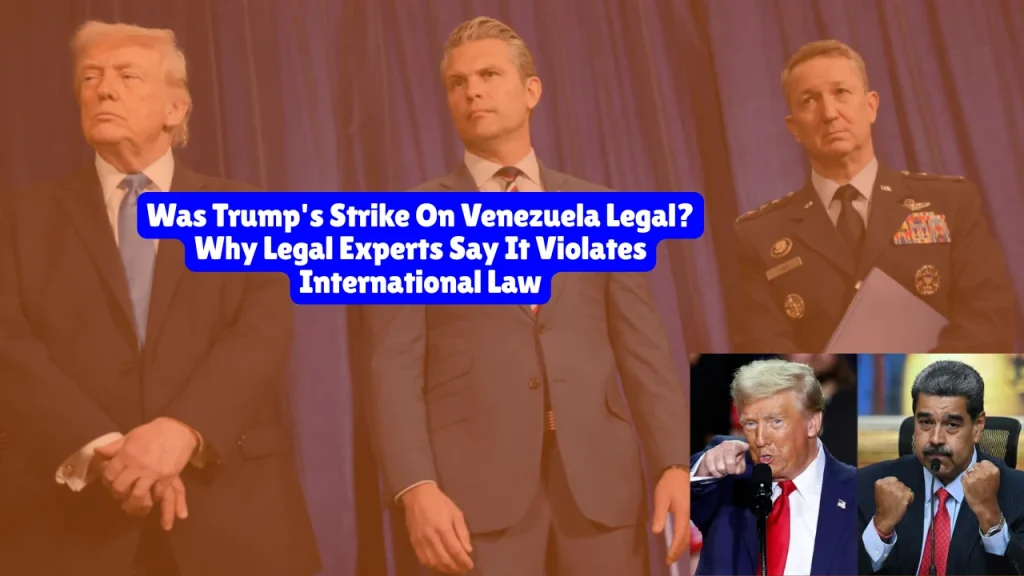
Was Trump’s Strike On Venezuela Legal? Why Legal Experts Say It Violates International Law
Trump’s January 3, 2026 military strike on Venezuela—which killed over 80 people, including 32 Cubans, and resulted in capturing President Nicolás Maduro—violates both US constitutional law and international law according to legal experts. Trump didn’t seek congressional authorization required by the War Powers Resolution, and the attack breaks UN Charter Article 2(4)’s prohibition on using force against sovereign nations. The administration claims “inherent constitutional authority” under Article II, but Democratic senators call the strike “illegal” and “dangerous.”
Over 115 people have died in 35 US boat strikes since September 2025, all without congressional approval. Now Trump says the US will “run” Venezuela indefinitely—the most aggressive assertion of unilateral presidential military power in a generation.
What Actually Happened on January 3, 2026
At 10:46 PM on January 2, 2026, Trump gave the green light for “Operation Absolute Resolve”—a massive military strike on Caracas, Venezuela’s capital.
US forces bombed Fort Tiuna military barracks, multiple airfields, and military bases. Special operations teams simultaneously raided the compound where Maduro was staying, broke through steel-reinforced doors, and captured the Venezuelan president along with his wife Cilia Flores.
According to Venezuelan officials, at least 80 people died in the attacks, including 32 Cuban military and intelligence personnel who were in Venezuela assisting Maduro’s government. Trump acknowledged some US forces were injured but claimed none were killed.
Maduro was flown to the USS Iwo Jima, then transported to New York where he was jailed at the Metropolitan Detention Center in Brooklyn. He faces narcoterrorism charges in Manhattan federal court.
Trump announced at a Mar-a-Lago press conference: “We’re going to run the country until such time as we can do a safe, proper and judicious transition.”
The Constitutional Law Problem: No Congressional Authorization
The [US Constitution Article II](https://constitution.congress.gov/constitution/article-2/) makes the president commander-in-chief, but [Article I gives Congress](https://constitution.congress.gov/constitution/article-1/) the exclusive power to declare war.
Trump didn’t ask Congress for authorization before bombing Venezuela and overthrowing its government. No debate. No vote. No declaration of war.
The [War Powers Resolution of 1973](https://www.congress.gov/bill/93rd-congress/house-joint-resolution/542) requires presidents to notify Congress within 48 hours of introducing armed forces into hostilities. Trump met that requirement—barely. But the law also limits unauthorized military operations to 60 days with a 30-day withdrawal period.
Trump isn’t withdrawing. He’s said the US will “run” Venezuela indefinitely. That exceeds any claim to emergency executive authority.
Democratic Senator Tim Kaine called the strike “illegal under the War Powers Act” and said Trump “has no authority to wage war on Venezuela without congressional approval.”
Related article: Paycheck Wipeouts, Your Entire Paycheck Just Vanished—Here’s What the Law Says About Illegal Deductions
Why International Law Says This Strike Is Illegal
The [UN Charter Article 2(4)](https://www.un.org/en/about-us/un-charter/chapter-1) is crystal clear:
“All Members shall refrain in their international relations from the threat or use of force against the territorial integrity or political independence of any state.”
Trump’s strike did exactly what Article 2(4) prohibits—used military force to violate Venezuela’s territorial integrity and overthrow its government.
There are only two legal exceptions to this rule:
**Self-Defense (Article 51):** A country can use force if it’s been attacked. Venezuela didn’t attack the US. Trump can’t claim self-defense.
**UN Security Council Authorization:** The Security Council can authorize military action to maintain international peace and security. Trump didn’t seek or obtain UN approval.
Without either exception, the strike is an illegal act of aggression under international law.
International law professor Mary Ellen O’Connell told reporters: “This is a textbook violation of the UN Charter. The US cannot unilaterally invade another country, overthrow its government, and claim it’s legal.”
What Trump’s Team Claims as Justification
The administration hasn’t released a formal legal memo yet, but officials have offered several justifications:
**Narcoterrorism Threat:** Trump says Maduro ran a “narco-terrorist state” flooding America with drugs. The Justice Department indicted Maduro in 2020 on narcotrafficking charges.
**Humanitarian Intervention:** Officials point to Venezuela’s humanitarian crisis—millions have fled, the economy has collapsed, and human rights abuses are widespread.
**Inherent Presidential Authority:** The White House claims Article II commander-in-chief powers give Trump authority to protect US interests without congressional approval.
**Protecting Americans:** Trump mentioned US citizens in Venezuela needed protection, though he didn’t specify threats they faced.
Here’s the problem: None of these justifications are recognized under international law as exceptions to the Article 2(4) prohibition on force.
“Humanitarian intervention” isn’t in the UN Charter. Countries have tried claiming it before—NATO in Kosovo 1999, Russia in Georgia 2008—and the international community rejected those claims as illegal.
The drug trafficking argument doesn’t work either. If it did, the US could bomb any country it suspects of drug crimes. That’s not how international law operates.
The “Maduro Isn’t Legitimate” Argument
Trump defenders say Maduro isn’t Venezuela’s legitimate president because the 2018 election was fraudulent. The US recognized opposition leader Juan Guaidó as interim president in 2019 (though he later lost support).
Does that make the strike legal? No.
International law doesn’t let countries decide which foreign governments are “legitimate” and overthrow the ones they don’t like. The UN Charter protects even governments the US considers illegitimate.
As international law expert Oona Hathaway notes: “The rule against the use of force applies regardless of whether we think a government is legitimate. Otherwise, any country could claim its target government wasn’t legitimate and invade.”
The US itself has insisted on this principle when other countries tried similar arguments. When Russia claimed Ukraine’s 2014 government was illegitimate and invaded Crimea, the US condemned it as illegal aggression.
Historical Precedents: Other Presidents Did It Too
Trump isn’t the first president to launch military strikes without congressional approval.
**Libya (2011):** Obama bombed Libya for months without authorization, claiming it wasn’t “war” but merely “kinetic military action.”
**Syria (2017, 2018):** Trump himself bombed Syria twice without congressional approval, claiming humanitarian justification.
**Yemen (ongoing):** Multiple presidents have supported Saudi military operations in Yemen despite no congressional authorization.
**Somalia, Iraq, Pakistan:** Drone strikes have killed thousands without formal war declarations.
Congress rarely pushes back. The War Powers Resolution has been violated dozens of times since 1973, and Congress hasn’t forced compliance.
But the Venezuela strike goes further. Those previous actions involved airstrikes lasting days or weeks. Trump is talking about indefinite occupation and “running” another country.
Legal scholar Bruce Ackerman argues: “The Venezuela operation crosses a constitutional line. This isn’t a limited strike—it’s regime change and occupation without congressional authorization.”
What Congress Is Saying
Democratic senators have condemned the strike. Senator Chris Murphy tweeted: “This is illegal. The president cannot unilaterally overthrow foreign governments and occupy other countries.”
Republican senators have been quieter. Some praise the action, calling Maduro a “dictator” and “narco-terrorist.” Senator Marco Rubio said: “Maduro had to go. Trump did what needed to be done.”
No congressional resolution authorizing force against Venezuela has been introduced. No emergency session has been called. Congress is essentially letting Trump proceed without legal authority.
That’s constitutionally problematic. If Congress believes the strike is illegal, it has tools: pass a resolution demanding withdrawal, file a lawsuit, or cut funding for the operation.
So far, they’ve done none of that.
International Response: US Isolated
The UN Security Council held an emergency session on January 5, 2026. Russia and China condemned the strike as “illegal aggression.” Even US allies like France and Germany expressed “serious concerns.”
The UN General Assembly is expected to vote on a resolution condemning the strike. The US will veto any Security Council action, but General Assembly condemnation would be politically significant.
The International Court of Justice (ICJ) could theoretically hear a case if Venezuela sues the US, though the US doesn’t recognize ICJ jurisdiction in many matters. Venezuela might try anyway.
Several international law experts have called for the International Criminal Court to investigate potential war crimes, though the US isn’t an ICC member and won’t cooperate.
What This Means for Presidential War Powers
If Trump gets away with this—if Congress doesn’t push back and the public accepts it—the precedent is enormous.
Future presidents will point to Venezuela and say: “Trump overthrew a foreign government, occupied the country indefinitely, and faced no legal consequences. I can do the same.”
Constitutional law professor Michael Dorf warns: “This is how presidential war powers expand. Each administration pushes boundaries slightly further, and eventually we have an imperial presidency unchecked by Congress or courts.”
The Founders deliberately gave war powers to Congress, not the president. They feared executive overreach and wanted collective decision-making before committing the nation to war.
The Venezuela strike shows how far we’ve drifted from that constitutional design.
Frequently Asked Questions
Can Congress stop Trump from occupying Venezuela?
A: Yes, but it requires political will. Congress can pass a resolution invoking the War Powers Resolution and demanding withdrawal. It can also cut funding for the operation. Whether they’ll do it is a political question.
Could Trump be impeached for this?
A: Theoretically yes, if the House believes the strike constitutes “high crimes and misdemeanors.” But impeachment is political, not purely legal. Given current partisan divisions, it’s unlikely.
What if Maduro’s trial happens and he’s convicted?
A: The legality of the strike doesn’t depend on whether Maduro is guilty of crimes. Even if he’s a drug trafficker, international law doesn’t allow invading countries to arrest foreign leaders.
Has any president ever been held accountable for illegal military strikes?
A: Not really. Presidents have violated the War Powers Resolution repeatedly since 1973 without facing legal consequences. The political branches don’t enforce it.
What would a court say if this was challenged?
A: Federal courts usually avoid “political questions” about war powers, deferring to the executive and Congress. If Congress authorized the strike, courts would likely uphold it. Without authorization, the legal question is murky but courts might still avoid deciding.
Is this different from the bin Laden raid?
A: Yes. The bin Laden operation in Pakistan was a covert raid targeting a terrorist leader. Venezuela is an overt military invasion overthrowing a government and occupying a country. The scale and nature are completely different.
Could other countries legally intervene to defend Venezuela?
A: Under Article 51, Venezuela has the right of self-defense and could request military assistance from allies. Cuba, Russia, or China could theoretically provide support. Whether they will is another question.
Bottom Line
Trump’s Venezuela strike violates international law’s core prohibition on using force against other countries. It violates the War Powers Resolution by conducting military operations without congressional authorization beyond emergency self-defense.
The administration’s justifications—narcoterrorism, humanitarian concerns, inherent presidential authority—aren’t recognized legal exceptions under the UN Charter or US constitutional law.
Whether Trump faces consequences depends entirely on political will. If Congress demands withdrawal and the public opposes the occupation, Trump may be forced to back down. If Congress stays silent and the public supports “getting Maduro,” the operation continues and the precedent expands presidential war powers even further.
For now, the strike stands as one of the most legally questionable uses of military force by a US president in modern history—condemned by international law experts, constitutional scholars, and much of the international community, but backed by executive power and political support that makes legal constraints difficult to enforce.
This article provides legal analysis of Trump’s Venezuela strike but does not constitute legal advice. International law and constitutional law are complex, evolving fields. For questions about specific legal matters, consult with attorneys specializing in constitutional law or international law.
About the Author

Sarah Klein, JD, is a licensed attorney and legal content strategist with over 12 years of experience across civil, criminal, family, and regulatory law. At All About Lawyer, she covers a wide range of legal topics — from high-profile lawsuits and courtroom stories to state traffic laws and everyday legal questions — all with a focus on accuracy, clarity, and public understanding.
Her writing blends real legal insight with plain-English explanations, helping readers stay informed and legally aware.
Read more about Sarah