
Warren Sapp Lawsuit, $20M Civil Rights Claim After Wrongful Arrest, Sheriff’s Office Admits Errors
NFL Hall of Famer Warren Sapp filed a $20 million notice of claim against the Okeechobee County Sheriff’s Office in December 2024, alleging civil rights violations after his February 24, 2024 arrest during a charity event. The state attorney dropped all charges, and an internal after-action report confirmed deputies made multiple procedural errors during the arrest.
What Is the Warren Sapp Lawsuit About?
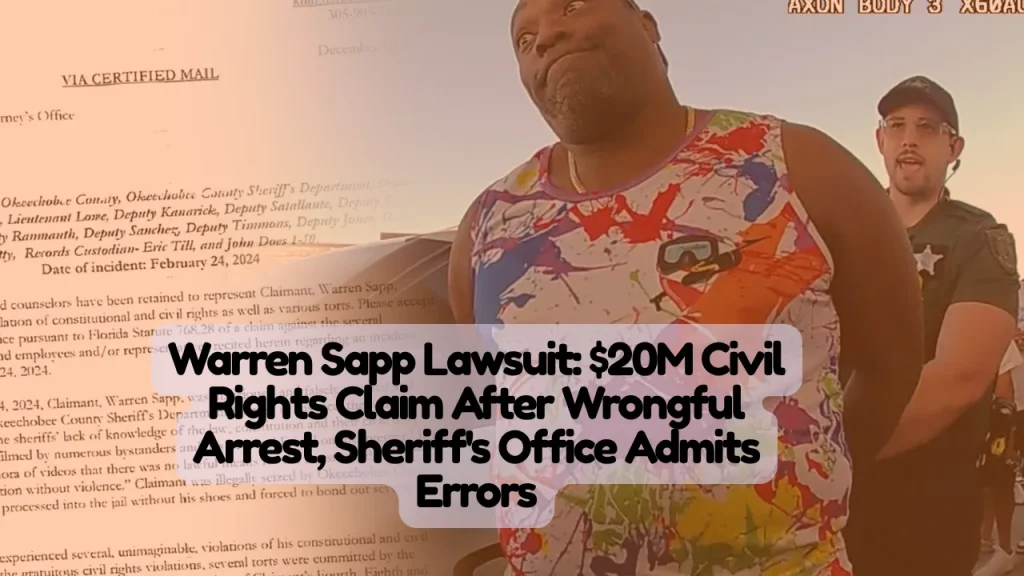
Warren Sapp claims deputies violated his constitutional and civil rights when they arrested him at a gas station in Okeechobee County, Florida, on February 24, 2024. He was charged with obstruction without violence after allegedly refusing to identify himself during a traffic stop involving another driver.
The charges were dismissed days later when Assistant State Attorney Ashley Albright determined the law would not support a conviction, stating officers’ actions were unlawful.
Sapp’s attorney, Ariel Mitchell, filed the notice of claim in December 2024, a required legal step before filing a formal lawsuit. Under Florida law, she must wait six months after filing the notice before proceeding with litigation.
Arrest Details: What Happened February 24, 2024?
Sapp was participating in an annual charity convoy from Miami across Florida, an event he had joined for 12 years to raise funds for charitable causes. Law enforcement received calls about high-end vehicles speeding over 100 mph.
At a gas station, deputies stopped a driver from New Jersey to issue a citation. When the printer malfunctioned, a crowd gathered. Body camera footage shows Sapp approached deputies and began speaking with them.
According to the arrest report:
- Deputy asked Sapp for his name
- Sapp refused to identify himself
- Deputy detained Sapp for interfering with the investigation
- Crowd chanted “set him free”
- Sapp allegedly tensed up and planted his feet when deputies tried placing him in the patrol car
- Sapp was arrested and transported to Okeechobee County Jail
During the arrest, Sapp claimed he heard racial language. In February 2025 on “Thee Pregame Podcast,” he stated an officer told him to “Shut your mouth, boy.”
What Do the Latest Legal Developments Reveal?
December 2024: Notice of claim filed seeking $20 million in damages for civil rights violations, emotional distress, and reputational harm.
February 2025: Internal after-action report obtained through public records request revealed “several things could have been handled differently.”
February 2025: Sheriff’s office insurance provider, Florida Sheriff’s Risk Management Fund, offered $3,500 settlement. Sapp’s attorney rejected it as inadequate.
April 2025: Sapp appeared at Okeechobee County Board of Commissioners meeting, his first public appearance in Florida since the arrest. He confronted officials, calling them “the definition of abuse of power.” Several attendees were removed due to heated exchanges.
May 2025: Yahoo Sports reported Sapp continues pushing forward with the claim despite the nominal settlement offer.
August 2025: Status remains pending. Mitchell has not received substantive response from the county regarding the $20 million claim.
Sheriff’s Office Admits Procedural Failures
The internal after-action report obtained by WPTV in February 2025 documented multiple errors:
Equipment Failures: Deputies issued vehicles without ensuring printers and laptops functioned properly. Lieutenant Bryan Lowe wrote that when equipment fails, deputies should either handwrite citations or issue verbal warnings.
No Weapons Pat Down: After placing Sapp in restraints, deputies never conducted a pat-down or frisk for weapons as required by policy. The report stated this could have located Sapp’s identification and “potentially could have changed the outcome.”
Unclear Verbal Direction: Deputies failed to give clear commands during the arrest.
Improper Arrest Procedures: Standard protocols were not followed during the detention and arrest.
The report concluded supervisors should ensure deputies have working equipment before issuing patrol vehicles.
What Legal Claims Is Warren Sapp Making?
Sapp’s notice of claim alleges violations under:
42 U.S.C. § 1983 (Civil Rights Act): Federal statute allowing individuals to sue government officials for constitutional violations. Sapp claims deputies violated his Fourth Amendment rights against unlawful seizure and his First Amendment right to free speech.
Florida Constitution Article I, Section 12: Protects against unreasonable searches and seizures.
False Arrest/False Imprisonment: Sapp was detained without probable cause. The state attorney’s dismissal supports this claim.
Malicious Prosecution: Deputies arrested and charged Sapp despite insufficient evidence, causing reputational damage.
Emotional Distress: The notice states Sapp suffered sleep disruption, and his son’s birthday was negatively affected by the incident.
What Laws Apply to This Case?
Fourth Amendment (U.S. Constitution): Protects against unreasonable searches and seizures. Requires probable cause for arrests.
First Amendment (U.S. Constitution): Protects freedom of speech and the right to observe and comment on police activity in public spaces, provided individuals do not physically interfere with law enforcement duties.
Florida Statute § 843.02 (Obstruction): Defines obstruction as “resisting, opposing, or obstructing an officer… without offering or doing violence.” Legal experts note verbal disagreement or refusing to identify oneself does not constitute obstruction unless the person is lawfully detained under Terry v. Ohio standards.
Terry v. Ohio (1968): Establishes police may stop and frisk individuals only with reasonable suspicion of criminal activity. Merely being present at a scene does not create reasonable suspicion.
Florida Statute § 768.28: Florida’s sovereign immunity waiver allowing lawsuits against government entities for torts committed by employees within the scope of employment, capped at $200,000 per claim without legislative approval.
Related article: Riley Keough Egg Donation Lawsuit Controversy, New Claims, Latest Legal Developments, and What It Means for the Presley Family
Who Can Be Held Liable?
Okeechobee County Sheriff’s Office: Primary defendant. The agency employs the deputies who conducted the arrest.
Individual Deputies: May face personal liability if their actions violated clearly established constitutional rights. Qualified immunity protects officers performing discretionary functions unless they violate clearly established law.
Okeechobee County: Potentially liable under respondeat superior (employer liability) for deputies’ actions during employment.
Florida Sheriff’s Risk Management Fund: The insurance provider offered $3,500 but is not a direct defendant.
Florida law caps damages against government entities at $200,000 per person and $300,000 per incident under sovereign immunity unless the legislature grants a claims bill for excess amounts. Sapp seeks $20 million, which would require legislative approval if he prevails.
What Damages Is Warren Sapp Seeking?
The $20 million claim covers:
Reputational Harm: Arrest generated negative publicity. Sapp is a public figure coaching at University of Colorado under Deion Sanders.
Emotional Distress: Sleep disruption, anxiety, humiliation from being handcuffed and detained in public.
Loss of Enjoyment of Life: His son’s birthday celebration was negatively impacted.
Punitive Damages: To punish wrongful conduct and deter future civil rights violations.
Economic Damages: Potential lost income or opportunities due to reputational damage.
Attorney Fees and Costs: Legal expenses incurred pursuing the claim.
Sapp stated on the podcast he plans to donate a portion of any recovery to help others who experience wrongful arrests but lack resources to fight back.
Current Status of the Lawsuit
Notice of Claim Filed: December 2024
Six-Month Waiting Period: Required under Florida law before filing formal lawsuit. This period expires approximately June 2025.
County Response: As of February 2025, Ariel Mitchell reported no substantive response from Okeechobee County.
Settlement Offer Rejected: Florida Sheriff’s Risk Management Fund offered $3,500. Mitchell dismissed it as inadequate given the severity of constitutional violations.
Next Steps: Sapp can file a formal lawsuit after the six-month period. If filed in June 2025, the case would proceed through federal or state court.
The case has not yet been filed as a formal lawsuit. It remains in the pre-litigation claims phase.
What Potential Outcomes Exist?
Settlement: Most civil rights cases settle before trial. Given the state attorney’s dismissal and the sheriff’s internal report acknowledging errors, Okeechobee County faces substantial liability exposure. Settlement would likely exceed $3,500 but fall below $20 million.
Jury Trial: If no settlement, Sapp could pursue trial in federal court under 42 U.S.C. § 1983 or in Florida state court. Jury awards in civil rights cases vary widely.
Dismissal: County could move to dismiss based on sovereign immunity or qualified immunity for individual officers. Given the state attorney’s actions and internal report, this outcome appears unlikely.
Claims Bill: If Sapp wins more than $200,000, he would need Florida Legislature to pass a claims bill authorizing payment above the statutory cap.
Policy Changes: Sapp’s attorney indicated he wants systemic accountability. The sheriff’s office has already begun addressing equipment and training issues identified in the after-action report.
Warren Sapp’s Public Statements
During the April 2025 Okeechobee County Board of Commissioners meeting, Sapp directly addressed officials:
“You are the definition of abuse of power. You want a badge that bad? Go get one!”
On “Thee Pregame Podcast” in February 2025, Sapp described the incident:
“To be violated in less than 30 seconds and then not to have a supervisor come to me, nothing. Speak to the lieutenant, he don’t want to come. Speak to the Sheriff… The Sheriff talk wild at me.”
He emphasized his refusal to be silent: “I was exercising my freedom of speech, and that being told he was in violation of obstruction, despite that being a physical act.”
Sapp also highlighted difficulties filing complaints: “The lieutenant wouldn’t take it, the sergeant wouldn’t take it, the Internal Affairs wouldn’t take it… Right when the Internal Affairs guy said he wasn’t taking my complaint.”
Similar Civil Rights Cases
Floyd v. City of New York (2013): Federal court found NYPD’s stop-and-frisk practices violated Fourth and Fourteenth Amendments, leading to policy reforms.
Rodney King v. City of Los Angeles (1994): $3.8 million jury award for excessive force and civil rights violations after videotaped beating.
Eric Garner Estate Settlement (2015): New York City paid $5.9 million to settle wrongful death claim after officers’ actions led to Garner’s death during arrest.
Philando Castile Settlement (2017): $3 million settlement after officer shot Castile during traffic stop.
These cases demonstrate substantial liability exposure when law enforcement violates constitutional rights, particularly when evidence (body camera footage, internal reports) supports plaintiffs’ claims.
What This Case Means for Police Accountability
Sapp’s case highlights several critical issues:
Equipment Failures: Technical malfunctions should not escalate into arrests. Departments must ensure officers have functioning tools or train them to de-escalate when equipment fails.
First Amendment Protections: Citizens have the right to observe, film, and comment on police activity. Mere verbal disagreement does not constitute obstruction.
Arrest Standards: Probable cause requires more than annoyance or frustration with a citizen’s words. The state attorney’s swift dismissal signals weak legal grounds for the arrest.
Qualified Immunity Challenges: When constitutional rights are clearly established (as with the First and Fourth Amendments), officers may lose qualified immunity protection.
Internal Accountability: The sheriff’s office after-action report demonstrates recognition of errors, which may encourage settlement but strengthens Sapp’s claims of systemic failures.
FAQs
Has Warren Sapp filed a lawsuit yet?
No. He filed a notice of claim in December 2024, a prerequisite under Florida law. He can file a formal lawsuit after the six-month waiting period, approximately June 2025.
Why were the charges dropped?
Assistant State Attorney Ashley Albright determined the law would not support a conviction, stating the officers’ actions were not legal and did not meet obstruction standards.
What is a notice of claim?
Florida law requires individuals to notify government entities of intent to sue and provide opportunity to settle before filing formal litigation. This allows governments to investigate and potentially resolve claims without court involvement.
Could Warren Sapp win $20 million?
Unlikely at full amount. Florida caps damages against government entities at $200,000 per person without legislative claims bill. Even with a claims bill, $20 million would be exceptionally high for a case without physical injury.
What is the Florida Sheriff’s Risk Management Fund?
An organization owned by Florida sheriffs providing liability insurance to sheriff’s offices. It offered Sapp $3,500, which his attorney rejected.
Can citizens refuse to identify themselves to police?
Depends on circumstances. Under Terry v. Ohio, police may demand identification only when they have reasonable suspicion of criminal activity. In “stop and identify” situations, refusal may be lawful if no reasonable suspicion exists.
What happens at the six-month mark?
After six months from the December 2024 notice (approximately June 2025), Sapp’s attorney can file a formal lawsuit in federal or state court if no settlement is reached.
Last Updated: December 2025. Case remains in pre-litigation phase. Information based on public records, court filings, and verified news reporting. This article provides legal information, not legal advice.
About the Author

Sarah Klein, JD, is a licensed attorney and legal content strategist with over 12 years of experience across civil, criminal, family, and regulatory law. At All About Lawyer, she covers a wide range of legal topics — from high-profile lawsuits and courtroom stories to state traffic laws and everyday legal questions — all with a focus on accuracy, clarity, and public understanding.
Her writing blends real legal insight with plain-English explanations, helping readers stay informed and legally aware.
Read more about Sarah