
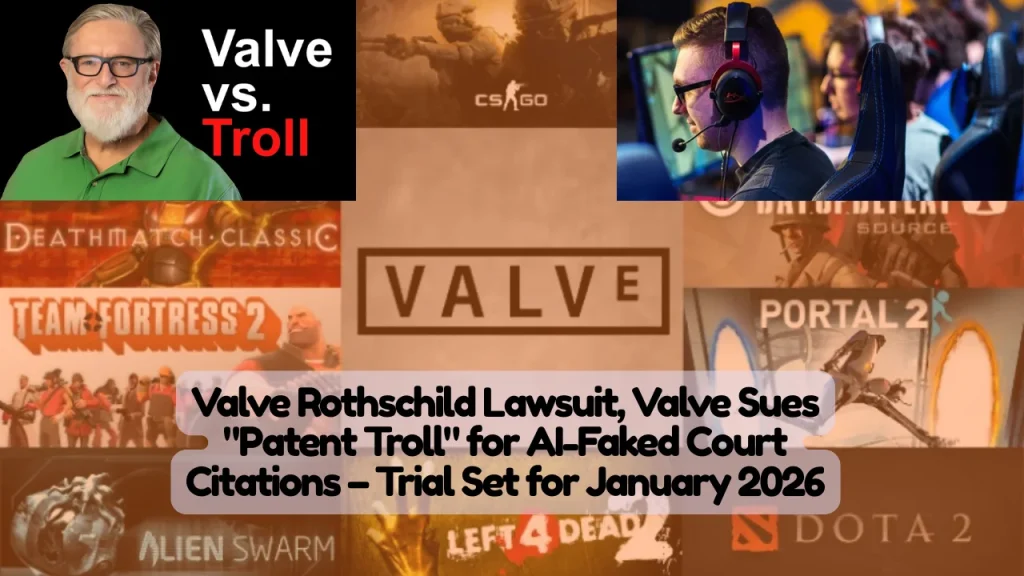
Valve Rothschild Lawsuit, Valve Sues “Patent Troll” for AI-Faked Court Citations – Trial Set for January 2026
Steam creator Valve Corporation is fighting back against inventor Leigh Rothschild in a federal lawsuit accusing him of running a patent troll operation—and the case just took a bizarre turn. In December 2024, Rothschild dropped his counterclaim against Valve after discovery evidence undermined his case. Meanwhile, Valve exposed fake AI-generated court citations in Rothschild’s legal filings. Trial is scheduled for January 26, 2026 in Washington federal court.
The stakes? Valve is pursuing damages, attorney fees, and a ruling that Rothschild violated Washington’s Patent Troll Prevention Act by demanding money for patents Valve already licensed years ago.
What Is the Valve Rothschild Lawsuit About?
Case Number: 2:23-cv-01016, U.S. District Court for the Western District of Washington
Valve filed this lawsuit on July 7, 2023, after Rothschild’s companies repeatedly threatened litigation over U.S. Patent No. 8,856,221—a patent Valve already licensed under a 2016 settlement agreement.
Core Allegations:
- Rothschild operates shell companies solely to file patent lawsuits
- His entities demand licensing fees for patents already licensed to Valve
- These actions breach a 2016 Global Settlement and License Agreement (GSLA)
- Rothschild violated Washington’s Patent Troll Prevention Act (RCW 19.350)
- His conduct constitutes bad faith patent assertion under Washington law
Valve accuses Rothschild of running what it calls a classic “patent troll” scheme: threaten litigation, extract quick settlements, never litigate on the merits.
Related article: Truth Behind Hillary Clinton $90M Divorce Rumors, Why False Claims Keep Spreading Online

The 2016 License Agreement They’re Fighting Over
The root of this case is the Global Settlement and License Agreement (GSLA) signed November 14, 2016.
What Happened in 2015-2016:
- June 8, 2015: Display Technologies LLC (Rothschild’s company) sued Valve for infringing U.S. Patent No. 8,671,195
- November 14, 2016: Parties settled with a GSLA giving Valve a “fully paid-up, perpetual, irrevocable license” to all Rothschild patents
- The GSLA specifically covered U.S. Patent No. 8,856,221—the patent at the center of the current dispute
- The agreement included a covenant not to sue Valve for any licensed patents
The GSLA was supposed to end all patent disputes between the parties. It didn’t.
Why Valve Says Rothschild Is a Patent Troll
Valve’s complaint alleges Rothschild controls multiple shell companies that exist “for the sole purpose of asserting patent infringement claims”:
Rothschild’s Network:
- Display Technologies, LLC
- Rothschild Broadcast Distribution Systems (RBDS)
- Patent Asset Management (PAM)
- Meyler Legal, PLLC (his law firm)
The Pattern Valve Identified:
March 2022: Daniel Falcucci from Patent Asset Management bombarded Valve’s legal team via email and LinkedIn, demanding Valve license patents it already had under the GSLA—including the ‘195 Patent and U.S. Patent 9,300,723.
September 2022: Display Technologies sued Valve for infringing the ‘723 Patent—which is a continuation of the ‘195 Patent explicitly covered by the GSLA. Valve sent the GSLA to Rothschild’s attorneys twice (October and December 2022) proving it had the license.
October 13, 2022: Display Technologies dismissed its lawsuit without prejudice once Valve proved the license existed.
June 21, 2023: Rothschild Broadcast Distribution Systems (RBDS) sent Valve a new demand letter threatening litigation over U.S. Patent No. 8,856,221—also covered by the GSLA. This letter came from the same attorneys (Meyler Legal) who had just seen proof of the GSLA months earlier.
That’s when Valve filed this lawsuit.
Current Case Status: Trial Set for January 2026
Latest Major Development: December 9, 2024 Rothschild and his companies requested dismissal of their counterclaim alleging Valve infringed Patent No. 8,856,221. Judge Jamal N. Whitehead granted the dismissal on December 9, 2024.
Why did they drop it? Discovery evidence likely showed their infringement claim couldn’t survive trial.
Upcoming Trial:
- Trial Date: January 26, 2026
- Duration: 3-4 days
- Type: Jury trial
- Judge: Jamal N. Whitehead
- Court: U.S. District Court for the Western District of Washington
Key Pretrial Deadlines:
- Fact discovery cutoff: June 25, 2025
- Expert witness disclosure: July/August 2025
- Dispositive motions deadline: September 2025
- Pretrial conference: January 2026

The AI Citation Scandal That Rocked the Case
In November 2024, Valve dropped a bombshell allegation: Rothschild’s attorneys submitted court filings containing AI-generated fake citations.
What Valve Found:
Rothschild filed a motion to exclude Valve’s expert witnesses in October 2024. Valve’s response on November 10, 2024 revealed:
- Nonexistent court decisions cited as precedent
- Fabricated quotes allegedly from Valve’s expert witnesses
- Citations to orders that don’t exist
Valve told the court: “Given the prevalence of fake citations and quotes in Defendants’ motion, Valve is concerned Defendants improperly used artificial intelligence in the drafting process.”
The Apology:
Attorney Joseph J. Zito from DNL Zito (representing Rothschild) filed an open letter apologizing for the AI errors. Zito claimed his firm “has a solid policy of zero use of AI,” but a young contract attorney used it anyway, causing “significant scrambling” of citations.
Zito took “full responsibility” but said this was “an explanation and assurance that the mistake will not be repeated, not as an excuse.”
This AI citation scandal is the latest in a pattern Valve says demonstrates bad faith throughout Rothschild’s patent enforcement.
September 2024: Judge Denies Motion to Dismiss
On September 26, 2024, Judge Whitehead issued a critical ruling denying Rothschild’s motion to dismiss the entire case.
What Rothschild Argued:
- He issued Valve an irrevocable license, so there’s no “case or controversy”
- The covenant not to sue means Valve has nothing to fear
- Valve failed to state valid claims under Washington law
Judge Whitehead’s Response:
The court found Valve has a “reasonable apprehension” that Rothschild will sue despite the covenant not to sue. The judge noted:
“Rothschild’s recent actions—including his 2022 lawsuit against Valve and 2023 demand letter—have made Valve understandably fearful that an infringement suit is still to come despite any prior agreement between the parties.”
Key Holdings:
- Valve established subject matter jurisdiction for its declaratory judgment claims
- Valve sufficiently alleged breach of contract under the GSLA
- Valve’s claims under the Patent Troll Prevention Act survive dismissal
- The litigation privilege doesn’t protect extrajudicial demand letters
The case moves forward to trial on all counts.
What Washington’s Patent Troll Prevention Act Says
Washington’s Patent Troll Prevention Act (RCW 19.350) is one of the nation’s earliest laws targeting bad faith patent assertions.
The Law Prohibits:
- Making bad faith assertions of patent infringement
- Threatening litigation without a good faith basis
- Demanding payment for patents without legitimate infringement claims
Bad Faith Factors (Valve alleges Rothschild meets these):
- Demanding payment after already granting a license
- Failing to compare the patent claims to the accused product
- Demanding licenses for patents the target already licensed
- Threatening litigation without intending to file
- Making serial demands through different shell entities
Penalties:
- Injunctive relief stopping the bad faith conduct
- Actual damages
- Attorney fees under 35 U.S.C. § 285 if the case is “exceptional”
- Treble damages under Washington Consumer Protection Act
Valve is seeking all of these remedies.
Rothschild’s Defenses and Counterclaims (Now Dismissed)
Rothschild initially filed counterclaims alleging Valve infringed U.S. Patent Nos. 8,671,195 and 8,856,221.
The Patents at Issue:
- U.S. Patent No. 8,671,195: Cloud-based system and method
- U.S. Patent No. 8,856,221: Related to the ‘195 patent, also covers cloud technology
Both patents were explicitly licensed to Valve under the 2016 GSLA.
What Happened:
- Rothschild filed counterclaims on October 17, 2024 (amended November 15, 2024)
- Discovery proceeded through fall 2024
- December 9, 2024: Rothschild requested dismissal of the ‘221 Patent counterclaim
- The court granted dismissal, eliminating Rothschild’s offensive claims
Valve’s lawsuit against Rothschild continues.
Discovery Battles and Legal Fee Disputes
The case has been marked by contentious discovery disputes:
June 2025: Judge Whitehead paused the case for 45 days after Rothschild’s attorneys (Merchant & Gould PC) sought to withdraw due to unpaid legal fees. The attorneys claimed Rothschild refused to pay outstanding bills without insurance coverage.
April 2025: Valve moved to compel Rothschild to complete document production, accusing him of a “pattern of delays” in responding to discovery requests served in July 2024. The judge expressed skepticism about Rothschild’s “rolling production” practices.
October 2025: Valve requested sanctions against Rothschild for failing to properly respond to information requests.
These discovery battles suggest Rothschild may be struggling to defend his patent troll allegations as Valve uncovers internal documents.
What This Means for Steam Users
This case doesn’t directly impact Steam platform users or involve consumer class action claims.
Why It Matters:
- Valve is defending its business practices from what it calls frivolous patent claims
- A win for Valve strengthens protections against patent trolls in the gaming industry
- Washington’s Patent Troll Prevention Act could set precedent for other tech companies
- The case demonstrates how patent trolls target profitable companies even after settlement
Steam users aren’t eligible for compensation. This is a business dispute between Valve and Rothschild over patent licensing.
Who Can Join This Lawsuit?
No one. This is not a class action lawsuit.
The case involves only:
- Plaintiff: Valve Corporation
- Defendants: Leigh Rothschild, Display Technologies LLC, Rothschild Broadcast Distribution Systems LLC, Patent Asset Management LLC, Meyler Legal PLLC, and Samuel Meyler
There are no opt-in procedures, settlement funds for consumers, or class certification.
What Valve Is Seeking at Trial
Valve’s Second Amended Complaint requests:
Declaratory Relief:
- Declaration that U.S. Patent No. 8,856,221 is invalid
- Declaration that the patent is unenforceable against Valve
Damages:
- Breach of contract damages for violating the GSLA
- Damages under Washington’s Patent Troll Prevention Act
- Damages under Washington Consumer Protection Act
- Punitive damages
- Attorney fees under 35 U.S.C. § 285 (exceptional case provision)
- Pre- and post-judgment interest
Injunctive Relief:
- Court order stopping Rothschild from making further patent assertions covered by the GSLA
- Permanent injunction preventing future bad faith patent demands
Valve is also demanding a jury trial.
Rothschild’s Legal Team Changes
The defendants have experienced significant attorney turnover:
Original Counsel: Meyler Legal PLLC (also named as a defendant for its role in sending demand letters)
Current Counsel:
- Donald R. McPhail (Merchant & Gould PC) – sought to withdraw over unpaid fees
- Eric R. Chad (Merchant & Gould PC) – admitted pro hac vice December 19, 2024
- Matthew J. Cunanan (DC Law Group) – local counsel
- Joseph J. Zito (DNL Zito) – involved in the AI citation controversy
The revolving door of attorneys and fee disputes suggest financial pressures on the defendants.
Key Upcoming Deadlines
Immediate:
- January 31, 2025: Hearing on Valve’s motion to strike and motion to dismiss counterclaims
- March 11, 2025: Joint claim construction statement due
- June 18, 2025: Markman hearing (claim construction)
- June 25, 2025: Fact discovery cutoff
Trial:
- January 26, 2026: Jury trial begins (3-4 days)
- January 29, 2026: Case management conference
How Other Tech Companies Are Watching
This case could set important precedent for how patent troll prevention laws apply when:
- A licensee already has a valid license
- Shell companies make serial demands
- The same patents are asserted through different entities
- Demand letters threaten litigation for already-licensed patents
Tech companies facing similar patent troll tactics will closely watch whether Valve wins attorney fees and damages under Washington’s Patent Troll Prevention Act.
Frequently Asked Questions
Q: Is this a class action lawsuit that Steam users can join?
No. This is a business dispute between Valve Corporation and inventor Leigh Rothschild. No consumers can join or receive compensation.
Q: What is the current status of the case?
The case is proceeding to trial on January 26, 2026. Rothschild dropped his counterclaim in December 2024. Discovery is ongoing through June 2025.
Q: What are the specific allegations against Rothschild?
Valve alleges Rothschild operates shell companies that demand licensing fees for patents Valve already licensed in 2016, violating Washington’s Patent Troll Prevention Act and breaching the 2016 settlement agreement.
Q: What happened with the AI-generated citations?
In November 2024, Valve exposed fake court citations and invented expert witness quotes in Rothschild’s filings. His attorney apologized, blaming a contract lawyer who used AI.
Q: Why did Rothschild drop his counterclaim?
On December 9, 2024, Rothschild voluntarily dismissed his patent infringement counterclaim, likely because discovery evidence undermined his claims that Valve infringed his patent.
Q: What patents are involved?
U.S. Patent No. 8,856,221 (cloud-based system) is the primary patent. Valve already licensed this patent under the 2016 Global Settlement and License Agreement, yet Rothschild’s companies continued demanding additional payment.
Q: What happens if Valve wins at trial?
Valve could receive breach of contract damages, statutory damages under Washington’s anti-troll laws, attorney fees, and an injunction preventing Rothschild from making future patent assertions for licensed patents.
Q: Can I track this case?
Yes. The case is Valve Corporation v. Rothschild et al., Case No. 2:23-cv-01016, Western District of Washington. Court documents are available through PACER or CourtListener.
What Happens Next
The trial scheduled for January 26, 2026 will determine whether Rothschild violated Washington’s Patent Troll Prevention Act and breached the 2016 license agreement.
If Valve prevails, the ruling could strengthen protections against patent trolls in Washington and provide a roadmap for other tech companies facing similar tactics.
For now, discovery battles continue through June 2025, with both sides preparing for a jury to decide if Rothschild’s patent enforcement crossed the line from legitimate licensing to bad faith trolling.
Case: Valve Corporation v. Rothschild et al., No. 2:23-cv-01016 (W.D. Wash.). For official case documents, visit PACER or CourtListener. This article will be updated as developments occur.
About the Author

Sarah Klein, JD, is a licensed attorney and legal content strategist with over 12 years of experience across civil, criminal, family, and regulatory law. At All About Lawyer, she covers a wide range of legal topics — from high-profile lawsuits and courtroom stories to state traffic laws and everyday legal questions — all with a focus on accuracy, clarity, and public understanding.
Her writing blends real legal insight with plain-English explanations, helping readers stay informed and legally aware.
Read more about Sarah