
Unilever / SmartyPants Class Action Claims Children’s Vitamins Falsely Advertise Fiber and Nutrient Content
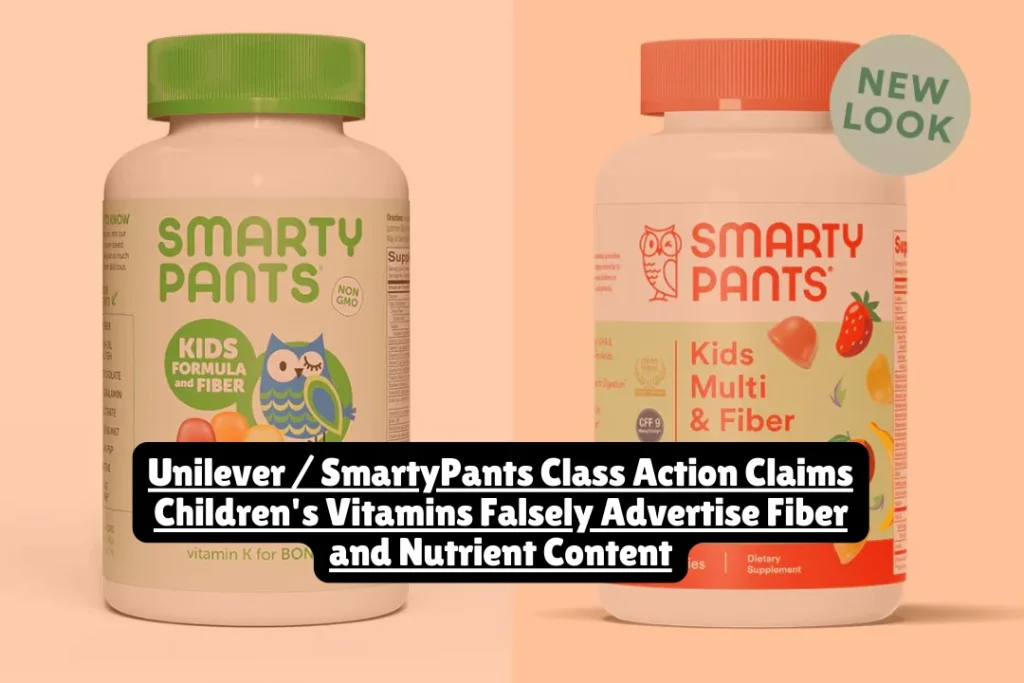
A proposed class action lawsuit targets SmartyPants, Inc. — a children’s vitamin brand now owned by Unilever — over allegations that its gummy vitamin products are falsely labeled as “complete” and providing “essential” nutrition. The 37-page suit against SmartyPants Healthy Minds, Inc. claims the company has “cheated customers” by touting its multivitamins as “complete” and providing “essential” nutrients even though they lack, for instance, vitamins K, B-12 and B-3. The lawsuit was filed in the U.S. District Court for the Southern District of New York. No settlement has been announced. The case is in the litigation phase.
Quick Facts
| Detail | Information |
| Lawsuit Type | Proposed Class Action — False Advertising |
| Defendants | SmartyPants, Inc.; SmartyPants Healthy Minds, Inc. (owned by Unilever) |
| Case Name | Foster et al. v. SmartyPants, Inc., No. 7:21-cv-06430 |
| Court | U.S. District Court, Southern District of New York |
| Current Status | Proposed Class Action — Litigation Phase |
| Who May Be Affected | U.S. consumers who purchased SmartyPants multivitamins, including fiber products |
| Settlement Amount | None — litigation is ongoing |
| Claim Deadline | TBD — no settlement or claim process exists yet |
| Official Settlement Website | None — case has not settled |
Current Status and What Happens Next
This lawsuit is in an active litigation phase. No settlement has been proposed, negotiated, or approved, and no claim filing process is currently available to consumers.
Here is where the case stands:
- Filed: U.S. District Court, Southern District of New York, Case No. 7:21-cv-06430
- Class certification: Not yet granted
- Settlement: None announced
- Claim filing: No claim form or settlement process available at this time
- Corporate background: Unilever acquired SmartyPants Vitamins in November 2020. SmartyPants products are distributed in more than 30,000 stores across the country, including Amazon, Costco, Target, Walmart, Whole Foods Market, and Walgreens.
Check back for updates as the litigation progresses. If a settlement is reached, AllAboutLawyer.com will update this article with claim filing information.
What the Lawsuit Alleges
The core allegation is that SmartyPants markets its gummy vitamins — including products specifically advertising fiber content — with label claims that overstate their nutritional completeness and mislead consumers.
The filing alleges that none of the purportedly “complete” products contain all 13 of the FDA-recommended essential vitamins. The agency has specified that the 13 vitamins the body absolutely needs are vitamins A, C, D, E, K, B-1, B-2, B-3, B-5, B-7, B-6, B-12 and B-9.
Per the complaint, SmartyPants labeled the multivitamins at issue as “complete” and able to offer “essential” daily nutrition and “aid bones, energy and digestion” despite the fact that the products lack a number of the 13 aforementioned vitamins.
The lawsuit highlights the gap between what the label implies and what the product delivers. None of the multivitamin labels expressly state that the product is “incomplete” or otherwise disclose that not all essential vitamins are present. As a result, a reasonable consumer who viewed the products’ supplement facts would “not have any reason to know or suspect” that they are being deprived of some of the vitamins the FDA has deemed essential.
The plaintiffs accuse SmartyPants Inc. of misrepresenting their products in order to charge unwitting consumers a hefty premium. The fiber advertising angle fits within this broader pattern: SmartyPants Kids Complete and Fiber products are marketed as all-in-one solutions combining multivitamins and soluble fiber, with labels that parents reasonably rely on when selecting supplements for their children.
The FDA Fiber Labeling Standard
Under FDA regulations, nutrient content claims — including fiber claims — must comply with strict standards. The Nutrition Labeling and Education Act of 1990 permits the use of label claims that characterize the level of a nutrient in a food if they have been authorized by FDA and are made in accordance with FDA’s authorizing regulations. Food and supplement makers have recently seen class action lawsuits predicated on an alleged failure to comply with FDA’s authorizing regulations related to nutrient content claims. A product labeled as a “good source” of fiber must meet specific per-serving thresholds under FDA rules. Plaintiffs in similar cases have argued that when these thresholds are not met, the label constitutes false advertising under consumer protection law.
Related article: Tesla Class Action Alleges Model S Door Handles Trap Occupants During Emergencies
Who Could Be Included
The case looks to cover a proposed class that includes all persons in the United States who, within the applicable statute of limitations period, bought any of the SmartyPants multivitamins listed in the complaint.
Plaintiffs want to represent a nationwide class of consumers, along with New York and California subclasses, who purchased various SmartyPants multivitamins.
The products named in or related to the complaint include, among others:
- SmartyPants Kids Complete and Fiber Multivitamin
- SmartyPants Adult Complete and Fiber Multivitamin
- Other SmartyPants products labeled as “Complete” or advertising essential nutrients
The class has not yet been certified. A court must formally review and approve class certification before the case can proceed as a full class action. Precise product lists and timeframes will be defined during litigation.
Prior Cases and Industry Context
The SmartyPants lawsuit fits into a well-established pattern of legal challenges targeting children’s and adult vitamin brands over label claims.
Bayer has been accused of misrepresenting popular Flintstones kids vitamins in a class action lawsuit. The makers of Rainbow Light prenatal vitamins paid $1.75 million to exit a class action lawsuit accusing the company of falsely representing the heavy metal content of certain products.
Fiber claims in particular have attracted litigation across the food and supplement industry. A class action against Ole Mexican Foods alleged that the company overstated the dietary fiber content of its Xtreme Wellness Tortilla Wraps. A lawsuit against New Chapter alleged that front labels on fiber gummies misled consumers into believing each gummy delivered the full advertised dose, when multiple gummies were required. Additionally, that case alleged New Chapter marketed two separate organic fiber gummy products — one for adults and one for children — when both had identical formulas.
The dietary supplement industry in the U.S. faces increasing class action risk driven by labeling, testing, and compliance claims. Courts continue to apply the “reasonable consumer” standard when assessing plausibility, and recent decisions have emphasized that context, qualifiers, and disclaimers matter when evaluating label claims.
Frequently Asked Questions
Is this a class action lawsuit?
It is a proposed class action. The lawsuit was filed in the U.S. District Court for the Southern District of New York against SmartyPants, Inc. and SmartyPants Healthy Minds, Inc. A judge has not yet certified it as a class action — that step comes later in the litigation process.
Has a settlement been announced?
No. As of March 2026, no settlement has been proposed or approved in this case. The lawsuit is in the litigation phase, and no claim filing process is currently available to consumers.
Who may be eligible to participate if a settlement is reached?
The case looks to cover all persons in the United States who, within the applicable statute of limitations period, bought any of the SmartyPants multivitamins listed in the complaint — including Kids Complete and Fiber products and adult fiber multivitamins. Final eligibility will be defined if and when a class is certified or a settlement is reached.
What specifically does the lawsuit allege about fiber and nutrient content?
The lawsuit alleges that SmartyPants labels its products as “complete” and advertising fiber and essential nutrients, when the products allegedly fall short of FDA standards for what constitutes a nutritionally complete multivitamin. The filing alleges that none of the purportedly “complete” products contain all 13 of the FDA-recommended essential vitamins.
Is there a claim form I can file right now?
No. Because no settlement exists, there is no claim form or official settlement website. Consumers cannot take action to join or claim compensation at this stage.
What does Unilever / SmartyPants say?
SmartyPants has not publicly admitted any wrongdoing. Unilever describes SmartyPants as “scientifically formulated, made with premium, responsibly sourced ingredients” and states its products are “third-party lab tested.” The company has not issued a public statement in direct response to the false advertising claims.
What happens next in this case?
The defendants will have an opportunity to respond to the complaint, potentially by filing a motion to dismiss. If the case survives early legal challenges, plaintiffs will seek class certification. A settlement could be reached at any point during the process. This article will be updated as the case develops.
Are SmartyPants products still on store shelves?
Yes. No recall or regulatory action has been taken against SmartyPants products. The lawsuit is a civil consumer protection action and does not involve any product safety concerns or government enforcement as of the date of this article.
Additional Context
SmartyPants positions its children’s vitamin line as a premium all-in-one product. SmartyPants markets its Kids Complete Fiber Multivitamin as providing a multivitamin, omega-3 fish oil, and soluble fiber in a single gummy, with no synthetic colors, artificial sweeteners, artificial flavors, artificial preservatives, high fructose corn syrup, or GMOs.
The premium price point is central to the legal claims. When parents pay extra for a product labeled as “complete” or advertised as delivering specific fiber and nutritional benefits, the lawsuit argues they have a reasonable expectation that the label is accurate. Courts evaluating similar cases have generally applied the “reasonable consumer” standard — asking whether an ordinary person would be misled by the label — when deciding whether these lawsuits can proceed.
This article will be updated if and when a settlement is reached, a class is certified, or additional case developments occur.
Last Updated: March 4, 2026
Disclaimer: This article is for informational purposes only and does not constitute legal advice. Legal claims and outcomes depend on specific facts and applicable law. For advice regarding a particular situation, consult a qualified attorney.
About the Author

Sarah Klein, JD, is a licensed attorney and legal content strategist with over 12 years of experience across civil, criminal, family, and regulatory law. At All About Lawyer, she covers a wide range of legal topics — from high-profile lawsuits and courtroom stories to state traffic laws and everyday legal questions — all with a focus on accuracy, clarity, and public understanding.
Her writing blends real legal insight with plain-English explanations, helping readers stay informed and legally aware.
Read more about Sarah