
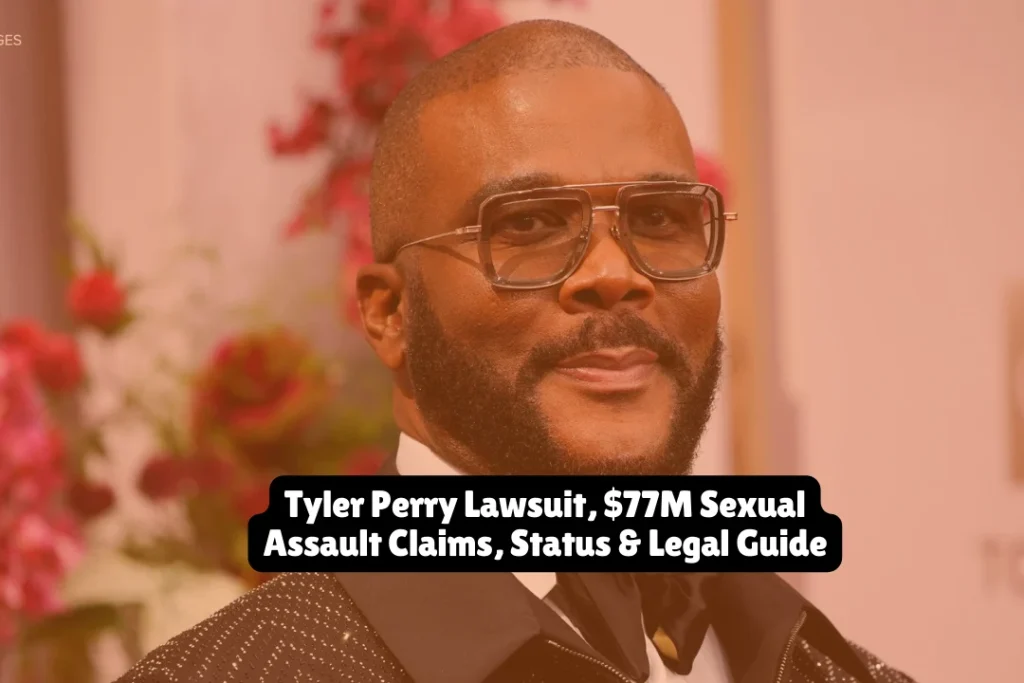
Tyler Perry Lawsuit, $77M Sexual Assault Claims, Status & Legal Guide
Mario Rodriguez, an actor who appeared in the 2016 film Boo! A Madea Halloween, sued Tyler Perry and Lionsgate Entertainment in Los Angeles Superior Court on December 25, 2025. Rodriguez alleges Perry subjected him to repeated unwanted sexual advances and physical contact on multiple occasions between 2015 and 2019. The lawsuit seeks at least $77 million in damages. Perry’s attorney has denied all allegations. The case is in early proceedings, with a judge reassignment occurring in January 2026.
Case Overview
Parties:
- Plaintiff: Mario Rodriguez, actor and model, appearing as “Frat Guy #10” in Boo! A Madea Halloween (2016)
- Defendants: Tyler Perry (filmmaker, producer, and founder of Tyler Perry Studios) and Lionsgate Entertainment Corp. (distributor of Boo! A Madea Halloween)
- Plaintiff’s attorney: Jonathan Delshad, Los Angeles-based civil attorney
- Perry’s attorney: Alex Spiro, of Quinn Emanuel
Court and jurisdiction: Rodriguez filed his lawsuit in Los Angeles Superior Court.
Filing date: December 25, 2025.
Background on Tyler Perry: Perry is one of the most commercially successful independent filmmakers in the United States, known for the Madea film and stage franchise, as well as television series including The Oval, Ruthless, and Sistas. He is the founder of Tyler Perry Studios in Atlanta, Georgia. Perry’s extensive independent studio ownership and control over casting decisions is central to the plaintiff’s factual allegations.
Early procedural development: Los Angeles Superior Court Judge Gail Killefer accepted plaintiff Mario Rodriguez’s challenge to her assignment in January 2026. The lawsuit was transferred to Judge Brock Hammond, who will assign the first date for proceedings in the case at a later date. Rodriguez was not required to state his reasons for seeking the reassignment.
What Does the Lawsuit Allege?
According to the complaint, Rodriguez was approached in 2014 by a trainer at an Equinox gym in Los Angeles who said Perry wanted his phone number to discuss an acting role. Rodriguez alleges the contact was the beginning of a years-long pattern of Perry using his industry position to create access to him.
Perry later encouraged Rodriguez to audition for Boo! A Madea Halloween, telling him, “I’m not a bad person to know and have in your corner.” After Rodriguez was cast, he was invited to Perry’s home, where Perry allegedly touched him inappropriately while they watched a movie.
The complaint describes an incident that allegedly occurred in Perry’s home screening room a few months after they met in 2015, in which Perry placed his hand on Rodriguez’s leg and rubbed his inner thigh. The lawsuit also describes additional alleged incidents in 2016, 2018 and 2019, including one encounter in which Perry allegedly attempted to unbuckle Rodriguez’s pants and another in 2018 in which Perry placed Rodriguez’s hand on his genitals and made sexual comments.
The complaint states that Perry gave Rodriguez $5,000 on multiple occasions following the alleged encounters. Rodriguez alleges he resisted the advances throughout and that contact tapered off in 2019, though Perry allegedly reached out periodically after that.
Rodriguez said he filed the case after seeing the allegations made in Derek Dixon’s earlier lawsuit.
Legal Claims Explained
The complaint includes three claims against Tyler Perry and one against Lionsgate. Here is what each requires and what Rodriguez alleges in support:
1. Sexual Assault (California Civil Code) Sexual assault in a California civil lawsuit does not require criminal charges or a criminal conviction. A plaintiff must show the defendant intentionally caused harmful or offensive contact with an intimate part of the plaintiff’s body, or attempted to do so, and that the plaintiff did not consent. Rodriguez alleges multiple specific incidents of non-consensual physical contact by Perry between 2015 and 2019 at Perry’s Los Angeles home.
2. Sexual Battery (California Civil Code § 1708.5) California’s civil sexual battery statute specifically covers touching of intimate parts without consent for the purpose of sexual arousal, gratification, or abuse. This claim mirrors the sexual assault count but relies on a specific California statute that provides distinct civil remedies, including the possibility of punitive damages. Rodriguez alleges Perry’s physical conduct at his home on multiple occasions meets this definition.
3. Intentional Infliction of Emotional Distress (IIED) To succeed on an IIED claim, a plaintiff must show the defendant’s conduct was extreme and outrageous, was intentional or reckless, and caused the plaintiff severe emotional suffering. Rodriguez alleges that Perry’s repeated conduct over multiple years — combined with the power dynamic of Perry controlling his access to acting roles — caused him lasting emotional harm.
4. Negligence (against Lionsgate) Rodriguez also sued Lionsgate, which distributed the 2016 film, accusing the studio of turning a blind eye to Perry’s alleged misconduct. This claim argues that Lionsgate owed a duty of care to actors working on its productions, was aware or should have been aware of Perry’s conduct, and failed to act. Negligence claims against studios in sexual misconduct cases hinge on what the studio knew and when, and what steps it took — or failed to take — in response.
Tyler Perry’s Response
Perry’s attorney Alex Spiro, who has previously represented Alec Baldwin, Jay-Z, and other high-profile clients, issued a statement calling the lawsuit a “failed cash grab.” Spiro stated: “Having recently failed in another matter against Mr. Perry, the very same lawyer has now made yet another demand from more than a decade ago which will also be a failed money grab.”
Perry has not filed a formal motion to dismiss or an answer to the complaint as of the date of this article. Those responsive filings typically come after the initial procedural period and the assignment of a first hearing date, which Judge Hammond had not yet set as of early February 2026.
Lionsgate had not publicly commented on the claims as of the filing date, according to reporting from multiple outlets.
Related article: Hostile Work Environment Lawsuits, What Employees Need to Know in 2026
The First Lawsuit: Derek Dixon vs. Tyler Perry
Dixon, who appeared on the Perry-created BET series The Oval from 2021 until 2025 after appearing on two episodes of its spin-off Ruthless, alleged in his June 2025 lawsuit that Perry asked him inappropriate questions about his sexuality, groped him on several occasions, and offered him acting jobs to keep him quiet. Dixon alleged that in January 2020, he was spending the night at Perry’s Georgia home after a night of drinking when Perry got into his bed and touched him. Dixon is seeking $260 million in punitive damages.
Dixon’s case has had an unconventional path through the courts. Filed in Los Angeles Superior Court in June 2025, the matter was moved to federal court in California, and Dixon then filed to have it remanded back to state court. On December 12, 2025, a federal judge ruled that Dixon had not proved he had legal residence in California and denied the return to state court. As a result, Dixon’s case was shifted to federal court in Georgia — Perry’s home base — where it is assigned to Judge Sarah E. Geraghty. The case had not moved significantly further by the end of December 2025.
Current Status
Rodriguez lawsuit (Los Angeles Superior Court): Early proceedings. Judge Killefer was removed from the case and replaced with Judge Brock Hammond in January 2026. Judge Hammond will set the first date for proceedings. No hearing dates, motion deadlines, or trial dates have been announced publicly. The case is in its pre-motion, pre-discovery phase.
Dixon lawsuit (U.S. District Court, Northern District of Georgia): Assigned to Judge Sarah E. Geraghty. The case was recently transferred from federal court in California to federal court in Georgia following a ruling on Dixon’s residency. No trial date has been set.
Neither case has reached discovery, motions practice, or settlement discussions that have been made public.
Possible Outcomes
Civil lawsuits of this type can resolve in several ways, and no outcome in either Perry case should be assumed at this stage:
Motion to dismiss: Perry or Lionsgate may file a motion arguing that even if all facts alleged are taken as true, the complaint does not state a valid legal claim — for example, by arguing that the statute of limitations has expired. California extended the statute of limitations for certain sexual assault claims in recent years through legislation including AB 2777 (the FAIR Act), which may affect the timeliness arguments available to the defense.
Discovery: If the case survives early motions, both sides exchange evidence — documents, communications, financial records, witness lists, and depositions. Rodriguez’s attorney Jonathan Delshad has pointed to numerous text messages allegedly exchanged between Rodriguez and Perry that he says bolster his client’s claims. Discovery would allow Perry’s team to challenge those records and develop its own evidence.
Settlement: Civil sexual assault cases frequently resolve before trial. Any settlement terms in these cases would likely be confidential. No settlement discussions have been reported.
Trial: If no settlement is reached and the case survives pretrial motions, a jury trial would determine liability and damages. Delshad stated: “Mr. Rodriguez is looking forward to his day in court and holding Mr. Perry accountable for his actions.”
Appeal: Either party may appeal a trial court verdict to a California Court of Appeal.
Why Lionsgate Was Named
Naming a studio or production company as a co-defendant in entertainment sexual misconduct cases has become more common following the wave of litigation that followed the 2017 reporting on Harvey Weinstein and Miramax. Plaintiffs’ attorneys argue that studios and distributors share responsibility when they benefit financially from content created through a production environment where misconduct allegedly occurred and either knew or should have known about it. Whether Lionsgate had knowledge of the alleged conduct between Perry and Rodriguez — a question central to any negligence claim — has not been addressed in any court ruling to date.
Key Dates
| Event | Date |
| Alleged first incident (Perry’s home) | 2015 |
| Boo! A Madea Halloween releases | October 2016 |
| Alleged incidents during class period | 2016, 2018, 2019 |
| Derek Dixon files first lawsuit | June 2025 |
| Mario Rodriguez files second lawsuit | December 25, 2025 |
| Judge Killefer removed; Judge Hammond assigned | January 6, 2026 |
| Dixon case transferred to Georgia federal court | December 2025 |
| First hearing date (Rodriguez case) | Not yet set |
| Trial date (Rodriguez case) | Not yet set |
Frequently Asked Questions
What is this lawsuit about? Mario Rodriguez, an actor who appeared in Boo! A Madea Halloween, filed a civil lawsuit on December 25, 2025, alleging Tyler Perry repeatedly made unwanted sexual advances and committed sexual battery against him between 2015 and 2019. Rodriguez is also suing Lionsgate for allegedly ignoring Perry’s conduct. He is seeking at least $77 million.
Has the case been decided? No. The case was filed in December 2025 and is in early proceedings. A new judge was assigned in January 2026, but no hearing dates, motion deadlines, or trial dates have been set. No ruling of any kind has been issued. The case has not reached discovery.
What claims are being alleged? Rodriguez alleges sexual assault, sexual battery, and intentional infliction of emotional distress against Tyler Perry. He also alleges negligence against Lionsgate, arguing the studio knew or should have known about the alleged misconduct and failed to act. All allegations are contested.
What is Tyler Perry’s response? Perry’s attorney Alex Spiro denied all allegations and called the lawsuit “another failed money grab,” citing that the same attorney previously brought a different matter against Perry. Perry himself has not made a direct public statement. No formal legal response — such as a motion to dismiss or an answer to the complaint — has been filed in court yet.
Is this the only lawsuit against Tyler Perry? No. Derek Dixon filed a separate sexual assault lawsuit against Tyler Perry in June 2025, alleging Perry groped him while Dixon worked on Perry’s television series The Oval and Ruthless. That lawsuit has been moved to federal court in Georgia. Dixon is seeking $260 million in that separate case.
When is the next hearing? No hearing date has been publicly announced in the Rodriguez case. Judge Brock Hammond, who was newly assigned in January 2026, will set the first date for proceedings at a later time. The Dixon case is pending in U.S. District Court in Georgia with no trial date set.
Why is Lionsgate named in the lawsuit? Rodriguez’s complaint names Lionsgate, the distributor of Boo! A Madea Halloween, on a negligence theory — alleging the studio was aware of or ignored Perry’s alleged conduct and failed to protect people working on its productions. Lionsgate has not publicly commented on the allegations.
What happens next? Judge Hammond will set an initial hearing date for the Rodriguez case in Los Angeles Superior Court. Perry and Lionsgate will likely file either a motion to dismiss or an answer to the complaint. If the case survives early motions, it would proceed to discovery — the exchange of evidence. A trial, if the case is not settled or dismissed, would be determined well in the future. The timeline in civil litigation of this type typically spans one to several years.
Last Updated: February 28, 2026
This article is for informational purposes only and does not constitute legal advice. Legal claims and outcomes depend on specific facts and applicable law. For advice regarding a particular situation, consult a qualified attorney.
About the Author

Sarah Klein, JD, is a licensed attorney and legal content strategist with over 12 years of experience across civil, criminal, family, and regulatory law. At All About Lawyer, she covers a wide range of legal topics — from high-profile lawsuits and courtroom stories to state traffic laws and everyday legal questions — all with a focus on accuracy, clarity, and public understanding.
Her writing blends real legal insight with plain-English explanations, helping readers stay informed and legally aware.
Read more about Sarah