
Trump Signed Executive Order a Second College Sports Order Here’s What Actually Changes for Athletes
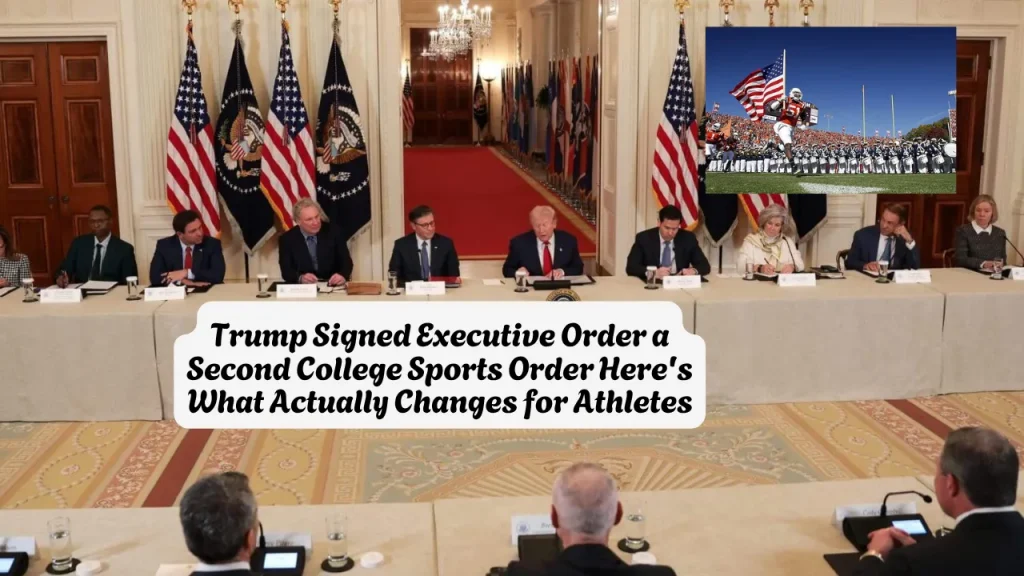
President Donald Trump signed an executive order on April 4, 2026, titled “Urgent National Action to Save College Sports.” The order directs the NCAA to create rules mandating that college athletes can play for no more than a five-year period and limits how often they can transfer between schools. Schools that do not comply risk losing federal funding. Legal experts expect lawsuits — and courts have already blocked parts of Trump’s previous college sports order.
Quick Facts
| Field | Detail |
| Order Title | Urgent National Action to Save College Sports |
| Signed | April 4, 2026 |
| Takes Effect | August 1, 2026 |
| Signed By | President Donald Trump |
| Governing Body Directed | NCAA |
| Enforcement Mechanism | Federal funding cuts to non-compliant schools |
| Prior Order | July 2025 (had no notable impact) |
| NCAA Response | Supportive — called it “a significant step forward” |
| Legal Challenges Expected | Yes — courts struck down the previous order |
This Is Trump’s Second Try — What’s Different This Time
Friday’s order is the second attempt from the Trump administration to use executive power to create change in college sports. His first order, signed in July 2025, did not have any notable impact on how the industry is governed.
Trump’s new order is considered “comprehensive and direct” compared to his last attempt, which was directed at cabinet members. This time, the order goes straight to the NCAA and threatens federal money — the same lever Trump used to pressure universities on DEI and other policies.
The White House states that the convergence of enormous pressure to win in football and basketball, loosened eligibility rules, and pay-for-play schemes has created a financial arms race that is driving universities into debt, threatening to siphon resources from other sports, and damaging student-athletes’ educational opportunities.
What the Order Says About Transfers
This is the part most athletes and fans care about most.
Athletes will be given one “free” transfer as an undergraduate and again as a graduate. The order directs the NCAA to create rules that mandate college athletes can play for no more than a five-year period.
Trump’s recommendation includes strict guardrails on player transfers and mentions the return of the NCAA’s “one-time” transfer rule, with an exception for graduate transfers. Athletes would be allowed to transfer once without penalty, but a second transfer would trigger an automatic redshirt season.
Related article: A Federal Judge Blocked Trump’s College Admissions Data Demand Here’s What It Means for Students
There is a big legal problem with this. That rule was previously deemed illegal in court. The order now creates a situation where the NCAA must choose between following a federal executive order or honoring prior court rulings. That conflict almost guarantees new litigation.
What the Order Says About NIL and Pay-for-Play
The order commands the NCAA to create strict guardrails around booster-backed NIL collectives — describing them as “fraudulent NIL schemes” — and directs that federal funds not be used for NIL or revenue sharing.
Trump writes in the order that the NCAA should implement revenue sharing that preserves or expands scholarships in women’s and Olympic sports and prohibit improper financial activities, including collectives.
The order also calls for a national registry for player agents. Schools must protect women’s and Olympic sports programs when distributing revenue-share money to athletes. Many smaller programs have already cut non-revenue sports to cover football and basketball payroll — this order tries to stop that pattern from spreading.
How Schools Could Lose Federal Funding
The enforcement mechanism here mirrors tactics Trump has already used on other issues.
Trump’s order includes a provision to review federal government grants and contracts for schools and potentially cut funding if they fail to comply with NCAA rules.
The threat of cutting funding to cash-strapped schools is real, even if the stricter rules Trump wants could take a while to figure out. He called on federal agencies to ensure schools follow the rules — a similar approach his administration has taken to force universities to alter policies involving DEI, transgender rights, and other areas.
The practical impact is still unclear. Federal courts have previously stopped Trump from withholding federal funds from Harvard as a pressure tactic, suggesting this enforcement lever has real legal limits.
What the NCAA’s President Said
The NCAA did not push back. NCAA president Charlie Baker released a statement saying: “The NCAA has modernized college sports to deliver more benefits for student-athletes, and the Executive Order reinforces many of our mandatory protections — including guaranteed health care coverage, mental health services, and scholarship protections. This action is a significant step forward, and we appreciate the Administration’s interest and attention to these issues.”
Baker also explained why outside help is needed: “On some of these issues, it’s hard for us to do this without at least some support from the feds. The courts are one way to settle the debate, but it takes a really long time, and it creates a lot of uncertainty.”
The Power Five conferences backed the move. Commissioners at the ACC and SEC released statements thanking Trump for weighing in, with the ACC’s Jim Phillips saying “there continues to be significant momentum to preserve the athletic and academic opportunities for the next generation of student-athletes.”
Will Courts Block This?
Almost certainly, athletes and third parties will challenge it in court.
Multiple provisions of the executive order address areas that federal and district courts have previously ruled on. It creates a situation where NCAA members will have to follow Trump’s order or ignore previous judicial decisions. Courts have already struck down several of Trump’s orders in recent months. Trump previously predicted that the order would be challenged in the courts.
College sports attorney Mit Winter said the order is likely to set up a situation where the NCAA and schools have to decide whether to follow a federal court order or an executive order. “Either way, we’re likely going to see litigation challenging the EO by athletes and third parties,” Winter said.
The root problem is the 2021 Supreme Court ruling in NCAA v. Alston, which confirmed the NCAA is not exempt from federal antitrust law. Athletes have used that precedent to win transfer rights and eligibility battles one by one in court. Understanding how those cases work is key context — see how athletes have already been fighting these eligibility battles in the Diego Pavia NCAA eligibility antitrust lawsuit for background on the legal landscape this order is walking into.
What Congress Is Being Asked to Do
Trump’s order also puts pressure on lawmakers to act. Congress is strongly encouraged to expeditiously pass legislation that satisfactorily addresses these issues. But further delay is not an option given what is at stake — the 500,000 annual educational, athletic, and leadership-development opportunities that provide almost $4 billion in scholarships.
Five presidential committees — covering legislation, rules, NCAA reform, media, and player-agent issues — began meeting this week with the goal of informing congressional legislation.
Senator Maria Cantwell, a key member of the Senate committee looking into changes, said: “I’m glad to know the president wants Congress to pass something.” Bipartisan negotiations over legislation like the SCORE Act have been ongoing for more than a year with no resolution.
Key Dates
| Milestone | Date |
| First Trump College Sports Order | July 2025 |
| White House College Sports Roundtable | March 6, 2026 |
| Second Executive Order Signed | April 4, 2026 |
| Order Takes Effect | August 1, 2026 |
| Legal Challenges Expected | TBD — litigation anticipated before August 1 |
| Congressional Legislation Timeline | TBD — bipartisan talks ongoing |
Frequently Asked Questions
Does this order immediately change transfer portal rules?
Not yet. The rule changes are scheduled to go into effect August 1, 2026. Athletes currently in the portal or who transferred this cycle are not immediately affected. The NCAA must update its rulebook by that date for the order to carry any weight.
Can a president legally control NCAA eligibility rules?
That’s the central legal question. A key sticking point will be whether the president has legal authority over NCAA eligibility rules. Courts have struck down several of Trump’s orders, and executive orders are subject to close legal scrutiny. Opponents will argue this oversteps executive power and conflicts with existing antitrust court rulings.
What happens if a school plays an ineligible athlete under these new rules?
A school that plays an athlete who does not meet these new limits could risk losing its federal funding. That is a serious threat for most universities, which receive hundreds of millions in federal research grants, financial aid, and contracts.
Does this order kill NIL deals for college athletes?
No. The order does not impose any restrictions on NIL payments to college athletes by third-party sources. It targets booster-run NIL collectives specifically, not direct school-to-athlete deals or brand deals athletes negotiate themselves.
What about athletes who already transferred multiple times?
The rule changes are scheduled to go into effect August 1, 2026. Athletes who completed transfers before that date fall under current rules. Whether courts block the new limits before August 1 will determine whether any currently enrolled multi-transfer players face issues for the 2026–27 academic year.
Does this affect women’s sports?
The order specifically tries to protect women’s and Olympic sports. The order states the NCAA should implement revenue sharing that preserves or expands scholarships in women’s and Olympic sports. Schools cannot cut women’s programs to fund football and basketball revenue-sharing obligations under this framework — though enforcement depends heavily on court outcomes.
How is this different from Trump’s July 2025 order?
Trump’s new order is considered “comprehensive and direct” compared to his last attempt, which was directed at cabinet members and had no notable impact on how the industry is governed. This version goes directly to the NCAA, sets a hard effective date, and names federal funding as the enforcement tool.
For a deeper look at how athletes have been pushing back against eligibility restrictions in court — the same legal battleground this order is entering — read the Joey Aguilar NCAA eligibility lawsuit update.
Sources & References
Last Updated: April 5, 2026
Disclaimer: This article is for informational purposes only and does not constitute legal advice. Legal claims and outcomes depend on specific facts and applicable law. For advice regarding a particular situation, consult a qualified attorney.
About the Author

Sarah Klein, JD, is a licensed attorney and legal content strategist with over 12 years of experience across civil, criminal, family, and regulatory law. At All About Lawyer, she covers a wide range of legal topics — from high-profile lawsuits and courtroom stories to state traffic laws and everyday legal questions — all with a focus on accuracy, clarity, and public understanding.
Her writing blends real legal insight with plain-English explanations, helping readers stay informed and legally aware.
Read more about Sarah