
Trump Greenland Tariff Threats, What the Nobel Prize Snub Means for US-Europe Trade
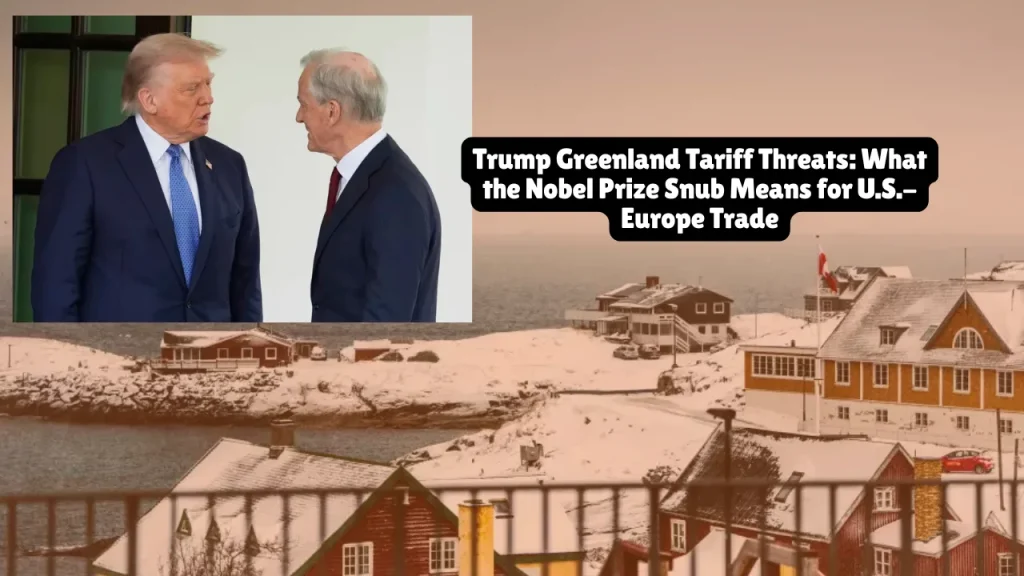
President Trump announced 10% tariffs on eight European countries starting February 1, 2026, escalating to 25% by June unless they support U.S. acquisition of Greenland. In a letter to Norway’s Prime Minister, Trump linked his aggressive stance to not winning the Nobel Peace Prize, stating he no longer feels obliged to “think purely of Peace.”
The move has triggered emergency EU meetings and threats of retaliatory trade measures against American goods. As of January 19, 2026, European leaders are preparing coordinated responses while Greenland’s 60,000 residents make clear they have no interest in U.S. ownership.
What Countries Face Trump’s Greenland Tariffs
Trump’s tariff announcement targets eight NATO allies: Denmark, Norway, Sweden, France, Germany, the United Kingdom, the Netherlands, and Finland. The 10% tariff begins February 1, 2026, and increases to 25% by June 2026 unless these nations agree to support U.S. control of Greenland.
British Prime Minister Keir Starmer called the tariff threat “completely wrong,” stating that decisions about Greenland belong solely to Greenland’s people and Denmark. The EU held an emergency meeting on January 18, 2026, to discuss coordinated responses.
Trump’s Letter Connects Nobel Snub to Greenland Demands
In a letter obtained by Reuters and confirmed by Norwegian officials, Trump wrote to Prime Minister Jonas Gahr Støre: “Considering your Country decided not to give me the Nobel Peace Prize for having stopped 8 Wars PLUS, I no longer feel an obligation to think purely of Peace.”
Trump conflates Norway’s government with the independent Norwegian Nobel Committee, which awards the prize without political influence. Venezuelan opposition leader María Corina Machado, who received the 2025 Nobel Peace Prize, presented her medal to Trump in January 2026, though the Nobel Institute clarified that prizes cannot be transferred.
The letter continues by questioning Denmark’s sovereignty over Greenland, claiming Denmark cannot protect the territory from Russia or China and arguing “there are no written documents” establishing Danish ownership.
Why Trump Says He Wants Greenland
Trump’s stated reasons for demanding control of Greenland center on three key factors: national security, Arctic shipping routes, and natural resources.
The Arctic island’s strategic position between the U.S. and Europe matters for military defense. The U.S. already operates Pituffik Space Base (formerly Thule Air Base) in Greenland, established during World War II. Trump argues that Denmark cannot adequately defend Greenland against Russian and Chinese interests in the Arctic.
As climate change opens new Arctic shipping routes, Greenland sits at the nexus of the GIUK gap connecting the Arctic to the Atlantic Ocean. Trump’s former national security adviser Mike Waltz stated in 2024 that Greenland’s importance relates to critical minerals and natural resources, including rare earth elements essential for technology manufacturing.
Related Article: Kaiser Class Action Lawsuit, $57M in Settlements—March 12 Deadline Approaching, Who Qualifies for Up to $75
Europe’s “Trade Bazooka” Response
French President Emmanuel Macron has reportedly asked the European Union to activate its Anti-Coercion Instrument, dubbed the “trade bazooka” by European media. This tool allows the EU to impose export controls, block U.S. access to European markets, or implement other countermeasures against economic coercion.
The EU’s 27 ambassadors held emergency consultations on January 18, 2026. Eight European countries issued a joint statement warning that “tariff threats undermine transatlantic relations and risk a dangerous downward spiral.”
European Council President António Costa announced an extraordinary in-person meeting in Brussels later this week to coordinate the bloc’s response. Treasury Secretary Scott Bessent said Europe will “understand” America’s position on Greenland, framing it as defense against China and Russia.
What You Must Know
Greenland Isn’t for Sale
Greenland has been part of the Kingdom of Denmark for more than 300 years and operates as a semi-autonomous territory with its own elected government. Greenland’s Prime Minister Jens-Frederik Nielsen and Danish Prime Minister Mette Frederiksen held a joint press conference making clear that Greenland would choose Denmark over the U.S. if forced to decide.
Approximately 60,000 people live in Greenland, and protests erupted in the capital Nuuk on January 17, 2026, opposing Trump’s demands. Shopkeepers report increased sales of survival gear, camping stoves, and freeze-dried foods as residents prepare for potential instability.
NATO Implications Matter
All eight countries facing Trump’s tariffs are NATO allies. The threat marks an unprecedented use of economic coercion against formal military partners. Several European leaders, including those from Germany, the Netherlands, and Sweden, have characterized Trump’s approach as “blackmail.”
NATO’s mutual defense treaty under Article 5 requires members to defend each other if attacked. Trump’s letter claims he has “done more for NATO than any other person since its founding” and that “NATO should do something for the United States.”
Legal Ownership Has Deep Roots
Trump’s claim that Denmark’s ownership rests only on “a boat that landed there hundreds of years ago” oversimplifies centuries of documented sovereignty. Denmark’s relationship with Greenland dates to the early 1700s, with formal colonial administration established in 1814 under the Treaty of Kiel.
The U.S. attempted to purchase Greenland in 1867 and 1946 but was refused both times. Denmark granted Greenland home rule in 1979 and expanded self-governance in 2009, giving Greenlanders control over most domestic affairs while Denmark retains responsibility for defense and foreign policy.
What to Do Next
Businesses Should Prepare for Trade Disruption
Companies importing goods from the U.S. or exporting to American markets should review supply chains and consider the impact of potential 10-25% tariff increases starting February 1, 2026. U.S. businesses with European operations may face retaliatory measures if the EU activates its Anti-Coercion Instrument.
Consulting with trade lawyers about tariff classifications, alternative sourcing, or cost-sharing arrangements may help mitigate financial impacts. The EU is expected to provide updated guidance following its extraordinary meeting this week.
Follow Official Government Sources
The European Commission and individual European governments will issue formal responses to Trump’s tariff threats. Monitor announcements from the U.S. Trade Representative and the European Commission’s Directorate-General for Trade for specific implementation details.
Denmark’s Ministry of Foreign Affairs and Greenland’s government provide updates on diplomatic developments. NATO may issue statements regarding alliance cohesion and Arctic security cooperation.
Understand This Remains a Developing Situation
As of January 19, 2026, no deal exists for U.S. acquisition of Greenland, and Greenlandic and Danish officials maintain their opposition. The February 1 tariff deadline approaches quickly, but negotiations or policy changes could alter the timeline.
British Prime Minister Starmer said he spoke with Trump on January 18, 2026, attempting to find solutions “rooted in partnership, facts and mutual respect.” Other European leaders are similarly engaging in diplomatic outreach.
FAQs
Can Trump Actually Buy Greenland?
No, not without Greenland and Denmark’s consent. Greenland is a self-governing territory within the Kingdom of Denmark with its own parliament and government. Under Denmark’s constitution and Greenland’s self-government act, Greenlandic people would need to vote for independence or a change in status before any transfer could occur. Both Greenlandic and Danish leaders have repeatedly stated Greenland is not for sale.
When Do Trump’s Tariffs Start?
Trump announced that 10% tariffs on goods from Denmark, Norway, Sweden, France, Germany, the United Kingdom, the Netherlands, and Finland begin February 1, 2026. These tariffs escalate to 25% by June 2026 unless a deal is reached for U.S. acquisition of Greenland. Specific product categories and implementation details have not been fully released as of January 19, 2026.
What Is the EU’s Anti-Coercion Instrument?
The Anti-Coercion Instrument, informally called Europe’s “trade bazooka,” is an EU regulation adopted in 2023 allowing the bloc to respond to economic coercion by third countries. Potential countermeasures include restricting access to EU markets, imposing export controls on goods or services, limiting foreign investment in strategic sectors, or restricting public procurement contracts. France has reportedly urged the EU to activate this tool in response to Trump’s threats.
Does Norway Control the Nobel Peace Prize?
No, the Norwegian government does not control Nobel Peace Prize selections. The prize is awarded by the five-member Norwegian Nobel Committee, appointed by the Norwegian Parliament but operating independently. Committee members serve six-year terms and make decisions based on Alfred Nobel’s will without government interference. Norwegian Prime Minister Jonas Gahr Støre confirmed this distinction in his response to Trump’s letter.
Has the U.S. Tried to Buy Greenland Before?
Yes, the United States has attempted to acquire Greenland multiple times throughout history. In 1867, Secretary of State William Seward explored purchasing Greenland and Iceland. After World War II in 1946, President Harry Truman offered Denmark $100 million for Greenland, which Denmark rejected. Trump first raised the idea publicly in 2019 during his first term, calling it a “large real estate deal,” before reviving the proposal in December 2024.
What Happens If Europe Retaliates With Its Own Tariffs?
A full-scale trade war between the U.S. and EU would significantly impact both economies. The EU is America’s largest trading partner, with approximately $1.5 trillion in bilateral trade annually. European countermeasures could target U.S. agricultural products, technology exports, and services. Financial markets reacted negatively on January 19, 2026, as global stocks sold off following news of Trump’s letter to Norway, indicating investor concern about escalating trade tensions.
What Rights Do Greenlandic People Have in This Situation?
Under international law principles of self-determination and Denmark’s constitutional framework, Greenlandic people have the right to decide their political future. Greenland’s Self-Government Act of 2009 grants Greenlanders the right to declare independence through a referendum. Any change in Greenland’s status requires consent from Greenland’s parliament and people. The United Nations Charter and various international covenants protect peoples’ rights to self-determination, which European leaders have emphasized in their responses to Trump’s demands.
Last Updated: January 19, 2026
Disclaimer: This article provides general information about international trade policy and diplomatic developments and is not legal or financial advice.
Call to Action: Stay informed about trade policy changes that could affect your business or investments by following official government announcements.
Stay informed, stay protected. — AllAboutLawyer.com
About the Author

Sarah Klein, JD, is a licensed attorney and legal content strategist with over 12 years of experience across civil, criminal, family, and regulatory law. At All About Lawyer, she covers a wide range of legal topics — from high-profile lawsuits and courtroom stories to state traffic laws and everyday legal questions — all with a focus on accuracy, clarity, and public understanding.
Her writing blends real legal insight with plain-English explanations, helping readers stay informed and legally aware.
Read more about Sarah