
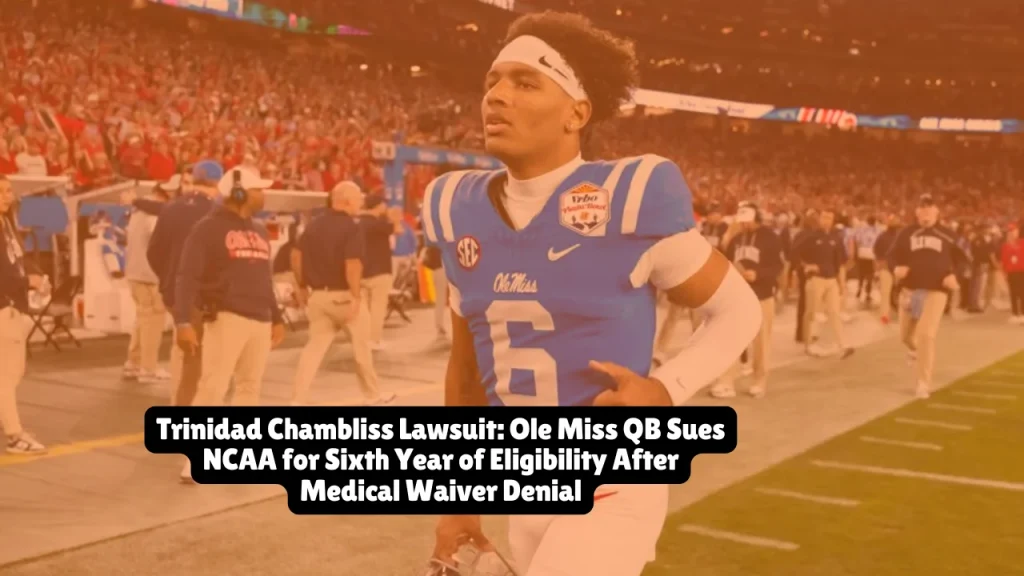
Trinidad Chambliss Lawsuit, Ole Miss QB Sues NCAA for Sixth Year of Eligibility After Medical Waiver Denial
Ole Miss quarterback Trinidad Chambliss filed a lawsuit against the NCAA on January 16, 2026, in Lafayette County Chancery Court in Mississippi, seeking a preliminary injunction that would grant him a sixth year of college football eligibility for the 2026 season. The NCAA denied his medical waiver request on January 9, 2026, claiming insufficient documentation to prove he missed the 2022 season at Ferris State due to incapacitating illness rather than competitive or development reasons.
Who Is Trinidad Chambliss
Trinidad Chambliss is a 23-year-old quarterback who led Ole Miss to the College Football Playoff semifinals in January 2026, losing to Miami 31-27 in the Fiesta Bowl. He transferred to Ole Miss before the 2025 season after two successful years at Division II Ferris State University in Michigan, where he led the Bulldogs to a national championship.
Chambliss has already signed a deal with Ole Miss for the 2026 season that, including incentives, could be worth as much as $6 million according to sources. However, his eligibility status puts that entire agreement in jeopardy. If the court denies his injunction request, Chambliss will be eligible for the 2026 NFL Draft, where he’s ranked as the third-best quarterback prospect behind Indiana’s Fernando Mendoza and Alabama’s Ty Simpson.
What the Lawsuit Alleges
The lawsuit claims the NCAA acted in bad faith and breached its contract with Ole Miss by denying Chambliss’s medical waiver. Chambliss’s attorneys, Tom Mars and William Liston, argue that while Chambliss has been enrolled in college for five years, he only played three years of competitive football due to medical issues beyond his control.
Chambliss took a redshirt (sitting out his first year to preserve eligibility) during the 2021-22 season at Ferris State. During the 2022-23 season, he claims he was physically unable to compete due to serious medical conditions. According to court documents, Chambliss suffered from chronic tonsillitis and adenoiditis that severely impacted his breathing and sleep, post-COVID-19 complications including heart palpitations and chest pains, and recurrent throat infections that caused daytime fatigue and exercise-related airway discomfort.
Ole Miss provided 91 pages of medical records to the NCAA. In supporting letters attached to the lawsuit, Ferris State assistant athletic director for sports medicine Brett Knight wrote that Chambliss’s combination of acute and chronic illness prevented him from consistently engaging in weight training, conditioning, and football practice. Head coach Tony Annese confirmed Chambliss was suffering from post-COVID complications and chronic tonsillitis during the 2022-23 academic year.
What the NCAA’s Response Has Been
The NCAA formally rejected Ole Miss’s waiver request on January 9, 2026, stating the university and Ferris State failed to provide adequate medical documentation proving Chambliss suffered from an incapacitating injury or illness during the 2022 season. A statement from the NCAA noted that documents provided included a physician’s note from a December 2022 visit stating Chambliss was “doing very well” since his August 2022 appointment.
Additionally, the NCAA pointed out that Ferris State indicated it had no documentation of medical treatment, injury reports, or medical conditions involving Chambliss during that timeframe. The school cited “developmental needs and our team’s competitive circumstances” as the reason Chambliss did not play in the 2022-23 season, suggesting the decision was based on football strategy rather than medical necessity.
This creates the central dispute: Chambliss claims he was medically unable to compete, while the NCAA says the evidence shows he sat out for competitive reasons unrelated to injury or illness.
What Makes This Case Different
Attorney Tom Mars told ESPN and OutKick that this lawsuit will be more detailed and better documented than similar eligibility cases filed over the past year. The case differs from most recent player eligibility lawsuits because it’s filed in state court rather than federal court and alleges bad faith breach of contract rather than federal antitrust violations.
The lawsuit claims the NCAA considered evidence in an isolated manner rather than comprehensively evaluating Chambliss’s complete medical history. Mars told media outlets, “There was an easy way to resolve this and a hard way. For the life of me, I don’t understand why the NCAA always chooses the hard way.”
Current Status as of January 2026
As of January 17, 2026, the lawsuit is pending in Lafayette County Chancery Court with Judge Robert Whitwell presiding. Judge Whitwell is a graduate of Ole Miss law school, though this fact alone doesn’t determine how he’ll rule on the merits of the case.
Chambliss’s attorneys are seeking both preliminary and permanent injunctive relief. A preliminary injunction is a court order that would allow Chambliss to play immediately while the full case proceeds. If the court grants the injunction, Chambliss would be eligible to suit up for Ole Miss during the 2026 season.
Mars told ESPN that “considerable work needs to be done” before seeking the injunction. No hearing date has been publicly announced yet. Ole Miss athletic director Keith Carter previously stated the school will appeal the NCAA’s ruling through the organization’s internal appeals process while the lawsuit proceeds.
Related Article: Subway Tuna Lawsuit, Case Dismissed with No Settlement—What You Need to Know
What You Must Know
The Timing Creates Complications for Ole Miss
Ole Miss is caught in a difficult position. The school signed Deuce Knight, a former Auburn quarterback and blue-chip recruit, who would be the projected starter if Chambliss heads to the NFL. However, Knight transferred to Ole Miss specifically because of uncertainty around Chambliss’s eligibility status.
If Chambliss wins his lawsuit after spring practice or during the summer, Ole Miss would have two elite quarterbacks competing for the starting job. If Chambliss loses, the school needs Knight ready to lead the offense. This creates recruiting and roster management challenges that extend beyond just the legal case.
Medical Waivers Require Strict Documentation Standards
The NCAA requires extensive proof that a player missed competition due to incapacitating injury or illness. Incapacitating means the condition prevented athletic participation entirely, not just that the player felt unwell or needed rest. A physician’s note saying a player is “doing very well” months after the missed season can undermine claims of incapacitation during that time.
Schools and players must document contemporaneous medical treatment, meaning records created at the time the injury or illness occurred, not retrospective statements written years later. The conflict between Ferris State’s official explanation (competitive circumstances and development needs) and Chambliss’s medical claims creates credibility questions the NCAA used to justify denial.
State Court vs. Federal Court Strategy
Filing in Mississippi state court rather than federal court changes the legal analysis. State courts apply different standards and may be more sympathetic to arguments about the NCAA’s contractual duties. Additionally, filing in Lafayette County, where Ole Miss is located and where the judge is an Ole Miss law school graduate, may present a more favorable venue than federal court.
However, state court rulings only bind the parties in that specific case and don’t create nationwide precedent the way federal antitrust cases do. Even if Chambliss wins, other players in similar situations would need to file their own lawsuits rather than automatically benefiting from his victory.
What to Do Next
How to Follow the Case
The lawsuit is filed in the Chancery Court of Lafayette County, Mississippi. Court documents and hearing schedules are public records available through the Lafayette County Chancery Clerk’s office. Major sports news outlets including ESPN, CBS Sports, Fox News, and OutKick are actively covering developments in the case.
Interested parties can monitor for announcements about hearing dates for the preliminary injunction request. The timing of any ruling will be critical, as Ole Miss needs clarity on Chambliss’s status before the 2026 season begins.
What This Means for Other Athletes
Players facing similar eligibility disputes should document medical conditions thoroughly and contemporaneously. Keep all medical records, physician communications, treatment documentation, and evidence of how injuries or illnesses affected your ability to train and compete. Written statements from coaches, athletic trainers, and medical staff created at the time of the injury or illness carry more weight than retrospective letters written years later.
If your school cites competitive or development reasons for your lack of playing time, obtain written documentation of any medical issues that actually prevented participation. Conflicting explanations from your school can undermine medical waiver requests.
When Legal Counsel Is Necessary
Consult an experienced sports attorney if: you believe you deserve a medical hardship waiver but the NCAA denied your request; your school’s official explanation for your lack of playing time conflicts with medical reasons you didn’t compete; you’re considering challenging NCAA eligibility decisions in court; or you need guidance on documenting medical conditions to support future waiver requests.
Attorney Tom Mars specializes in NCAA eligibility cases and has represented numerous high-profile athletes in disputes with the NCAA. Other attorneys with experience in sports law and NCAA matters can evaluate whether your situation warrants legal action.
Official Resources
Court Information: The Trinidad Chambliss lawsuit is filed in the Chancery Court of Lafayette County, Mississippi. Contact information for the court clerk is available through the Lafayette County government website.
NCAA Eligibility Resources: The NCAA publishes its Division I Manual, including all bylaws governing eligibility, at ncaa.org. Medical hardship waiver requirements are detailed in NCAA Bylaw 12.8.4.
Sports Law Databases: Legal databases including Westlaw and LexisNexis contain previous NCAA eligibility rulings and court decisions in similar cases, though access typically requires a subscription or law school affiliation.
Frequently Asked Questions
Who is Trinidad Chambliss?
Trinidad Chambliss is a 23-year-old quarterback who played for Ole Miss during the 2025 season, leading the Rebels to the College Football Playoff semifinals. He previously played two seasons at Division II Ferris State University, where he won a national championship. He has a reported $6 million deal with Ole Miss for the 2026 season pending his eligibility status.
What is the Trinidad Chambliss lawsuit about?
The lawsuit challenges the NCAA’s denial of a medical waiver that would grant Chambliss a sixth year of college eligibility. Chambliss claims chronic tonsillitis, post-COVID complications including heart palpitations, and other medical conditions prevented him from competing during the 2022-23 season at Ferris State. The NCAA says insufficient medical documentation supports this claim.
Who is being sued in the Trinidad Chambliss case?
Chambliss is suing the NCAA, the national governing body for college athletics. The lawsuit alleges the NCAA breached its contract with Ole Miss by acting in bad faith when denying Chambliss’s medical waiver request.
What is the current status of the Trinidad Chambliss lawsuit?
As of January 17, 2026, the lawsuit is pending in Lafayette County Chancery Court in Mississippi. Chambliss’s attorneys are preparing to seek a preliminary injunction that would allow him to play during the 2026 season while the full case proceeds. No hearing date has been publicly announced.
Has the Trinidad Chambliss lawsuit been settled?
No. The lawsuit was just filed on January 16, 2026, and remains in its earliest stages. The NCAA has not changed its position since denying the medical waiver on January 9, 2026.
What are the legal claims in the Trinidad Chambliss case?
The lawsuit alleges bad faith breach of contract, claiming the NCAA violated its duty of good faith and fair dealing owed to Ole Miss by denying the medical waiver based on an isolated rather than comprehensive review of evidence. This differs from federal antitrust claims filed in other NCAA eligibility cases.
When will the Trinidad Chambliss lawsuit be resolved?
The timeline is uncertain. Chambliss’s attorneys must first seek a preliminary injunction, which requires a court hearing. If the court grants the injunction quickly, Chambliss could play during the 2026 season while the underlying lawsuit continues. If the court denies the injunction, Chambliss will likely enter the 2026 NFL Draft. Full resolution of the breach of contract claims could take months or years.
Last Updated: January 17, 2026
Disclaimer: This article provides general information about the Trinidad Chambliss lawsuit based on publicly available court filings and news reports. It does not constitute legal advice or predict the outcome of pending litigation.
If you are an athlete facing NCAA eligibility disputes or medical waiver denials, consult with a qualified sports law attorney who can evaluate your specific situation and advise you on your legal options.
Stay informed, stay protected. — AllAboutLawyer.com
About the Author

Sarah Klein, JD, is a licensed attorney and legal content strategist with over 12 years of experience across civil, criminal, family, and regulatory law. At All About Lawyer, she covers a wide range of legal topics — from high-profile lawsuits and courtroom stories to state traffic laws and everyday legal questions — all with a focus on accuracy, clarity, and public understanding.
Her writing blends real legal insight with plain-English explanations, helping readers stay informed and legally aware.
Read more about Sarah