
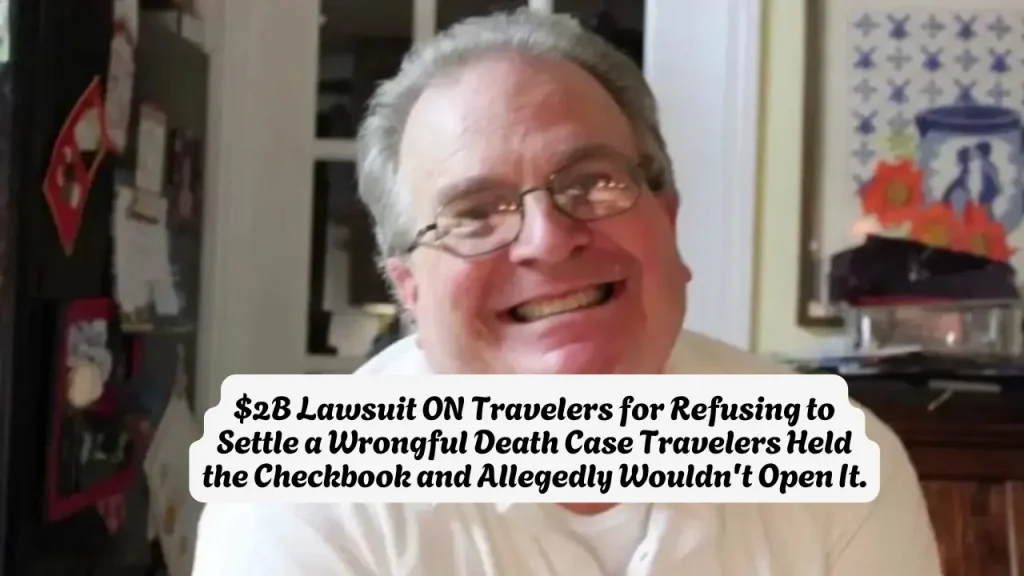
$2B Lawsuit ON Travelers for Refusing to Settle a Wrongful Death Case Travelers Held the Checkbook and Allegedly Wouldn’t Open It.
A 64-year-old courier died in 2016 after carbon dioxide gas from dry ice filled his vehicle. His family sued and a jury awarded $241 million. That should have been the end of the legal story. It wasn’t. Johnson’s widow has now filed a separate federal lawsuit against Travelers Property Casualty Company of America, claiming the insurer had multiple chances to settle before trial and refused — a decision the family says cost everyone, including the company Travelers was supposed to protect.
| Field | Detail |
| Defendant | Travelers Property Casualty Company of America |
| Underlying Defendant | Prairie Farms (Travelers policyholder) |
| Original Incident | 2016 — carbon dioxide exposure, courier death |
| Original Jury Verdict | $241 million (Madison County, Illinois) |
| New Lawsuit Amount | $2 billion |
| New Case Filed | U.S. District Court, Southern District of Illinois |
| Theory of Liability | Bad faith failure to settle |
| Case Status | Active litigation — Travelers has not responded |
What’s Happening Now
- The $2 billion federal lawsuit was filed this week in southern Illinois.
- Travelers has not yet responded to the complaint or issued a public statement.
- The case will proceed through the federal court process; no hearing date has been set.
He Was Delivering Strawberries. Dry Ice Filled His Car. He Never Made It Home.
Eric Johnson was a 64-year-old courier delivering strawberries packed with dry ice when he died in 2016. Dry ice releases carbon dioxide gas, and attorneys say that gas filled his vehicle. Johnson lost consciousness while driving and died days later.
His family sued. The case landed in Madison County, Illinois — a jurisdiction with a strong reputation for plaintiff verdicts in serious injury cases. A jury heard the evidence and returned a $241 million verdict.
That verdict was the starting gun for a second legal fight, not the finish line.
Travelers Held the Checkbook. Prairie Farms Wanted to Pay. Travelers Said No.
This is the part of the story most people miss when they read a headline about a bad-faith insurance suit. Prairie Farms didn’t refuse to settle. Prairie Farms, according to the plaintiff’s attorneys, tried to.
Attorney Patrick Salvi Jr. said Prairie Farms had a desire to resolve the case for an amount the Johnson family would have accepted. Instead, the litigation dragged on for years, ultimately producing a verdict and judgment that caused substantial business harm to Prairie Farms.
Attorney Lance Northcutt laid out the core legal theory directly: “What we have now learned is that it was not Prairie Farms that refused to settle. It was the insurance company, Travelers… They essentially controlled the spigot of funds that would be provided for a settlement.”
This is how commercial liability insurance works in practice. When a company faces a lawsuit, its insurer — not the company itself — typically controls whether and when to negotiate a settlement. The policyholder often cannot write a check without the insurer’s approval. That structure works fine when the insurer acts reasonably. When it doesn’t, the insured can be left exposed to a verdict that towers over any settlement the family would have accepted years earlier.
Related article: CVS Caremark Settles FTC Insulin Lawsuit, CVS Got Paid More When Insulin Cost More. The FTC Is Forcing That to Stop.
Why the Widow Is Suing for $2 Billion — Not $241 Million
The $241 million verdict is what a jury decided Eric Johnson’s life and his family’s loss were worth. The $2 billion lawsuit is something different — it is the legal claim for what Travelers’ conduct cost on top of that.
Under Illinois law and similar statutes in most states, when an insurer refuses in bad faith to settle a claim within a reasonable amount, it can be held liable for the full judgment that results — even if that judgment exceeds the policy limit. It can also face additional damages for the harm caused by prolonging the litigation.
The widow’s attorneys are arguing that Travelers’ decision to stall stretched a resolvable case into years of further suffering for the Johnson family, caused serious financial damage to Prairie Farms as a business, and ultimately produced a verdict the insurer could have avoided at a fraction of the cost. The gap between what a settlement might have cost and what the jury ultimately awarded forms the foundation of the $2 billion figure.
Travelers has not publicly responded to the complaint and has not issued a statement.
What This Means If You or Your Business Have a Liability Insurance Policy
Most people never read the fine print that controls who actually makes settlement decisions when a lawsuit is filed against them. For small business owners, contractors, landlords, and employers especially, this case is a reminder of how that arrangement can go wrong.
Under a standard commercial liability policy, your insurer has what is called the “duty to defend” — meaning it controls the litigation on your behalf. That includes deciding whether to settle and for how much. In theory, this protects you from having to manage complex litigation alone. In practice, it means your insurer can calculate that fighting a case is cheaper for it — even if settling would have been better for you.
When an insurer makes that calculation badly, and a verdict comes in above what a settlement would have cost, the policyholder is supposed to be shielded. But the shield has limits. And when an insurer’s refusal to settle is alleged to be in bad faith — meaning unreasonable, self-serving, or in disregard of the insured’s interests — the insured, or someone acting in their place, can sue the insurer directly for the damage that refusal caused.
That is exactly what the Johnson family’s lawsuit claims happened here.
FAQs: Travelers, Bad Faith, and the $2 Billion Lawsuit
What is “bad faith” by an insurance company?
Bad faith occurs when an insurer acts unreasonably toward its own policyholder — such as refusing to settle a case within policy limits when settlement is clearly the better option. In these cases, the insurer can be held liable not just for the original claim, but for the additional harm its refusal caused.
Can an insurance company really block a settlement without the policyholder’s consent?
Yes. Under standard commercial liability policies, the insurer controls the defense and settlement process. The policyholder typically cannot settle without the insurer’s agreement. That structure is the reason this kind of lawsuit is possible — Prairie Farms allegedly wanted to settle and Travelers would not allow it.
Why does the new lawsuit ask for $2 billion when the jury only awarded $241 million?
The $241 million reflects what a jury decided the wrongful death case was worth. The $2 billion reflects the alleged damage caused by Travelers’ conduct — including the prolonged suffering of the Johnson family, harm to Prairie Farms as a business, and potentially punitive damages for the insurer’s alleged bad faith. These are separate legal theories that can produce separate damage awards.
Does this lawsuit mean Prairie Farms is off the hook?
This case involves Johnson’s widow suing Travelers directly. The $241 million verdict against Prairie Farms still stands unless it is overturned on appeal. The new lawsuit is a separate claim arguing that Travelers, not Prairie Farms, bears ultimate responsibility for the outcome.
Is this lawsuit legitimate?
The lawsuit was filed this week in the U.S. District Court for the Southern District of Illinois. It is an active federal case. Whether the claims succeed depends on evidence gathered during discovery and the legal standards for bad faith in Illinois. No court has ruled on the merits yet.
Do I need a lawyer if my insurer won’t settle a claim involving my business?
You should speak with one promptly. If you believe your insurer is refusing to settle a claim against you in bad faith — and you could face a verdict that exceeds your policy limit as a result — an attorney can advise you on whether you have a claim, and what steps to take before a trial judgment changes your options.
When will I know the outcome of the $2 billion lawsuit?
No hearing dates or timelines have been set. Federal civil litigation at this scale typically takes years to resolve. Check the U.S. District Court for the Southern District of Illinois docket for case updates.
Could this settlement affect my taxes?
If a court ultimately awards damages in a bad faith insurance case, the tax treatment depends on whether the damages are compensatory or punitive. Compensatory amounts tied to physical injury are generally excluded from taxable income under federal law; punitive damages may not be. A tax professional can clarify what applies to any specific payment.
Sources
- FOX 32 Chicago: Insurance company sued for $2B over failure to settle wrongful death case (April 1, 2026)
- U.S. District Court, Southern District of Illinois: https://www.ilsd.uscourts.gov
Last Updated: April 2, 2026
Disclaimer: This article is for informational purposes only and does not constitute legal advice. Legal claims and outcomes depend on specific facts and applicable law. For advice about a particular situation, consult a qualified attorney.
About the Author

Sarah Klein, JD, is a licensed attorney and legal content strategist with over 12 years of experience across civil, criminal, family, and regulatory law. At All About Lawyer, she covers a wide range of legal topics — from high-profile lawsuits and courtroom stories to state traffic laws and everyday legal questions — all with a focus on accuracy, clarity, and public understanding.
Her writing blends real legal insight with plain-English explanations, helping readers stay informed and legally aware.
Read more about Sarah