
Tractor Trailer Accident Lawyer, They’re Ready. Are You?
A tractor trailer accident lawyer investigates your crash, preserves black box and ELD data, identifies every liable party including the trucking company, and fights insurers to win maximum compensation. If a fair settlement is refused, your attorney takes the case to court to recover every dollar you are legally owed.
What does a tractor trailer accident lawyer do?
A tractor trailer accident lawyer investigates your crash, secures black box and ELD records, identifies all liable parties including the trucking company, and fights insurers for maximum compensation. If a fair settlement is denied, your attorney takes the case to court and fights for every dollar you are legally owed.
The moment a tractor trailer collides with your vehicle, two clocks start ticking. One counts your recovery time. The other counts how fast the trucking company’s legal team moves to protect themselves.
These machines are authorized by the FMCSA to carry loads up to 80,000 pounds. When one crashes into a passenger car, the damage is rarely survivable without serious consequences. According to FMCSA data, large truck crashes killed 5,837 people in 2022 — and nearly 1 in 8 fatal motor vehicle crashes involves a large commercial truck.
The trucking company’s insurer does not wait. Adjusters arrive at crash scenes within hours. Defense attorneys are on retainer before you leave the hospital. Their goal is simple — minimize what they pay you, as fast as possible.
A tractor trailer accident lawyer is the one person standing between you and that machine. These attorneys know exactly what evidence to secure, which federal regulations were violated, and how to build a case powerful enough to force a real settlement — or win at trial.
This guide covers everything that matters right now: who is liable, what unique dangers tractor trailers create, what your case is worth, and the exact steps to take before critical evidence disappears. Start by understanding your rights as an injured victim under personal injury law before speaking to anyone from the trucking company.
Why Tractor Trailer Accidents Are More Dangerous Than Other Truck Crashes
Not all commercial vehicle crashes are equal. Tractor trailers create specific, deadly hazards that other trucks simply do not — and your attorney must understand every one of them to build a winning case.
The Unique Dangers Tractor Trailers Create
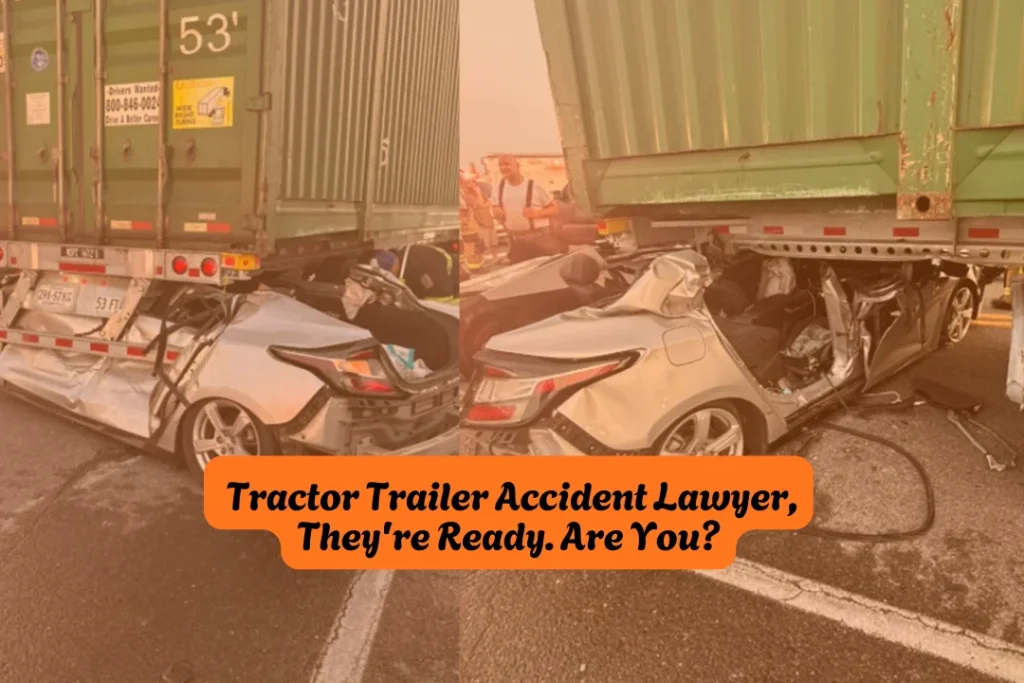
Underride accidents are one of the most devastating and unique risks of tractor trailers. Because of their extreme height, smaller vehicles can slide directly underneath the trailer during a side or rear collision. The result is crushing injuries, decapitation, and fatalities that a standard crash would not cause. Federal underride guard requirements exist — but not all trucking companies comply.
Jackknife crashes occur when the trailer swings outward and the truck folds at the hitch point, often sweeping across multiple lanes of traffic simultaneously and giving other drivers no time to react.
Rollover collisions happen when improperly loaded or overloaded cargo shifts during a turn or sudden lane change, pulling the trailer onto its side. Under 49 CFR Part 393, cargo must be properly secured — violations of this rule are direct evidence of negligence.
Blind spot dangers are magnified on tractor trailers. These vehicles have four massive blind zones — directly in front, directly behind, and on both sides. Drivers who fail to check these zones before merging or turning create catastrophic collision risk.
Braking failures are common. According to FMCSA research, braking system issues caused 29% of all large tractor trailer crashes — making defective or poorly maintained brakes one of the most documented causes of fatal tractor trailer accidents nationwide.
Understanding the specific nature of your crash helps your attorney identify the right liable parties and the right evidence to pursue. That knowledge leads directly into who you can hold legally responsible.
Who Is Liable in a Tractor Trailer Accident?
Liability in a tractor trailer crash almost never stops at the driver. Multiple parties frequently share legal responsibility — and your attorney will pursue every single one.
Every Party That May Owe You Compensation
The truck driver carries direct personal liability for negligence — speeding, fatigued driving, distracted driving, or violating federal hours-of-service rules under 49 CFR Part 395, which caps consecutive driving at 11 hours.
The trucking company faces liability under vicarious liability law, which holds employers legally accountable for their employees’ on-duty actions. Beyond that, companies face direct liability for negligent hiring, inadequate training, pressuring drivers to falsify ELD records, and failing to maintain their fleet. Trucking companies must carry a minimum of $750,000 in liability insurance — and your attorney will examine every policy to maximize what is available for your claim.
The cargo loading company shares fault when improperly secured or overloaded freight shifts in transit, triggering a jackknife or rollover.
The vehicle or parts manufacturer faces product liability exposure when a defective component — brakes, tires, steering systems — contributes to the crash. This is where product liability law works alongside your personal injury claim to open additional recovery channels.
A third-party maintenance contractor may be liable if negligent repairs left the tractor trailer unsafe for the road.
Courts have consistently ruled that trucking companies cannot simply point at their driver to escape responsibility — especially when corporate cost-cutting, policy violations, or poor oversight contributed to the collision. Your attorney traces liability through every layer.
Critical Steps to Take After a Tractor Trailer Accident
What you do — or fail to do — in the first 72 hours can determine whether you win or lose your case. Every step matters.
Your Step-by-Step Protection Plan
- Call 911 immediately — A police report is essential evidence. Never leave the scene before officers arrive and document the crash.
- Seek medical attention the same day — Traumatic brain injuries, internal bleeding, and spinal damage frequently show zero immediate symptoms. A same-day evaluation creates a documented medical record tied directly to the crash date.
- Photograph absolutely everything — Vehicle damage from all angles, skid marks, trailer position, cargo spills, road conditions, traffic signs, and every visible injury on your body.
- Collect witness contact information — Bystander accounts become invaluable when the trucking company disputes liability months later.
- Do not give a recorded statement — The trucking company’s insurer will call you quickly. Do not speak with them, accept any offer, or sign anything without your attorney present.
- Contact a tractor trailer accident lawyer within 24 hours — Your attorney immediately sends a legal spoliation notice demanding the trucking company preserve black box data, ELD records, driver qualification files, logbooks, and maintenance records before they are legally destroyed.
Speaking with a tractor trailer accident lawyer can help you understand your full legal options at absolutely no cost.
What Compensation Can You Claim After a Tractor Trailer Crash?
The financial damage from a serious tractor trailer accident extends far beyond your first hospital visit. Your attorney will fight for every category — including losses that may not become clear for months.
Tractor Trailer Accident Compensation Breakdown
| Compensation Type | What It Covers | Real-World Examples |
| Medical Expenses | All past and future treatment costs | Surgery, hospitalization, rehab, long-term care |
| Lost Wages | Income lost throughout recovery | Missed work, reduced capacity, forced career change |
| Pain & Suffering | Physical pain and emotional trauma | Chronic pain, PTSD, anxiety, loss of life enjoyment |
| Property Damage | Vehicle and personal property losses | Total loss replacement, belongings inside vehicle |
| Punitive Damages | Punishment for extreme recklessness | ELD falsification, impaired driving, knowingly unsafe truck |
| Wrongful Death | Full losses when a victim does not survive | Funeral costs, lost financial support, grief counseling |
Compensatory damages cover your actual documented losses — economic and emotional. In cases involving deliberate safety violations — such as a trucking company that knew their driver was over hours but dispatched him anyway — courts may award punitive damages as additional punishment beyond your compensation.
You can explore how civil courts calculate full injury compensation to better understand every category before your first attorney consultation.
How Insurance Companies Fight Tractor Trailer Claims
Trucking companies carry insurance policies worth $750,000 to several million dollars. Insurers do not write those checks willingly. They deploy calculated, well-funded strategies to protect every dollar — and they count on victims not knowing the playbook.
Their Tactics — And How Your Attorney Counters Each One
- Immediate contact after the crash — Adjusters call within hours hoping to lock in a recorded statement before you have legal protection. Your attorney blocks all direct insurer contact from day one.
- Comparative fault arguments — Insurers claim you were partly responsible to cut your payout under comparative fault rules. Your lawyer builds evidence to minimize any blame attributed to you.
- Medical history fishing — Insurers request your full medical history to find pre-existing conditions to blame for your injuries. Your attorney controls exactly what records are shared and when.
- Lowball early settlement offers — A fast offer before you understand your full injuries is almost always a fraction of your case’s true value. Your attorney will not let financial pressure force an inadequate settlement.
- Strategic delays — Dragging the process out for months creates desperation in victims who need money now. Your attorney keeps proceedings moving and holds insurers accountable.
Every tactic has a legal counter. An experienced tractor trailer accident lawyer handles all communications, fights with evidence, and never lets the insurer dictate the timeline.
Frequently Asked Questions
How long do I have to file a tractor trailer accident lawsuit?
The statute of limitations for tractor trailer accident claims varies by state, but most states allow two to three years from the date of your crash to file a lawsuit. Some states set shorter deadlines, and claims against government-owned vehicles can have windows as short as 90 days. Contact a tractor trailer accident lawyer immediately — missing the deadline permanently eliminates your right to any compensation.
How much is a tractor trailer accident settlement worth?
Settlement values depend on injury severity, available insurance coverage, the number of liable parties, and the quality of your evidence. Minor injury cases may settle for tens of thousands of dollars, while catastrophic injury and wrongful death claims can reach into the millions. No attorney can guarantee a specific amount, but an experienced lawyer will fight to maximize every category — medical expenses, lost income, pain and suffering, and punitive damages where applicable.
What if I was partly at fault for the tractor trailer accident?
Most states use comparative fault rules, which allow you to recover compensation even when you share some responsibility for the crash. Your total award is simply reduced by your percentage of fault. For example, if you were 20% at fault and your damages total $600,000, you could still recover $480,000. Your attorney will work aggressively to challenge any fault assigned to you and keep your recovery as high as possible.
How long does a tractor trailer accident lawsuit take?
Cases with clear liability and strong documentation often settle within six to eighteen months. Complex cases involving multiple defendants, disputed fault, catastrophic injuries, or trial preparation can take two to three years or longer. The insurer’s willingness to negotiate fairly and the court’s schedule both affect the timeline significantly. Your attorney will give you a realistic projection based on your specific facts.
What makes underride accidents in tractor trailer cases so legally significant?
Underride accidents — where a smaller vehicle slides beneath the trailer — are uniquely dangerous and often evidence-rich for your attorney. Federal regulations require rear and side underride guards on commercial trailers. When a trucking company fails to maintain or install compliant guards, that regulatory violation becomes powerful direct evidence of negligence. Underride crashes also tend to involve catastrophic injuries, which significantly increases the value of your claim and strengthens the case for punitive damages.
Legal Terms Used in This Article
Negligence: Failure to act with the level of care a reasonable person would use in the same situation. In tractor trailer cases, this includes violating hours-of-service rules, skipping mandatory inspections, or driving while impaired.
Liability: Legal responsibility for causing an accident or injury. In a tractor trailer crash, liability can fall simultaneously on the driver, the trucking company, cargo loaders, and parts manufacturers.
Vicarious Liability: A legal doctrine that holds employers responsible for their employees’ harmful actions taken while on the job. Trucking companies face vicarious liability whenever their drivers cause crashes during working hours.
Comparative Fault: A rule that reduces your compensation by your percentage of responsibility for the crash. Most states allow you to recover damages even when you share some fault — your award is simply reduced proportionally.
Statute of Limitations: The legal deadline for filing a personal injury lawsuit. Missing this deadline permanently eliminates your right to pursue compensation, no matter how strong your evidence is.
Contingency Fee: A payment arrangement where your attorney only collects a fee if your case wins. You pay absolutely nothing upfront — making experienced legal representation accessible regardless of your financial situation.
Punitive Damages: Additional money courts award specifically to punish extreme recklessness or deliberate safety violations. These go beyond compensating your losses — they hold trucking companies financially accountable for putting profit above human lives.
ELD (Electronic Logging Device): A federally mandated device that automatically records a commercial driver’s driving hours, speed, and rest periods. ELD data is often the single most powerful piece of evidence in proving hours-of-service violations.
Conclusion
A tractor trailer crash reshapes everything — your health, your income, your family, and your sense of security. The trucking company that caused it has experienced attorneys, deep-pocketed insurers, and a clear strategy to minimize what they pay you.
You need a tractor trailer accident lawyer who knows federal trucking regulations inside out, has the resources to investigate every corner of your crash, and will not hesitate to take the fight all the way to trial.
Every hour you wait, black box data gets closer to being overwritten. Logbooks get altered. Legal deadlines count down.
If you or a loved one was injured in a tractor trailer accident, do not wait. Contact a tractor trailer accident lawyer today for a free consultation — understand your rights, protect your evidence, and fight for everything you deserve.
Legal Disclaimer
The information in this article is for general informational purposes only and does not constitute legal advice. Reading this content does not create an attorney-client relationship between you and any law firm. Laws vary significantly by state and every case is unique. Always consult a licensed tractor trailer accident lawyer in your jurisdiction for guidance specific to your individual situation and circumstances.
About the Author

Sarah Klein, JD, is a former civil litigation attorney with over a decade of experience in contract disputes, small claims, and neighbor conflicts. At All About Lawyer, she writes clear, practical guides to help people understand their civil legal rights and confidently handle everyday legal issues.
Read more about Sarah