
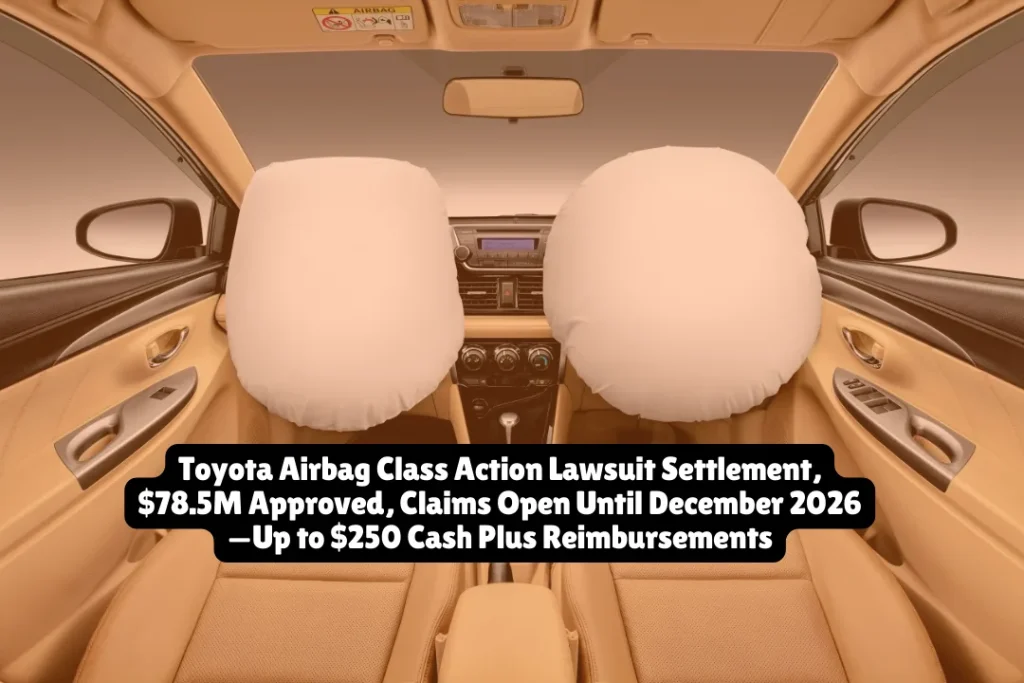
Toyota Airbag Class Action Lawsuit Settlement: $78.5M Approved, Claims Open Until December 2026—Up to $250 Cash Plus Reimbursements
Toyota Motor Corporation agreed to pay $78.5 million to settle a class action lawsuit alleging that defective airbag control units in over 3 million vehicles could fail during crashes, preventing airbags from deploying when needed most. U.S. District Judge John A. Kronstadt in the Central District of California gave final approval to the settlement on November 16, 2023.
If you currently own or previously owned a 2011-2019 Toyota Corolla, 2011-2013 Corolla Matrix, 2012-2018 Avalon, 2013-2018 Avalon Hybrid, 2012-2019 Tacoma, 2012-2017 Tundra, or 2012-2017 Sequoia, you can claim reimbursement for recall-related expenses and potentially receive up to $250 in residual cash payments—but you must file your claim by December 16, 2026.
What the Toyota Airbag Class Action Lawsuit Claims
The lawsuit alleges Toyota equipped millions of vehicles with ZF-TRW airbag control units (ACUs) that are vulnerable to electrical overstress, a condition that can cause the ACU to malfunction and prevent airbags from deploying during collisions. The ACU is the electronic brain that controls when airbags inflate—if it fails, your airbags won’t deploy even in serious crashes where they should activate to protect you.
Plaintiffs filed the original lawsuit in 2019 after Toyota issued a voluntary recall on January 17, 2020, affecting approximately 3.4 million vehicles under NHTSA Recall No. 20V-023. The recall notice explained that electrical overstress could damage the ACU’s internal circuits, potentially causing the supplemental restraint system warning light to illuminate on the dashboard and preventing airbags and seatbelt pretensioners from working properly during crashes.
According to court documents filed in In Re: ZF-TRW Airbag Control Units Products Liability Litigation, Case No. 2:19-ml-02905-JAK-MRW, class representatives argued that Toyota knew about the defect before selling the vehicles but failed to warn consumers. The lawsuit claims Toyota violated state consumer protection laws, breached warranties, and committed fraud by marketing these vehicles as safe when the airbag systems could fail without warning.
Who Can Claim Money From This Settlement
You’re eligible if you currently own, lease, or previously owned or leased one of these Toyota models during the class period:
- 2011-2019 Toyota Corolla
- 2011-2013 Toyota Corolla Matrix
- 2012-2018 Toyota Avalon
- 2013-2018 Toyota Avalon Hybrid
- 2012-2019 Toyota Tacoma
- 2012-2017 Toyota Tundra
- 2012-2017 Toyota Sequoia
Not all vehicles in these model years qualify—only those equipped with the specific ZF-TRW ACU covered by the recall. The settlement website at www.AirbagControlUnitSettlement.com has a VIN lookup tool where you enter your 17-character Vehicle Identification Number to check if your specific vehicle is part of the settlement class.
Certain exclusions apply. You’re not eligible if you purchased your vehicle as salvage, owned it outside the United States at the time of purchase, or if you’re a Toyota dealer, distributor, or affiliated entity. Government entities and fleet purchasers may also be excluded depending on specific circumstances detailed in the settlement agreement.
How Much Money You Can Get and What Benefits Are Included
The settlement provides several types of benefits depending on whether your vehicle was part of the recall and what expenses you incurred:
Reimbursement for Out-of-Pocket Expenses: If you paid for recall-related costs, you can claim reimbursement for rental car fees, towing charges, childcare expenses while getting your vehicle serviced, unreimbursed ACU repair costs, lost wages from taking time off work for vehicle drop-off or pickup, and transportation costs to and from the dealership. You must submit receipts and documentation proving these expenses.
Residual Cash Payment of Up to $250: After all valid expense claims are paid and administrative costs are deducted, any remaining funds will be distributed equally among class members who register for this benefit. The exact amount depends on how many people register—it could be less than $250 if many people sign up, or potentially the full $250 if fewer register. This payment doesn’t require proof of expenses; you just need to register your vehicle through the settlement website.
Extended New Parts Warranty: If your vehicle was part of the recall and you completed the repair (or complete it in the future), you receive an extended warranty covering the replacement ACU parts installed during the recall service. This warranty extends beyond Toyota’s standard warranty period.
Loaner Vehicle and Rental Reimbursement Program: If you took your vehicle to a Toyota dealer for the recall repair but didn’t receive a temporary loaner vehicle, you can claim reimbursement for reasonable rental car costs during the repair period. This benefit requires submitting a claim form with rental receipts before the December 16, 2026 deadline.
Future Recall Outreach Program: Toyota agreed to implement enhanced communication methods to notify owners about any future ACU recalls, using multiple contact methods and adjusting strategies as needed to increase recall completion rates.
How to File Your Claim and Where to Submit It
Step 1: Check Your Eligibility
Visit www.AirbagControlUnitSettlement.com and use the VIN lookup tool. Your VIN is on your vehicle registration, insurance card, or visible through the windshield on the driver’s side dashboard.
Step 2: Gather Documentation
Collect receipts, invoices, and proof of any recall-related expenses you want reimbursed. This includes rental car agreements, towing bills, repair invoices, childcare receipts, pay stubs showing lost wages, and transportation costs like Uber/Lyft receipts or mileage logs.
Step 3: Complete the Claim Form
You can file online at www.AirbagControlUnitSettlement.com or request a paper claim form by calling the settlement administrator at 1-833-747-5737. The online form is faster and you’ll receive immediate confirmation of submission.
For the claim form, you’ll need to provide:
- Your contact information (name, address, phone, email)
- Vehicle details (VIN, make, model, year)
- Documentation of expenses (upload scans or photos of receipts)
- Bank account information for direct deposit (optional but faster than checks)
Step 4: Submit Before the Deadline
Your claim must be submitted online or postmarked by December 16, 2026. This is a hard deadline—late claims will not be accepted. If mailing a paper form, send it to:
Toyota Airbag Control Unit Settlement
c/o Kroll Settlement Administration, LLC
P.O. Box 225391
New York, NY 10150-5391
Step 5: Register for the Residual Payment
Even if you don’t have expenses to claim, you should register for the potential $250 residual payment. This is a separate registration process on the settlement website and has the same December 16, 2026 deadline.
What You Must Know About Settlement Approval and Payment Timing
Judge Kronstadt granted final approval to the settlement on November 16, 2023, after determining it was fair, reasonable, and adequate for class members. The settlement becomes effective after the appeals period expires—if anyone appeals the settlement, it could delay payments. As of February 2026, no appeals have been filed and the settlement is proceeding as planned.
Payment distribution will begin after the claims deadline passes and the settlement administrator processes all submitted claims. Based on typical class action timelines, expect to receive payments sometime in the first or second quarter of 2027—roughly 3 to 6 months after the December 2026 claims deadline. The administrator will first process expense reimbursements, then calculate and distribute residual payments based on how many class members registered.
Toyota denied all allegations of wrongdoing and maintains the settlement resolves the litigation solely to avoid the cost and uncertainty of trial. The settlement agreement explicitly states that Toyota does not admit liability, fault, or wrongdoing of any kind. This is standard language in class action settlements and doesn’t prevent you from receiving the benefits—it just means Toyota settled without admitting the plaintiffs’ allegations were true.
How This Compares to Other Automotive Safety Settlements
The $78.5 million Toyota ACU settlement is substantial but smaller than the massive Takata airbag recall settlement, which ultimately cost automakers over $1 billion. The Takata case involved airbag inflators that could explode and send metal shrapnel into vehicle occupants—a more severe safety defect that resulted in multiple deaths and serious injuries.
Toyota’s settlement compensates owners for the risk of airbag non-deployment rather than actual injuries, which explains the lower per-vehicle payout compared to injury-based settlements. Similar automotive class action settlements like the Sierra Mist Lawsuit Untold Story Of False Advertising Claims, Product Liability demonstrate how consumer protection litigation holds manufacturers accountable when marketing claims don’t match reality.
The National Highway Traffic Safety Administration continues monitoring ACU performance across all automakers. In Geier v. American Honda Motor Co. (2000), the U.S. Supreme Court established that federal safety standards don’t preempt state tort claims for defective vehicle safety systems, preserving consumers’ rights to sue manufacturers for safety defects even when vehicles meet federal requirements.
Where to Find Official Settlement Documents and Court Records
All official settlement documents are available at www.AirbagControlUnitSettlement.com including the full settlement agreement, preliminary approval order, final approval order, and frequently asked questions. You can also access court filings through the federal court’s PACER system (pacer.uscourts.gov) by searching for Case No. 2:19-ml-02905-JAK-MRW in the U.S. District Court for the Central District of California.
For questions about your claim status, call the settlement administrator’s toll-free helpline at 1-833-747-5737 (available Monday-Friday, 8:00 AM to 5:00 PM Pacific Time) or email [email protected]. Do not contact Toyota directly about the settlement—they cannot provide claim information or legal advice; all settlement questions must go through Kroll Settlement Administration.
What to Do Next to Maximize Your Settlement Benefits
Complete the recall repair if you haven’t already. Even though Toyota will reimburse recall-related expenses, the most important action is getting your ACU replaced to ensure your airbags will function properly. Contact your nearest Toyota dealer to schedule the free recall service—this also makes you eligible for the extended warranty benefit.
Document everything related to the recall. If you incur any expenses for rental cars, transportation, childcare, or time off work, save every receipt and take photos as backup. The more documentation you provide, the more likely your expense reimbursement claim will be approved at the full amount.
Mark your calendar for the December 16, 2026 deadline. Set multiple reminders starting in October 2026 to ensure you don’t miss the cutoff. If you’re having trouble completing the claim form or gathering documentation, contact the settlement administrator well before the deadline to get assistance—waiting until the last minute could result in technical issues or incomplete submissions.
Consider whether to opt out or object. If you believe you suffered significant damages beyond what the settlement offers (such as actual injuries from airbag failure), you have the right to opt out of the settlement and pursue individual legal action. However, the opt-out deadline has passed—it was October 20, 2023. If you remain in the settlement class, you release Toyota from liability for the claims covered by this lawsuit.
Does This Mean My Airbags Are Definitely Defective?
Not necessarily. The settlement covers vehicles equipped with potentially defective ACUs, but not every unit will fail. The electrical overstress condition affects ACUs under certain environmental and electrical conditions—some may never experience the problem. However, Toyota issued the recall as a precaution because the defect could occur without warning, so you should complete the recall service even if your airbag warning light hasn’t illuminated.
What If I Sold My Toyota Before Learning About the Settlement?
You can still file a claim if you owned or leased an eligible vehicle at any time during the class period (from the date of purchase through the settlement approval date). You don’t need to currently own the vehicle to claim reimbursement for expenses you paid or to register for the residual payment. You’ll need documentation proving you owned the vehicle, such as registration records, bill of sale, or lease agreement.
Can I File Claims for Multiple Vehicles?
Yes, if you owned or leased more than one eligible Toyota vehicle, you can submit separate claims for each VIN. Each vehicle is treated as a separate claim, and you could receive benefits for each one. For example, if you own both a 2015 Corolla and a 2016 Tacoma that both qualify, you can claim reimbursements for expenses on both vehicles and register both for the residual payment.
What Happens If I Don’t File a Claim?
If you do nothing, you’ll still receive the extended warranty benefit if you complete the recall repair, but you won’t receive any cash payments. You’ll also release your right to sue Toyota for the claims covered by the settlement, even though you received no money. This is why it’s important to at least register for the residual payment—it takes just a few minutes and could result in up to $250.
Is There a Minimum Payout Amount Guaranteed?
No. The settlement doesn’t guarantee minimum payment amounts for the residual cash payment—the actual amount depends on how many class members register and how much money remains after paying expense reimbursements and administrative costs. Toyota committed to the $78.5 million fund, but expense claims get paid first, then administrative costs, attorney fees, and class representative service awards, with the remainder split among registered class members.
How Long Will It Take to Receive My Settlement Check?
Based on the settlement timeline, payments will likely be distributed in early to mid-2027, approximately 3-6 months after the December 16, 2026 claims deadline. The settlement administrator needs time to review and validate all submitted claims, calculate final payment amounts, and process millions of payments to class members nationwide. You can check your claim status on the settlement website after filing.
What If I Never Received a Recall Notice From Toyota?
Many eligible vehicles haven’t been repaired yet because owners never received the recall notice or moved without updating their address with Toyota. Even if you never got a notice, you can still get the recall repair for free and claim settlement benefits. Use the NHTSA recall lookup tool at nhtsa.gov/recalls by entering your VIN to see all open recalls for your vehicle, then contact a Toyota dealer to schedule the free ACU replacement.
Does This Settlement Cover Injuries From Airbag Failures?
No. This settlement only covers economic damages like recall expenses and provides modest cash payments for the inconvenience and diminished value of owning a vehicle with a defective ACU. If you suffered physical injuries because your airbags failed to deploy in an actual crash, you would need to pursue a separate personal injury lawsuit. The settlement explicitly excludes personal injury and wrongful death claims, which class members can still pursue individually. For complex injury claims, consult with a product liability attorney who specializes in automotive defect cases.
Last Updated: February 2, 2026
Disclaimer: This article provides general information about the Toyota airbag control unit class action settlement and should not be considered legal advice.
Need guidance? If you own an affected Toyota vehicle, visit www.AirbagControlUnitSettlement.com to check your eligibility and file your claim before the December 16, 2026 deadline, or call 1-833-747-5737 for assistance.
Stay informed, stay protected. — AllAboutLawyer.com
About the Author

Sarah Klein, JD, is a licensed attorney and legal content strategist with over 12 years of experience across civil, criminal, family, and regulatory law. At All About Lawyer, she covers a wide range of legal topics — from high-profile lawsuits and courtroom stories to state traffic laws and everyday legal questions — all with a focus on accuracy, clarity, and public understanding.
Her writing blends real legal insight with plain-English explanations, helping readers stay informed and legally aware.
Read more about Sarah