
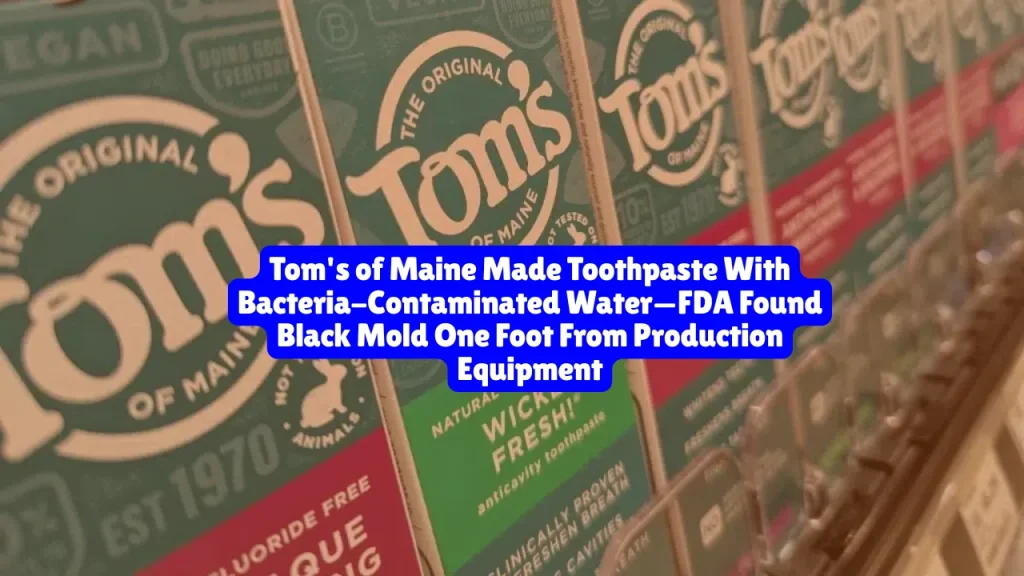
Tom’s of Maine Class Action Lawsuit, Made Toothpaste With Bacteria-Contaminated Water—FDA Found Black Mold One Foot From Production Equipment
Tom’s of Maine faces a class action lawsuit alleging the company sold toothpaste products contaminated with disease-causing bacteria and manufactured in facilities with black mold. The lawsuit, filed by California consumer Teresa Pitre in December 2024 (Case No. 3:24-cv-09318, Northern District of California), follows an FDA warning letter that found Pseudomonas aeruginosa bacteria in water used to make toothpaste between June 2021 and October 2022, plus black mold-like substances near production equipment. The lawsuit seeks to represent all US consumers who purchased Tom’s of Maine toothpaste in the past three years.
Here’s what makes this shocking: Tom’s of Maine reaches millions of families who specifically choose “natural” products believing they’re safer. The FDA documented 400+ consumer complaints about odor, color, and taste that the company never investigated.
What the FDA Found: Bacteria in Your Toothpaste Water
Picture this: You brush your teeth every morning with Tom’s of Maine. You chose it because it’s “natural.” You trust it.
Meanwhile, the FDA discovers the water used to make your toothpaste is contaminated with bacteria that can cause lung and blood infections.
Here’s what the November 2024 FDA warning letter documented:
The complaint, citing the FDA’s warning letter, says the bacteria Pseudomonas aeruginosa, which can cause lung and blood infections, was recovered in multiple water samples from the Tom’s of Maine facility between June 2021 and October 2022.
Per the suit, the water was used to make Tom’s Simply White clean mint toothpaste and to conduct a final rinse of certain production equipment.
Tom’s of Maine also reported detecting Ralstonia insidiosa in water and Paracoccus yeei in the finished product Wicked Cool! Anticavity Toothpaste.
The black mold discovery:
Per the case, the “mold-like substance” found at the Tom’s of Maine facility was located at “the base of a hose reel and behind a water storage tank at the facility,” roughly a foot away from equipment used to make toothpaste.
According to the FDA warning letter: “Our investigator observed a black mold-like substance at the base of the hose reel and behind the water storage tank. The black substance was within one foot of stainless-steel pails and other product-contact equipment used for OTC drug production.”
The Products Involved: Which Toothpastes Were Contaminated
The FDA specifically identified these products manufactured with bacteria-contaminated water:
Confirmed contaminated products:
- Tom’s Simply White Clean Mint Paste (manufactured with Pseudomonas aeruginosa-contaminated water)
- Wicked Cool! Anticavity Toothpaste (Paracoccus yeei bacteria found in finished product batch 3025UST11B)
Potentially affected products:
The lawsuit looks to cover all individuals in the United States who bought the Tom’s of Maine products at issue within the applicable statute of limitations period.
Given the water system contamination documented from June 2021 through October 2022, potentially ALL Tom’s of Maine toothpaste products manufactured during this period could be affected.
The Bacteria Explained: What You Were Exposed To
Let’s break down what these bacteria actually are and why they’re dangerous.
Pseudomonas aeruginosa
This is the big one. Found in multiple water samples between 2021-2022.
Health risks:
- Causes lung infections (especially dangerous for people with weakened immune systems)
- Can cause blood infections
- May cause urinary tract infections
- Can infect wounds
- Particularly dangerous for hospitalized patients, people with cystic fibrosis, and those with compromised immunity
Ralstonia insidiosa
Found in the water system.
Health risks:
- Opportunistic pathogen (infects vulnerable individuals)
- Can cause respiratory infections
- Associated with healthcare-associated infections
Paracoccus yeei
Found in finished Wicked Cool! Anticavity Toothpaste.
Health risks:
- Can cause peritonitis
- May cause bacteremia (bacteria in blood)
- Associated with infections in immunocompromised patients
The FDA’s concern:
The case claims that despite the microbial test results, Tom’s of Maine continued to distribute merchandise based on tests of final products while failing to investigate the quality of water used in its production processes.
In fact, the FDA found that batches of products manufactured after the water samples were taken were released to the public “despite the quality of the water used as a component or to clean the equipment,” the suit states.
Related Article: Continuum Health Class Action Settlement Pays Up to $5,000—380,000 Patients’ Social Security Numbers and Medical Records Exposed
What the Lawsuit Alleges: They Knew and Sold It Anyway
The class action makes serious allegations about Tom’s of Maine’s knowledge and conduct.
Pitre argues Tom’s of Maine knew the toothpastes were contaminated with the harmful mold and disease-causing bacteria, despite advertising them as natural and safe.
“Contrary to Defendants’ express warranties, the products did not conform to the advertised representations. Specifically, the products were unsafe, unnatural, and unhealthy,” the Tom’s of Maine class action says.
The deception alleged:
Pitre argues that, despite the FDA’s findings, Tom’s of Maine continued to sell the contaminated toothpaste products without informing consumers.
As a result, consumers were misled into paying a premium for products they believed were safe and natural, the Tom’s of Maine class action alleges.
Legal violations claimed:
- Intentional misrepresentation
- Negligent misrepresentation
- Breach of warranty (express and implied)
- Violations of California consumer protection laws
- Unjust enrichment
The 400 Ignored Complaints: What Tom’s Refused to Investigate
Here’s one of the most damning findings in the FDA warning letter:
Further still, the FDA found that Tom’s of Maine failed to investigate hundreds of consumer complaints concerning odor, color and taste of products “because they did not indicate a trend,” the lawsuit continues.
From the FDA warning letter:
“For example, approximately 400 complaints related to odor, color, and taste in your toothpaste products, including those for children, were not investigated. These complaints are not investigated because your procedure requires an investigation only if a trend is identified.”
Think about that: 400 complaints about something being wrong with the toothpaste—including children’s toothpaste—and the company didn’t investigate because they claimed there was “no trend.”
The FDA response: “Although you state complaint investigations were not required because there was no trend identified, you did not provide a documented evaluation determining the lack of trend for the quality issue specific to each complaint.”
Who Can Join This Lawsuit?
Pitre wants to represent a nationwide class and California subclass of consumers who bought Tom’s of Maine toothpaste products in the past three years.
Likely eligibility:
- Purchased Tom’s of Maine toothpaste products
- Purchased in the United States (nationwide class)
- Purchased within the past three years (approximately December 2021 – December 2024)
- Products manufactured at the Sanford, Maine facility
You likely DON’T need:
- Receipts (though helpful)
- Proof of illness or health problems
- Medical records
Important: This is a product contamination and false advertising case. You don’t need to prove you got sick—just that you bought contaminated products marketed as safe and natural.
Tom’s Response to FDA: “Inadequate” Says the Agency
The FDA didn’t just find the problems—they also found Tom’s response insufficient.
The FDA told Tom’s of Maine, a majority-owned subsidiary of Colgate-Palmolive, that the company’s response to the bacterial findings was “inadequate” and failed to include “additional supporting evidence or testing results for the finished products.”
“In addition, you are resampling the water points of use, 4 days after initial sampling, without further evaluation of manufacturing activities or water use during those 4 days that may impact other products,” the agency says in the warning letter.
What the FDA demanded:
- Comprehensive remediation plan for water system
- Detailed risk assessment of contamination effects
- Complete investigations into all contaminated batches
- Testing of all batches within expiry
- Customer notifications and product recalls if necessary
Multiple Lawsuits: It Gets Worse
The bacterial contamination case isn’t the only lawsuit Tom’s of Maine faces.
Lead and Arsenic Lawsuit (February 2025):
A separate class action alleges Tom’s Natural Kids Toothpaste contains unsafe levels of toxic heavy metals. Plaintiff Douglas White claims Kid’s Natural Fluoride-Free Toothpaste Silly Strawberry contains:
- 240 ppb of lead (48 times safe levels for children’s products)
- Arsenic levels 4 times allowable limits
Independent testing by Lead Safe Mama consumer advocacy group documented the contamination.
The pattern:
Multiple contamination issues (bacteria, mold, heavy metals) suggest systemic quality control failures at Tom’s of Maine manufacturing facilities.
Current Lawsuit Status
Bacterial Contamination Case:
- Filed: December 2024
- Court: U.S. District Court for the Northern District of California
- Case number: 3:24-cv-09318
- Status: Early stages, class certification pending
What typically happens next:
- Defendant files motion to dismiss or answer
- Discovery (collecting evidence)
- Class certification motion
- Settlement negotiations or trial
Potential Compensation
Pitre demands a jury trial and requests declaratory and injunctive relief and an award of statutory damages for herself and all class members.
Typical remedies in contaminated product cases:
- Full refunds for all purchases
- Statutory damages per violation
- Medical monitoring (if health impacts claimed)
- Corrective advertising
- Changes to manufacturing practices
- Attorney fees
For comparison:
Similar contaminated personal care product settlements have ranged from $2 million to over $10 million depending on number of affected consumers and severity of contamination.
What This Reveals About “Natural” Product Safety
This case exposes a critical gap: “Natural” doesn’t mean “safe” or “properly manufactured.”
Tom’s of Maine is a subsidiary of Colgate-Palmolive, which claims to use naturally sourced ingredients to manufacture toothpastes, mouthwashes, lip balms and other products.
But “natural ingredients” don’t matter if your manufacturing water is contaminated with disease-causing bacteria.
The regulatory reality:
The FDA regulates toothpaste as an over-the-counter drug, which means Tom’s of Maine must follow Current Good Manufacturing Practices (CGMP).
The warning letter documents systematic CGMP violations—not just isolated incidents.
FAQ: Everything You Need To Know
Q: Which Tom’s of Maine products should I be concerned about?
The FDA specifically identified Tom’s Simply White Clean Mint Paste and Wicked Cool! Anticavity Toothpaste. However, given water system contamination from June 2021-October 2022, any Tom’s toothpaste manufactured during this period could be affected.
Q: Did Tom’s recall these products?
No. Despite the FDA findings, no recall has been issued. The lawsuit alleges Tom’s continued selling the products without informing consumers of the contamination.
Q: Can the bacteria in toothpaste make me sick?
Yes, potentially. Pseudomonas aeruginosa can cause lung, blood, and urinary tract infections, especially in vulnerable populations. However, you don’t need to prove illness to join the lawsuit.
Q: Do I need receipts to join?
Not necessarily. Class action settlements often allow claims without receipts, though payments may be smaller.
Q: I’ve used Tom’s for years—should I be worried?
The documented contamination occurred between June 2021 and October 2022. If you used products manufactured during this period, you may have been exposed. Consult your doctor if you have health concerns.
Q: Has Tom’s issued a statement?
Tom’s has not issued a comprehensive public statement about the lawsuit or FDA findings beyond their initial response to the FDA (which the FDA deemed “inadequate”).
Q: What’s the difference between the bacterial contamination lawsuit and the lead/arsenic lawsuit?
They’re separate issues. The bacterial contamination involves water system failures and manufacturing violations. The lead/arsenic case involves toxic heavy metals in the product formulation itself.
Q: How long will this take?
Class action lawsuits typically take 1-3 years. The case must survive dismissal, achieve class certification, complete discovery, and either settle or go to trial.
What To Do If You Bought Tom’s of Maine Toothpaste
Step 1: Check Your Bathroom
Look for Tom’s of Maine toothpaste purchased between 2021-2024, especially:
- Tom’s Simply White Clean Mint Paste
- Wicked Cool! Anticavity Toothpaste
- Any Tom’s toothpaste from this period
Step 2: Save Evidence
- Keep product packaging and tubes
- Save receipts if you have them
- Take photos of products
Step 3: Monitor Your Health
If you have unexplained respiratory issues, infections, or other health concerns, consult your doctor.
Step 4: Monitor the Lawsuit
Check Top Class Actions and ClassAction.org for updates. Class certification will trigger formal notice to eligible consumers.
Official Resources
Court Information:
- Court: U.S. District Court for the Northern District of California
- Case: Pitre, et al. v. Colgate-Palmolive Co., et al.
- Case number: 3:24-cv-09318
Plaintiff Attorneys:
- Wilshire Law Firm PLC
- Thiago M. Coelho, Shahin Rezvani, Chumahan B. Bowen, Jennifer M. Leinbach, Reuben Aguirre
The Bottom Line
You trusted Tom’s of Maine because it’s “natural.” You believed natural meant safe.
The FDA found bacteria that cause lung and blood infections in the water used to make your toothpaste. Black mold one foot from production equipment. 400 complaints ignored.
This isn’t about whether “natural” products are better—it’s about whether the products you buy meet basic safety standards.
Three things to remember:
- Check your products: Tom’s toothpaste from 2021-2024, especially Simply White and Wicked Cool
- You don’t need to be sick to qualify: Economic harm from buying contaminated products is enough
- Monitor the case: Class certification will trigger notice to eligible consumers
The case is Pitre v. Colgate-Palmolive, Case No. 3:24-cv-09318, U.S. District Court for the Northern District of California.
You paid for safe, natural toothpaste. The FDA says you got bacteria instead.
Disclaimer: This article is for informational purposes only and does not constitute legal or medical advice. If you have health concerns, consult your doctor. For legal assistance, consult a licensed attorney.
About the Author

Sarah Klein, JD, is a licensed attorney and legal content strategist with over 12 years of experience across civil, criminal, family, and regulatory law. At All About Lawyer, she covers a wide range of legal topics — from high-profile lawsuits and courtroom stories to state traffic laws and everyday legal questions — all with a focus on accuracy, clarity, and public understanding.
Her writing blends real legal insight with plain-English explanations, helping readers stay informed and legally aware.
Read more about Sarah