
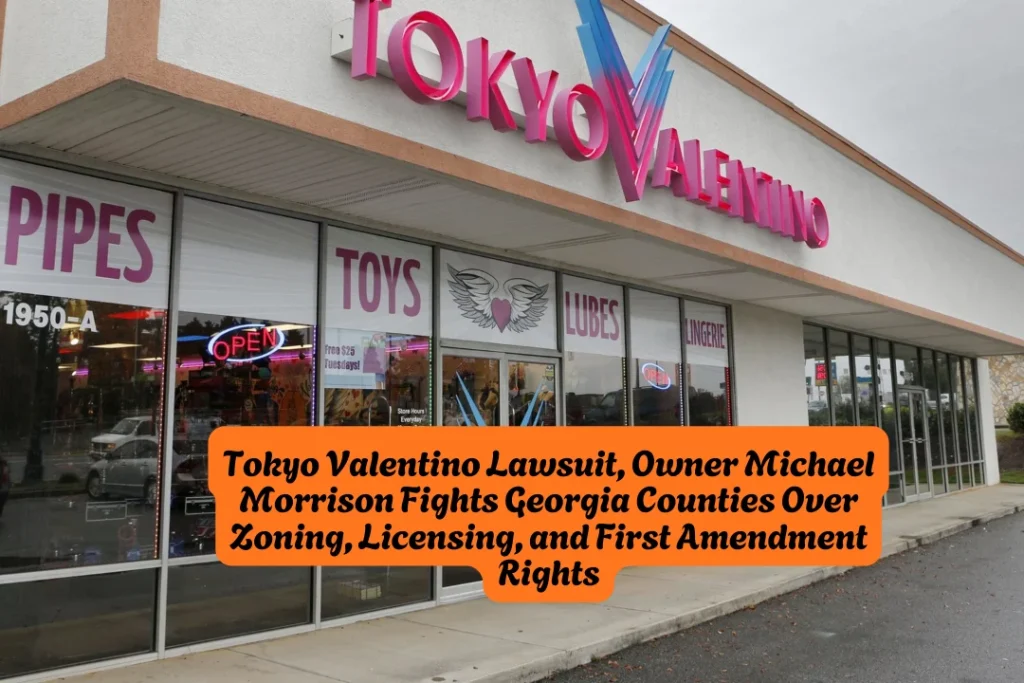
Tokyo Valentino Lawsuit, Owner Michael Morrison Fights Georgia Counties Over Zoning, Licensing, and First Amendment Rights
Adult retailer’s decades-long legal battle intensifies as DeKalb County revokes building permit and multiple metro Atlanta locations face permanent closure.
Michael Morrison, founder and owner of the Tokyo Valentino adult retail chain, is engaged in a multi-front legal battle across several Georgia counties and municipalities, challenging local governments’ efforts to close or prevent the opening of his stores. Morrison’s federal lawsuits name multiple Georgia municipalities — including Atlanta, Marietta, Cobb County, Gwinnett County, and their officials — as defendants, alleging violations of constitutional rights through adult business regulations. The most recent development occurred on October 9, 2025, when DeKalb County revoked the building permit for Tokyo Valentino’s planned location at 1850 Lawrenceville Highway in Greater Decatur, and the business license application remains incomplete.
Quick Case Snapshot
| Field | Detail |
| Plaintiff | Michael Morrison / Tokyo Valentino (Cheshire Bridge Holdings / Cheshire Visuals) |
| Defendants | City of Atlanta; City of Marietta; Cobb County; Gwinnett County; DeKalb County; and their respective officials |
| Courts | U.S. District Court for the Northern District of Georgia; U.S. Court of Appeals for the Eleventh Circuit; Cobb County Superior Court; DeKalb County |
| Case Numbers | Multiple (Not fully disclosed in public records reviewed) |
| Filing Dates | Various — spanning 2015 through 2025 |
| Judge(s) | Multiple judges across cases; Cobb Superior Court Judge Greg Poole (Marietta/Cobb matters); U.S. District Court Judge Thomas Thrash (Atlanta federal matter) |
| Claims Alleged | First Amendment (free speech), due process violations, equal protection, vague ordinance challenges, unconstitutional zoning enforcement, procedural improprieties in license revocations |
| Damages Sought | Approximately $250,000 in attorney’s fees (Atlanta case); injunctions preventing enforcement; declaratory judgments that adult entertainment ordinances are unconstitutional |
| Current Status | Active and ongoing — federal appeals continue in the Eleventh Circuit; state court cases proceeding; DeKalb permit revoked October 2025; Marietta location permanently closed |
What the Lawsuit Alleges
Tokyo Valentino’s legal battles with Georgia municipalities trace back nearly three decades, but the core dispute has sharpened significantly since 2015. At its heart, owner Michael Morrison argues that local governments have weaponized zoning ordinances, licensing requirements, and adult entertainment laws to unconstitutionally suppress a business that serves a legitimate — and constitutionally protected — commercial purpose.
Tokyo Valentino’s dispute with Atlanta began even before the store opened its doors in 1996, and the conflict has spanned more than a decade of fights over zoning, building codes, and alleged violations of city ordinances.
In the Atlanta case, the complaint alleges that the city changed its zoning ordinance to specifically target and block the store. According to the amended complaint, the city changed a zoning ordinance the same day Tokyo Valentino’s license application was filed, prohibiting adult businesses from operating in certain districts, including where the store is located. Morrison’s legal team contends that the city effectively moved the goalposts mid-application — an act they argue violated due process and free speech protections. Morrison has requested a negotiated settlement with the city attorney to recover approximately $250,000 in accumulated legal fees and to have Tokyo Valentino formally recognized as a legally licensed and correctly-zoned adult entertainment establishment, after more than 20 years of continuous operation and two prior legal victories.
In Cobb County and Marietta, Morrison faces separate but related legal battles. The county alleged that Tokyo Valentino’s owner misrepresented the intent of his business when applying for a license under the name 1290 Clothing LLC, describing it as a general retail clothing store. Morrison’s attorneys have disputed this characterization, arguing the application complied with all available guidelines and that the inventory was legally permissible. The Marietta City Council revoked Morrison’s business license for the Cobb Parkway location in 2020, and Tokyo Valentino filed a federal lawsuit against the city alleging constitutional violations including free speech.
In DeKalb County, the most recent flashpoint, Morrison maintains that Tokyo Valentino is not legally an adult business at the proposed Lawrenceville Highway site. In communications with the county, Morrison stated that the store would sell adult material at less than the 20% threshold allowed under local ordinance, and described it as primarily serving the LGBTQ+ community — with no live entertainment or video booths. He compared the store’s product mix to Spencer’s Gifts found in mainstream malls. Despite this, county officials revoked the permit in October 2025.
Across all cases, Morrison seeks declaratory judgments that adult entertainment ordinances are unconstitutional, injunctions preventing their enforcement, attorney’s fees totaling approximately $250,000, and permission to operate without restrictive licensing requirements.
Defendants’ Response
The municipal defendants — Atlanta, Marietta, Cobb County, and DeKalb County — have consistently argued that their ordinances serve legitimate public interests: protecting residential neighborhoods, churches, schools, and libraries from the proximity of adult-oriented businesses.
In the Cobb County matter, Judge LaTain Kell ordered the east Cobb shop to close, citing multiple ordinance violations — including lack of a valid business license, no sexually oriented business (SOB) license, operating after midnight, being within 750 feet of a residential zone, and being within 1,500 feet of a hospital.
Marietta’s 2022 updated adult establishments ordinance required special adult establishment licenses, imposed restrictions on hours, lighting, and building materials, and barred such shops from operating within 1,000 feet of churches, schools, libraries, and residentially-zoned parcels.
Regarding DeKalb County, a local resident captured the sentiment of many neighbors, stating: “We don’t want Lawrenceville Highway to become the next Cheshire Bridge Road, especially not adjacent to our neighborhood.”
On the Atlanta federal case, the city previously argued that the store had been operating in violation of a 1996 ordinance for years, and sought a permanent injunction. After the 11th Circuit ruled against the city, Atlanta dropped its outside counsel, Scott Bergthold — a Tennessee-based attorney with a long record of representing municipalities seeking to restrict adult businesses — and stated it was “evaluating all legal options.”
Legal Context
This case sits at the intersection of First Amendment law, local zoning authority, and adult entertainment regulation — an area where courts have long struggled to draw clear lines.
Adult entertainment businesses are not without constitutional protection. Under a line of U.S. Supreme Court decisions, businesses that sell sexually-oriented products and materials retain some First Amendment protections as forms of expressive commerce. However, the government has historically been permitted to impose what courts call “time, place, and manner” restrictions — regulations that don’t ban adult businesses outright but control where and how they may operate. Critically, such restrictions must serve a substantial government interest (such as reducing secondary effects like crime or neighborhood blight) and must leave open alternative channels for the business to operate.
The 11th Circuit’s ruling revived a possible constitutional challenge against Atlanta’s adult entertainment ordinance, which has been used to restrict business operations along the 1.5-mile stretch of Cheshire Bridge Road.
A significant procedural win came for Morrison in 2019: the appellate panel reversed an earlier ruling which had held that Tokyo Valentino should have challenged the constitutionality of the law in prior lawsuits, finding that earlier cases did not deal with constitutionality and that the store had no way of knowing it would later be cited for code violations the city had ignored for decades.
Should Morrison ultimately prevail in Atlanta on his constitutional challenge, the stakes extend far beyond one store. If the ordinance is struck down, there could be an influx of adult business applications across the city without zoning regulations to govern them — creating what Morrison himself has described as a very precarious position for the city.
Current Status & What Happens Next
The litigation is active on multiple fronts simultaneously:
- Atlanta: Federal appeals continue in the Eleventh Circuit while state court cases proceed in parallel. The Atlanta case is expected to return to the U.S. District Court for the Northern District of Georgia for summary judgment proceedings or potentially trial.
- Marietta / Cobb County: The Marietta location on Cobb Parkway has permanently closed following a December 2023 injunction by Cobb Superior Court Judge Greg Poole, who found all three enjoined businesses had continued to operate illegally after being ordered not to. A federal lawsuit filed against Marietta on First Amendment grounds remains pending.
- DeKalb County: The building permit for the Lawrenceville Highway location was revoked in October 2025. Morrison can pursue administrative appeals or file new litigation challenging this decision.
Settlement discussions in the Atlanta matter have been floated by Morrison, who has publicly indicated willingness to drop the constitutional challenge in exchange for back payment of legal fees and formal recognition of the store’s operating status.
FAQs
What is Tokyo Valentino arguing in its lawsuits?
Morrison contends that Georgia municipalities are selectively enforcing adult entertainment ordinances to unconstitutionally shut down his stores, violating his First Amendment free speech rights, due process rights, and equal protection guarantees under the U.S. Constitution.
Has Tokyo Valentino won any of these cases?
Yes. The U.S. Court of Appeals for the Eleventh Circuit reversed a lower court ruling that attempted to bar the adult superstore from operating, and also revived a constitutional challenge against Atlanta’s adult entertainment ordinance. However, multiple store locations have also been permanently closed through court injunctions.
What is at stake if Morrison wins the constitutional challenge?
If Atlanta’s adult entertainment ordinance is struck down as unconstitutional, the city could lose its primary regulatory tool for restricting where adult businesses operate, potentially affecting regulation of the entire industry citywide.
Why does this case matter beyond Tokyo Valentino?
Adult entertainment businesses receive some First Amendment protection as expressive commerce, but courts allow greater government regulation than traditional speech. Municipalities can impose time, place, and manner restrictions through zoning ordinances if they serve substantial government interests and leave alternative channels for expression. This litigation will help define where that line falls in Georgia.
Has Morrison said anything publicly about the ongoing fight?
Morrison has acknowledged the legal battles come with operating a controversial business, stating: “Part of the business model is you have to fight some of this litigation. I think it gets us a lot of publicity, which always helps. But really it hurts the customer because all these fees get passed on in higher prices to the consumer.”
Last Updated: March 15, 2026
This article is for informational purposes only and does not constitute legal advice. Allegations in a complaint are not findings of fact. All parties are presumed innocent unless and until proven otherwise in court.
About the Author

Sarah Klein, JD, is a licensed attorney and legal content strategist with over 12 years of experience across civil, criminal, family, and regulatory law. At All About Lawyer, she covers a wide range of legal topics — from high-profile lawsuits and courtroom stories to state traffic laws and everyday legal questions — all with a focus on accuracy, clarity, and public understanding.
Her writing blends real legal insight with plain-English explanations, helping readers stay informed and legally aware.
Read more about Sarah